Flapping wings while running may have helped the evolutionary ancestors of birds develop flight. Experiments with modern birds show that flapping wings while running helps even flight-capable birds ascend slopes and uses only 10% as much power as actual flight along a 65-degree incline. #
Month: June 2011

Rocket Diamonds
The exhaust of a Pratt and Whitney J58 shines with Mach diamonds, a series of shock waves and expansion fans that form to equalize the exhaust and ambient pressures. This pattern can occur any time an engine nozzle operates at its non-ideal altitude.

Propeller Cavitation
Cavitation occurs in moving liquids when the local pressure–in this case, at the tip of the propeller–drops below the vapor pressure. The fast-moving fluid transitions to a gas phase, creating a tip vortex of water vapor even though the propeller is completely submerged.
Tank Shock Waves
High-speed video of a tank firing at 18000 fps shows shock waves made visible due to light distortion. When the air density changes (due to temperature or compression), it’s index of refraction changes, causing the background to appear distorted. Most of the video shows the subsonic development of the turbulent exhaust plume. Note the speed at which the exhaust moves relative to the airborne shrapnel. (submitted by Stephan)
Shear-Thinning at Home
Shear-thinning isn’t just confined to canned whipped cream. It’s also a feature of such non-Newtonian fluids as ketchup, shampoo, latex paint, and blood. The NASA research on shear-thinning the video author refers to is here and comes from the Critical Viscosity of Xenon-2 (CVX-2) experiment flown on the final mission of Columbia. Surprisingly, almost all of the experimental data was recovered from the crash. #
Liquid Rope Coiling
Some liquids, when falling in a stream into a pool, tend to coil into a liquid rope. This video shows honey, but the effect can also be observed in syrups and silicone oil. The rate of coiling is dependent on the height from which the liquid falls. Other factors governing coiling include viscosity, density, and flow rate.

Drafting Flags
Wired Science has published a gallery of fluid dynamics photos and videos, several of which have been featured here previously. There’s some neat stuff there, well worth checking out. #
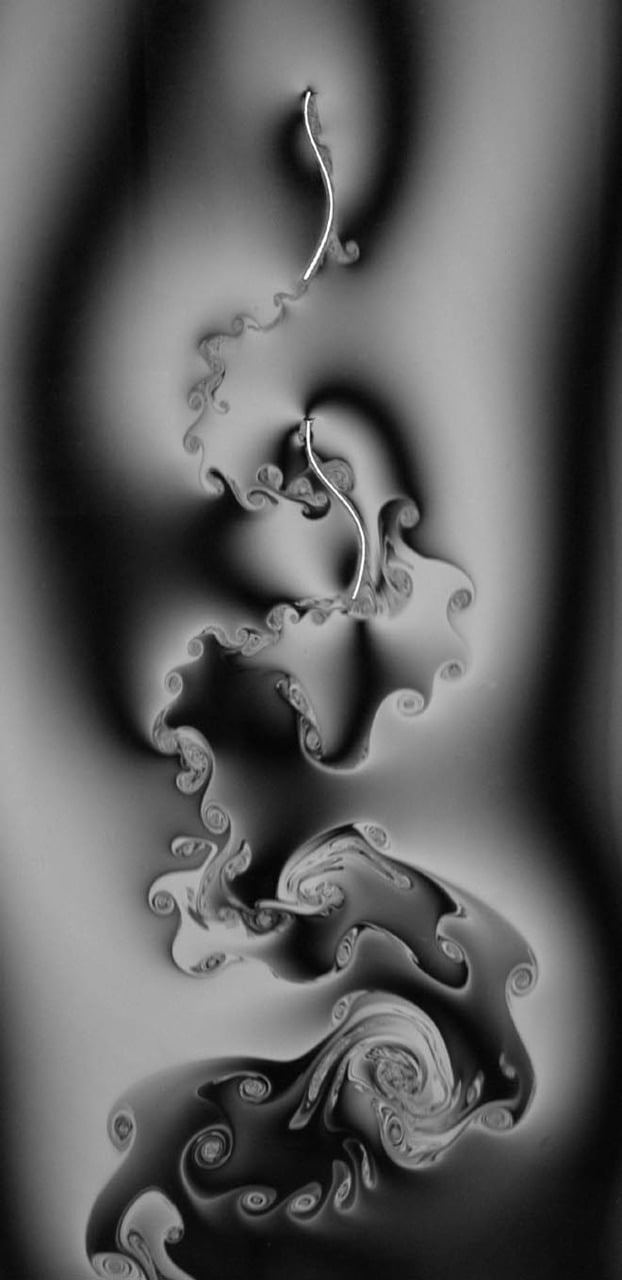
This image shows two flags oriented in line with a film flowing top to bottom. The second flag interrupts the wake of the first one, which reduces the drag experienced by the first flag and increases that on the second. This is called inverted drafting and occurs because the flags are passive objects that bend to every change in the flow. #

Stall-Sensing Hairs
Bats use tiny hairs on their wings to sense the direction and speed of air flow. Researchers found that removing these hairs caused bats to fly faster and make wider turns, likely because the bat believed it was on the verge of stalling and losing lift. Engineers are considering whether artificial versions made of flexible polymers that respond to strain could provide improved stall sensing on fixed-wing aircraft. # (Photo credit: justynk)
Solutal Convection
Solutal convection, rather than relying on temperature gradients, can occur due to gradients in concentration or in surface tension. While less spectacular than this previously posted video, this video contains a nice simplified explanation of the mechanism. And, as noted in the video, this is a demo you can do yourself at home.

Beluga Whale Bubble Rings
Beluga whales and dolphins in captivity have taken to blowing bubble rings to entertain themselves. You can learn how to do the same in the pool. #