Ever notice the distinctive ring that forms in your kitchen sink when you turn the water on? This phenomenon is known as a hydraulic jump; it occurs when a fast moving fluid (the water just discharged from the faucet) runs into a slow moving fluid (the water that’s been sitting in the sink) and transfers some of its kinetic energy into potential energy by increasing its elevation. Researchers have recently shown that this everyday occurrence is actually a physical analog to a white hole, the cosmological inverse of a black hole. (In theory, a white hole cannot be entered, but light and matter can escape it.) Check out Wired’s article for an explanation of the clever experiment that showed the equivalence of the two. #
Month: October 2010

Superhydrophobic Carbon Nanotubes
Carbon nanotubes form a superhydrophobic (super water repellent) surface that interacts with water droplets in interesting ways. The droplet is unable to wet the surface and thus the bounces along. When the impact velocities are too great for surface tension to hold the decelerating mass together, it breaks into many, smaller droplets that also bounce along the surface. # (via @JetForMe and @Vinnchan)
Fluidized Sand
What’s shown in this video are some pretty spectacular demonstrations of fluidization, where a gas is introduced at the bottom of a bed of granular particles–like sand. At the critical gas velocity, the aerodynamic forces exerted on each particle by the gas will balance the gravitational force on the particle and it will become suspended. All of a sudden, the macroscopic behavior of the solid particles will be like that of a fluid; you can even make it “boil”!

The Silence of Owls
Owls are among the most silent hunters in nature, thanks to their feathers. The leading edge of the wing, shown in the bottom part of the photo, has a serrated comb-like edge, which breaks flow over the wing into small vortices, which are quieter than larger ones. The fringe-like trailing edge breaks the flow up further and helps absorb the sound produced by the turbulence. The fluffy feathers along the owl’s body can also help muffle noise. Researchers are investigating ways to use these techniques to quiet aircraft. # (via jshoer)
Canon Sound Sculptures
In a new series of ads for Canon, colorful paints are placed on a speaker cone and filmed at high speed to create beautiful “sound sculptures”. Paint, like oobleck, is a non-Newtonian fluid but does not react the same when excited by sound because it is shear-thinning. (When painting, you want the paint to run off the brush easily but not drip when it’s on the wall; hence, shear-thinning.) Both the photos and videos are lovely examples of fluid mechanics as art. Watch how they did it. # (Via jshoer, @ftematt, @JetForMe)

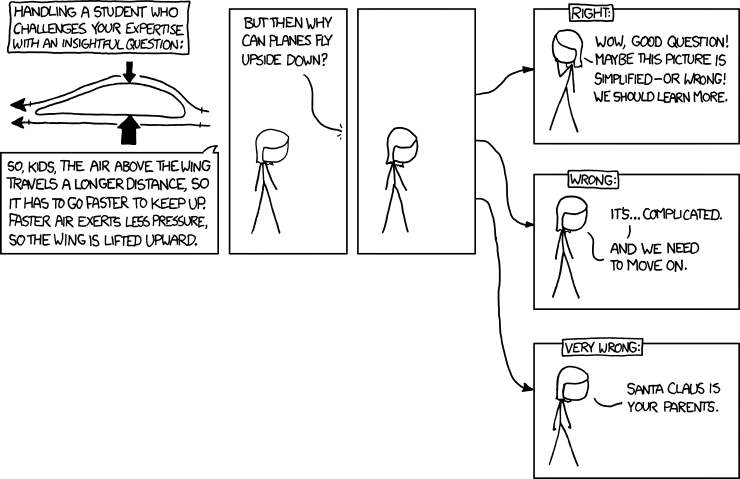
xkcd and Lift
xkcd identifies a very common misconception about how airfoils work! (via Vinnchan and jasonas14) #

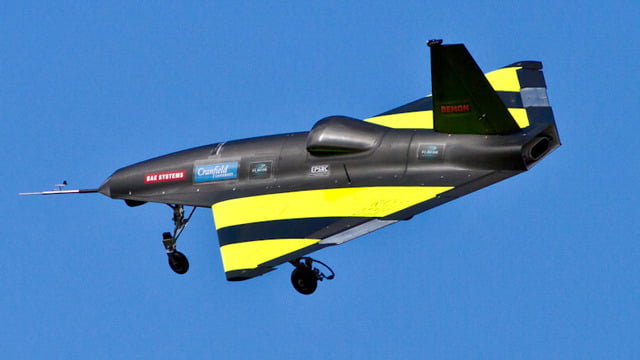
Jet-Based Control
Researchers have flown the first aircraft designed to maneuver without conventional control surfaces like ailerons and flaps. Instead of changing the wing geometry to alter the lift on different parts of the craft, the UAV uses strategically placed jets of air along the wing to control its flight. The plane can also alter the direction of its thrust, not by turning the nozzle as is conventionally done, but by modifying the thrust vector by directing and firing a secondary jet into the exhaust. #
Steam Devils
The formation of the ethereal steam devil is quite similar to the formation of a fire tornado. In this case, the first frost of the season cooled air temperatures substantially below the temperature of the water of the lake, creating conditions for steam and for updrafts of rising, warmer air. A slight breeze across the lake is enough to create pockets of vorticity, which stretch due to the updrafts and intensify due to conservation of angular momentum. This creates the narrow spinning vortex filaments that pull steam up and dance across the lake’s surface. #

Wind Turbines and Weather
A new study reports that wind turbine farms may be changing local surface temperatures, resulting in warmer temperatures at night and cooler temperatures during the day. The result is neither surprising nor new; the motion of the propellers increases the turbulence downstream of the turbines. Turbulent flow mixes much better than laminar flow, so air from above the ground is getting mixed into surface air in the wakes. At night, the air next to the ground cools more quickly than air higher up, so the mixing of higher, warmer air results in localized warmer air on the ground. Orange farmers use this effect when they put out fans at night to keep their crops from freezing. #

Jupiter and the Kelvin-Helmholtz Instability
Jupiter, known for its colorful bands of stormy clouds, is a beautiful subject for fluid dynamics in action. As the planet turns, the cloud bands move at different relative speeds. This velocity difference at the interface of the bands can trigger the Kelvin-Helmholtz instability, resulting in a line of whorls where the cloud bands meet. The instability has been observed on Saturn and is thought to be fairly common among gas giants.