When a projectile is fired from a gun or other firearm, it is propelled by the expansion of high-temperature, high-pressure gases resulting from the combustion of a propellant, like gunpowder, inside the weapon. The explosive expansion of these gases transfers momentum to the bullet; however, the gases will continue to expand outward from the gun even after the bullet is fired. They do so in the form of a supersonic blast wave; it’s this blast wave that’s responsible for the noise of the firearm. Firing a gun underwater is one way to see the blast wave, though it is far from the only way. In fact, a blast wave viewed underwater is not equivalent to one in air. The differences in density and compressibility between the two fluids mean that, while the general form may be similar, the specifics and the results may not be. In general, a blast wave underwater is much more damaging than one in air. (Video credit: destinsw2/Smarter Every Day; requested by nikhilism)
Videos

Stirring Faces
This video features simulation of the laminar flow around a plate plunging sinusoidally in a quiescent flow. As the plate moves up and down, it mixes the fluid around it. This is visualized in several ways, beginning with the vorticity. Clockwise and anti-clockwise vortices are shed by the edges of the plate as it moves. The flow is also visualized using particle trajectories, which are classified by their tendency to accumulate (attract) or lose (repel) particles. These trajectories are particularly intriguing to watch develop as they appear to show ornate faces and designs. (Video credit: S. L. Brunton and C. W. Rowley)

Swirling Jets
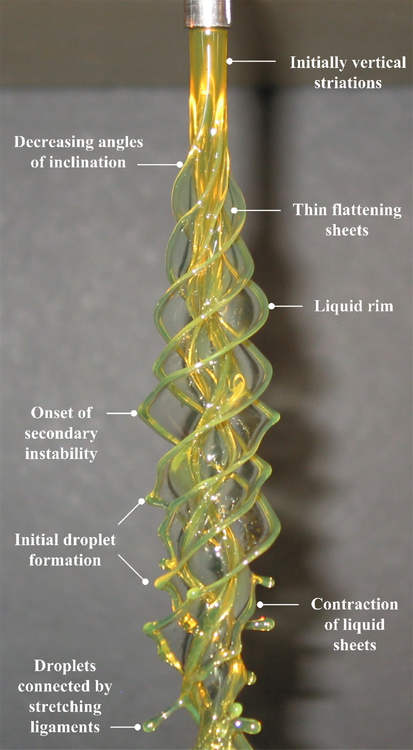
In fluid dynamics, we like to classify flows as laminar–smooth and orderly–or turbulent–chaotic and seemingly random–but rarely is any given flow one or the other. Many flows start out laminar and then transition to turbulence. Often this is due to the introduction of a tiny perturbation which grows due to the flow’s instability and ultimately provokes transition. An instability can typically take more than one form in a given flow, based on the characteristic lengths, velocities, etc. of the flow, and we classify these as instability modes. In the case of the vertical rotating viscous liquid jet shown above, the rotation rate separates one mode (n) from another. As the mode and rotation rate increase, the shape assumed by the rotating liquid becomes more complicated. Within each of these columns, though, we can also observe the transition process. Key features are labeled in the still photograph of the n=4 mode shown below. Initially, the column is smooth and uniform, then small vertical striations appear, developing into sheets that wrap around the jet. But this shape is also unstable and a secondary instability forms on the liquid rim, which causes the formation of droplets that stretch outward on ligaments. Ultimately, these droplets will overcome the surface tension holding them to the jet and the flow will atomize. (Video and photo credits: J. P. Kubitschek and P. D. Weidman)
Supersonic Bubble Shock Waves
Supercomputing has been an enormous boon to fluid dynamics over the past few decades. Many problems, like the interaction between a supersonic shock wave and a bubble, are too complicated for analytical solutions and difficult to measure experimentally. Numerical simulation of the problem, combined with visualization of key variables, adds invaluable understanding. Here a shock wave strikes a helium bubble at Mach 3, and the subsequent interactions in terms of density and vorticity are shown. This situation is relevant to a number of applications, such as supersonic combustion and shockwave lithotripsy–a medical technique in which kidney stones are broken up inside the body using shock waves. After impact, an air jet forms and penetrates the center of the structure while the outer regions mix and form a persistent vortex ring. (Video credit: B. Hejazialhosseini et al.; via Physics Buzz)
Sandy Jets
When a fluid is vibrated, instabilities can form along its surface. With a sufficient amplitude, voids form inside the fluid and their collapse leads to a jet that shoots out from the fluid. A very different process leads to air cavities forming in a vibrated granular medium, but the jets produced are remarkably similar, as seen in this video. (Video credit: M. Sandtke et al.)
Frozen Powder Drops
Droplet impacts on granular surfaces and water interactions with superhydrophobic surfaces are not unfamiliar topics for FYFD. But this behavior of water droplets falling on a superhydrophobic powder is unusual, to say the least. When the droplets impact in powder, they rebound with a partial coating of powder. In the case of the superhydrophobic powder, the shape of the droplet is “frozen” by the powder. A satellite droplet is ejected from the region not coated in powder and the resultant main drop falls back to the surface and comes to rest with little to no deformation. The researchers report a critical velocity at which the behavior is observed. (Video credit: J. Marston et al.; via Physics Buzz)
Superfluid Vortices
Cooling helium to a few degrees Kelvin above absolute zero produces superfluid helium, a substance with some very bizarre behaviors caused by a lack of viscosity. Superfluids exhibit quantum mechanical properties on a macroscopic scale; for example, when rotated, a superfluid’s vorticity is quantized into distinct vortex lines, known as quantum vortices. These vortices can be visualized in a superfluid by introducing solid tracer particles, which congregate inside the vortex line, making it appear as a dotted line, as shown in the video above. When these vortex lines approach one another, they can break and reconnect into new vortices. These reconnections provoke helical Kelvin waves, a phenomenon that had not been directly observed until the present work by E. Fonda and colleagues. They are even able to show that the waves they observe match several proposed models for the behavior. (Video credit: E. Fonda et al.)
Self-Healing Soap Films
Some soap films are capable of self-healing after a solid object passes through them, as shown in the video above. The behavior is primarily dependent on Weber number–a nondimensional ratio of the film’s inertia to its surface tension. Although demonstrated for positive curvature in the video, the same behavior is observed in negatively curved soap films as well. For a look at how the behavior varies with projectile velocity and size, check out this video. (Video credit: J. Bryson, BYU Splash Lab)
Grooving Bubbles
Here bubbles in a microchannel are subjected to an external ultrasonic acoustic field. Under the influence of this vibration, the bubbles self-organize into crystal-like structures with a fixed finite separation distance. Some bubbles cluster and contact. Some bubbles also pulsate in star-shaped vibration modes. When the external sound is turned off, the bubble crystal loses form and drifts apart. For more, see Rabaud et al. 2011. (Video credit: P. Marmottant et al.)
Leidenfrost Explosions
When a drop of water touches a very hot pan, it will skitter across the surface on a thin layer of water vapor due to the Leidenfrost effect. But what happens when another chemical is added to the droplet? Researchers find that adding a surfactant to the water droplets creates some spectacular results. As the water evaporates, the concentration of the surfactant in the droplet increases causing the surfactant to form a shell around the droplet. The pressure inside the droplet increases until the shell breaks in a miniature explosion much like the popping of popcorn. (Video credit: F. Moreau et al.)