Tag: waves

  • Prehistoric Seiche

    Prehistoric Seiche

    Sixty-six million years ago, a meteorite impact in modern-day Mexico wiped out the dinosaurs and most other living species of the time. To call the event catastrophic feels like an understatement. At the site of impact, rocks and animals were vaporized. Further away, molten rock condensed into glass beads that form a geological layer found around the world.

    Still further away, in what is now North Dakota and was then the bank of a freshwater river, scientists have discovered a deposit full of saltwater fish, sharks, and rays that would have lived in the vast inland sea (A) that stretched northward from Texas. The meteorite’s impact pushed these creatures kilometers upstream against the river’s natural flow.

    One possible explanation for the inundation is a tsunami. But geological evidence indicates the deposit took place within 15 minutes to two hours of the impact, when glass beads were still raining down. To travel the 3,000 km from the point of impact would take a tsunami on the order of 18 hours – far too long.

    Instead, the deposit is likely the result of a seiche (pronounced “saysh”) – a type of standing wave that occurs in an enclosed or partially enclosed body of water. If you imagine water sloshing in a cup or a tub, that’s essentially what a seiche is, but this was on a much larger scale. (For an example, check out this insane footage of an earthquake-induced seiche in a swimming pool.)

    What set the seiche to sloshing are the seismic waves triggered by the meteorite impact. They would have reached this site 6-13 minutes after the impact and triggered waves on the order of 10m. As the waves drove up the riverways, they carried dead and dying sea creatures with them, leaving them stranded on the riverbank until scientists uncovered them tens of millions of years later. (Image and research credit: R. DePalma et al.; via The Conversation; submitted by Kam-Yung Soh)

  • Rogue Waves

    Rogue Waves

    After centuries of tales from sailors, in 1995 the Draupner off-shore platform recorded the first ever evidence of a freak wave – a single, wall-like wave steeper and taller than any other waves around it. Theories have been tossed back and forth for the last quarter century as to how the Draupner wave formed, but now a group of researchers report they have recreated a lab-scale version of this is famous wave. 

    They did so in a wave pool by making two smaller groups of waves cross one another at about 120 degrees (top). The interaction of those wave packets generated a much larger, steeper wave (bottom image sequence) that matched the profile of the Draupner wave. Recreating this past freak wave confirms that wave-crossing can lead to freak waves, which will hopefully help us forecast when conditions may be right for more to occur. (Image credit and research credit: M. McAllister et al., source; via Motherboard; submitted by Kam-Yung Soh)

  • Amber Waves

    Amber Waves

    When I was a teenager, I liked riding my bike along the river boardwalk near my house. There were fields there, like those in the image above and video below, with tall grass that would bend and sway in the wind. The long stalks undulated almost like a fluid, and they were mesmerizing. This video gives you a higher vantage point, where you can see the larger patterns of motion. What you’re seeing, I think, are some of the large-scale turbulent variations in the wind. Rather than being uniform and laminar, the wind contains pockets of turbulent gusts, which the sway of the long grass reveals to the naked eye. In terms of physical mechanism, I suspect it’s similar to how wind imprints its patterns on water. (Video and image credit: N. Moore)

  • Collective Motion: Waving Bees

    Collective Motion: Waving Bees

    Giant honeybees live in huge open nests. To protect themselves, they’ve developed a mesmerizing wave-like defense known as shimmering. When shimmering, the bees in a hive, beginning from a distinct spot, will flip over to expose their abdomens. Taken together, this creates large-scale patterns like those seen above.

    Scientists have connected the behavior to the presence of wasps that prey on the bees. It seems that shimmering helps to repel the wasps without putting individual bees in danger. If shimmering doesn’t ward off the wasps, the bees can also use their flight muscles to heat the area around the intruder to a wasp-lethal temperature – or, individuals bees can sacrifice themselves by stinging the wasp. (Image credit: Beekeeping International, source; research credit: G. Kastberger et al.; via Gizmodo)

    This post is part of our series on collective motion. Check out our previous posts about how crowds are like sand, the fluid properties of worms, and why a lack of randomness makes predicting group behaviors hard.

  • Supernumerary Bows

    Supernumerary Bows

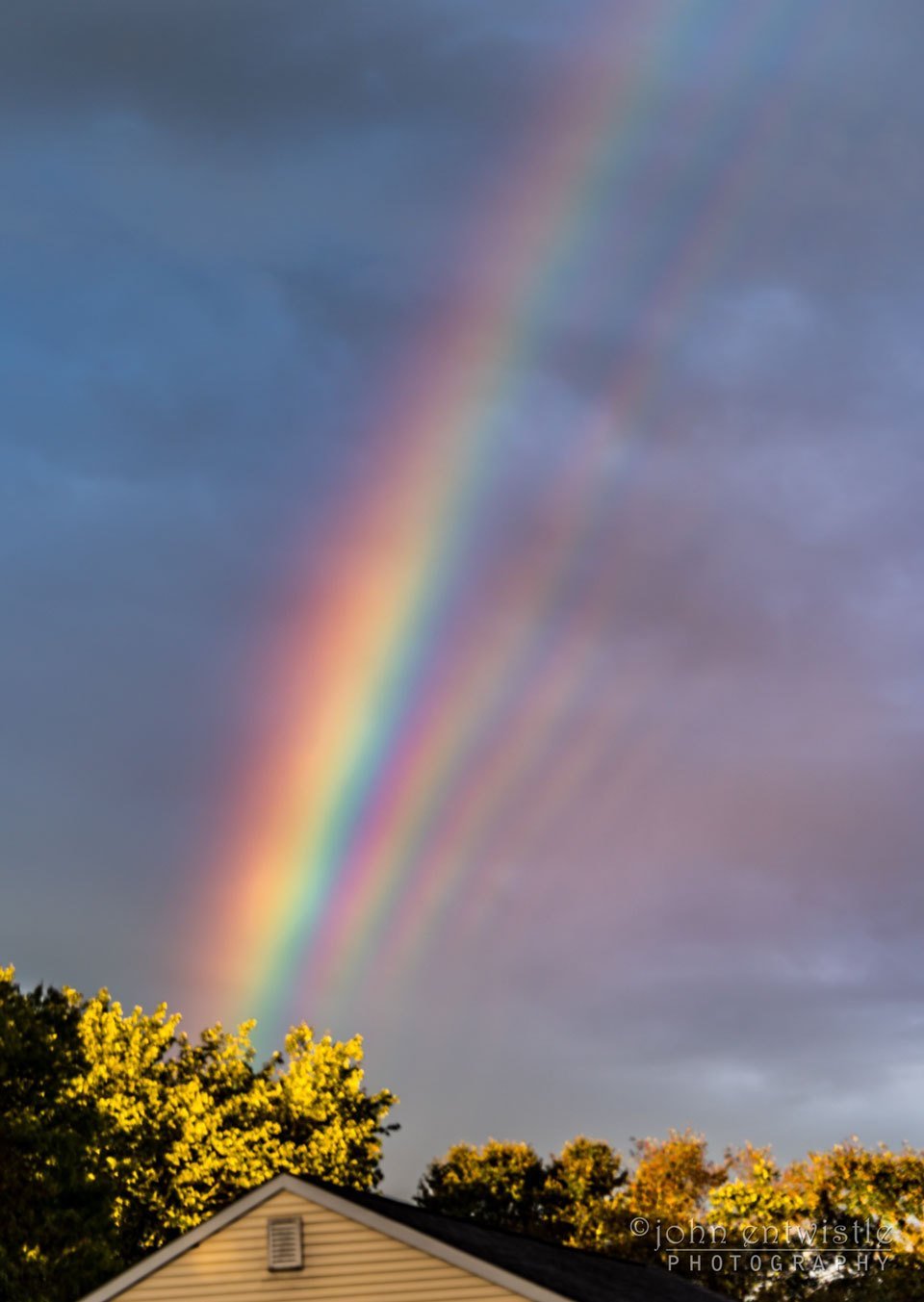
    After the rain of Hurricane Florence came the rainbow, or rainbows, in this case. Photographer John Entwistle captured this image of a rainbow with several additional supernumerary bows. The inner fringes seen here form when light passes through water droplets that are all close to the same size; given the spread seen here, the droplets are likely smaller than a millimeter in diameter. Supernumerary rainbows cannot be explained with a purely geometric theory of optics; instead, they require acknowledging the wave nature of light. (Image credit: J. Entwistle; via APOD; submitted by Kam-Yung Soh)

  • Kelly Slater’s Surf Ranch

    Kelly Slater’s Surf Ranch

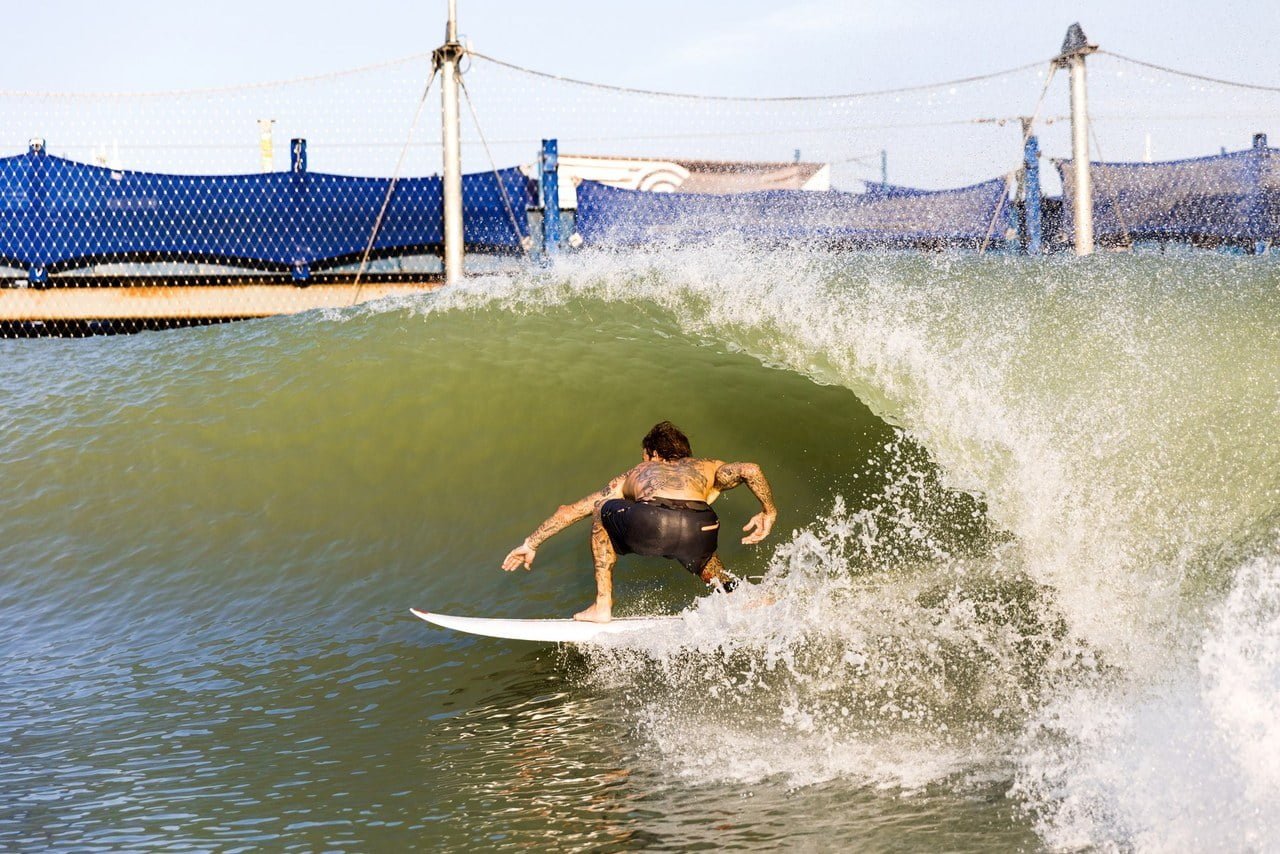
    Many of us who grew up visiting water parks instead of ocean beaches have spent time bobbing in a wave pool. They’ve been around for decades. But a new generation of wave pools are aiming for a different goal: the perfect surf wave. One of the foremost current facilities is Kelly Slater’s Surf Ranch, shown above. Here a hydrofoil (draped in blue tarps on the left) is pulled along an artificial lagoon to create dozens of wave profiles, all engineered to give surfers a long ride on the perfect solitary wave.

    Other facilities, like the surf ranch used by USA Surfing in Waco, Texas, design their waves with different goals in mind. The Waco wave pool uses air pressure to drive their waves, and aims for a larger quantity of shorter waves. They’re designed to help young surfers practice skills they’re working on, and to give them a place where they can experience waves like those they’ll face in the upcoming 2020 Olympics in Tokyo. (Image credit: R. Young/WIRED; CNet, source; submitted by Lionel V.)

  • Fluid Black Holes

    Fluid Black Holes

    Fluid systems can sometimes serve as analogs for other physical phenomena. For example, bouncing droplets can recreate quantum effects and a hydraulic jump can act like a white hole. In this work, a bathtub vortex serves as an analog for a rotating black hole, a system that’s extremely difficult to study under normal circumstances. In theory, the property of superradiance makes it possible for gravitational waves to extract energy from a rotating black hole, but this has not yet been observed. A recent study has, however, observed superradiance for the first time in this fluid analog.

    To do this, the researchers set up a vortex draining in the center of a tank. (Water was added back at the edges to keep the depth constant.) This served as their rotating black hole. Then they generated waves from one side of the tank and observed how those waves scattered off the vortex. The pattern you see on the water surface in the top image is part of a technique used to measure the 3D surface of the water in detail, which allowed the researchers to measure incoming and scattered waves around the vortex. For superradiance to occur, scattered waves had to be more energetic after interacting with the vortex than they were before, which is exactly what the researchers found. Now that they’ve observed superradiance in the laboratory, scientists hope to probe the process in greater detail, which will hopefully help them observe it in nature as well. For more on the experimental set-up, see Sixty Symbols, Tech Insider UK, and the original paper. (Image credit: Sixty Symbols, source; research credit: T. Torres et al., pdf; via Tech Insider UK)

  • Breaking Wave

    Breaking Wave

    This animation shows a cinemagraph of a breaking wave photographed by Ray Collins. The motion was inferred and digitally added by a second artist, Jersey Maria. The result is hypnotic, as if we are traveling beside the wave and watching it tear apart ever so slowly. The wave seems to be poised on a tipping point, only breaking up along its back edge, when instinct tells us it will keep steepening and tipping forward until its top curl crashes down in a wave of white foam. Surf photography like Collins’ work shows us an alternative perspective on waves, their power frozen into a single instant. Reanimated, it feels like we’re seeing the wave in hyper-slow-motion, watching every tiny movement of water before everything crashes down. Even if it’s not physically realistic, it is an awesome view.  (Image credit: R. Collins / J. Maria, source, original; via Iwan A.)

  • Wrinkling Winds

    Wrinkling Winds

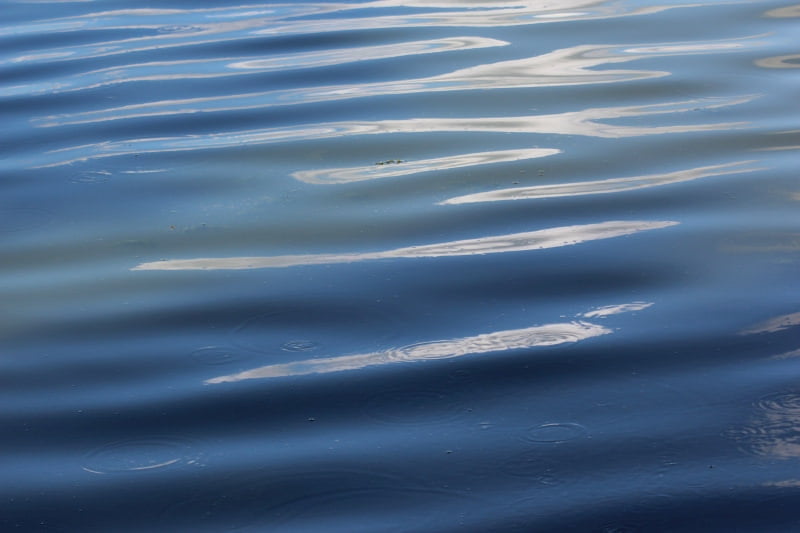
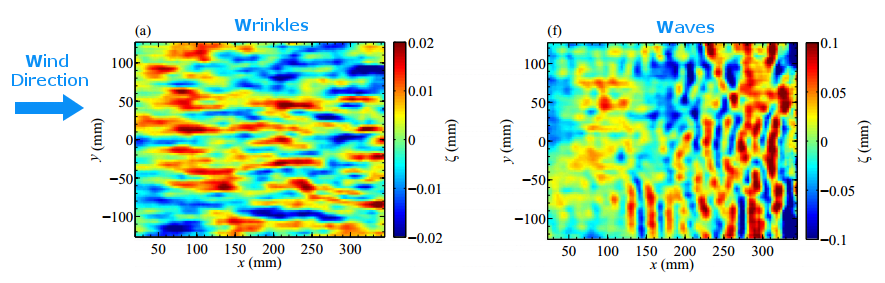
    If you’ve ever sat out on a lake and just watched the water’s surface, you’ve probably noticed how complex and variable it looks. There may be waves that rock your kayak but there are smaller variations, too, like little ripples or even tiny wrinkles that appear on the surface. Much of this activity comes from wind blowing across the water. When the wind exceeds a critical speed, waves form. They generally travel in lines that are aligned perpendicular to the wind (lower right). But what happens when the wind is below the critical speed?

    A recent study looked at just this question. By blowing air across the surface of different liquids and observing variations in the surface height as small as 2 micrometers, the researchers were able to measure tiny wrinkles on the water’s surface (lower left) when the wind speed was small. The size and shape of the wrinkles actually corresponds to structures in the turbulent air flow over the water! For fluids like water, there’s a smooth transition from wrinkles to waves as the wind speed increases, so both may be visible at the same time. For higher viscosity fluids, the switch from one to the other is more abrupt. (Image credits: water – M. Soveran; figure – A. Paquier et al. w/ annotations added in blue; research credit: A. Paquier et al.)

  • Breaking Soon

    Breaking Soon

    Australian photographer Warren Keelan captures spectacular photos of waves just before and during the moment they break. Fluid dynamics is defined by motion – specifically the motion of substances that do not hold a single form – but one thing I love about wave photography is how crisp and solid water appears when frozen in time. In a way, it feels like a reminder that, even though we classify matter into different states, ultimately those states have a lot in common. (Image credit: W. Keelan; via Colossal)