For years, mariners have reported occurrences of rogue waves–sudden, isolated waves many times larger than the surrounding surface waves. Until 1995, when a rogue wave was first measured, debate raged as to whether such waves even existed. Scientists have since agreed that nonlinear models of wave interaction are the most likely source of the amplification necessary to create rogue waves. Since the Navier-Stokes equations that govern hydrodynamics are so difficult to solve, scientists have looked to simpler nonlinear wave equations, like the nonlinear Schroedinger equation that governs optics, to generate rogue-wave-like behavior. While the equation gives insight into how a given wave system will evolve, it is still necessary to determine what initial conditions can lead to the formation of a rogue wave. All manner of random conditions exist in the ocean, but to recreate the behavior in a simplified system, we must know which initial conditions are the right ones. Akhmediev et al presented a theoretical perspective on the initial conditions that might lead to rogue wave amplification, and now, for the first time, researchers have been able to create a rogue wave in a wave tank. That little blip that sinks the Lego pirate ship is a great accomplishment toward understanding a phenomenon whose very existence was in question less than twenty years ago. (Video credit: A Chabchoub, N Hoffmann, and N Akhmediev; via Gizmodo; for more, see APS Viewpoints and Akhmediev et al)
Tag: waves

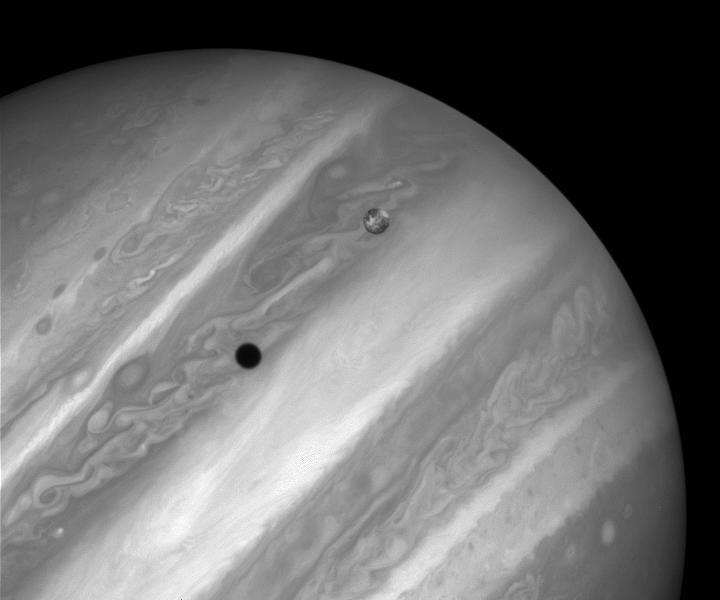
Where Jupiter Got Its Swirls
When layers of a fluid are moving at different relative velocities, they shear against one another. This shear can trigger the Kelvin-Helmholtz instability, which develops as a waves along the interface. Here Hubble captures Kelvin-Helmholtz waves along the cloud bands of Jupiter, but such clouds are also not uncommon here on Earth. (Photo credit: J. Spencer and NASA)

“Tidal Wave” vs. “Tsunami”
This is part of the trouble when the same term has a scientific meaning and a lay meaning. See also: fluid.

Wave-Particle Duality in Bouncing Droplets
A droplet atop a vibrating pool is prevented from coalescing by the constant influx of air into a thin lubrication layer between it and the pool. But that is not the strangest aspect of its behavior. Researchers have found that this system demonstrates some aspects of the mind-bending wave-particle duality at the heart of quantum physics. (Submitted by Dan H.) #
Coronal Waves
NASA’s Solar Dynamics Observatory has found evidence of Kelvin-Helmholtz waves in the sun’s corona. These waves, which occur between two fluids of different densities or moving at different speeds, are similar to the iconic waves surfers ride. Researchers suspect that this turbulent motion may help explain why the corona is 1,000 times hotter than the surface of the sun. #