Tag: wake

  • The Swimming of a Dead Fish

    The Swimming of a Dead Fish

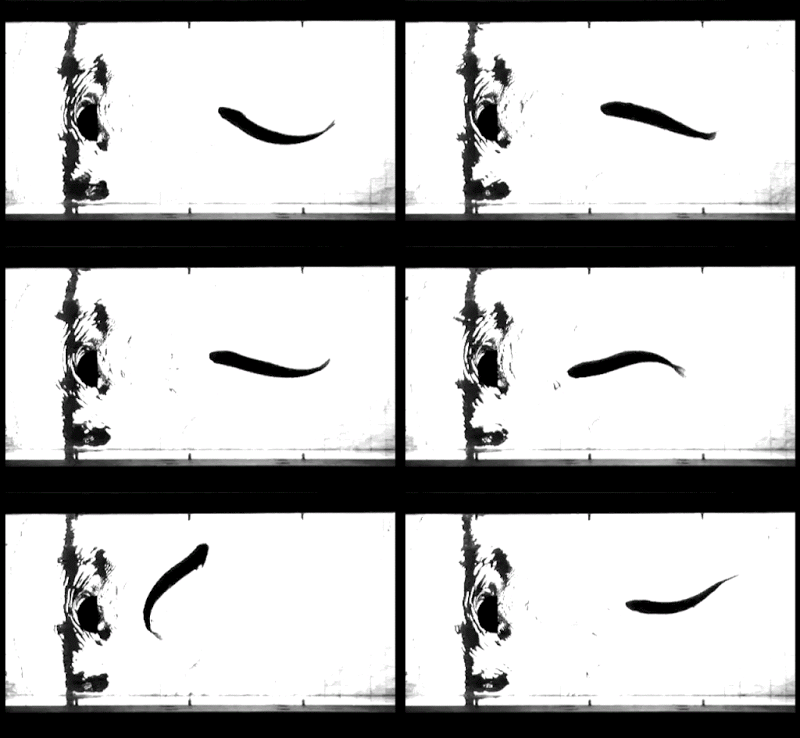
    When I was a child, my father would take me trout fishing, and I spent hours marveling from the riverbank at the trouts’ ability to, seemingly effortlessly, hold their position in the fast-moving water. As it turns out, those trout really were swimming effortlessly, in a manner demonstrated above. The fish you see here swimming behind the obstacle is dead. There’s nothing powering it, except the energy its flexible body can extract from the flow around it.

    The obstacle sheds a wake of alternating vortices into the flow, and when the fish is properly positioned in that wake, the vortices themselves flex the fish’s body such that its head and its tail point in different directions. Under just the right conditions, there’s actually a resonance between the vortices and the fish’s body that generates enough thrust to overcome the fish’s drag. This means the fish can actually swim upstream without expending any energy of its own! The researchers came across this entirely by accident, and one of the questions that remains is how the trout is able to sense its surroundings well enough to intentionally take advantage of the effect. (Image and research credit: D. Beal et al.; via PhysicsBuzz; submitted by Kam-Yung Soh)
  • Star Wars Aerodynamics

    Star Wars Aerodynamics

    Science fiction is not always known for hewing to scientific fact, so it will probably come as little surprise that Star Wars’ ships have terrible aerodynamics. But it’s nevertheless fun to see EC Henry’s analysis of drag coefficients of various Rebel and Imperial ships and just how poorly they fare against our own designs.

    Drag coefficients really only give a tiny piece of the story, though. We don’t know what speed Henry is testing the ships at, and we get no information about properties like lift or lift-to-drag ratio, which can be even more important than just the drag when it comes to evaluating an aircraft.

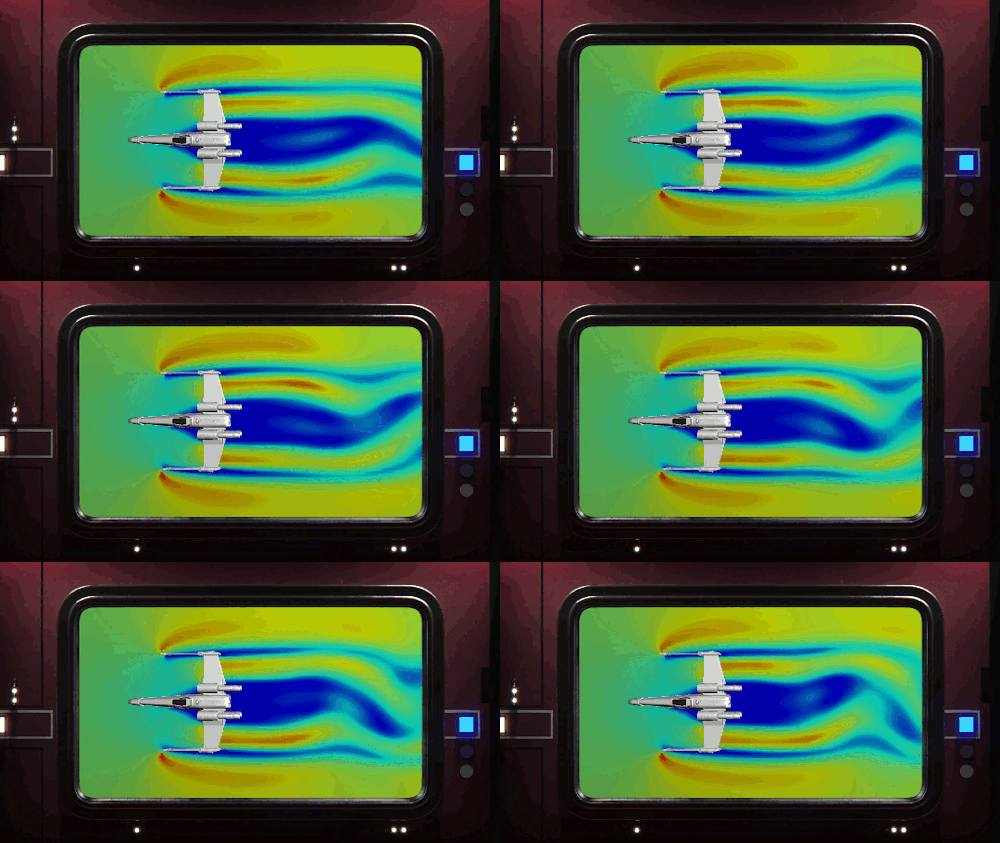
    There are some intriguing hints about other aerodynamic properties in the clips of flow around an X-wing and TIE fighter, though. Notice that the wake of both ships meanders back and forth. This is an indication of vortex shedding, and it means that both spacecraft would tend to be buffeted from side-to-side when flying in an atmosphere. Either the ships would need some kind of active control to counter those forces, or pilots would need iron constitutions to operate under those conditions! (Video and image credit: EC Henry)

    [original video no longer available]

  • Symmetric Wakes

    Symmetric Wakes

    Nature is full of remarkable patterns and moments of symmetry. This image shows the wake behind two rotating cylinders. Half of the cylinders are visible at the far left. The flow moves left to right. The cylinders are rotating at the same rate but in opposite directions, clockwise for the cylinder on top and counter-clockwise for the bottom one. At this speed relative to the freestream, there is a beautiful symmetry to the vortices in the wake, but the researchers found that even a slight deviation from this condition quickly destroyed the pattern. The flow is visualized here by introducing tiny hydrogen bubbles via electrolysis. The bubbles are small enough that their buoyancy has no appreciable effect. (Image credit: S. Kumar and B. Gonzalez)

  • Bubbles Sliding

    Bubbles Sliding

    Two-phase flows involve more than one state of matter – in this case, both gas and liquid phases. Flows like this are common, especially in applications involving heat transfer. In some heat exchangers, bubbles will rise and then slide along an inclined surface, as shown above. The motion of these bubbles is a complicated interplay between the surface, the bubble, and the surrounding fluid. The bubble’s wake, visualized here using schlieren imaging, is unsteady and turbulent. Although the bubble oscillates in its path, the wake spreads even wider, and its turbulence stirs up the liquid nearby, increasing the heat transfer. (Image and research credit: R. O’Reilly Meehan et al., source)

  • Island Wakes

    Island Wakes

    One of my favorite aspects of fluid dynamics is watching how patterns repeat at all kinds of scales. The cotton-candy-colored image above is a false-color satellite image of the island Tristan da Cunha (left), a volcanic island group in the South Atlantic. The prevailing winds, oriented roughly left to right in the image, flow over the rocky island and part in a series of swirls that alternate in their direction of rotation: clockwise for the upper set and counter-clockwise for the lower ones. This pattern is called a von Karman vortex street, named for an  aerodynamicist who studied the mechanism. Von Karman vortices are frequently observed in satellite images of remote islands, but they are also common behind spherical and cylindrical objects of all sizes. Sometimes they even show up in sci-fi! (Image credit: NASA Earth Observatory; submitted by Steve G.)

  • Turbine Wakes in the Sea

    Turbine Wakes in the Sea

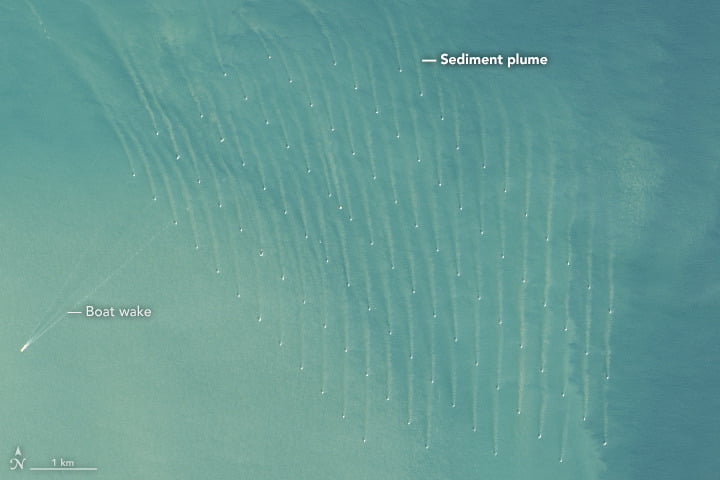
    What we we build always has an impact on the environment around us. The white dots you see in the image above are an array of offshore wind turbines, standing in waters 20 to 25 meters deep. The brownish lines extending from each turbine show the underwater wakes of the turbines, colored by the sediment they’ve picked up. As with trees in a snowstorm, the currents flowing past the base of the turbine likely form a horseshoe vortex that lifts up the sediment into the wake. Because the tides in this area reverse direction every six hours, these sediment plumes can appear quite dynamic in satellite imagery, frequently changing strength and direction. (Image credit: NASA Earth Observatory)

  • Flying with Large Ears

    Flying with Large Ears

    Evolution often requires compromise between competing effects. Large-eared bats, for example, rely on the size of their ears to aid their echolocation, but such large ears can hurt them aerodynamically, thus limiting their flight. Results from a recent experiment, however, suggest that large ears are not a total loss aerodynamically speaking. Researchers used particle image velocimetry to study the wakes behind free-flying, large-eared bats and found significant downward flow behind the bats’ bodies. This indicates that the bats generate some lift with their ears, body, and/or tail. The position and tilt of the ears in flight is similar to forward swept wings, which the authors suggest could help contract the wake behind the ears and reduce its negative influence on flow over the wings. Although the evidence is not yet conclusive, the study does suggest that large ears may be more aerodynamically beneficial than they appear. (Image credit: L. Johansson et al./Lund University, source; via Jalopnik)

    The next FYFD webcast will be this Saturday, May 21st at 1pm EDT. My guests will be Professor Jean Hertzberg of the University of Colorado at Boulder and Professor Kate Goodman of the University of Colorado at Denver. Dr. Hertzberg is the creator of the course Flow Visualization, an interdisciplinary course combining engineering, art, and fluid dynamics. It’s a class (and website) that’s been an inspiration for me and FYFD since the early days! Dr. Goodman, an expert in engineering education, earned her PhD studying the Flow Viz course and its impact. This will be wide-ranging discussion – with everything from experimental fluid dynamics and engineering education to art, photography, and hopefully even cardiac fluid dynamics!

    (Original images: P. Davis et al.; B. Moore; L. Swift et al.)

  • Soap Film Visualization

    Soap Film Visualization

    Soap films provide a simple and convenient method for flow visualization. Here an allen wrench swept upward through a soap film leaves a distinctive wake. This trail of counter-rotating vortices is known as a von Karman vortex street. Their spacing depends on the wrench’s size and speed. Although the von Karman vortex street is usually associated with the wake of cylinders, it shows up often in nature as well, especially in the clouds trailing rocky islands. (Photo credit: P. Nathan)

  • Von Karman Vortex Streets

    Von Karman Vortex Streets

    The wake of a cylinder is a series of alternating vortices shed as the flow moves past. This distinctive pattern is known as a von Karman vortex street. The speed of the flow and the size of the cylinder determine how often vortices are shed. Incredibly, this pattern appears at scales ranging from the laboratory demo all the way to the wakes of islands. Von Karman vortex streets can even be seen from space. (Image credit: R. Gontijo and W. Cerqueira, source video)

  • Kelvin Wakes

    Kelvin Wakes

    Ducks, boats, and other objects moving along water create a distinctive V-shaped pattern known as a Kelvin wake. As the boat moves, it creates disturbance waves of many different wavelengths. The constructive interference of the slower waves compresses them into the shock wave that forms either arm of the V. Sometimes evenly spaced wavelets occur along the arms as well. Between the arms are curved waves that result from other excited wave components. The pattern was first derived by Lord Kelvin as universally true at all speeds – at least for an ideal fluid – but practically speaking, water depth and propeller effects can make a difference. Recently, some physicists have even suggested that above a certain point, an object’s speed can affect the wake shape, but this remains contentious. (Image credit: K. Leidorf; via Colossal; submitted by Peter)