The vibrations of a plate in the horizontal and vertical directions can be used to control the motion of a drop placed on the surface. Here a droplet of water on a superhydrophobic surface is controlled by joystick a la Pacman. For more, see papers here and here.
Tag: vibration

Vibration-Induced Atomization
Atomization–breaking a liquid into a fine spay of droplets–is common in engines, printers, and in the shower. Here a droplet of water is placed on a thin metal diaphragm that is vibrated at 1 kHz with increasing vibrational amplitude. Capillary waves form on the droplet, and once a critical vibrational amplitude is achieved, tiny droplets are ejected. Full atomization of the original droplet is achieved in about 0.3 seconds real-time. #
Disrupting the Coalescence Cascade
When a droplet contacts a pool, a thin layer of air can get trapped beneath the droplet, delaying the instant when the liquids contact and surface tension pulls the droplet into the pool. If the pool is being vibrated, air flows more easily into the gap, keeping droplets intact longer. It’s even possible to make them dance.
Sound and Harmonics
The vibrations we perceive as sound, whether in air, water, or any other fluid, are tiny pressure waves emanating from a source, transmitting like ripples across a pond, and finally being caught by our ears and translated by our brains. In this video, the mechanisms and mathematics of sound and harmonics are explained. Although we’re most familiar with these concepts in acoustics, the same principles are used when studying other oscillatory motions, including pendulums, mass-spring systems, disturbances in boundary layers, and the vibrations of a diving board. All of these things rely on the same fundamental principles and mathematics.
The Dance of Jets and Droplets
Placing a prism upside down in a bath of silicone oil creates a trapped bubble of air inside the prism. When oscillated above a critical amplitude, the corners of the prism, the oil, and the air perform an intricate dance of bubbles, singularities, jets, and droplets. Read more in the research paper. #
Cornstarch Monsters
[original media no longer available]
Shaking a fluid surface often results in standing waves known as Faraday waves, but with a non-Newtonian fluid like oobleck, at some frequencies it’s possible to incite other behaviors. Oobleck is shear-thickening, meaning that its viscosity increases when force is applied. This is what allows it to develop finger-like protrusions under high frequency vibrations.

Paint Vibrations
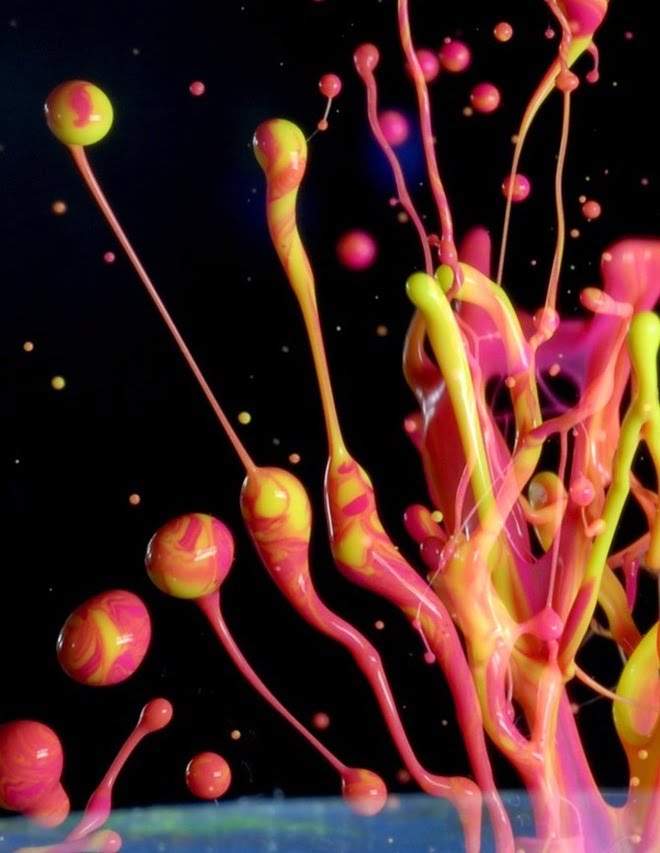
Paint vibrated on a loud speaker explodes in multi-colored jets and droplets. Most paints are shear-thinning non-Newtonian fluids (like ketchup, shampoo, or whipped cream), meaning that their viscosity decreases as they are sheared. This allows them to flow more readily once they are perturbed. #
The Tibetan Singing Bowl
The vibration caused by rubbing a Tibetan singing bowl excites standing waves in a Faraday instability on the surface of water in the bowl. As the amplitude of excitation increases, jets roil across the surface, creating a spray of droplets, some of which actually bounce on the surface as it vibrates. For more see the BBC and SciAm articles.

Singing Dunes
Some sand dunes can “sing”, but not because of the wind! When loose sand slides down over harder, packed sand, a standing wave is formed, causing the entire surface of the dune to vibrate on a single frequency. We hear this as a musical note – typically an E, F, or G. (via io9)
(Image credit: C. Larson)Jets from Waves
When vibrated, fluid surfaces can exhibit standing waves known as Faraday waves. In this experiment, increased forcing of these standing waves causes the formation of a jet. Under the right conditions, as the standing wave collapses, a singularity forms on the fluid surface when velocity and surface curvature diverge. The narrow jet column forms as a result of the fluid’s kinetic energy getting focused by the collapse. For more, see this letter to Nature. #