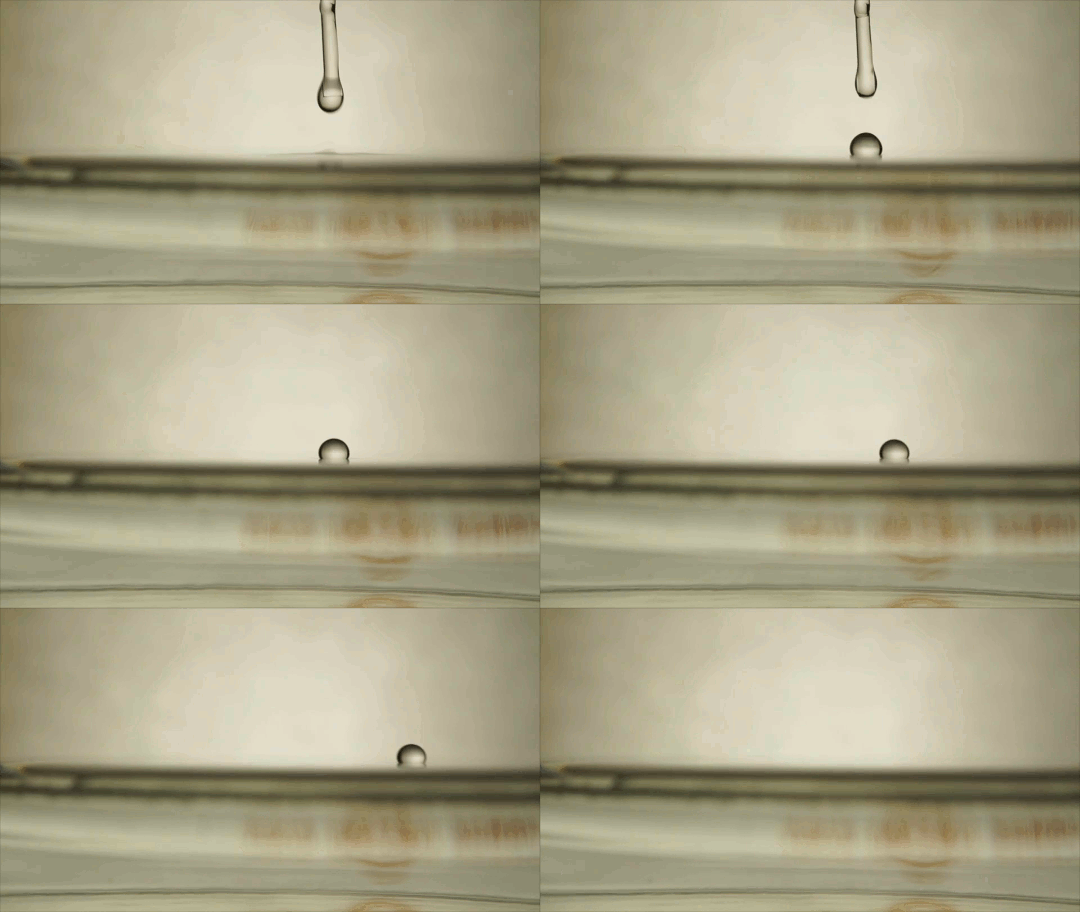
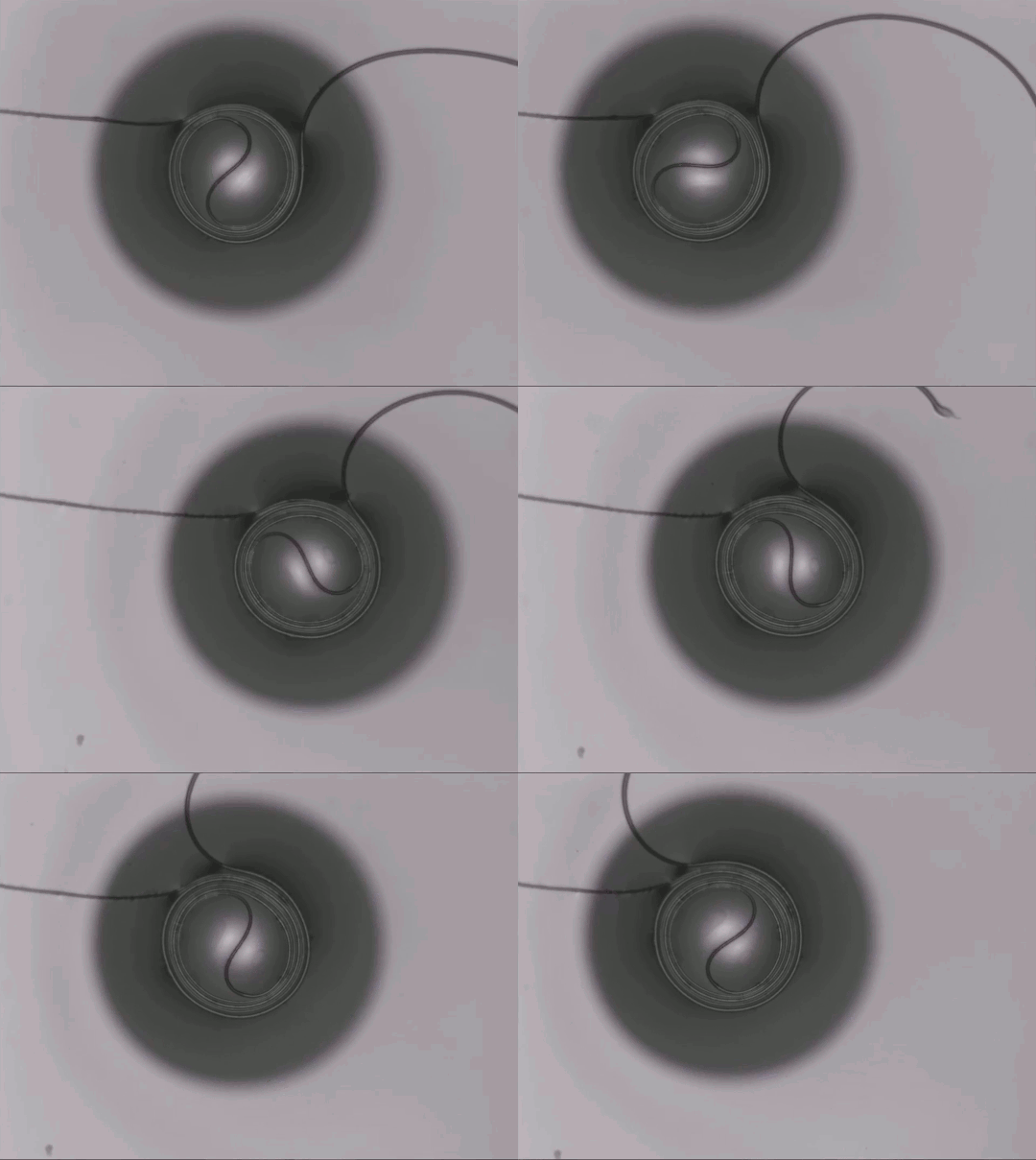
How liquid droplets spread on solid surfaces is pretty well understood, but researchers have looked less at the related problem of how a gas spreads. In a recent paper, scientists have examined the spreading dynamics of bubbles impacting an immersed solid. As the bubble contacts the surface, it quickly squeezes out water trapped between the bubble and the gas layer trapped at the solid surface. The bubble squishes as surface tension tries to flatten the liquid-gas interface. Buoyancy also helps flatten the bubble. The spreading is remarkably fast, taking only about 10 milliseconds. That’s good news for the many insects who use trapped air bubbles like these to breathe underwater. Check out the video below to learn about some of these natural scuba divers. (Image credit: H. de Maleprade et al., source; video credit: Deep Look)
Tag: surface tension

Self-Propelling Drops
Droplets of acetone deposited on a bath of warm water can float along on a Leidenfrost-like vapor layer. The droplets are self-propelling, too, thanks to interactions between the acetone and water. Acetone can dissolve in water, and when acetone vapor beneath the drop gets absorbed into the water bath, it lowers the local surface tension. That drop in surface tension creates a pull in the direction of a higher surface tension; this is what is known as the Marangoni effect. Because of that flow in the direction of higher surface tension, the acetone drop accelerates away. (Image credit: S. Janssens et al., source)

Hot Versus Cold
Did you know that you can hear the difference between hot and cold water when they’re poured? Go ahead and give the video above a listen to try it out. I’ll wait.
As explained in the video, the viscosity of water changes with temperature – the higher the temperature, the lower the viscosity. In fact, the viscosity of water at 10 degrees Celsius is more than 4 times higher than the viscosity at 100 degrees Celsius! That’s pretty significant, and it’s a big enough difference that we can hear it in the splash, even if we don’t see the difference when pouring.
Surface tension also decreases with temperature but not nearly as strongly. That 100 degrees Celsius water has 25% less surface tension than the 10 degrees Celsius water. But the combination of this change in viscosity and change in surface tension is why your cold water is more likely to dribble down the spout of your coffee pot when you’re filling the coffee machine than when you’re pouring coffee from the same pot. (Video credit: Steve Mould and Tom Scott; submitted by entropy-perturbation)

Surface Tension’s Pop
Surface tension in a liquid arises from molecular forces. Within a liquid like water, a molecule inside the fluid experiences equal tugs from similar molecules in every direction. A molecule at the surface, on the other hand, experiences the pull of similar molecules only on some sides. The net effect of this imbalance is a tensile force along the liquid surface that acts kind of like a sheet of elastic rubber – this is the effect we call surface tension. If you break the surface tension in a soap film like the one shown above, any tear will expand rapidly as the intact surface tension at the edges pulls the interior fluid away from the tear. (Image credit: C. Kalelkar and A. Sahni, source)
Sloshing in Space
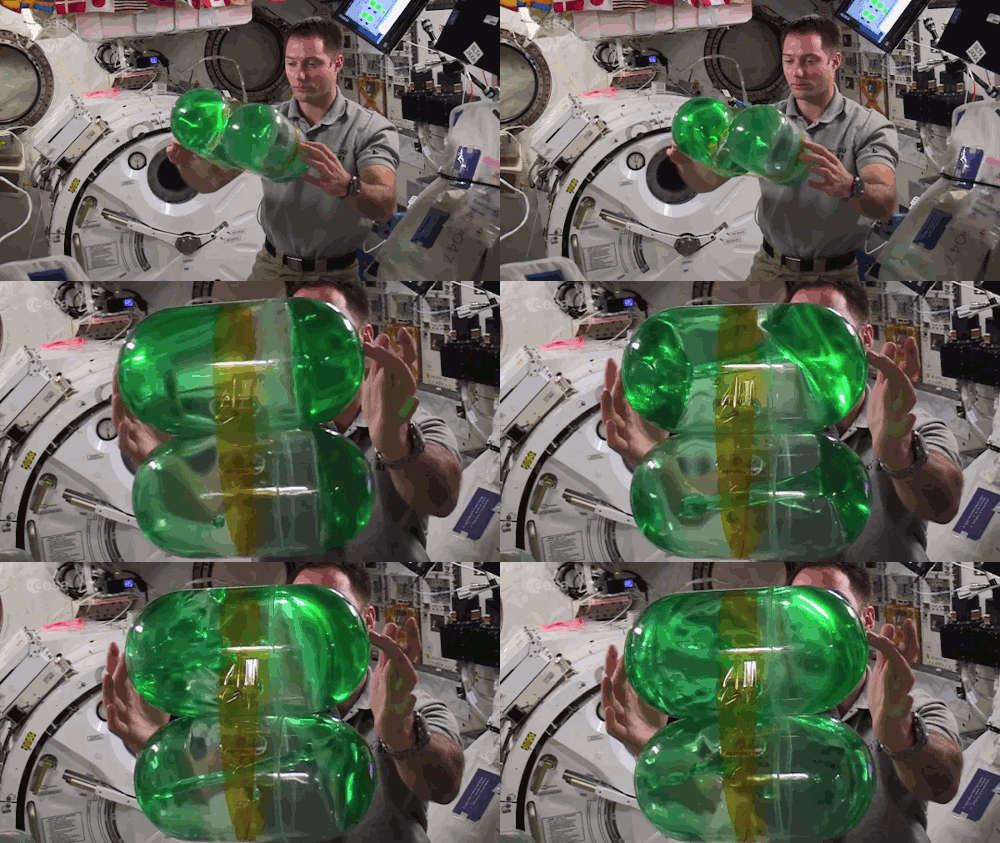
Last month, French astronaut Thomas Pesquet posted a video of some experiments he did on the International Space Station exploring the movement of fluids in microgravity. He filmed the experiments as part of the SPHERES Slosh project. Sloshing is the technical term for how liquids respond to the motion of their container, and it’s a tough problem whether you’re carrying a full coffee mug on Earth or dealing with a partially-emptied fuel canister in orbit.
Here on Earth, gravitational forces dominate how fluids respond, but in microgravity, surface tension is a more powerful player. Pesquet’s demonstrations help scientists here on Earth better understand and model how liquids respond to movement in space. One major application for this is in spacecraft fuel tanks, which engineers must be able to design so that they empty themselves consistently with or without the added complications of spinning, maneuvering, or impulsive kicks of acceleration. (Video and image credit: ESA; submitted by gdurey)

Bursting Droplets
Mixing multiple fluids can often lead to surprising and mesmerizing effects, whether it’s droplets that dance or tears along the walls of a wine glass. A recent paper highlights another such mixture-driven instability – the bursting of a water-alcohol droplet deposited on an oil bath. The Lutetium Project tackles the physics behind this colorful burst in the short video above. The behavior is driven by the quick evaporation rate of alcohol in the droplet and the way this changing chemical concentration affects surface tension in the droplet. Alcohol evaporates more quickly from the edges of the drop, creating a region of higher surface tension around the edge. This pulls fluid to the rim of the drop, where it breaks up into droplets that get pulled outward as the inner drop shrinks.
The oil bath plays an important role in the instability, too. Without it, friction between the drop and a wall is too high for the droplet to “burst”. A thick layer of oil acts as a lubricant, allowing the escaping satellite drops to speed away. (Video and image credit: The Lutetium Project; research credit: L. Keiser et al.; submitted by G. Durey)

Supporting Bubbles
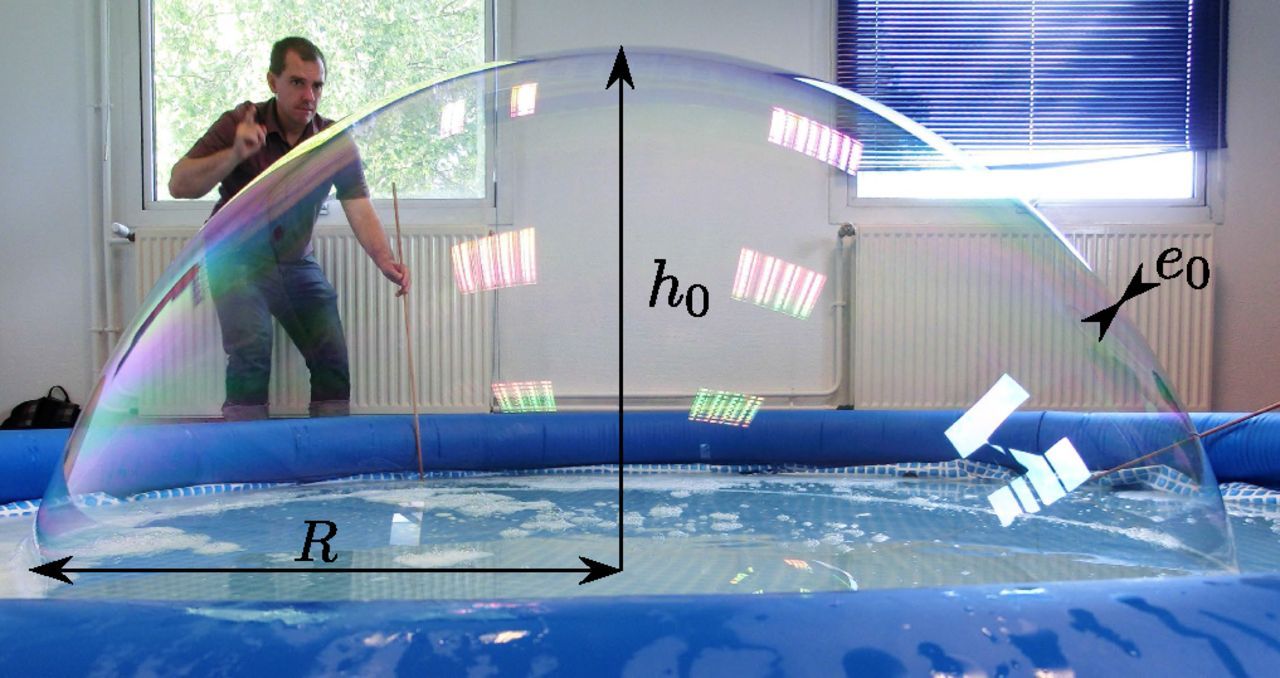
Surface tension holds small droplets in a partial sphere known as a spherical cap. But when droplets become larger, they flatten out into puddles due to the influence of gravity. In contrast, soap bubbles remain spherical to much larger sizes. The bubble pictured above, for example, is more than 1 meter in radius and nearly 1 meter in height.
There is a maximum height for a soap bubble, though, and it’s set by the physical chemistry of the surfactants used in the soap. To support itself, the bubble requires a difference in surface tension between the top and bottom of the bubble. A higher surface tension is necessary at the top of the bubble to help prevent fluid from draining away. The difference in surface tension between the top and bottom of the bubble can never be greater than the difference in surface tension between pure water and the soap mixture – thus those values set a maximum height for a bubble. The researchers found their bubbles maxed out at a height of about 2 meters, consistent with their theoretical predictions. (Image credit: C. Cohen et al.; via freshphotons)
Self-Wrapping Drops
A liquid drop can fold itself up in a thin sheet. The animation above shows a drop of water with an ultra-thin (79nm) circular sheet of polystyrene atop it. As a needle removes water from the underside of the droplet, the shrinking droplet causes wrinkles and folds to form in the sheet. What’s going on here is a competition between the energy required to change the droplet’s shape and the energy needed to bend the sheet. Eventually, the droplet’s volume is small enough that the bending of the sheet overrules surface tension in dictating the droplet’s shape. The result is a tiny empanada-shaped droplet completely encapsulated by the sheet. (Image credit: J. Paulsen et al., source; research paper)

Wrapping Up

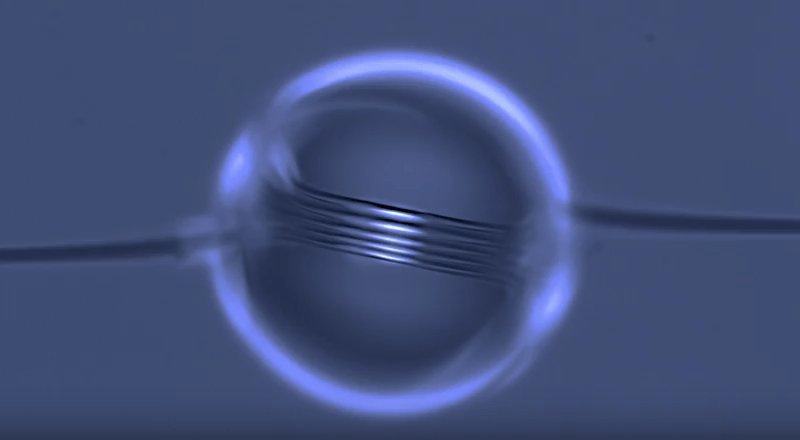
It’s often at the intersection of topics that we can learn something new and fascinating. The latest video from The Lutetium Project shows examples of this at the intersection of solid mechanics and fluid dynamics with a look at elastocapillarity. Breaking that word down, that’s where elasticity – that stretchy quality associated with solids – meets capillarity – the surface-tension-dominated behavior of a fluid. In particular, they explore some of the mind-boggling and surprising interactions that happen between drops, bubbles, and thin flexible fibers smaller than the width of a human hair. Check out the full video below. (Images credit: K. Dalnoki-Veress et al.; video credit: The Lutetium Project)
Soap Bubbles Up Close
Watching soap bubbles up close is endlessly fascinating. The iridescent colors reflect the soap film’s thickness, or, in the case of black spots, its lack thereof. The dancing of the colors shows the soap film’s flow and the ever-shifting balance of surface tension necessary to keep the film intact. Even the junctures of the bubbles–so precise and mathematically perfect in structure–reflect the molecular interactions that govern them. (Video credit: Stereokroma; via R. Weston)