Tag: supernova

  • Featured Video Play Icon

    Mimicking Supernovas

    The Hubble archives are full of incredible swirls of cosmic gas and dust, many of which were born in supernovas. Predicting the forms these massive explosions will generate is extremely difficult, thanks in large part to the complicated fluid dynamics generated by their blast waves. But new lab-scale experiments may help shed light on those underlying processes.

    Researchers mimic supernovas in the lab by launching blast waves through an interface between a dense gas (shown in white) and a lighter one (which appears black). As the blast wave passes, it drives the dense fluid into the lighter one, triggering a series of instabilities. Notice how any initial perturbations in the interface quickly grow into mushroom-like spikes that rapidly become turbulent. This behavior is exactly what’s seen in supernovas (and in inertial confinement fusion)! (Video credit: Georgia Tech; research credit: B. Musci et al.; submitted by D. Ranjan)

  • Inside a Supernova

    Inside a Supernova

    During a supernova, shock waves moving outward push denser material into less dense plasma and gas. This causes what is known as a RichtmyerMeshkov instability, where the interface between the two fluids first becomes wavy and then develops finger-like intrusions. Those too break down, as seen in the simulation above, causing large-scale mixing between the different fluids.

    Here on Earth this instability shows up in the process of inertial confinement fusion. In that case, the outer shell material is denser than the fuel core and the instability is triggered during the implosion process. As the fusion material is suddenly compressed, waviness and mixing occurs along the interface between the shell and the fuel. That’s undesirable because it reduces the efficiency of the fusion reaction.  (Image credit: E. Evangelista et al.)

  • Supernova Simulation

    Supernova Simulation

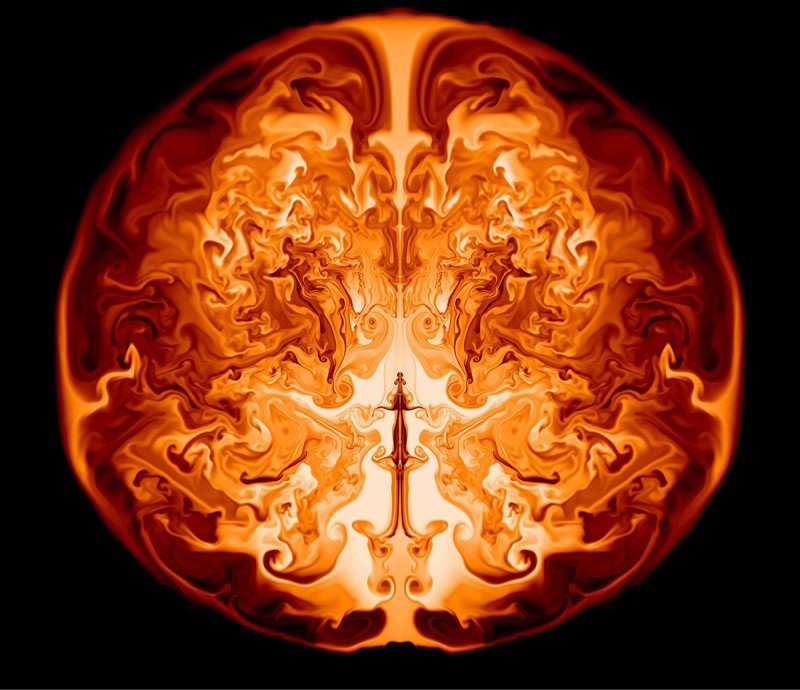
    New research shows that supermassive first-generation stars may explode in supernovae without leaving behind remnants like black holes. The work is a result of modeling the life and death of stars 55,000 to 56,000 times more massive than our sun. When such stars reach the end of their lives, they become unstable due to relativistic effects and begin to collapse inward. The collapse reinvigorates fusion inside the star and it begins to rapidly fuse heavier elements like oxygen, magnesium, or even iron from the helium in its core. Eventually, the energy released overcomes the binding energy of the star and it explodes outward as a supernova. The image above is a slice through such a star approximately one day after its collapse is reversed. Hydrodynamic instabilities like the Rayleigh-Taylor instability produce mixing of the heavy elements throughout the expanding interior of the star. The mixing should produce a signature that can be observed in the aftermath as these stars seed their galaxies with the heavy elements needed to form planets. For more, see Science Daily and Chen et al. (Image credit: K. Chen et al., via Science Daily; submitted by mechanicoolest)

  • Supernova Explosion

    Supernova Explosion

    Type 1a supernovae occur in binary star systems where a dense white dwarf star accretes matter from its companion star. As the dwarf star gains mass, it approaches the limit where electron degeneracy pressure can no longer oppose the gravitational force of its mass. Carbon fusion in the white dwarf ignites a flame front, creating isolated bubbles of burning fluid inside the star. As these bubbles burn, they rise due to buoyancy and are sheared and deformed by the neighboring matter. The animation above is a visualization of temperature from a simulation of one of these burning buoyant bubbles. After the initial ignition, instabilities form rapidly on the expanding flame front and it quickly becomes turbulent. (Image credit: A. Aspden and J. Bell; GIF credit: fruitsoftheweb, source video; via freshphotons)

  • Supernova Core Collapse

    Supernova Core Collapse

    A core-collapse, or Type II, supernova occurs in massive stars when they can no longer sustain fusion. For most of their lives, stars produce energy by fusing hydrogen into helium. Eventually, the hydrogen runs out and the core contracts until it reaches temperatures hot enough to cause the helium to fuse into carbon. This process repeats through to heavier elements, producing a pre-collapse star with onion-like layers of elements with the heaviest elements near the center. When the core consists mostly of nickel and iron, fusion will come to an end, and the core’s next collapse will trigger the supernova. When astronomers observed Supernova 1987A, the closest supernova in more than 300 years, models predicted that the onion-like layers of the supernova would persist after the explosion. But observations showed core materials reaching the surface much faster than predicted, suggesting that turbulent mixing might be carrying heavier elements outward. The images above show several time steps of a 2D simulation of this type of supernova. In the wake of the expanding shock wave, the core materials form fingers that race outward, mixing the fusion remnants. Hydrodynamically speaking, this is an example of the Richtmyer-Meshkov instability, in which a shock wave generates mixing between fluid layers of differing densities. (Image credit: K. Kifonidis et al.; see also B. Remington)

  • Featured Video Play Icon

    The Veil Nebula

    There is no grander scale for the observation of fluid dynamics than that of the astronomical. Here Hubble astronomers discuss the formation of the Veil Nebula, a supernova remnant formed some 5,000-10,000 years ago.  Wisps of gas and plasma remain, creating stunning astronomical landscapes that are the result of shock waves, turbulence, diffusion, and other processes familiar to us here on Earth. (Video credit: ESA/Hubble)