Ryan Teague’s “Cascades” music video features the enchanting process of ice growth. A chamber full of supercooled water vapor subject to a strong electric field is stimulated to grow crystals by providing a needle as the initial nucleation site. Because the vapor is supercooled, it will freeze upon contact with the nucleation site; the electric field keeps the water molecules aligned so that the crystal patterns formed are more even. The tree-like pattern seen here is called dendritic crystal growth; branches form at faults in the crystalline pattern. (Video credit: Ryan Teague, Village Green, Words are Pictures; via Gizmodo)
Tag: supercooling

Icing on Airplane Wings

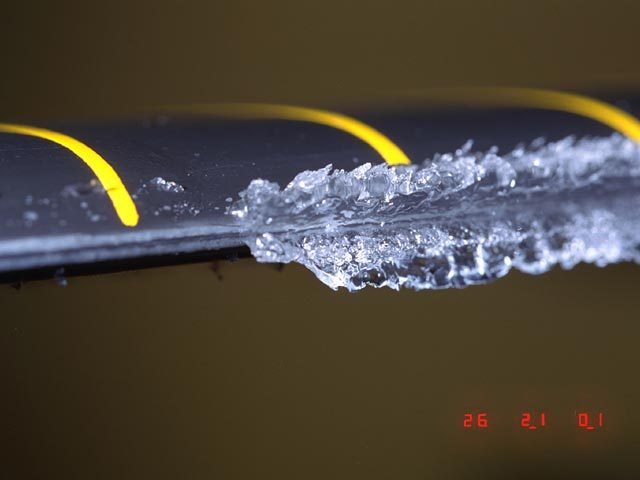
Icing on airplane wings remains little understood and a major hazard. These photos show examples of ice formation along the leading edge of a swept wing. If an aircraft flies through a cloud of supercooled water droplets, the droplets will freeze shortly after impact with the aircraft’s wings. As ice continues to build up in strange shapes, the aerodynamic profile of the wing changes, which can lead to disastrous effects as the stall and control characteristics of the wing shift. (Photo credit: NASA Glenn Research Center)

Freezing in a Microchannel
Fluid mechanics at the microscale can behave quite differently than in our everyday experience. Microfluidic devices–sometimes known as labs on a chip–are becoming increasingly important in research and daily life. For example, the test strips used by diabetics to check their blood sugar levels are microfluidic devices. In this video, researchers use a microfluidic channel to observe the freezing of supercooled water droplets. As the droplet first passes into the cold zone of the channel, it flash freezes, filling from the inside out with ice crystals. As it continues through the cold zone, the drop freezes fully, beginning at the outside surface and working inward. As it does so, the ice droplet fractures due to stresses. (Video credit: Stan et al)

Hole-Punch Clouds
These hole-punch clouds seen over Myrtle Beach, SC were probably caused by three aircraft flying in military formation. When airplanes pass through supercooled water vapor, the acceleration of air over the wing causes a pressure drop that can flash-freeze the water vapor, resulting in a localized snow shower. See National Geographic for more. #
Airplanes Creating Snow
Scientists now think that that airplanes may be responsible for increasing local snowfall by flash-freezing supercooled water vapor in clouds. Water droplets can persist in the atmosphere to temperatures of -42 degrees Celsius. But when an airplane’s wing passes through moist air, the acceleration of the air passing over the wing causes a pressure decrease that can drop the temperature by as much as 19 C, causing the water droplets to form ice crystals immediately. (The particulate matter in the aircraft exhaust probably also aids this process.) The same behavior can also create holes in clouds and cause ice to form on the wings. # (Related behavior: vapor cones)
Photo credit: lhoon