Tag: stellar evolution

  • Betelgeuse’s Flickering

    Betelgeuse’s Flickering

    Between November 2019 and March 2020 Betelgeuse, the red supergiant star in the constellation Orion’s left shoulder, experienced what’s being called the Great Dimming. Usually, the star is one of the ten brightest stars in the sky, often visible even in the suburban sprawl. But as of February 2020, it had dimmed by a factor of 2.5.

    Observers speculated all sorts of causes, including the idea that this was a precursor to a supernova explosion. Instead, it’s a relatively normal occurrence for a star like Betelgeuse. The image above is from a numerical simulation of the star, and it shows approximately what it would look like to the human eye over a 7.5 year time span. As you can see, its brightness varies noticeably, and its surface seems almost to boil. This has to do with convection in the star. Compared to a star like our sun, Betelgeuse has fewer — and much larger — convection cells.

    With a little more time and data, astronomers pinned down the exact source of Betelgeuse’s flickering during the Great Dimming. The year before the star belched an enormous bubble of gas into space. Then, when part of the star cooled in the aftermath, that gas condensed and formed a dust cloud which partially obscured the star. You can see an artist’s conception of the situation in the video below. (Image and research credit: B. Freytag; research credit: M. Montargès et al.; video credit: ESO/L. Calçada)

  • Eye of the Stellar Storm

    Eye of the Stellar Storm

    AG Carinae is a bright, unstable luminous blue variable star. This rare type of star lives fast and dies young (by stellar standards) over only a few million years. During that time, it will occasionally blow off its outer layers in a violent eruption as a result of the ongoing tug of war between its radiation pressure and gravity. That’s the source for the nebula we see surrounding the star in this image. The red areas of the image are a mixture of hydrogen and nitrogen gas; the blue clumps are cooler pockets of dust shaped by the hotter, faster-moving stellar wind. Zoom in on the image and you can see amazing structural detail in the nebula, evidence of turbulence on a scale of light-years. (Image credit: NASA/ESA/STScI; via Gizmodo)

  • Chaos in the Lagoon Nebula

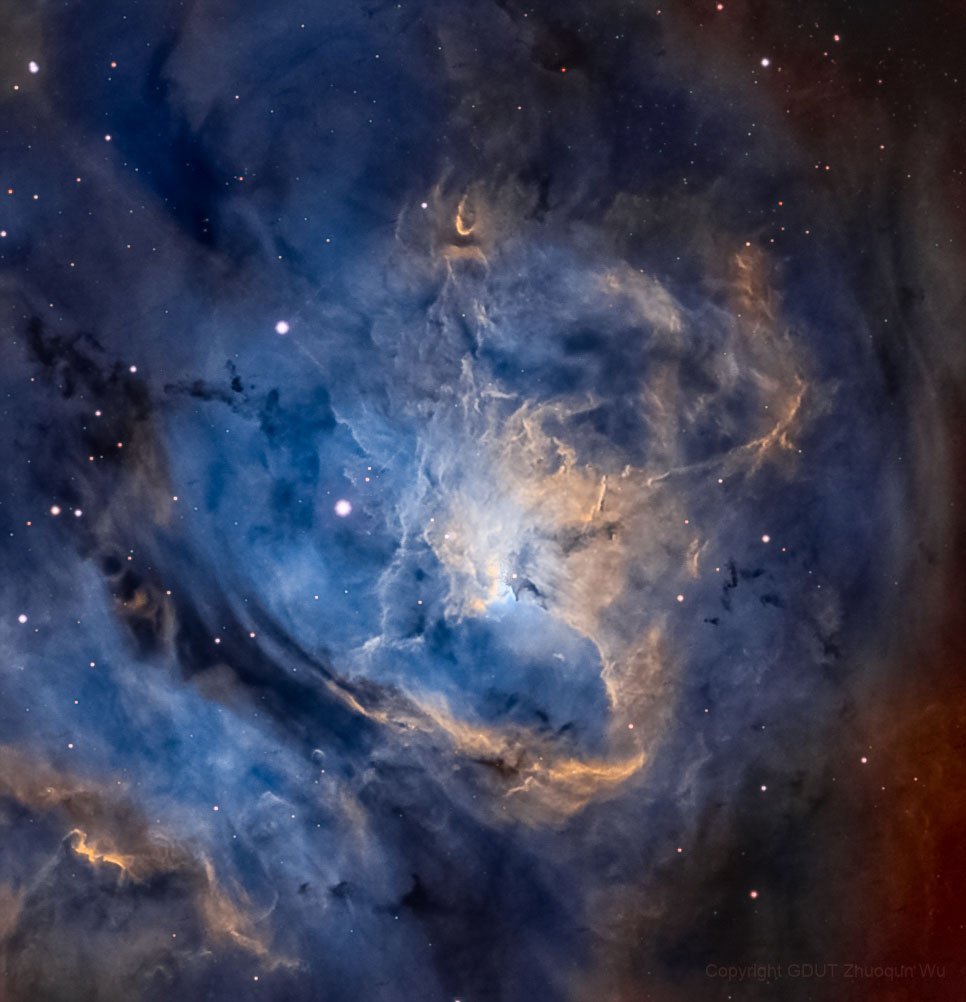
    Chaos in the Lagoon Nebula

    Even on the scale of light-years, fluid dynamics plays a role in our universe. This photograph shows the Lagoon Nebula, where stars, gas, and dust are battling for supremacy. Jets from young stars push the dust left from supernova remnants into a chaotic patterns, and the high-energy particles streaming from the youthful stars illuminate interstellar gases, creating the nebula’s distinctive glow. This section of the nebula is about 50 light-years across, so every picture we capture is only the tiniest snapshot of the true scale of its turbulence. (Image credit: Z. Wu; via APOD)

  • Featured Video Play Icon

    Shock Waves Drive Nova Brightening

    New observations of nova V906 Carinae have provided some of the first direct evidence that the observed brightening of these stellar objects is driven by shock waves. Novae form when hydrogen from a companion star settles onto a white dwarf. Once enough material accumulates, the white dwarf blows out the excess hydrogen in a donut-shaped shell moving about the speed of a typical solar wind.

    Next, another outflow — likely triggered by residual nuclear reactions on the dwarf’s surface — slams into the denser shell at about twice the speed. This collision triggers shock waves that emit light in the gamma and visible wavelengths. Weeks later, a third, even faster outflow expanded into the cloud, generating more shock waves and measurable flares. (Video credit: NASA Goddard; research credit: E. Aydi et al.)

  • Bringing the Stars Home

    Bringing the Stars Home

    One of my favorite aspects of fluid dynamics is the way that the same patterns and phenomena appear over and over again – sometimes in the most unexpected places. That’s the theme of my new article in American Scientist, which focuses on the connections between our daily lives and the stars:

    “Solar energy arises from nuclear fusion reactions in the core, but that energy is buried hundreds of thousands of kilometers beneath the surface, and most of the Sun’s overlying gas is nearly opaque; it hinders light from passing through, like a blanket thrown over a flashlight. Clearly the Sun does shine—but how? For the answer, you can simply go to your kitchen, fill a kettle, and flip on a burner.” #

    Click-through to read the full article. (Image credit: N. Sharp, Big Bear Solar Observatory, J. Blom, NASA/ESA, J. Straccia, NASA/JPL/B. Jonsson)

  • Turbulence and Star Formation

    Turbulence and Star Formation

    Space, as I’ve discussed previously, is surprisingly full of matter, especially clouds of dust. And yet the rate of star formation we observe is bizarrely low; the Milky Way, for example, produces only about one solar mass worth of new stars every year. If gravity were the sole force driving star formation, we’d see far more stars forming. Recent research suggests that turbulence plays a major role in regulating the star formation process, both by countering gravity’s attempts to collapse gases into a proto-star and by creating supersonic shocks that drive material together to jump-start star formation. There seem to be other important ingredients as well: young stars tend to form jets that blow material back into the interstellar clouds they’re forming in, feeding the turbulent background. For more, check out Physics Today. (Image credit: ESA/NASA/Hubble/ESO, via APOD; research credit: C. Federrath)

  • Stellar Bow Shock

    Stellar Bow Shock

    This Hubble image shows a young star in the Orion Nebula and the curved bow shock arcing around it. Despite its age, the star LL Orionis is energetic, producing a stellar wind that exceeds our sun’s. When that wind collided with the flow in the Orion Nebula, it formed this bow shock that is about a half a light-year wide. We don’t often think about fluid dynamics applying in space, but if we consider a lengthscale that is large enough, even space contains enough matter to behave like a fluid. LL Orionis’s bow shock is in many ways comparable to ones we see form around re-entering spacecraft. (Image credit: NASA/Hubble, via APOD; submitted by jshoer)

  • The Bubble Nebula

    The Bubble Nebula

    This spectacular Hubble image shows the Bubble Nebula. The source of this nebula is the star seen toward the upper left side of the bubble. This massive, super-hot star has ceased to fuse hydrogen and is now fusing helium, powering its way to a likely end as a supernova. As it burns, the star emits a stellar wind of gas moving at over 6.4 million kilometers an hour. As the flow moves outward, it encounters colder dense gases that it pushes along as it expands; this is the blue bubble surface that we see. The asymmetry of the bubble with respect to its source star is caused by the variation in the surrounding gas’s density. The bubble’s front moves more slowly in areas with more gas, thus making the bubble appear lop-sided. (Image credit: NASA; via Gizmodo)

  • Featured Video Play Icon

    The Veil Nebula

    There is no grander scale for the observation of fluid dynamics than that of the astronomical. Here Hubble astronomers discuss the formation of the Veil Nebula, a supernova remnant formed some 5,000-10,000 years ago.  Wisps of gas and plasma remain, creating stunning astronomical landscapes that are the result of shock waves, turbulence, diffusion, and other processes familiar to us here on Earth. (Video credit: ESA/Hubble)

  • Featured Video Play Icon

    Supersonic Stellar Jets

    Astronomers studying stellar jets–massive outflows of gases and particles pouring from the poles of newborn stars–are finding reasons to turn to fluid dynamicists to understand the timelapse videos they’ve stitched together from multiple exposures from the Hubble telescope. Usually astronomical events unfold on such a slow timescale that our only view of them is as a snapshot frozen in time.  Stellar jets can move relatively quickly, though, with portions of the jet flowing at supersonic speeds. Over the course of Hubble’s lifetime, these jets have been imaged multiple times, allowing astronomers to create movies that reveal swirling eddies and shock wave motion previously unseen. (submitted by sakalgirl)