Tag: stability

  • Hydrofoils and Stability

    Hydrofoils and Stability

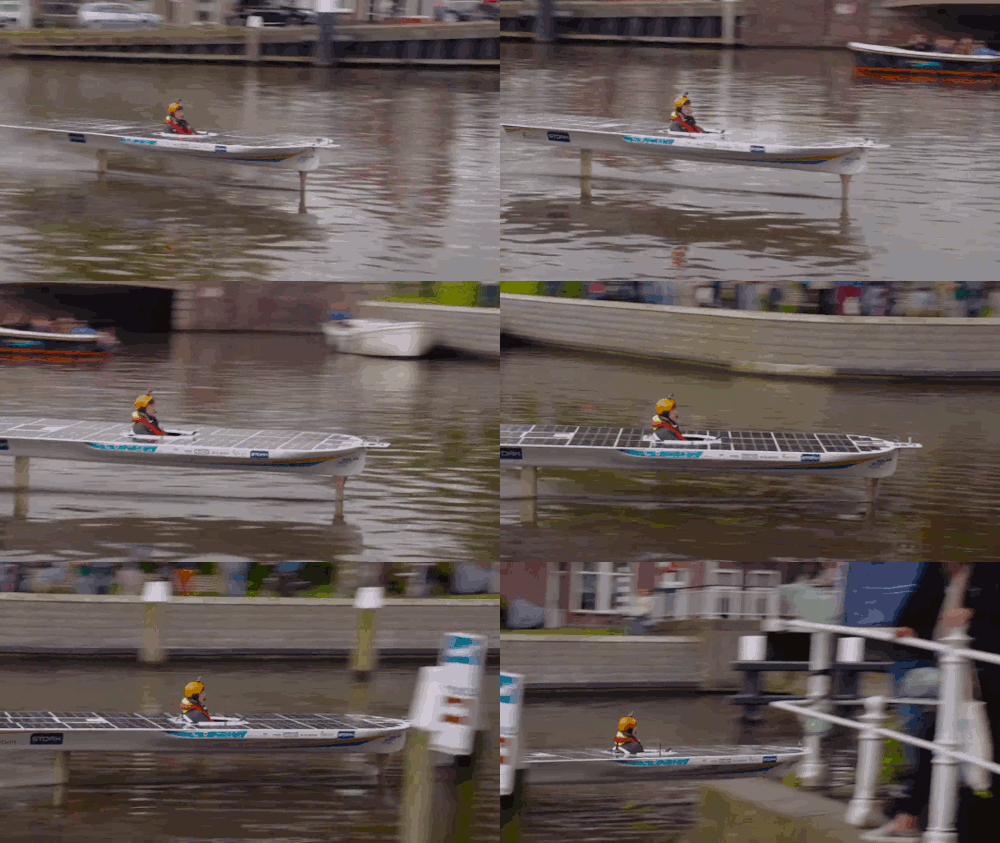
    Today’s fastest boats use hydrofoils to lift most of a boat’s hull out of the water. This greatly reduces the drag a boat experiences, but it can also make the boat difficult to handle. One style of hydrofoil boat, called a single-track hydrofoil, uses two hydrofoils in line with one another to support and steer the boat. The pilot can steer the lead hydrofoil into the direction of a fall to correct it. Stability-wise, this is the same way that you keep a bicycle upright. On a boat, the situation is a bit tougher to manage, and, like riding a bike, it takes practice. A group of students published a full mathematical model for the dynamics of this kind of boat, which allows designers to test a prototype’s stability early in the design process and enables student teams to use computer simulators to train their pilots to drive a boat before putting them out on the water, similar to the way that airplane pilots train. (Image credit: TU Delft Solar Boat Team, source; research credit: G. van Marrewijk et al., pdf; via TU Delft News; submitted by Marc A.)

  • Reader Question: Rippling Runoff

    Reader Question: Rippling Runoff

    Reader junolivi asks:

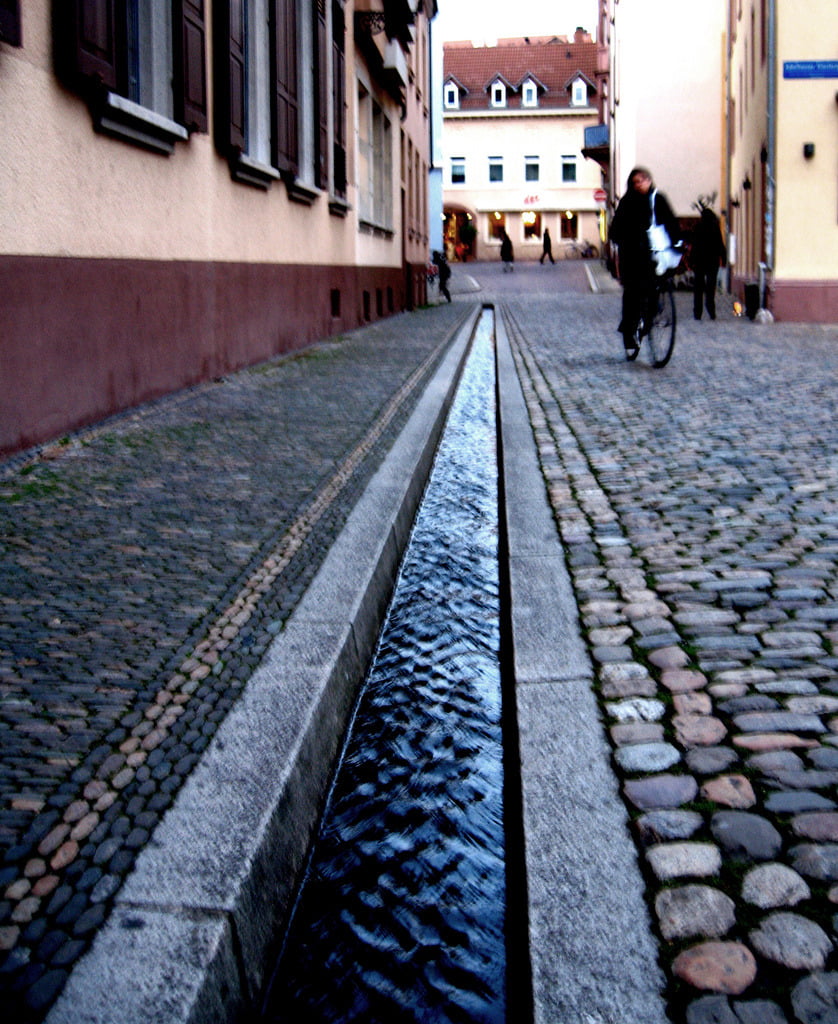
    When shallow water (like runoff from melting snow) flows across pavement, it creates small repeated wave-like ripples. What creates that texture and why isn’t it just a steady flow?

    This is a great question that’s probably crossed the mind of anyone who’s seen water running down the gutter of a street after a storm. The short answer is that this gravity-driven flow is becoming unstable.

    Fluid dynamicists often like to characterize flows into two main types: laminar and turbulent. Most flows in nature are turbulent, like the wild swirls you see behind cars driving in the rain. But there are laminar flows in nature as well. Often flows that begin as laminar will become turbulent. This happens because those laminar flows are unstable to disturbances.

    The classic example of stability is a ball on a hill. If the ball is at the top of the hill and you disturb it, it will roll down the hill because its original position was unstable. If, on the other hand, the ball is in a depression, then you can prod the ball and it will eventually settle back down into its original place because that position was stable. Another way of looking at it is that, in the unstable case, the disturbance–how far the ball is from its original position–grows uncontrollably. In the stable case, on the other hand, the disturbance can be initially large but eventually decays away to nothing.

    There are many ways to disturb a laminar flow–surface roughness, vibrations, curvature, noise, etc., etc. These disturbances enter the flow and they can either grow (and become unstable) or decay (because the flow is stable to the disturbance). Just as one can look at the stability of a pendulum, one can mathematically examine the stability of a fluid flow. When one does this for water flowing down an incline, one finds that the flow is quite unstable, even in the ideal case of a pure, inviscid fluid flowing down a smooth wall.

    The reason that one sees distinctive waves with a particular wavelength (assuming that they aren’t caused by local obstructions) is directly related to this idea of instability. Essentially, the waves are the disturbance, having grown large enough to see. One could imagine that any wavelength disturbance is possible in a flow, but mathematically, what one finds, is that different wavelengths have different growth rates associated with them. The wavelength we observe is the most unstable wavelength in the flow. This is the wavelength that grows so much quicker than the others that it just overwhelms them and trips the flow to turbulence. This is very common. For example, you can see distinctive waves showing up before the flow goes turbulent in both this mixing layer simulation and this boundary layer flow.

    (Image credits: anataman, mo_cosmo; also special thanks to Garth G. who originally asked a similar question via email)

  • Brazuca

    Brazuca

    Since 2006, Adidas has unveiled a new football design for each FIFA World Cup. This year’s ball, the Brazuca, is the first 6-panel ball and features glued panels instead of stitched ones. It also has a grippy surface covered in tiny nubs. Wind tunnel tests indicate the Brazuca experiences less drag than other recent low-panel-number footballs as well as less drag than a conventional 32-panel ball. Its stability and trajectory in flight are also more similar to a conventional ball than other recent World Cup balls, particularly the infamous Jabulani of the 2010 World Cup. The Brazuca’s similar flight performance relative to a conventional ball is likely due to its rough surface. Like the many stitched seams of a conventional football, the nubs on the Brazuca help trip flow around the ball to turbulence, much like dimples on a golf ball. Because the roughness is uniformly distributed, this transition is likely to happen simultaneously on all sides of the ball. Contrast this with a smooth, 8-panel football like the Jabulani; with fewer seams to trip flow on the ball, transition is uneven, causing a pressure imbalance across the ball that makes it change its trajectory. For more, be sure to check out the Brazuca articles at National Geographic and Popular Mechanics, as well as the original research article. (Photo credit: D. Karmann; research credit: S. Hong and T. Asai)

  • Vortex Cross-Sections

    Vortex Cross-Sections

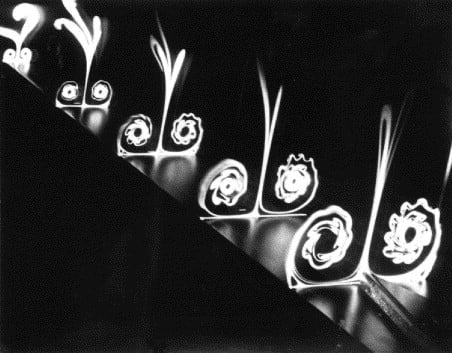
    The photos above show cross-sections through the leading edge vortices on a highly swept delta wing at angle of attack.  Flow in the photos is from the upper left to lower right. Notice how the vortices grow and develop waviness as they move downstream. When perturbations enter the vortex–for example, due to the shear between the vortex fluid and the freestream–some will grow and eventually cause a break down to turbulence, as in the lower picture. (Photo credits: R. Nelson and A. Pelletier)

  • London 2012: Badminton Physics

    London 2012: Badminton Physics

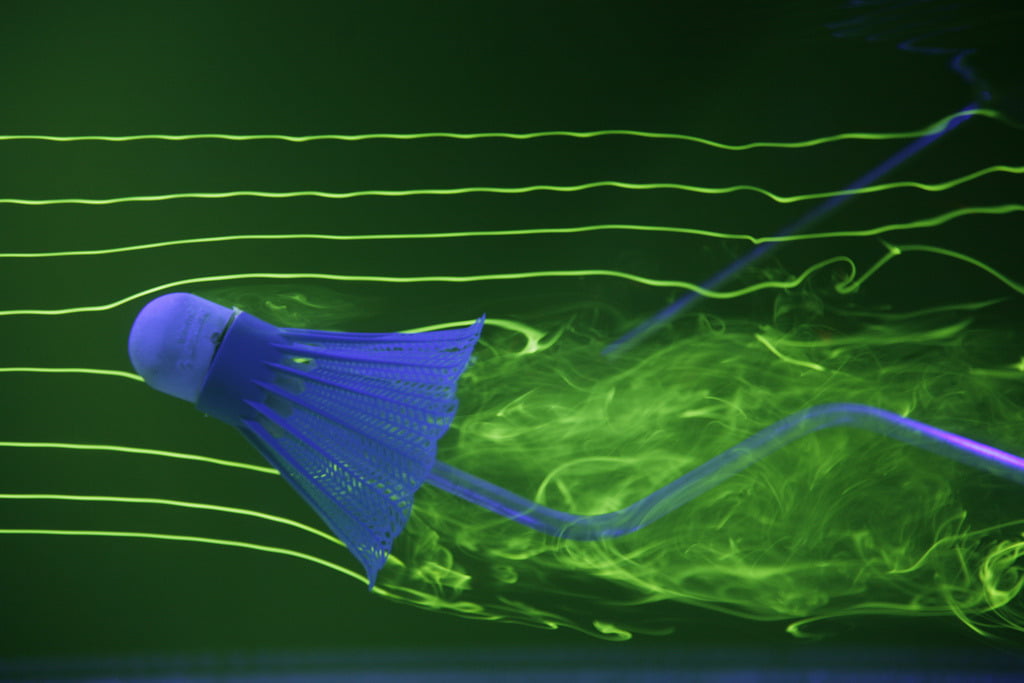
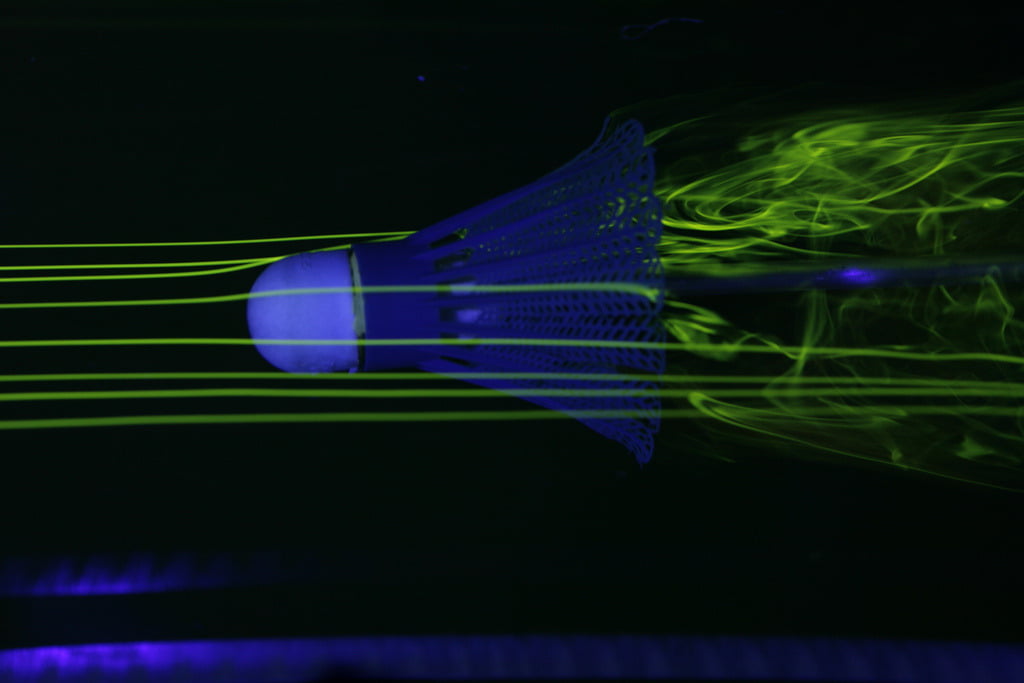
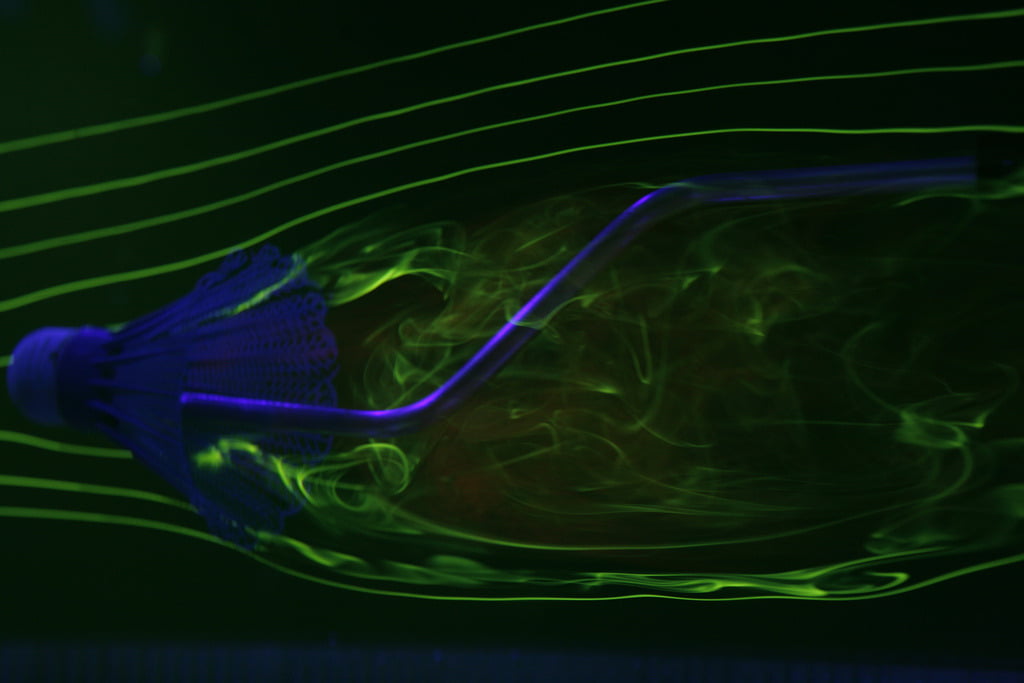
    Unlike most racket sports, badminton uses a projectile that is nothing like a sphere. The unusual shape of the shuttlecock not only creates substantial drag in comparison to a ball but increases the complexity of its flight path. The heavy head of the shuttlecock creates a moment that stabilizes its flight, ensuring that the head always points in the direction of travel. The skirt, traditionally made of feathers though many today are plastic, is responsible for the aerodynamic forces that make the shuttlecock’s behavior so interesting.

    Measuring the drag coefficient of the shuttlecock, modeling its trajectory and behavior in the four common badminton shots, and even attempting computational fluid dynamics of the shuttlecock are all on-going research problems in sports engineering. (Photo credit: Rob Bulmahn)

    FYFD is celebrating the Olympics with the fluid dynamics of sports. Check out our previous posts on how the Olympic torch works, what makes a pool fast, and the aerodynamics of archery.

  • Featured Video Play Icon

    London 2012: Archery Physics

    Archery is one of the oldest Olympic sports, but the physics involved are remarkably complex. Even looking only at the flight of the arrow, the problem is hardly simple. The heavy point of the arrow makes it front-heavy, and the fletches on the back of the arrow provide additional surface area on which air can act. This means that the center of mass of the arrow–where gravity acts–is further forward than the center of pressure–where aerodynamic forces act.  This results in the aerodynamic forces helping to stabilize the flight of the arrow.  To see why this is important, try throwing a dart fletching first!

    When an arrow is fired from a bow, as in the high speed video above, the sudden impetus of force from the bowstring causes the arrow to flex and vibrate as it is fired. The aerodynamic forces generated by the fletches straighten the arrow’s flight, helping it reach the intended target accurately.  Some fletching is designed to make the arrow spin; this can further improve accuracy but comes at the cost of speed since some of the arrow’s initial kinetic energy must be converted to rotation.  For more, check out Archery Report, which features some great articles on the physics of archery and even has CFD comparing arrow tips. Mark Leach also has some great information on tuning a bow, which, if done properly, allows one to accurately shoot unfletched arrows.

    FYFD is celebrating the Olympics by looking at the fluid dynamics of sports. Check out our previous posts on how the Olympic torch works and what makes a pool fast.

  • Featured Video Play Icon

    Hawk Moth Hovering

    The hawk moth (Manduca sexta) flies quite similarly to a hummingbird, able to hover over the flowers from which it feeds by rotating its wings as it flaps.  This constant change in angle of attack allows it to maintain lift while remaining stationary in space. Researchers study the stability of such miniature hovering flight by destabilizing the moths and studying how they react to disturbances like being struck with a miniature clay cannonball. By testing how the moths recover from disturbances, we can learn how to build better robots and micro air vehicles (MAVs). (via supercuddlypuppies)

  • Transition to Turbulence

    Transition to Turbulence

    Smoke introduced into the boundary layer of a cone rotating in a stream highlights the transition from laminar to turbulent flow. On the left side of the picture, the boundary layer is uniform and steady, i.e. laminar, until environmental disturbances cause the formation of spiral vortices. These vortices remain stable until further growing disturbances cause them to develop a lacy structure, which soon breaks down into fully turbulent flow. Understanding the underlying physics of these disturbances and their growth is part of the field of stability and transition in fluid mechanics. (Photo credit: R. Kobayashi, Y. Kohama, and M. Kurosawa; taken from Van Dyke’s An Album of Fluid Motion)

  • Reader Question: Swimming and Buoyancy

    Reader Question: Swimming and Buoyancy

    aniiika asks:

    How does buoyancy relate to swimming?

    Buoyancy is the force that enables a swimmer to float in the water, even when still. Buoyant force is equal to the weight of the fluid displaced by the swimmer; in other words, the density of the fluid multiplied by the volume of the swimmer that is submerged.

    Different people float at different heights in the water depending on many factors, such as body shape, amount of fat, and how much air is in their lungs. All of these things affect a person’s volume and/or density, thereby affecting the buoyant force they experience.

    Because a person’s body is not fully submerged their center of buoyancy–the point where all buoyant forces on the body can be represented by a single force–does not coincide with the center of mass (sometimes referred to as center of gravity). Where those forces are relative to one another determines the stability of a person floating in the water. Everyone’s center of buoyancy is higher than their center of mass, so people always float stably in an upright orientation. Our legs, for example, don’t float as well as our torsos, so, when floating horizontally, one’s legs will tend to sink.

    Swimmers can control their buoyancy to their advantage by actually pressing their upper chests further into the water. This tends to bring one’s hips closer to the surface and can reduce drag (#).

  • Paper Plane Physics

    [original media unavailable]

    It’s a little surprising that this would be so stable, but I don’t have any reason to believe it impossible. #