When the Hunga Tonga-Hunga Ha’apai volcano erupted in January 2022, its effects were felt — and heard — thousands of kilometers away. A new study analyzes crowdsourced data (largely from Aotearoa New Zealand) to estimate the audible impact of the eruption. The researchers found that the volume, arrival time, and nature of the rolling rumble reported by survey takers correlated well with seismic measurements. But humans provided data that monitoring equipment couldn’t. For example, reports of shaking buildings and rattling windows let researchers estimate the shock wave‘s overpressure far from the volcano. The team suggests that acting quickly to collect human impressions of rare events like this one can add valuable data that’s otherwise overlooked. (Image credit: NASA; research credit: M. Clive et al.; via Gizmodo)
Tag: shockwave

A Dandelion-Like Supernova Remnant
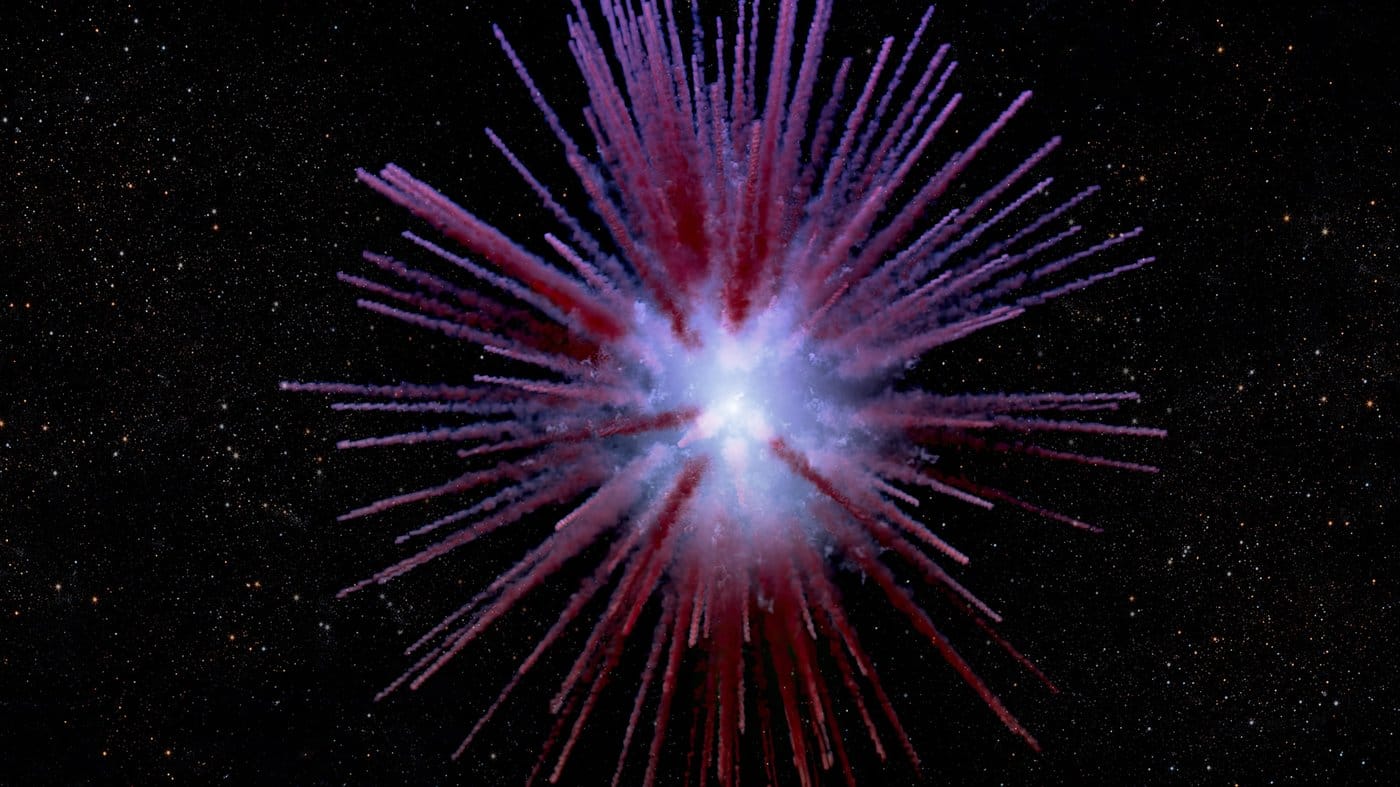
In 1181 CE, astronomers in China and Japan recorded a new, short-lived star in the constellation Cassiopeia. After burning for nearly six months, this historic supernova disappeared from the naked eye. It was only in 2013 that an amateur astronomer identified a nebula in the vicinity of that supernova, and, in the years since, astronomers have collected evidence that identifies the object, known as Pa 30, as the remnants of that 1181 supernova. Now, astronomers have mapped the supernova remnant, revealing an unusual dandelion-like structure (shown in an artist’s conception above and below). Filaments of sulfur project outward from a dusty central region that houses the remains of the original star. Normally, a supernova destroys its original star, but this was a Type Iax supernova, a “failed” explosion that left behind a hot, inflated star that may eventually cool into a white dwarf star.
Why the supernova remnant has this strange shape remains unclear. Scientists speculate that shock waves may have helped concentrate sulfur into these clumpy filaments. The material’s velocity suggests a ballistic trajectory (meaning, essentially, that it has neither sped up nor slowed down since the original explosion). Winding the trajectory backwards pegs their origin to 1181, helping confirm that Pa 30 is, indeed, the remains of that 1181 supernova. (Image and video credit: W.M. Keck Observatory/A. Makarenko; research credit: R. Fesen et al.; via Gizmodo)

Gigapixel Supernova
Eleven thousand years ago, a star exploded in the constellation Vela, blowing off its outer layers in a spectacular shock wave that remains visible today. Today’s image is a piece of a 1.3-gigapixel composite image of the supernova remnant, captured by the Dark Energy Camera of the Víctor M. Blanco 4-meter Telescope at Cerro Tololo Inter-American Observatory in Chile. Below is a labeled version of the image, identifying the original star — now a fast-spinning pulsar that packs our sun’s mass into an object only kilometers across — its shock wave, and other features. To explore the full-sized image, see NOIRLab. (Image credit: CTIO/NOIRLab/DOE/NSF/AURA; via Colossal)

A labeled version of the image shows the shock wave and other features. 
Simeis 147
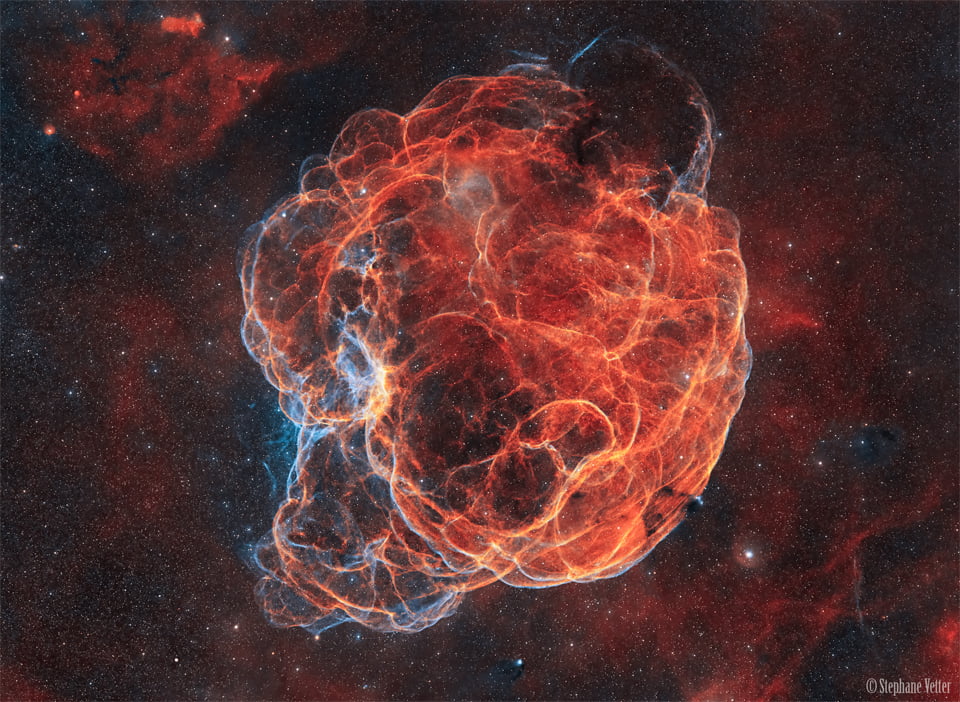
Sometimes known as the Spaghetti Nebula, Simeis 147 is the remnant of a supernova that occurred 40,000 years ago. The glowing filaments of this composite image show hydrogen and oxygen in red and blue, respectively. These are the outlines of the shock waves that blew off the outer layers of the one-time star within. What remains of that star’s core is now a pulsar, a fast-spinning neutron star with a solar wind that continues to push on the dust and gas we see here. (Image credit: S. Vetter; via APOD)

Lasers and Soap Films
Soap films are a great system for visualizing fluid flows. Researchers use them to look at flags, fish schooling and drafting, and even wind turbines. In this work, researchers explore the soap film’s reaction to lasers. When surfactant concentrations in the soap film are low, laser pulses create shock waves (above) in the film that resemble those seen in aerodynamics. The laser raises the temperature at its point of impact, lowering the local surface tension. That temperature difference triggers a Marangoni flow that draws the heated fluid outward. The low surfactant concentration gives the soap film relatively high elasticity, and that allows the shock waves to form.
In contrast, a soap film with a high concentration of surfactants has relatively little elasticity. In these films (below), the laser creates a mark that stays visible on the flowing soap film. This “engraving” technique could be used to visualize flow in the soap film without using tracer particles. (Image and research credit: Y. Zhao and H. Xu)

When surfactant concentrations are high, a laser pulse “engraves” spots onto a flowing soap film. Shown in terms of interference (left) and Schlieren (right) imaging. 
Can Explosions Deflect Bullets?


In one of their most Mythbusters-like videos ever, the Slow Mo Guys ask: can an explosion deflect a bullet? To find out, they built out a system to trigger a C4 explosive using a 9mm bullet, all while watching with a series of high-speed cameras. As you’d expect, there are lots of blast waves and neat flame propagation to watch. As for the fundamental question, well, you’ll have to watch to find out! (Video and image credit: The Slow Mo Guys)
Test Firing a Rocket Engine


Watching a rocket engine start up in slow motion is always fun. This Slow Mo Guys video shows a test fire of one of Firefly’s engines, which is capable of 45,000 pounds of thrust. Gav walks us through the process of preparing to film the test as well as what his footage shows.
Green flames mark ignition of the initial fuel, and bursts of flame jerk back and forth as shock waves pass through the engine. That’s a necessary part of establishing supersonic flow through the bell-shaped diffuser at the end of the engine. Once the exhaust reaches supersonic speeds, expelling it creates a diamond-like pattern of standing shock waves and expansion fans that ultimately equalize the exhaust jet’s pressure to that of the surrounding atmosphere. (Video and image credit: The Slow Mo Guys)
Withstanding Rocket Launches


It takes a lot of power to lift a giant rocket‘s payload all the way to orbit, and in the first moments of a rocket launch, all that energy is directed downward at a concrete pad. How do engineers design and protect launch pads? In this Practical Engineering video, Grady tackles just that question through a comparison of SpaceX’s Stage Zero and NASA’s Launch Pad 39A.
SpaceX notoriously chose to build Stage Zero without a trench or water sprayer system like the ones NASA use. Trenches deflect the rocket exhaust to reduce the impact on infrastructure beneath the engines. And water sprayers reduce the temperatures the pad experiences and disrupt shock waves that otherwise hammer the pad. Without those precautions, even special heavy-duty concretes have a hard time holding together against a launch. (Video and image credit: Practical Engineering)

Star YY Hya
A team of professional and amateur astronomers discovered and then imaged this previously undiscovered galactic nebula. At the heart of the stellar remnant is a binary star pair. Shock waves of the gas and dust twist and spread in the surrounding space, the remains of an earlier star’s violent eruption. (Image credit: M. Drechsler et al.; via 2023 Astronomy POTY)

Exploding a Bubble
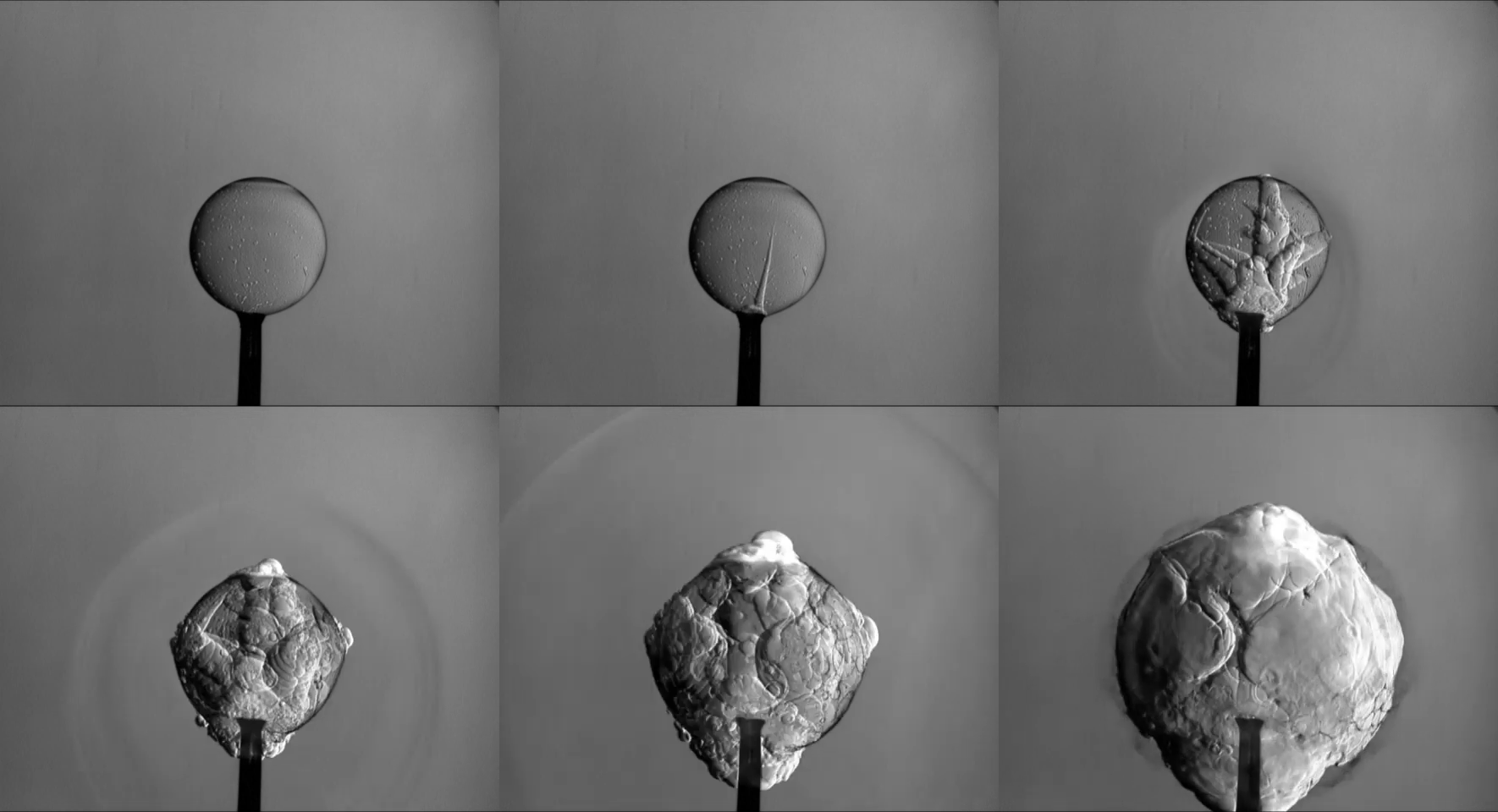
In this high-speed video, artist Linden Gledhill ignites a mixture of oxygen and hydrogen contained within a soap bubble. As neat as the video is, I decided to take a closer look at the initial detonation with this animation:

The ignition sequence within the bubble, slowed down further. Even here, it’s hard to appreciate just how fast ignition is; it lasts only a handful of frames, despite filming at 40,000 frames per second. But we can still pick out some very neat physics. The ignition begins with a spike-like jet but immediately forks into three ignition fronts that pierce the soap bubble. You can see the shadowy mist of the bubble bursting as the flame front expands. Watch the background carefully, and you can see a shock wave flying away from that moment of detonation.
Once the soap bubble is gone, the expanding flames begin to wrinkle and deform. Turbulence takes shape, eddying through the flames at a much slower speed than the initial detonation. This is where most of combustion takes place, with turbulence mixing the hydrogen and oxygen together to better enable burning. (Image and video credit: L. Gledhill)