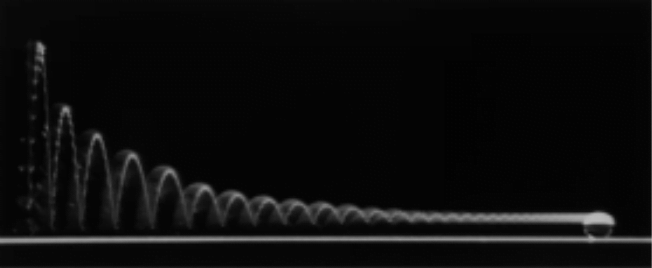
A water droplet can rebound completely without spreading from a superhydrophobic surface. The photo above is a long exposure image showing the trajectory of such a droplet as it bounces. In the initial bounces, the droplet leaves the surface fully, following a parabolic path with each rebound. The droplet’s kinetic energy is sapped with each rebound by surface deformation and vibration, making each bounce smaller than the last. Viscosity damps the drop’s vibrations, and the droplet eventually comes to rest after twenty or so rebounds. (Image credit: D. Richard and D. Quere)
Tag: science

Growing Turbulence

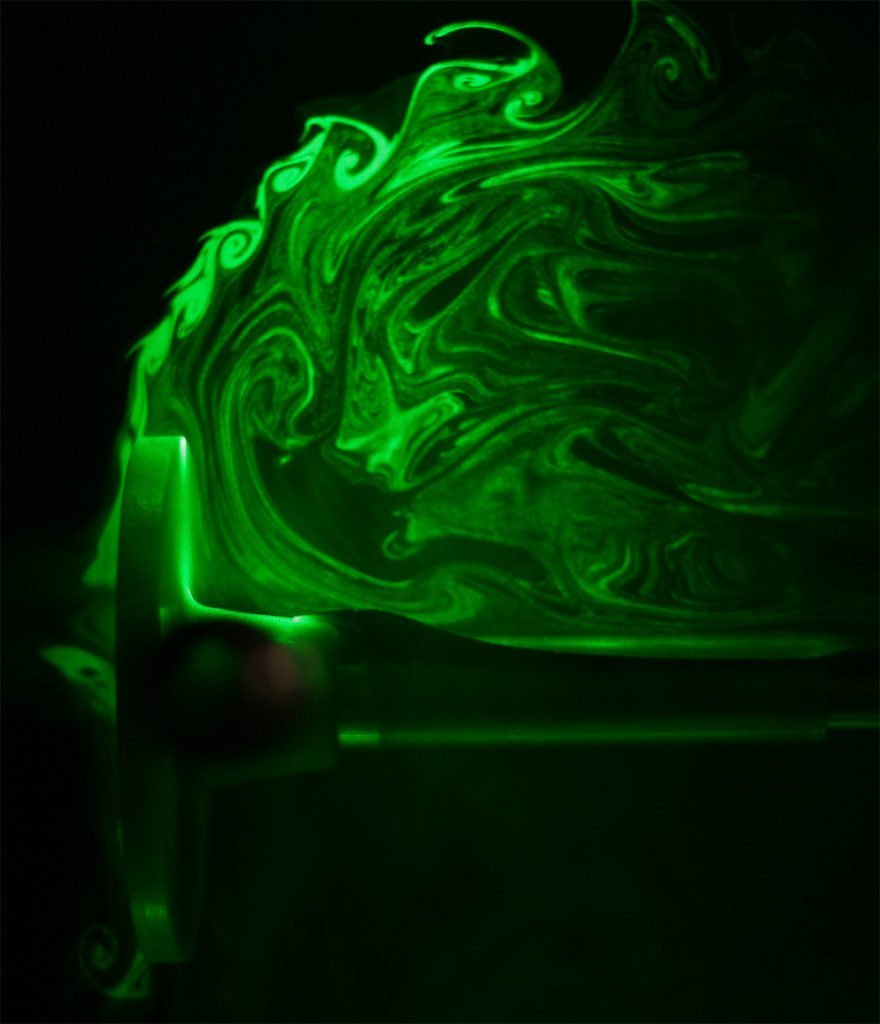
Flow patterns can change dramatically as fluid speed and Reynolds number increase. These visualizations show flow moving from left to right around a circular plunger. The lower Reynolds number flow is on the left, with a large, well-formed, singular vortex spinning off the plunger’s shoulder. The image on the right is from a higher Reynolds number and higher freestream speed. Now the instantaneous flow field is more complicated, with a string of small vortices extending from the plunger and a larger and messier area of recirculation behind the plunger. In general, increasing the Reynolds number of a flow makes it more turbulent, generating a larger range of length scales in the flow and increasing its complexity. (Image credit: S. O’Halloran)

“Becoming Harmonious”
Much as I try to keep from getting repetitious, this was just too neat to pass up. This new music video for The Glitch Mob’s “Becoming Harmonious” is built around the standing Faraday waves that form on a water-filled subwoofer. The vibration patterns, along with judicious use of strobe lighting, produce some fantastic and kaleidoscopic effects. (Video credit: The Glitch Mob/Susi Sie; submitted by @krekr)
Tiny Fliers
There’s an apocryphal story claiming that, aerodynamically speaking, honeybees should not be able to fly. Obviously, they can, but it’s true that a small, flapping creature and a large, fixed-wing aircraft will not generate lift exactly the same way. NYU professor Leif Ristroph has a lot of projects exploring flapping flight on smaller scales, as seen in this video. His oscillatory fliers and rotating flapping flight simulator have both been featured previously. Part of the beauty of these projects is their size; in a field that’s historically required giant wind tunnels and room-length wave tanks, Ristroph’s work provides insight into long-standing problems using apparatuses that fit on a countertop. (Video credit: Cool Hunting/L. Ristroph et al.)
What Sound Looks Like
NPR’s Skunk Bear Tumblr has a great new video on the schlieren visualization technique. The schlieren optical set-up is relatively simple but very powerful, as shown in the video. The technique is sensitive to variations in the refractive index of air; this bends light passing through the test area so that changes in fluid density appear as light and dark regions in the final image. Since air’s density changes with temperature and with compressibility, the technique gets used extensively to visualize buoyancy-driven flows and supersonic flows. Since sound waves are compression waves which change the air’s density as they travel, schlieren can capture them, too. (Video credit: A. Cole/NPR’s Skunk Bear)

Wingtip Vortices
Newton’s third law says that forces come in equal and opposite pairs. This means that when air exerts lift on an airplane, the airplane also exerts a downward force on the air. This is clear in the image above, which shows a an A380 prototype launched through a wall of smoke. When the model passes, air is pushed downward. The finite size of the wings also generates dramatic wingtip vortices. The high pressure air on the underside of the wings tries to slip around the wingtip to the upper surface, where the local pressure is low. This generates the spiraling vortices, which can be a significant hazard to other nearby aircraft. They are also detrimental to the airplane’s lift because they reduce the downwash of air. Most commercial aircraft today mitigate these effects using winglets which weaken the vortices’ effects. (Image credit: Nat. Geo./BBC2)
“High Ball Stepper”
The recently released music video for Jack White’s “High Ball Stepper” is a fantastic marriage of science and art. The audio is paired with visuals based around vibration effects using both granular materials and fluids. There are many examples of Faraday waves, the rippling patterns formed when a fluid interface becomes unstable under vibration. There are also cymatic patterns and even finger-like protrusions formed by when shear-thickening non-Newtonian fluids get agitated. (Video credit: J. White, B. Swank and J. Cathcart; submitted by Mike and Marius)

Kelvin Wakes
Ducks, boats, and other objects moving along water create a distinctive V-shaped pattern known as a Kelvin wake. As the boat moves, it creates disturbance waves of many different wavelengths. The constructive interference of the slower waves compresses them into the shock wave that forms either arm of the V. Sometimes evenly spaced wavelets occur along the arms as well. Between the arms are curved waves that result from other excited wave components. The pattern was first derived by Lord Kelvin as universally true at all speeds – at least for an ideal fluid – but practically speaking, water depth and propeller effects can make a difference. Recently, some physicists have even suggested that above a certain point, an object’s speed can affect the wake shape, but this remains contentious. (Image credit: K. Leidorf; via Colossal; submitted by Peter)
How Tsunamis Cross the Ocean
Last week an earthquake in Chile raised concerns over a possible tsunami in the Pacific. This animation shows a simulation of how waves would spread from the quake’s epicenter over the course of about 30 hours. In the open ocean, a tsunami wave can travel as fast as 800 kph (~500 mph), but due to its very long wavelength and small amplitude (< 1 m), such waves are almost unnoticeable to ships. It’s only near coastal areas, when the water shallows, that the wave train slows down and increases in height. Early in the video, the open ocean wave heights are only centimeters; note how, at the end of the video, the wave run-up heights along the coast are much larger, including the nearly 2 meter waves that impacted Chile. The power of the incoming waves in a tsunami are not their only danger, though; the force of the wave getting pulled back out to sea can also be incredibly destructive. (Video credit: NOAA/NWS/Pacific Tsunami Warning Center; via Wired)
Coalescence
The coalescence of two liquid droplets takes less than the blink of an eye, but it is the result of an intricate interplay between surface tension, viscosity, and inertia. The high-speed video above was filmed at 16000 frames per second, yet the initial coalescence of the silicone oil drops is still nearly instantaneous. At the very instant the drops meet, an infinitesimally small neck is formed between the droplets. Mathematically speaking, the pressure and curvature of the droplets diverge as a result of this tiny contact area. This is an example of a singularity. Surface tension rapidly expands the neck, sending capillary waves rippling along the drops as they become one. (Video credit: S. Nagel et al.; research credit: J. Paulsen)