Zesting the skin of a citrus fruit like oranges releases a spray of tiny oil droplets. Citrus oil has several volatile components, meaning that it evaporates quickly at room temperature. It is also a liquid with a relatively low flash point, meaning that only modest temperatures (~40-60 degrees Celsius) are needed to generate enough vapor to ignite a vapor/air mixture. With volatile and flammable liquid fuels, a spray of droplets is an ideal platform for combustion because the essentially spherical droplets have a high surface area from which they can evaporate and provide vaporous fuel. (Video credit: ChefSteps)
Tag: science

Shooting Droplets
This animation shows high-speed video of a polystyrene particle striking a falling water droplet. Under the right conditions, the particle rips through the droplet, stretching the water into a bell-shaped lamella extending from a thicker rim. When the particle detaches, surface tension rapidly collapses the lamella into a ring which destabilizes. Thin ligaments and droplets fly off the crown-like ring as momentum overcomes surface tension’s ability to hold the droplet together. Be sure to check out the full video on YouTube or later next month at the APS Division of Fluid Dynamics meeting. (Yes, I will be there!) (Image credit: V. Sechenyh et al., source video)

Phytoplankton Bloom
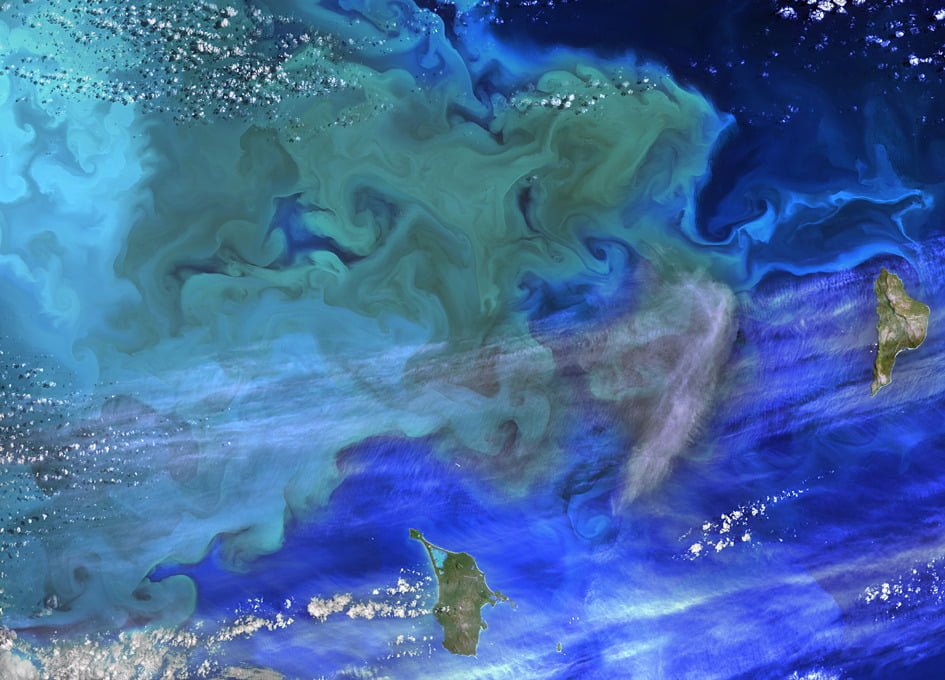
In satellite imagery the blue and green whorls of massive phytoplankton blooms stand out against the ocean backdrop. These microscopic organisms are part of a delicate predator-prey balance and can be very sensitive to nutrient concentrations and other environmental conditions. Their individual size is negligible, but in a bloom phytoplankton are numerous enough that they act as seed particles for the flow. As a result, differing concentrations of phytoplankton reveal the swirling, turbulent mixing of ocean waters. (Image credit: NASA/USGS; via SpaceRef; submitted by jshoer)

Bouncing with Liquids and Grains
Bouncing a ball partially filled with a liquid can create chaotic results when the motion of the ball, fluid, and vibration plate couple. The behavior of a grain-filled ball is a bit different, though. Large grains will tend to bounce with the same frequency as the ball, even across a range of vibration conditions. A ball filled with smaller grains displays a variety of responses depending on the vibration conditions. Among these is a localized wave-like form called an oscillon which oscillates with a period different from but coupled to that of the vibration plate. All these different behaviors inside the bouncing sphere have noticeable effects on its outward motion, too. The chaotic activity of the fluid inside a bouncing ball makes it unstable, and, if not confined, it will bounce itself off the vibration platform. The grain-filled ball, on the other hand, remains bouncing on the platform even after being perturbed. This seems to be a result of the energy dissipation provided by the many inelastic collisions inside the ball as it bounces. (Video credit: F. Pacheco-Vazquez et al.)

Supernova Simulation
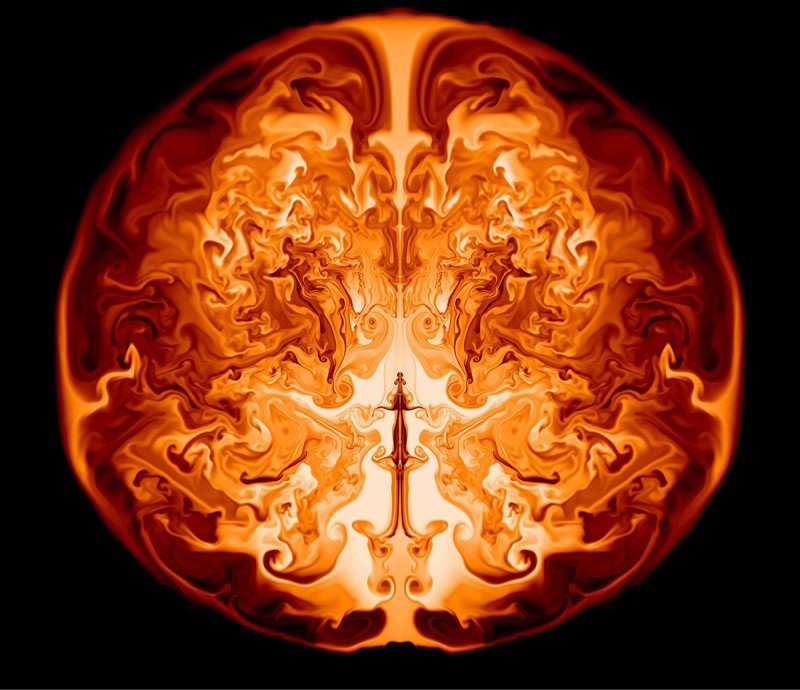
New research shows that supermassive first-generation stars may explode in supernovae without leaving behind remnants like black holes. The work is a result of modeling the life and death of stars 55,000 to 56,000 times more massive than our sun. When such stars reach the end of their lives, they become unstable due to relativistic effects and begin to collapse inward. The collapse reinvigorates fusion inside the star and it begins to rapidly fuse heavier elements like oxygen, magnesium, or even iron from the helium in its core. Eventually, the energy released overcomes the binding energy of the star and it explodes outward as a supernova. The image above is a slice through such a star approximately one day after its collapse is reversed. Hydrodynamic instabilities like the Rayleigh-Taylor instability produce mixing of the heavy elements throughout the expanding interior of the star. The mixing should produce a signature that can be observed in the aftermath as these stars seed their galaxies with the heavy elements needed to form planets. For more, see Science Daily and Chen et al. (Image credit: K. Chen et al., via Science Daily; submitted by mechanicoolest)
Turbine Blade Separation
[original media no longer available]
Maintaining consistent air flow along the contours of an object is key to aerodynamic efficiency. When air flow separates or forms a recirculation zone, the drag increases and efficiency drops. On wind turbine blades, flow often separates on the root end of the blade near its attachment point. This behavior is apparent in the video above at 0:34. The tufts in the foreground on the turning blade flap and flutter with no clear pattern because the air flow has separated from the surface. In the subsequent clip, a line of vortex generators has been attached near the leading edge of the blade. These structures–also commonly seen on airplanes–trail vortices behind them, mixing the flow and generating a turbulent boundary layer which is better able to resist flow separation. The effect on the flow is clear from the tufts, most of which now point in a consistent direction with little to no fluttering, indicating that the air flow has remained attached. (Video credit: Smart Blade Gmbh/Technische Universität Berlin)
(Source: /)
Hovering
Designer Eleanor Lutz used high-speed video of five different flying species to create this graphic illustrating the curves swept out in their wingbeats. The curves are constructed from 15 points per wingbeat and are intended more as art than science, but they’re a fantastic visualization of several important concepts in flapping flight. For example, note the directionality of the curves as a whole. If you imagine a vector perpendicular to the wing curves, you’ll notice that the bat, goose, and dragonfly would all have vectors pointing forward and slightly upward. In contrast, the moth and hummingbird would have vectors pointing almost entirely upward. This is because the moth and hummingbird are hovering, so their wing strokes are oriented so that the force produced balances their weight. The bat, goose, and dragonfly are all engaged in forward flight, so the aerodynamic force they generate is directed to counter their weight and to provide thrust. (Image credit: E. Lutz; via io9)
Bardarbunga Eruption
I thought I was done with volcanoes for this week, but DJI’s aerial footage from Iceland’s Bardarbunga eruption is too fantastic not to share. The eruption is over a month old now and more than 25,000 earthquakes have been registered in Iceland since this eruption began. The lava field covers more than 46 square kilometers, and experts remain unsure how long the eruption will continue. The lava itself is a basalt, which is lower in viscosity than more silica-rich lava. This lower viscosity means that the gases dissolved in the rising magma can escape more easily, like carbon dioxide fizzing out of a soda. If the lava’s viscosity were higher, those dissolved gases would generate a more explosive eruption as they try to escape. (Video credit: DJI; via Wired)
Undulatus Asperatus
This surrealistic timelapse doesn’t show an ocean in the sky. These are undulatus asperatus clouds rolling over Lincoln, Nebraska. Also known simply as asperatus, this cloud formation has been proposed as but not yet recognized as a distinctive cloud type. Their speed is much slower than shown in the animation, but the wave-like motion is accurate and is the source of the cloud’s name, which comes from the Latin word aspero, meaning to make rough. Though they appear stormy, asperatus clouds do not usually produce storms. They form under conditions similar to those of mammatus clouds, but wind shear at the cloud level causes the undulations to form. (Maybe some Kelvin-Helmholtz instabilities going on there?) You can check out many more images of asperatus clouds at the Cloud Appreciation Society’s gallery. (Image credit: A. Schueth, source video; submitted by leftcoastjunkies)

Krakatoa
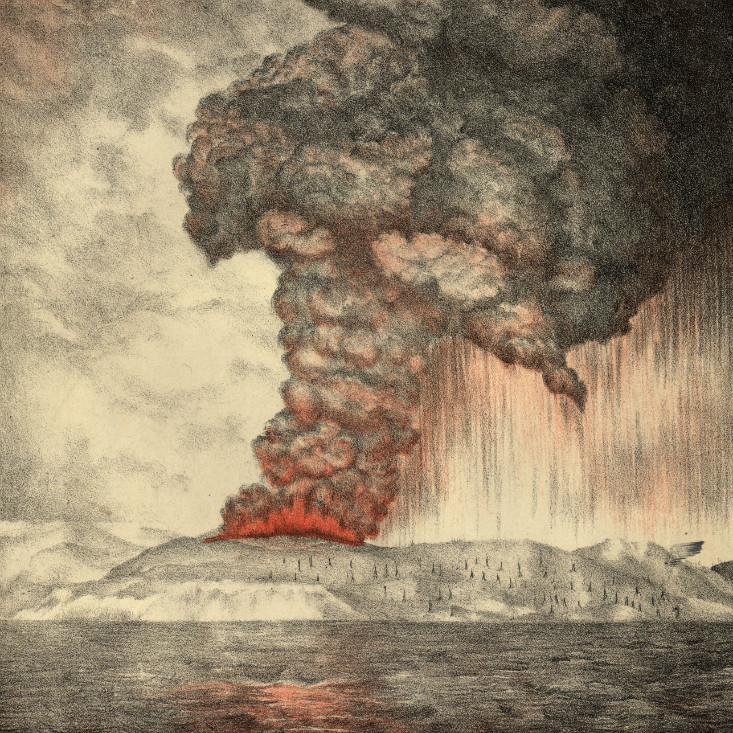
Volcanoes seem to be a common topic these days. Yesterday Nautilus published a great piece by Aatish Bhatia on the 1883 eruption of Krakatoa, which tore the island apart and unleashed a sound so loud it was heard more than 4800 km away:
The British ship Norham Castle was 40 miles from Krakatoa at the time of the explosion. The ship’s captain wrote in his log, “So violent are the explosions that the ear-drums of over half my crew have been shattered. My last thoughts are with my dear wife. I am convinced that the Day of Judgement has come.“
In general, sounds are caused not by the end of the world but by fluctuations in air pressure. A barometer at the Batavia gasworks (100 miles away from Krakatoa) registered the ensuing spike in pressure at over 2.5 inches of mercury. That converts to over 172 decibels of sound pressure, an unimaginably loud noise. To put that in context, if you were operating a jackhammer you’d be subject to about 100 decibels. The human threshold for pain is near 130 decibels, and if you had the misfortune of standing next to a jet engine, you’d experience a 150 decibel sound. (A 10 decibel increase is perceived by people as sounding roughly twice as loud.) The Krakatoa explosion registered 172 decibels at 100 miles from the source. This is so astonishingly loud, that it’s inching up against the limits of what we mean by “sound.” #
Those are some mindbogglingly enormous numbers. Aatish does a wonderful job of explaining the science behind an explosion whose effects ricocheted through the atmosphere for days afterward. Check out the full article over at Nautilus. (Image credit: Parker & Coward, via Wikipedia)