Carbonation and the fizzy bubbles that come with it are surprisingly popular among humans. Through fermentation or artificial introduction, carbon dioxide gas gets dissolved into a liquid under high pressure. Then, when the pressure is released to atmospheric levels, that gas comes out of solution, forming tiny bubbles that eventually grow large enough to rise buoyantly to the surface. There they will either pop – releasing carbon dioxide gas and aromatics – or form a layer of foam – like in beer – that insulates the liquid and makes it harder to spill. (Image credit: D. Cook; see also R. Zenit and J. Rodríguez–Rodríguez; via Jennifer O.)
Tag: science

Blowing Vortex Rings from Bubbles


When bubbles burst, we often pay attention to the retracting film and forming droplets, but what happens to the air that was inside? By placing a little smoke inside them, we can see. The air inside these bubbles is slightly pressurized compared to the ambient, and as such a bubble ruptures, its air gets pushed out the expanding hole. That momentum makes the air curl as it forces its way into the surrounding air, creating a stack of vortex rings. The researchers observed as many as six stacked vortices from bubbles just under 4 cm in diameter. (Image and research credit: A. Dasouqi and D. Murphy; video credit: Science; see also A. Dasouqi and D. Murphy)

Twirling Liquids

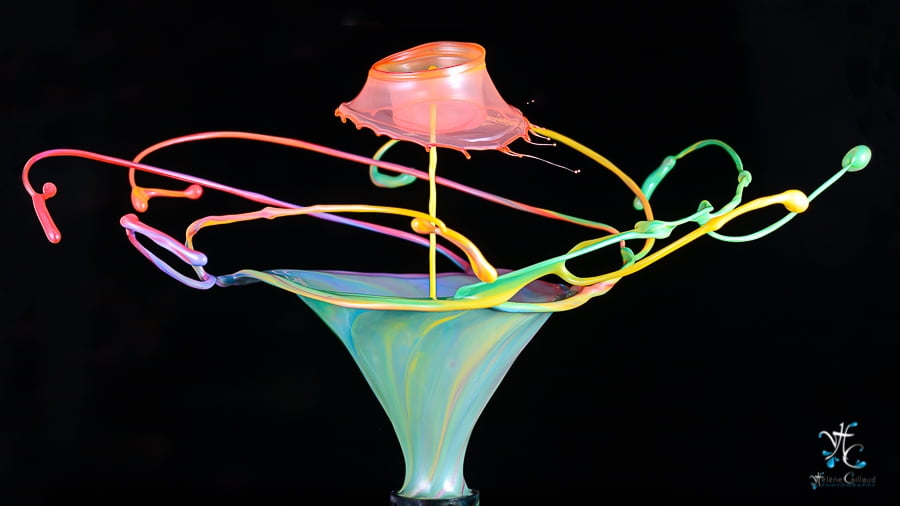


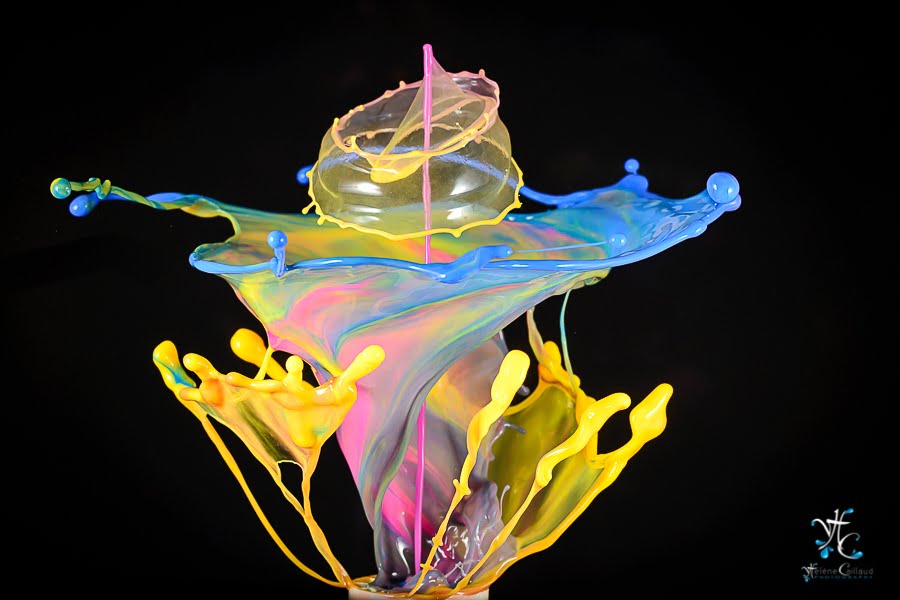
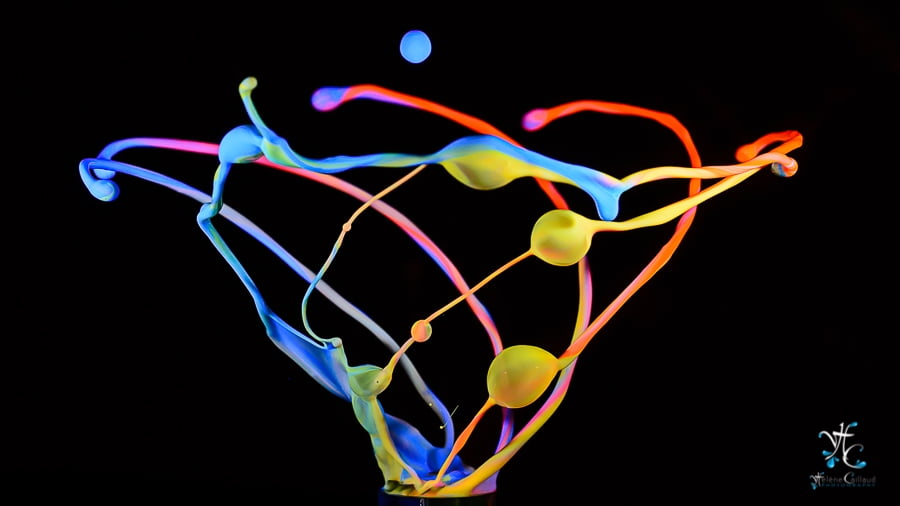
What do you get when you spin a splash? I expect the result is a lot like these whirling fluid structures captured by photographer Hélène Caillaud. I love the fantastical shapes she creates as sheets and filaments are flung outward. These liquid sculptures look like everything from the perfect martini glass to the skirts of a flamenco dancer. Check out the full gallery of images, and be sure to look around at Caillaud’s other stunning liquid art while you’re there. (Images credit: H. Caillaud)
Waltzing Defects


Liquid crystals are a peculiar state of matter with both liquid and crystalline properties. In this video, a microfluidic device breaks water into droplets surrounded by a shell of liquid crystal. Because the molecular structure of the liquid crystals is helical and cannot pack neatly in a spherical shell, there are visible defects in the liquid crystal shells. Given time, those defects can merge as the liquid crystal shell thickens. (Image and video credit: The Lutetium Project)
Inside the Fire Lab
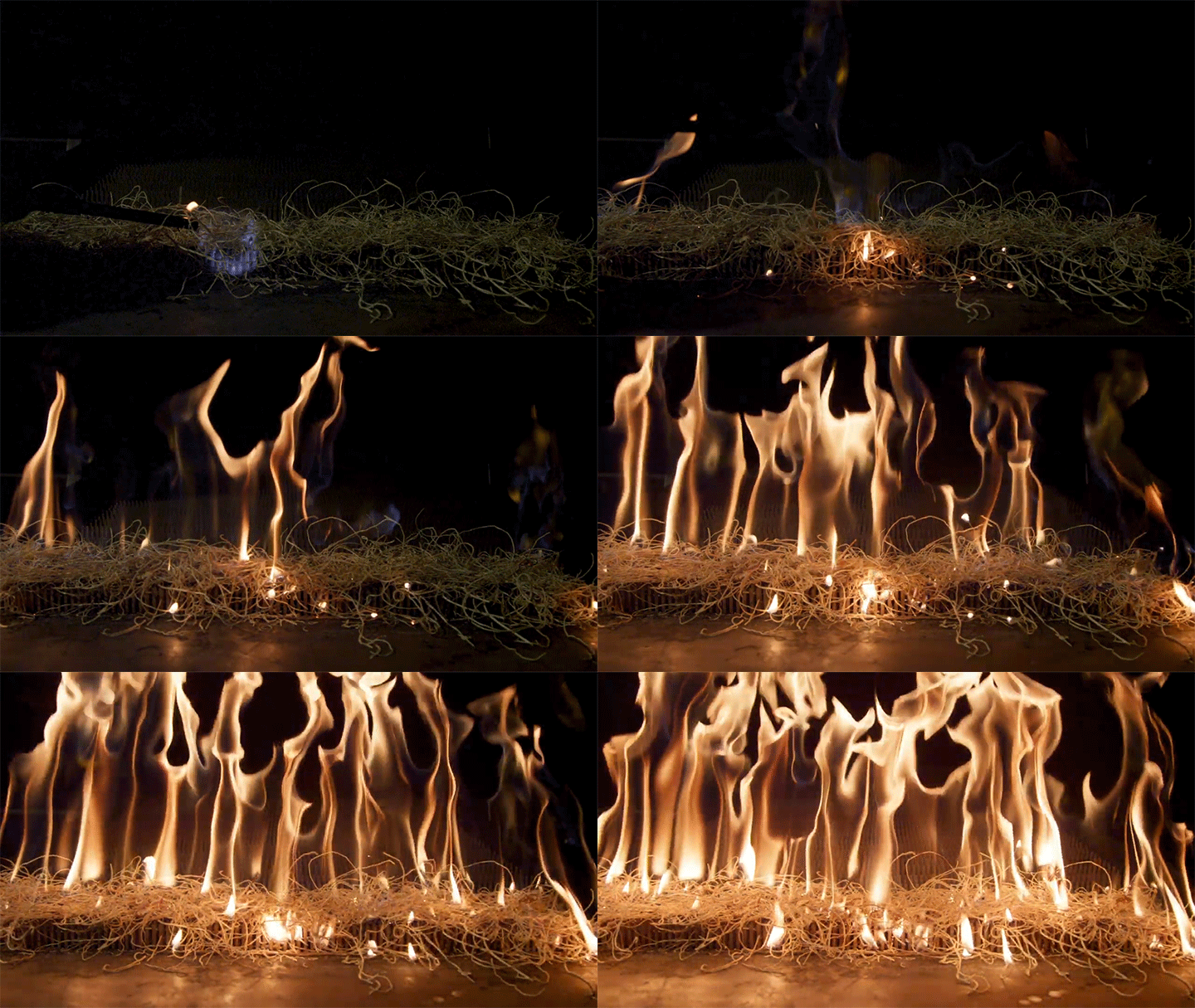


Fire plays an important role in nature, one with which humanity must live without controlling fully. After several disastrous historic wildfires in the American West, the U.S. Forest Service established its own fire lab, where research foresters can study flames firsthand. This video takes us inside the Fire Lab for a look at the facilities and people responsible for helping us better understand this fundamental force of nature. (Video and image credit: Gizmodo + Atlas Obscura)

Kneading Dough
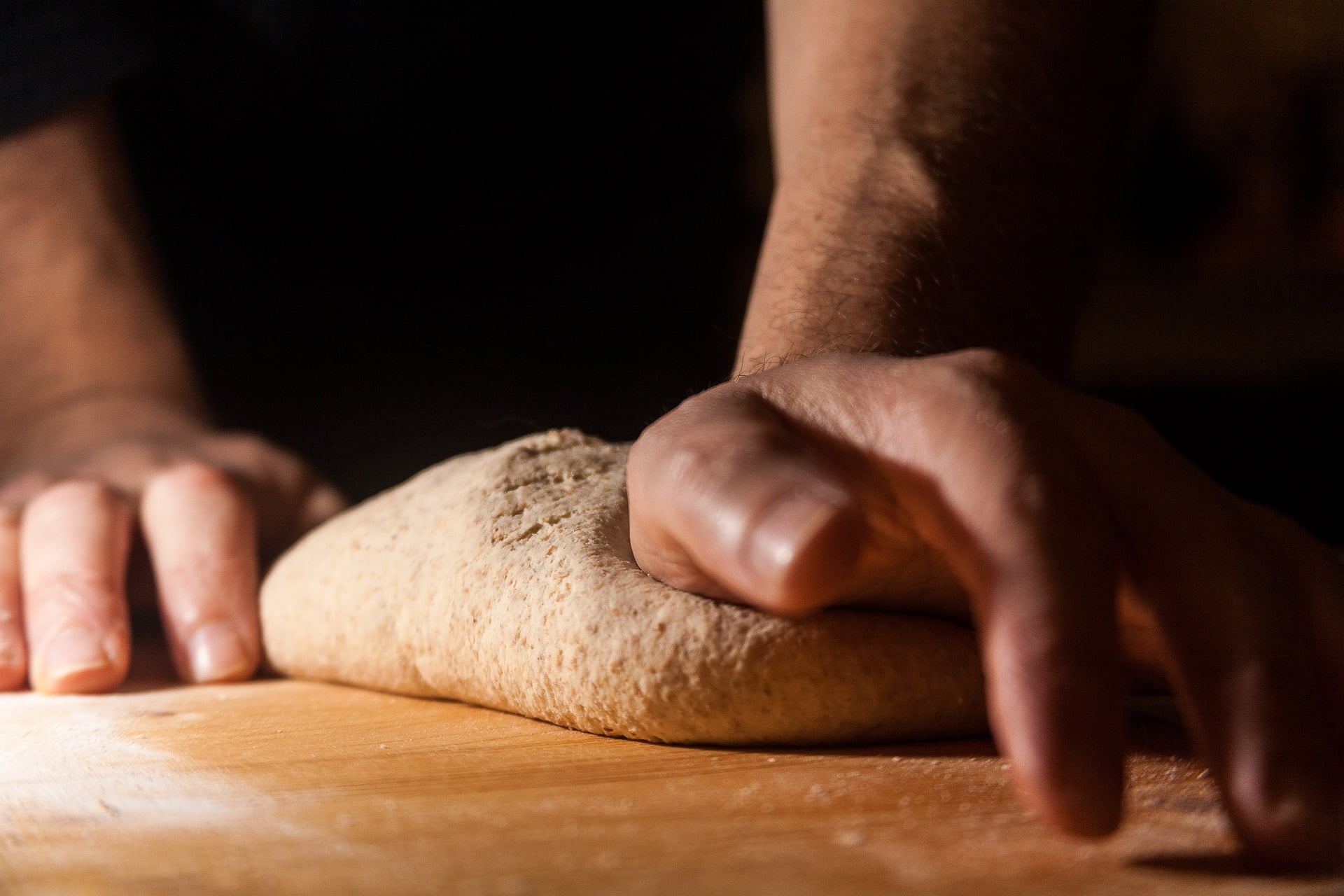
Kneading bread dough is something of an art. The process binds flour, water, salt, and yeast into a network that is both elastic and viscous. It also traps pockets of air that will determine the texture of the final loaf. Underknead and the bubbles won’t form; overknead and the result will be a dense loaf that doesn’t rise in the oven.
Capturing all of that physics in a realistic model is tough, but researchers have done so and validated their digital dough against experiments. The group focused on simulating industrial mixers, which knead dough with a moving, spiral-shaped rod rotating around a stationary vertical one. They found the industrial set-up did not mix as well as kneading by hand, but that could be improved by swapping the stationary rod for a second spiral one. (Image credit: G. Perricone; research credit: L. Abu-Farah et al.; via Physics World; submitted by Kam-Yung Soh)
Blooming Deposits


Evaporate a droplet full of silica nanoparticles, and you’ll get beautiful, flower-like films. As the water evaporates, dry nanoparticles build up in a solid deposit. The evaporation creates a pressure gradient that pulls toward the center of the drop, forcing the deposit to bend. As stress builds in the deposit, cracks form petal-like segments. The number of cracks is indicative of how much of the drop was solid material; the higher the volume fraction of particles is, the fewer cracks form and the less the deposit bends. (Image, video, and research credit: P. Lilin et al.)

Creating Star Wars-Like Volumetric Displays


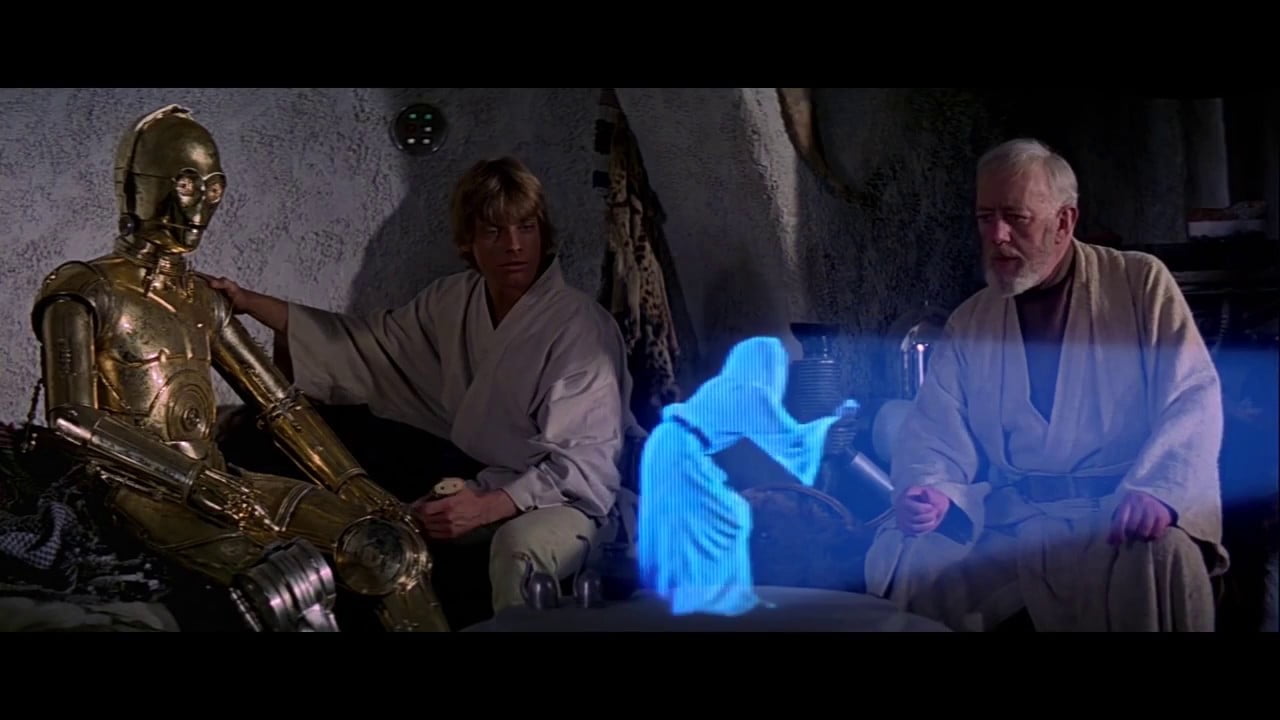
Despite their ubiquity in science fiction, volumetric displays — three-dimensional displays visible from any angle — have been tough to create in real life. But a team from the University of Sussex has made impressive strides using a system based on acoustic levitation.
Here’s how it works: an array of ultrasonic speakers levitates and moves small plastic beads at up to 9 m/s. Simultaneously, LED lights project colors onto the sphere. Thanks to the human brain’s ability to create persistent images from the motion, we’re able to see simple displays like the figure-8 and smiley face above with the naked eye. To form something more complicated, like the spinning globe seen in the final image, the bead must be filmed using a camera with a slow shutter speed. But with that, the display looks incredible.
There’s obviously a ways to go before your R2 unit can project holographic messages for you, but all the basic ingredients for that technology are here. Check out the coverage on Scientific American and the original research paper for more. (Image credit: Star Wars – Lucasfilm; others – E. Jankauskis; research credit: R. Hirayama et al.; via SciAm)

“Ornitographies”


If birds left trails in the sky, what would they look like? This is the question that haunted photographer Xavi Bou and inspired him to create his “Ornitographies” series. Using video of birds in flight, he combines frames to construct these snapshots of flight. In them, birds become streaklines feathered with wingbeats.
I love how the technique highlights the patterns of flapping flight. A bird flying steadily over a lake becomes a wavy line with consistent, perfectly matched up- and downstrokes, whereas a bird just taking off has short, fast wingbeats that slowly lengthen and steady out as the bird gets aloft. Flocks of birds turn into a tornado of swirling lines as they land or take-off en mass. (Image credit: X. Bou; via Flow Vis)

Martian Landslides
Sometimes there are advantages to studying planetary physics beyond Earth. Mars does not have plate tectonics, vegetation, or the level of erosion we do, allowing geological features like those left behind by landslides to persist undisturbed for millions of years. And, thanks to a suite of orbiters, we’ve mapped most of Mars at a resolution better than many parts of our own planet. All together, this gives researchers a treasure trove of geological data from our nearest neighbor.
One peculiar feature of many landslides is their long runout. Even over relatively flat ground, some landslides cover extreme distances from their point of origin. On Earth, we often see this behavior near glaciers, so scientists theorized that the presence of ice was somehow necessary for the landslide to cover such a long distance. But previous laboratory experiments with dry, ice-free grains showed the same behavior: long runouts marked with ridges running parallel to the flow. The mechanism behind the ridges is still somewhat unclear, but it seems to be connected to fluid dynamical instabilities that form between fast-flowing particles of differing density. But such results have been confined to lab-scale experiments and numerical simulations.
A new report, however, shows that landslides on Mars share the same characteristic spacing and thickness between their ridges. This evidence suggests that the same ice-free mechanism could account for the long run-out of landslides on Mars and other planets. (Image credit: NASA/JPL-Caltech/University of Arizona; research credit: G. Magnarini et al.; via The Conversation; submitted by Kam-Yung Soh)