Tag: propulsion

  • Ferrofluid Thrusters

    Ferrofluid Thrusters

    Ferrofluids–magnetically-sensitive fluids made up of a carrier liquid and ferrous nanoparticles–may soon have a new application as a miniature thruster on nanosatellites. Microspray thrusters use tiny hollow needles to electrically spray jets of liquid that propel a satellite. But manufacturing the fragile microscopic needles used to disperse the propellant is expensive. Instead researchers are now using ferrofluids to create both the needle-like structures and to serve as the propellant. A ring of ferrofluid is placed on the thruster surface and a magnetic field applied to create the ferrofluid’s distinctive spikes. Then, when an electric force is applied, tiny jets of ferrofluid spray out from each tip, creating thrust. Unlike the conventional needles, the ferrofluid spikes are robust and can reform after being disturbed. (Photo credit: L. B. King et al.; submitted by jshoer)

  • Featured Video Play Icon

    How Scramjets Work

    The scramjet–supersonic combustion ramjet–engine has been a holy grail of aerospace engineering for 50 years. It is an air-breathing engine with no moving parts capable of propelling crafts at hypersonic speeds beyond Mach 5. As indicated in the name, combustion in the scramjet occurs at supersonic speeds, where the heating due to air compression is sufficient to ignite fuel when injected into the engine. At present the record for the highest speed attained in scramjet flight is held by the NASA X-43A, which reached Mach 9.8 in 2004 after about 10 seconds of scramjet free-flight. The longest scramjet flight belongs to the Boeing X-51 Waverider with 140 seconds of burn time in a 2010 test flight. Few tests of these experimental hypersonic crafts have been completely successful; they represent the frontier of aerospace technology.

  • Featured Video Play Icon

    Godspeed, Discovery!

    The space shuttle, despite three decades of service, remains a triumph of engineering. Although it is nominally a space vehicle, fluid dynamics are vital throughout its operation. From the combustion in the engine to the overexpansion of the exhaust gases; from the turbulent plume of the shuttle’s wake to the life support and waste management systems on orbit, fluid mechanics cannot be escaped. Countless simulations and experiments have helped determine the forces, temperatures, and flight profiles for the vehicle during ascent and re-entry. Experiments have flown as payloads and hundreds of astronauts have “performed experiments in fluid mechanics” in microgravity. Since STS-114, flow transition experiments have even been mounted on the orbiter wing. The effort and love put into making these machines fly is staggering, but all things end. Godspeed to Discovery and her crew on this, her final mission!

  • The Roaming Rocks of Death Valley

    The Roaming Rocks of Death Valley

    The dry lake beds of Death Valley National Park in California are home to a perplexing phenomenon: roaming rocks. These rocks, some of which weigh hundreds of pounds, leave long furrows in the dirt but have no obvious means of propulsion. One theory posits that the rocks glide on collars of ice around their base. The ice acts like a flotation device when rain wets the valley and then the rocks slide so easily that high winds can move them across the surface. #

  • Jet-Based Control

    Jet-Based Control

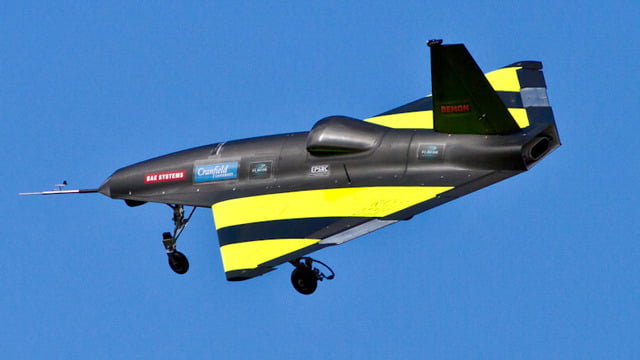
    Researchers have flown the first aircraft designed to maneuver without conventional control surfaces like ailerons and flaps. Instead of changing the wing geometry to alter the lift on different parts of the craft, the UAV uses strategically placed jets of air along the wing to control its flight. The plane can also alter the direction of its thrust, not by turning the nozzle as is conventionally done, but by modifying the thrust vector by directing and firing a secondary jet into the exhaust. #