Tag: propulsion

  • On Dolphin Turbulence

    On Dolphin Turbulence

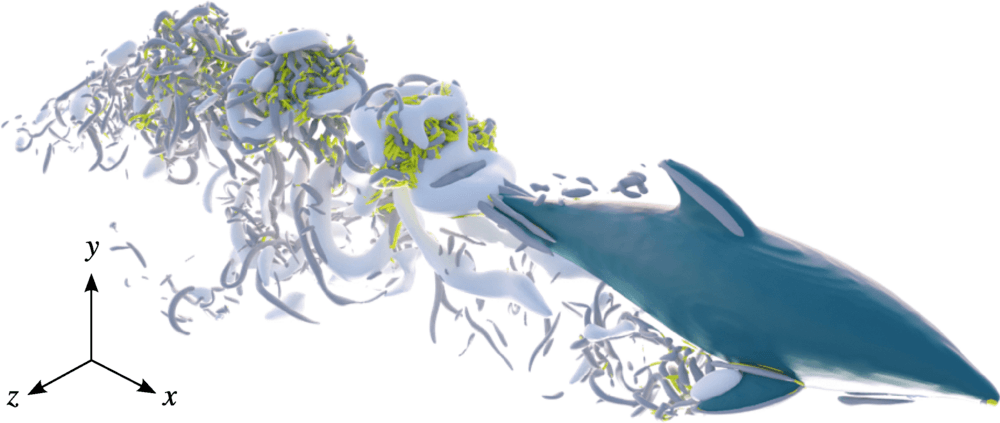
    Dolphins are such fast and agile swimmers that, naturally, scientists have long wanted to understand how they swim so well. A recent study draws on numerical simulation to analyze the flow a dolphin creates when flapping its tail.

    The resulting flow is highly turbulent–researchers were only able to simulate up to a fraction of a dolphin’s actual Reynolds number–with both large-scale vortices and a cascade of smaller ones. The largest vortices, shown here in white, form on the upper and lower surface of the dolphin’s tail, then slide off the tail in a vortex ring. It’s these vortex rings, the researchers found, that provide the bulk of a dolphin’s thrust.

    The smaller-scale vortices, in contrast, get formed by the large vortices, and they make little to no contribution to the dolphin’s propulsion. Interestingly, these results suggest that we might be able to describe the propulsion of dolphins and other highly turbulent swimmers by focusing only on the largest scales in the flow. (Video, image, and research credit: Y. Motoori et al.; via Ars Technica)


    Animation of the simulated flow from a swimming dolphin.
    Animation of the simulated flow from a swimming dolphin.
    Fediverse Reactions
  • Flettner Rotors Spin Anew

    Flettner Rotors Spin Anew

    In the 1920s, the world saw a new sort of marine propulsion, ships with one or more tall, smokeless cylinders. These Flettner rotors, named for their inventor, would spin in the wind, generating lift to propel the boat, much as a sail would. (The difference is that the rotor uses the Magnus effect.)

    The market crash that kicked off the Great Depression spelled an end to the rotorship, but the idea is getting revived as industries search for greener forms of ship propulsion. Although the Flettner rotor still uses fuel (to spin the rotor), it can complete a voyage on only a small fraction of the fuel needed for conventional propulsion. (Image credit: Getty Images; via PopSci)

    Fediverse Reactions
  • Paris 2024: Coordinating the Front-Crawl

    Paris 2024: Coordinating the Front-Crawl

    Of all the swimming strokes humans have invented, none is faster or more efficient than the front-crawl. That’s why all competitors use it in freestyle events, and why it’s the only stroke that appears in races longer than 200 meters. But elite swimmers don’t perform the front-crawl the same way in a sprint as they do in a longer race. Instead, researchers found that swimmers use three different regimes of arm coordination.

    For long-distance races, elite swimmers adopt a stroke that has only one arm in the water at a time. Each stroke is followed by a glide phase with one arm stretched in front of them. Researchers compared this to the burst-and-coast method that fish use to minimize the energy they use. As a swimmer’s speed increases, they shorten the glide phase and begin to maximize the force produced with each propulsive stroke.

    In the third regime — the fastest one used by elite sprinters — the strokes of a swimmer’s arms are superposed, with both arms engaged in propulsion at the same time during parts of the cycle. This mode maximizes propulsive force but requires a lot of energy, so swimmers can only sustain it for a short while.

    Since researchers built their observations into a physical model that explains how and why elite swimmers do this, the model can actually be used to advise individual swimmers on how they can adapt their stroke based on their size, desired speed, and other physical characteristics. (Image credit: J. Chng; research credit: R. Carmigniani et al.)

    Related topics: More on swimming physics including why swimmers are faster underwater and how to design faster pools.

    Find all of our current and past Olympics coverage here.

  • Featured Video Play Icon

    Backswimmers

    Backswimmers rule the surface of ponds, streams, and other bodies of water. These insects spend much of their time clinging just beneath the air-water interface, where they hunt larvae and other insects. They use oversized, oar-shaped back legs to row, and they breathe using an air bubble that clings to their abdomen like a personal scuba tank. Oxygen from the water diffuses into the bubble, keeping the insect’s air supply fresh. When the time comes to move to greener pastures, they flip to the other side of the water’s surface, unfurl their wings, and take off. (Image and video credit: Deep Look)

  • Featured Video Play Icon

    Pop-Pop Boats

    I confess I’ve never heard of the pop-pop boat toys Steve Mould uses in this video. They feature a tank filled with water and a small source of heat in the form of a tea light candle. Together, these features generate propulsion and a distinctive popping sound from the toy. As he is wont to, Mould explains the physics behind the toy using a transparent version to show the water/steam oscillations that drive the boat. Having watched, I have to say that this set-up seems ready made for an undergrad fluids class and a control volume analysis! (Image and video credit: S. Mould)

  • Featured Video Play Icon

    Coke and Butane Rockets

    Rocket science has a reputation for being an incredibly difficult subject. But while there’s complexity in the execution, the concept behind rockets is pretty simple: throw mass out the back really fast and you’ll move forward. Whether you’re talking about a Saturn V or these Coke-and-butane-powered bottles, the basic principle is the same.

    These rockets get their kick mostly from the added butane, which has a very low boiling point. When the bottle is flipped, the lighter butane is forced to rise through the Coke. With a large surface area of liquid butane exposed to the warmer Coke, the butane becomes gaseous. That sudden increase in volume forces a liquid-Coke-and-gaseous-butane mixture out of the bottle, which has a helpful nozzle shape to further increase the propellant’s speed. Once the phase change is underway, the rocket quickly takes off! (Image and video credit: The Slow Mo Guys)

  • Nautilus Swimming

    Nautilus Swimming

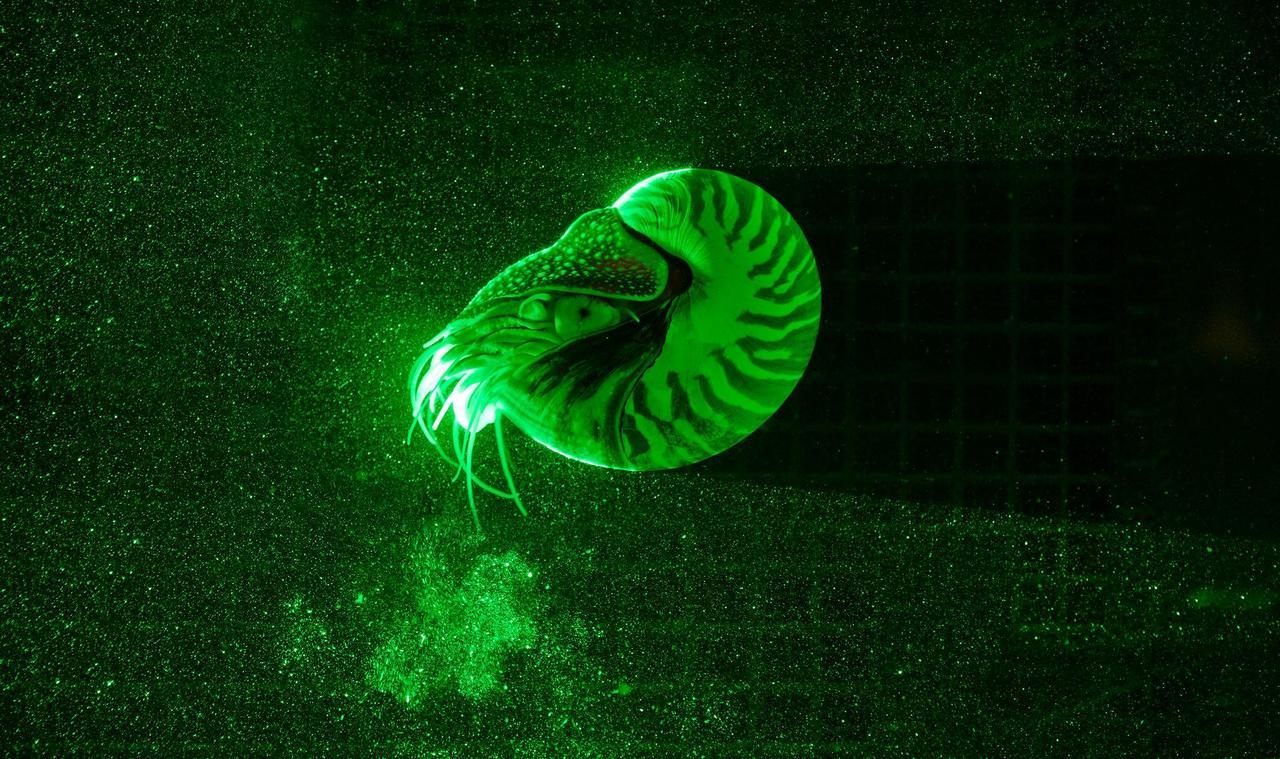
    The shellbound chambered nautilus is a champion of underwater jet propulsion. It can eke out efficiencies as high as 75%, far outclassing other jet-based swimmers like squid, salps, and jellyfish. That high efficiency is especially important for the nautilus, which spends a great deal of time at depths where the oxygen needed to fuel movement is in short supply. To get around, the nautilus draws water in through an enlarged orifice, then squirts it out little by little. Its this asymmetry between drawing in and expending that keeps efficiency high. By releasing a jet slower and at lower speeds, the nautilus is able to reduce wasteful losses to friction and thereby keep the efficiency high. The drawback is that the nautilus swims relatively slowly at an average of around 8 centimeters–less than one body length–per second. (Image credit: Simon and Simon Photography/University of Leeds; research credit: T. Neil and G. Askew; via NYTimes; submitted by Kam-Yung Soh)

  • Featured Video Play Icon

    Living Fluid Dynamics

    This short film for the 2016 Gallery of Fluid Motion features Montana State University students experiencing fluid dynamics in the classroom and in their daily lives. As in her previous film (which we deconstructed), Shanon Reckinger aims to illustrate some of our everyday interactions with fluids. This time identifying individual phenomena is left as an exercise for the viewer, but there are hints hidden in the classroom scenes. How many can you catch? I’ve labeled some of the ones I noticed in the tags. (Video credit: S. Reckinger et al.)

  • These Invertibrates May Help Robots Swim

    These Invertibrates May Help Robots Swim

    New FYFD video! Learn all about salps, vortex rings, and underwater robots. Thanasi Athanassiadis takes me inside his lab and his newly published research into how proximity affects the thrust two vortex rings can produce.

    There are a ton of little things I love about how this video came out, especially the chalkboard animations. Check it the full video below and click through to the video description for lots more information about salps and vortex rings.

    (Image and video credits: N. Sharp and A. Athanassiadis; Original salp images: A. Migotto and D. Altherr)

  • Surface-Tension Supported Walkers

    Surface-Tension Supported Walkers

    Nature’s smallest water-walkers use surface tension to keep themselves afloat. This includes hundreds of species of invertebrates like insects and spiders as well as the occasional extremely tiny vertebrate, like the 2-4 cm long pygmy gecko shown above. These animals typically have very thin parts of themselves touching the water – like the spindly legs of the water strider. These skinny appendages curve the air-water interface and that curvature, along with the water’s surface tension, generates the force supporting the animal.

    Staying afloat on surface tension does little good if a raindrop or passing splash submerges these tiny water-walkers. To avoid that fate, these animals are also hydrophobic or water repellent. This adaptation keeps them from drowning and helps them enhance the curvature where their feet meet the water.

    Those tiny indentations can also be important for the animal’s propulsion. Water striders, for example, use their long middle legs like oars to propel themselves. Any rower will tell you that sticks make poor paddles – they’re just not good at transferring momentum to the water. But curving the surface and then pushing off that curvature works remarkably well. It’s how the water strider creates the vortices in its wake in the image above.

    For more on water strider propulsion, I recommend this Science Friday video. If you’d like to see the gecko in action, check out BBC Life’s “Reptiles and Amphibians” episode, which is available on Netflix in the U.S. (Image credits: pygmy gecko, BBC; water strider, J. Bush et al.)

    This week FYFD is exploring the physics of walking on water, all leading up to a special webcast on March 5th with guests from The Splash Lab. You don’t want to miss it!