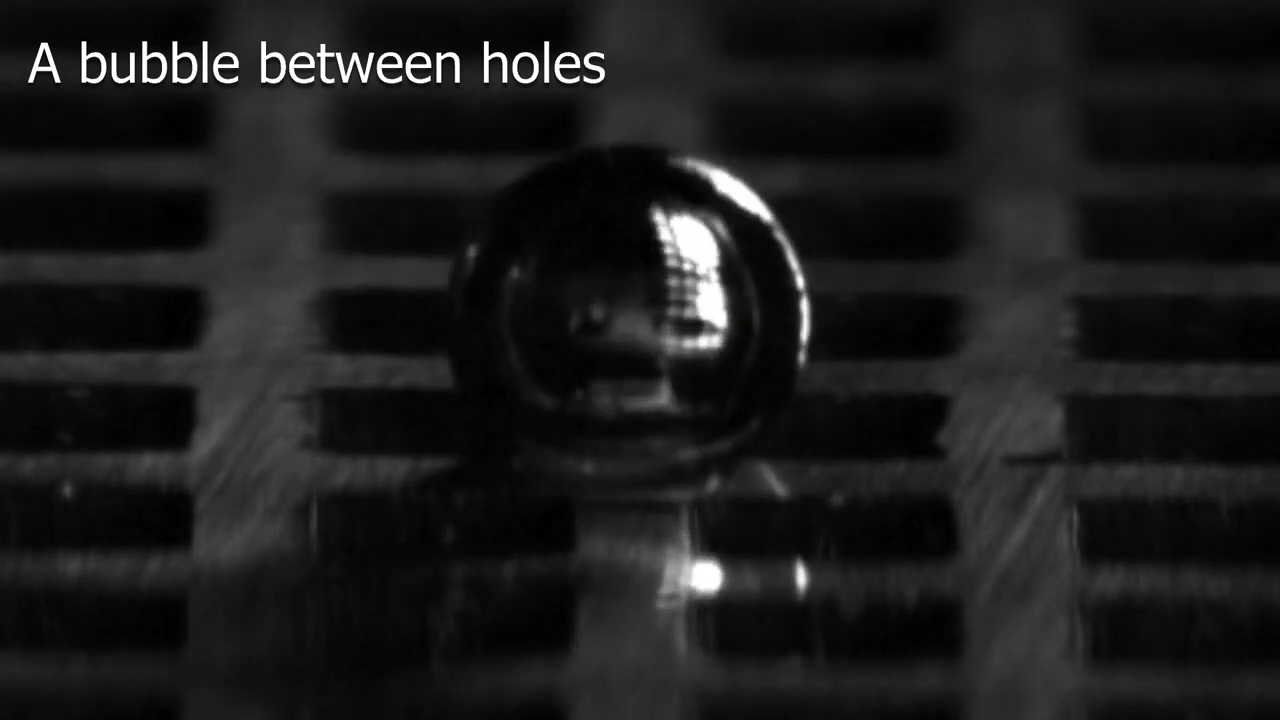
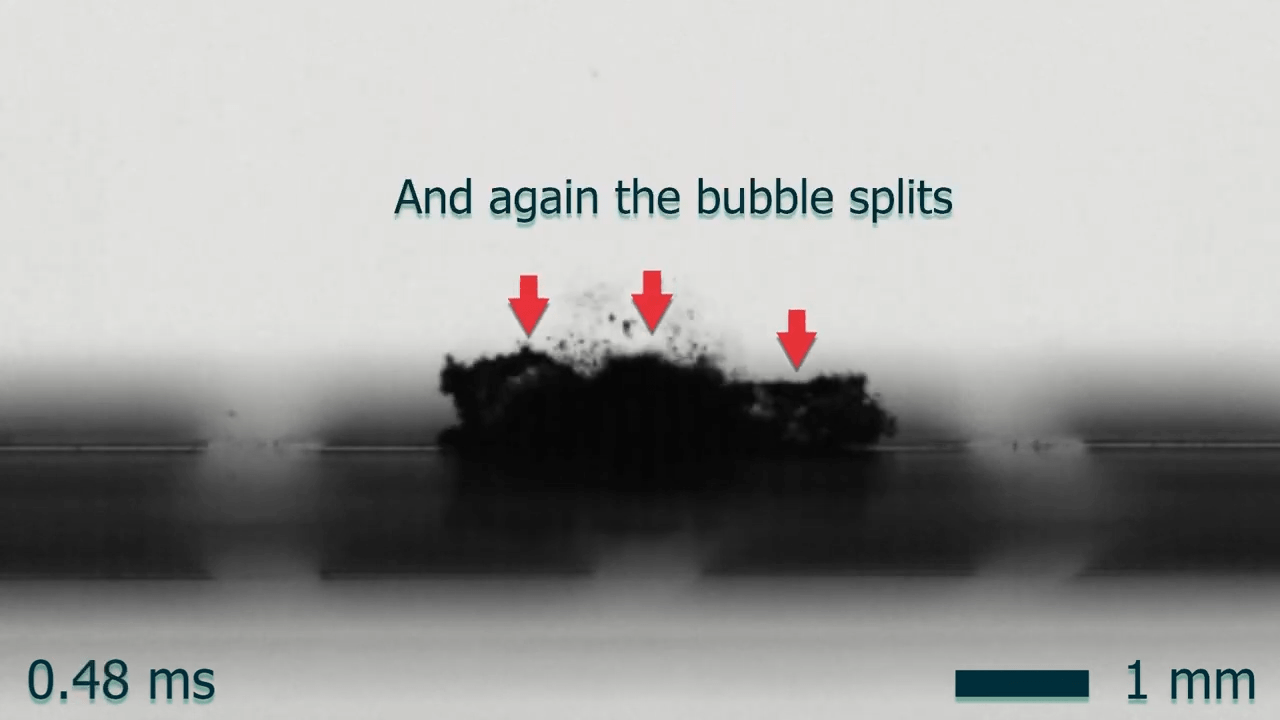
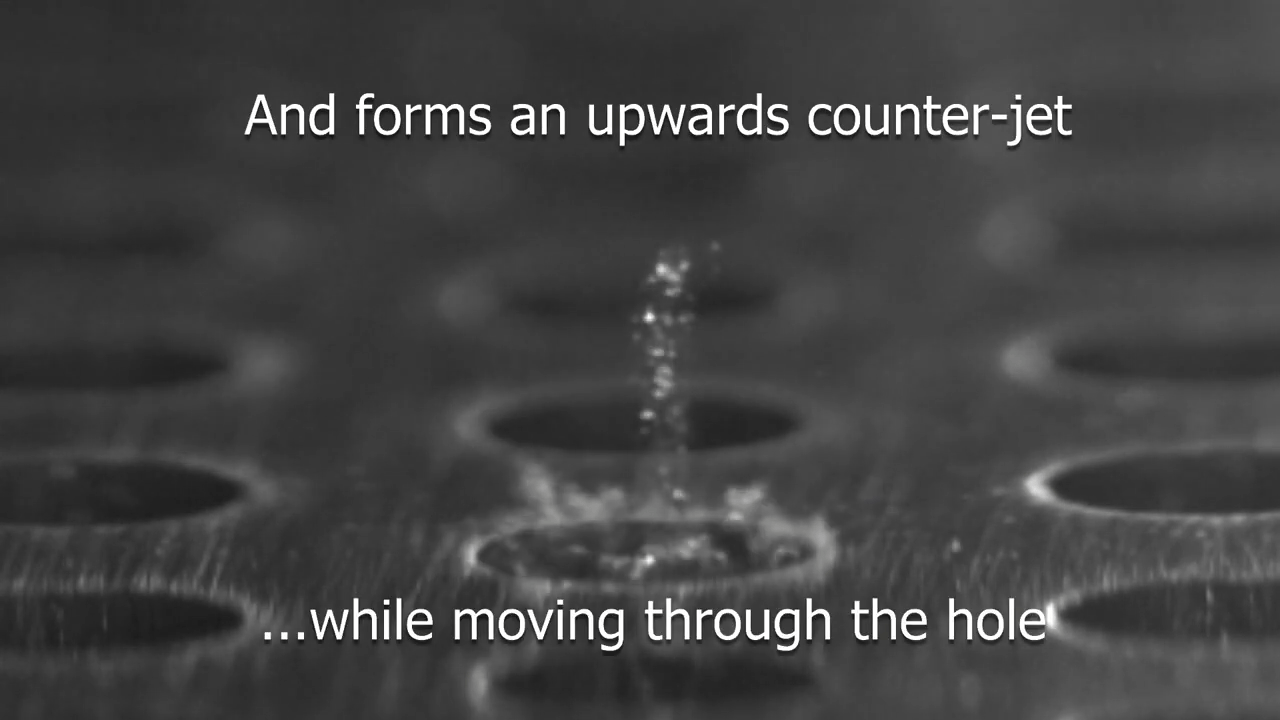
Cavitation bubbles live short, violent lives. Triggered here with a laser, these bubbles rapidly expand and then collapse, sending out shock waves. In this video, researchers explore how bubbles collapse when they’re near a plate with holes in it. For bubbles sitting between holes, collapse becomes asymmetric, eventually splitting the bubble into two as it falls in on itself. Bubbles centered over a hole perform a disappearing act, sucking themselves down into the hole during collapse. (Image and video credit: E. Andrews et al.)
In his recent short film, artist Roman De Giuli explores turbulence using metallic paints and inks in a fishtank. The effects are beautiful: sparkling pigments dispersing in clouds, mushroom- and umbrella-shaped Rayleigh-Taylor instabilities, and lots of swirling eddies. It’s exactly the kind of eyecandy to kick off your weekend with! (Image and video credit: R. De Giuli)
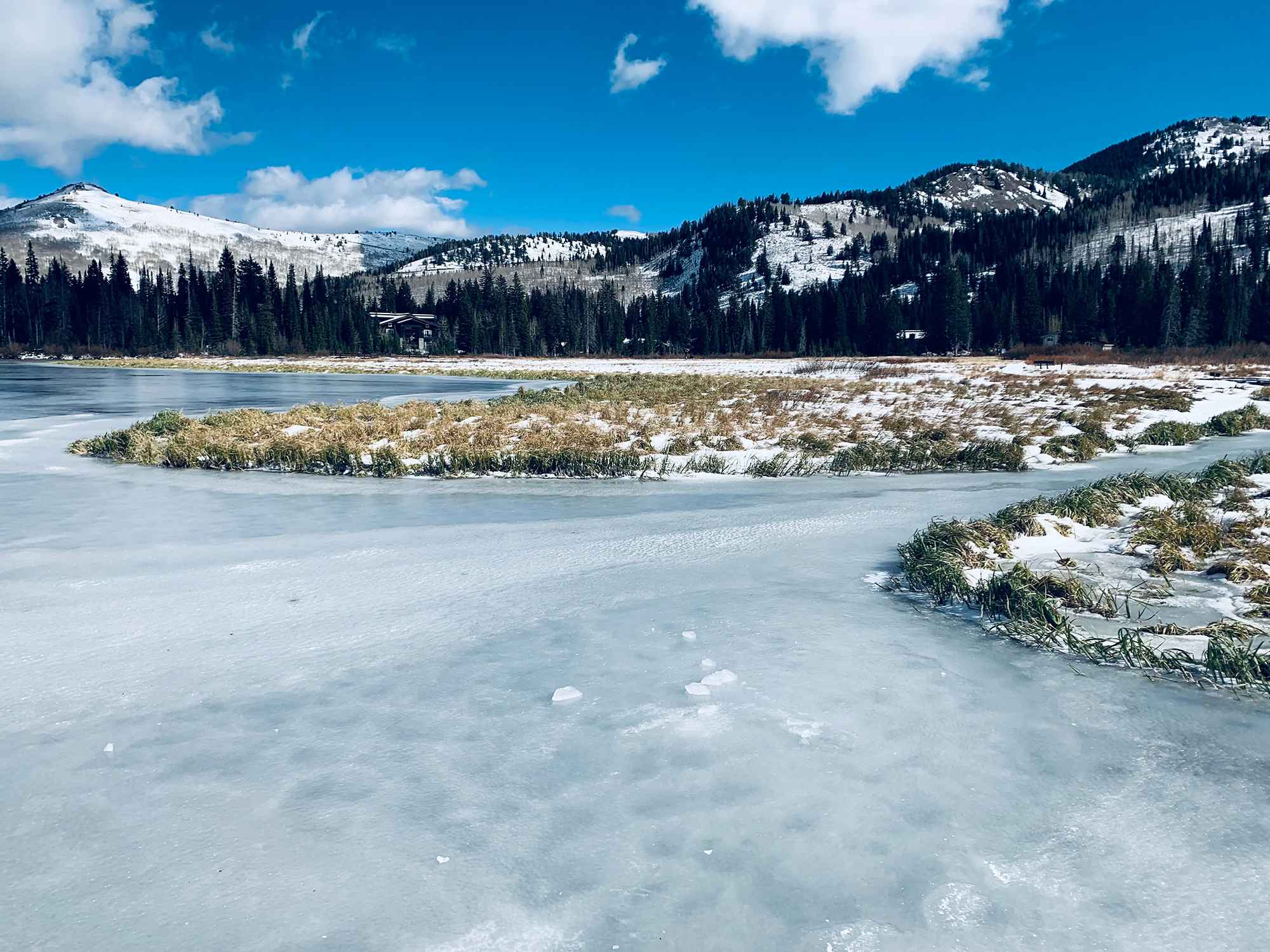
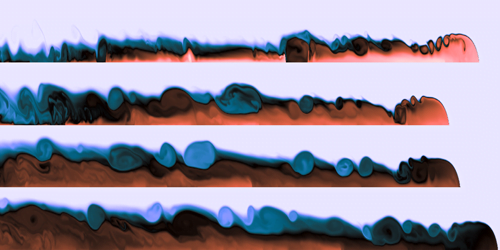
A frozen winter lake can hide surprisingly complex flows beneath its placid surface. Since water is densest at 4 degrees Celsius — just above the freezing point — mixing two water sources can lead to counterintuitive effects. A cold lake, for example, may contain water below 4 degrees Celsius, while a stream running into the lake is a bit warmer than 4 degrees Celsius. When the two parcels of water meet, they mix to form water at an intermediate temperature. But because of water’s density anomaly, that mixed water can wind up denser than the average of its parents. This is known as cabbeling.
Mixing patterns within a cold lake with a slightly warmer inflow. Image from A. Grace et al.
As shown in a recent study, this newly mixed water sinks to the bottom of the lake, forming a warm current that heats the lake from below. The researchers were able to model this current and its behavior over a range of conditions. Understanding these winter circulation patterns is key to tracking both nutrient transport and how pollutants spread in the ecosystem. (Image credit: lake – G. Murry, simulation – A. Grace et al.; research credit: A. Grace et al.; via APS Physics)
Though we rarely notice it, our sky is always aglow. Washed in solar radiation, the oxygen and nitrogen molecules at high altitude get broken apart during the daytime and recombine at night, producing a luminescent glow that forms a uniform backdrop against the sky. In this image, the airglow forms a bull’s-eye-like set of rings, thanks to atmospheric gravity waves left behind by a thunderstorm. (Image credit: J. Dai; via APOD)
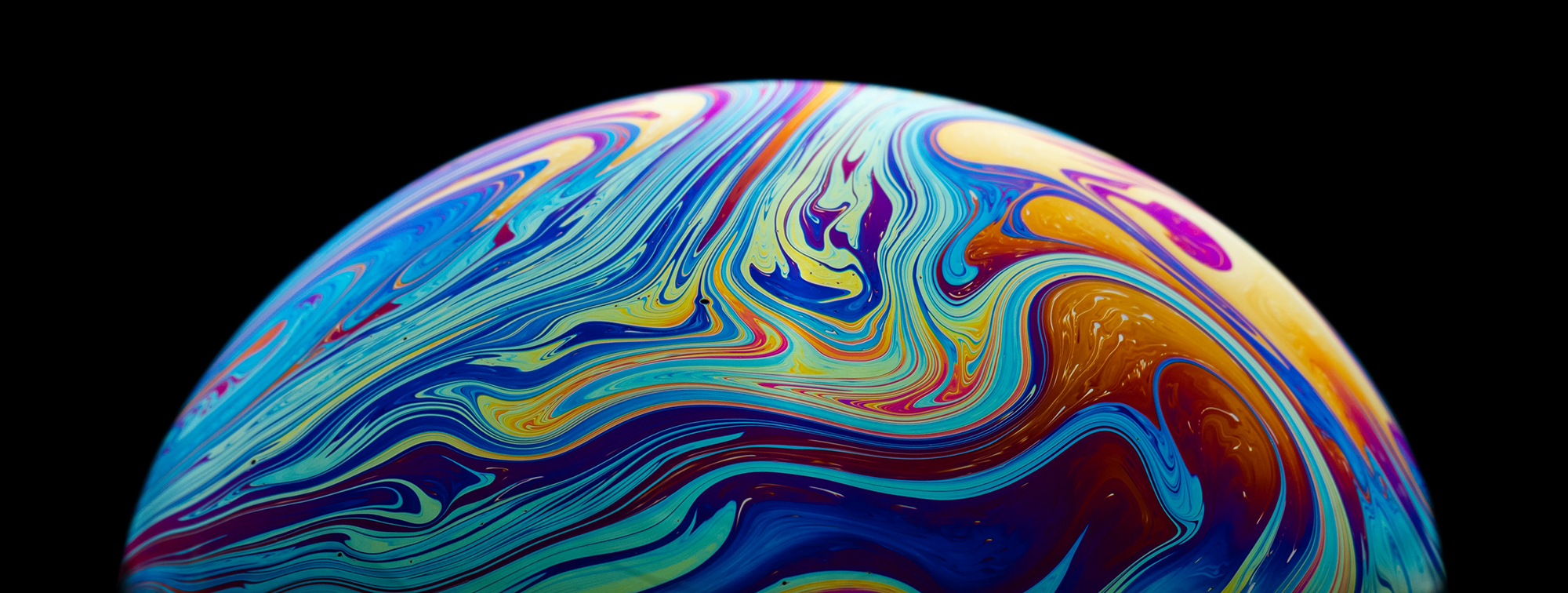
Evaporation is a well-known effect in soap films and bubbles. It’s responsible for the ever-changing thickness reflected in the film’s many colors. But evaporation does more than change the bubble’s thickness: it affects its temperature, too. Just as sweat evaporating off our skin cools us, the soap film’s evaporation makes it cooler than the surrounding air.
Researchers found that their soap films could be as much as 8 degrees Celsius cooler than the surrounding air! They also found that the film’s glycerol content affect how much cooler the soap film is; films with more glycerol had higher temperatures, which could impact their overall stability. (Image credit: E. Škof; research credit: F. Boulogne et al.; via APS Physics)
When a partially-air-filled drop hits a surface, it splashes and rebounds in a complex fashion. This video breaks down the physics of the process. Upon impact, a lamella spreads, eventually becoming wavy and unstable along its rim. At the same time, a counterjet forms, growing until it pierces the remaining bubble of the drop. The jet continues to stretch upward due to its momentum, pinching off and forming wobbly satellite drops that finally fall back to the surface. (Image and video credit: D. Naidu and S. Dash)
Many theories posit the physical and chemical origins of life. In the short film “aBiogenesis”, CGI artist Markos Kay imagines one such theory — the lipid world theory — in which cellular life began as a soup contained within immiscible fatty membranes. Chemicals trapped within these vesicles interacted and ultimately formed the building blocks of life as we know it, including RNA. Kay’s interpretation is a beautiful exploration of this intersection of physics, chemistry, and biology. (Image and video credit: M. Kay; via Colossal)
A lucky encounter led the Perseverance rover to record the first-ever sound of a dust devil on Mars. The rover happened to have its microphone on (something that only happens a few minutes every month) just as a dust devil swept directly over the rover. Check out the video above to see and hear what Perseverance captured.
Using the rover’s instrumentation, researchers worked out that the dust devil was at least 118 meters tall and about 25 meters wide. The team was even able to determine the density of dust in the vortex from the sound of individual grain impacts captured in the acoustic signal! Serendipitous as the experience was, planetary scientists may now look to include microphones on more missions, since we now know how to get useful meteorological data from them. (Video credit: JPL-Caltech/NASA; image credit: LPL/NASA; research credit: N. Murdoch et al.; via AGU Eos; submitted by Kam-Yung Soh)
Physicist Silke Weinfurtner studies fluids, not for themselves, but for what they can teach us about black holes, cosmic inflation, and quantum gravity. Black holes are notoriously difficult to study directly, but, mathematically speaking, it’s possible to set up a fluid system that behaves in the same way a black hole does. The result is a bathtub-like arrangement with a central vortex, seen above. And within this “bathtub,” Weinfurtner and her colleagues can directly measure sound waves equivalent to Hawking radiation, the theoretical means by which black holes emit heat. Learn more about these analogue gravity experiments in her interview over at Quanta Magazine. (Image credit: P. Ammon; via Quanta Magazine; submitted by clogwog)
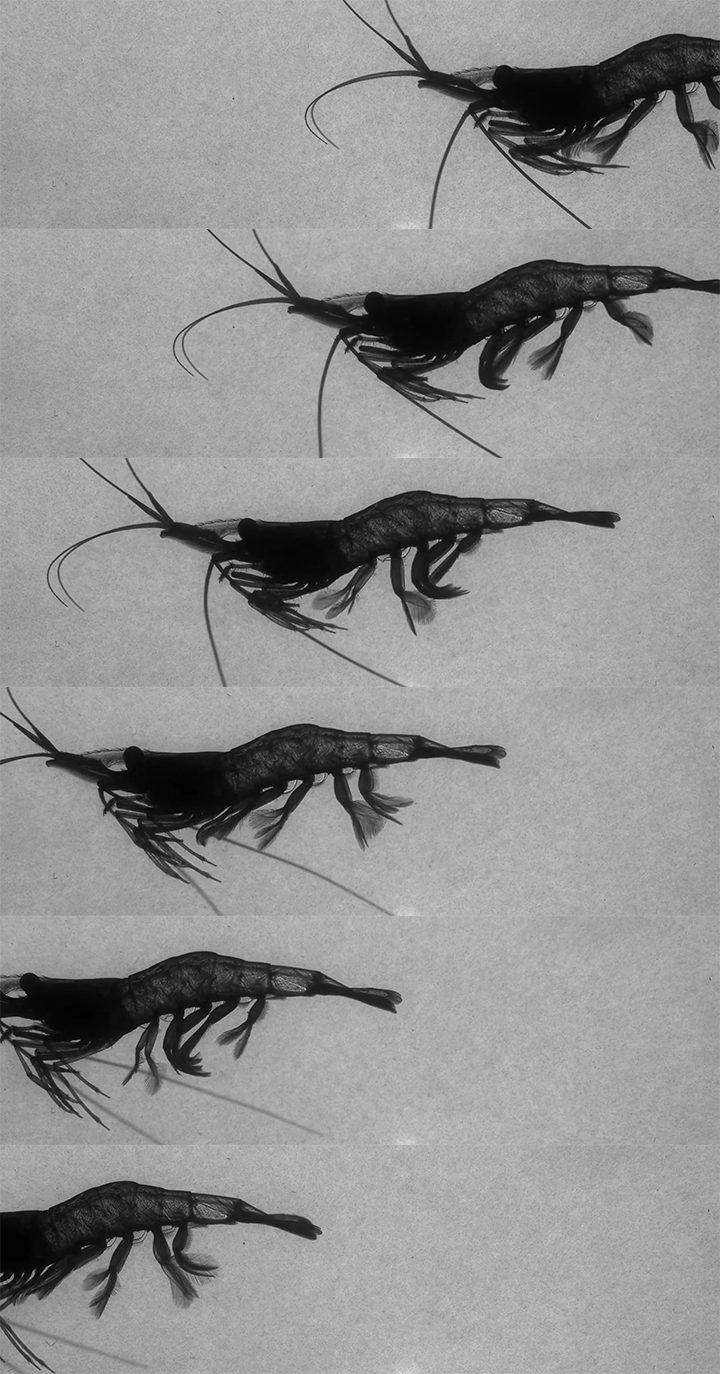
Marsh grass shrimp, despite their small size, are zippy swimmers. They move using a series of closely-spaced legs that stroke asynchronously. Researchers found that the flexibility and stiffness of the legs are critical for the shrimp’s efficiency. During the power stroke, the shrimp’s leg is held stiff, maximizing the force it’s able to transfer to the water. But during the forward-moving recovery stroke, the shrimp bends its legs almost horizontal and presses both legs in the pair together tightly. This action minimizes the area of the leg pair and reduces the drag they cause as they move into position for the next stroke. (Image, video, and research credit: N. Tack et al.; via Ars Technica; submitted by Kam-Yung Soh)