Tag: physics

  • Featured Video Play Icon

    The Polar Vortex

    Every year or two, the Northern Hemisphere gets treated to a bout of intensely cold temperatures thanks to the polar vortex. What you may not realize, though, is that it’s not the polar vortex that causes this cold weather – it’s the vortex breaking down. As Simon Clark explains in this video, the polar vortices (one at each pole) are intense and powerful regions of circulation in the stratosphere, or mid-atmosphere. They’re largely responsible for keeping cold air trapped in the Arctic and Antarctic. But occasionally, this region of the atmosphere will suddenly get warmer – to the tune of increasing by 80 degrees Celsius in less than a week! When this happens, a polar vortex will deform and potentially even split into smaller vortices, as seen below. When this happens, the vortex loses its hold on the cold air near the surface, allowing Arctic air to sneak as far south as Texas. After a couple of weeks of affecting our weather, the polar vortex will typically reform and we’ll return to normal. In the meantime, stay warm! (Video and image credit: S. Clark; submitted by Nikhilesh T.)

  • Featured Video Play Icon

    Dripping Down the Rivulet

    If you’ve ever watched water running down the side of the street, you’ve probably noticed that it doesn’t flow smoothly. Instead, you’ll see waves, rivulets, and disturbances that form. That’s because the simple action of flowing down an incline is unstable. Water and other viscous liquids can’t flow downhill smoothly. Any disturbances – an uneven surface, the rumble of passing cars, a pebble in the way – will create a disruption that grows, often until the entire flow is affected. This video shows some of the complex and beautiful patterns you get then. (Video and image credit: G. Lerisson et al.)

  • Enormous Ice Disk

    Enormous Ice Disk

    We’ve seen spinning ice disks before, but this month Westbrook, Maine has developed the largest one I’ve ever seen. A research paper from 2016 indicates that this seemingly alien formation spins due to an oddity of water. Water is at its densest around 4 degrees Celsius, so as the ice of the disk melts in the warmer waters of the river, it sinks. That downward plume sets up a vortex in the water beneath the disk. And as the water spins, it drags the ice with it, causing the disk’s rotation. The warmer the water is, the faster the disk spins. (Image credit: T. Radel/City of Westbrook; research credit: S. Dorbolo et al.; via Gizmodo; submitted by jpshoer)

  • An Inverted Leidenfrost Drop

    An Inverted Leidenfrost Drop

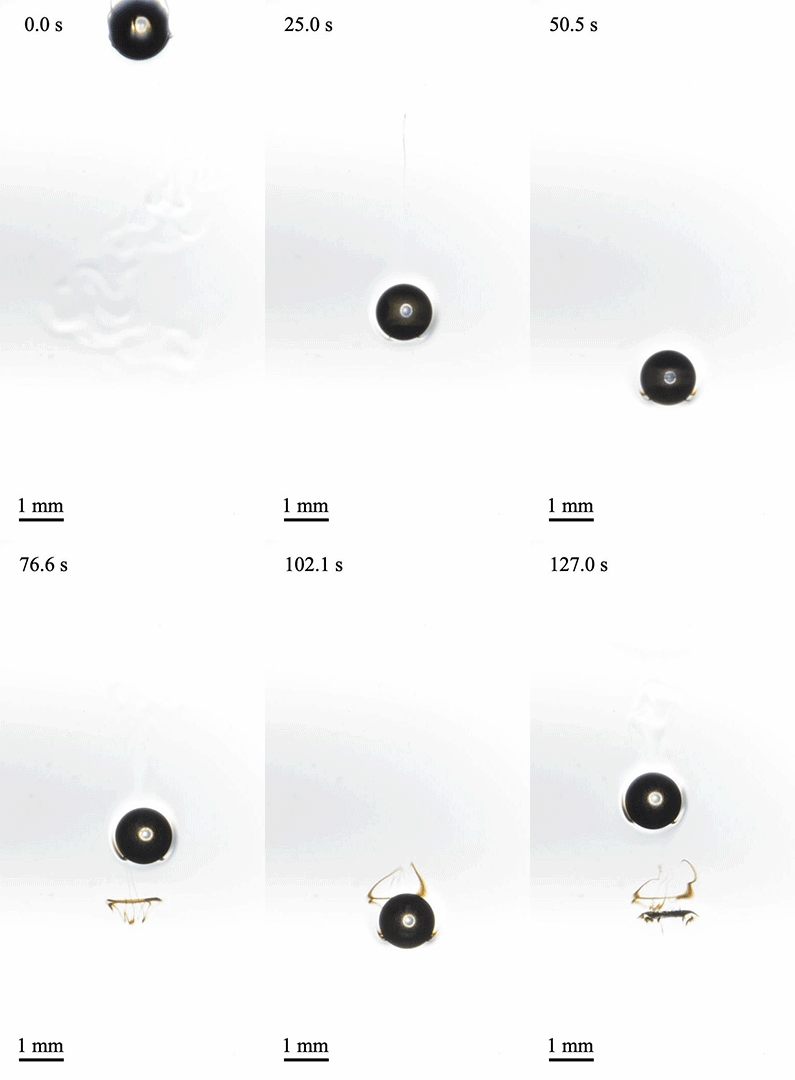
    Leidenfrost drops – liquid drops that levitate on a layer of their own vapor over a hot surface – have been all the rage in recent years. We’ve seen how they can be guided, trapped, and self-propelled. What you see here is a bit different. This is a droplet of room-temperature ethanol deposited on a bath of liquid nitrogen. What levitates the droplet in this case is vaporous nitrogen evaporating from the bath.

    The droplet is quickly cooling down; it freezes after its second or third bounce off the side walls of the beaker. What causes the droplet to self-propel is an asymmetry of the thin vapor layer beneath the droplet. As soon as some instability causes a slight difference in the thickness of the vapor layer, that triggers the propulsion, which the drop maintains even after freezing. (Image and research credit: A. Gauthier et al.)

  • Featured Video Play Icon

    The Boston Molasses Flood

    Today marks the 100th anniversary of the Boston Molasses Flood, and to commemorate this bizarre disaster, I’ve made a video about the key findings from my research with colleagues at Harvard University. Check it out below!

    And, if you’re still hankering to learn more about the Molasses Flood, here are some recent articles and interviews on the subject:

    Boston.com
    – NBC News
    –  New England News Collective
    – Historium Unearthia podcast

     (Video and image credits: N. Sharp)

  • Lava Bomb

    Lava Bomb

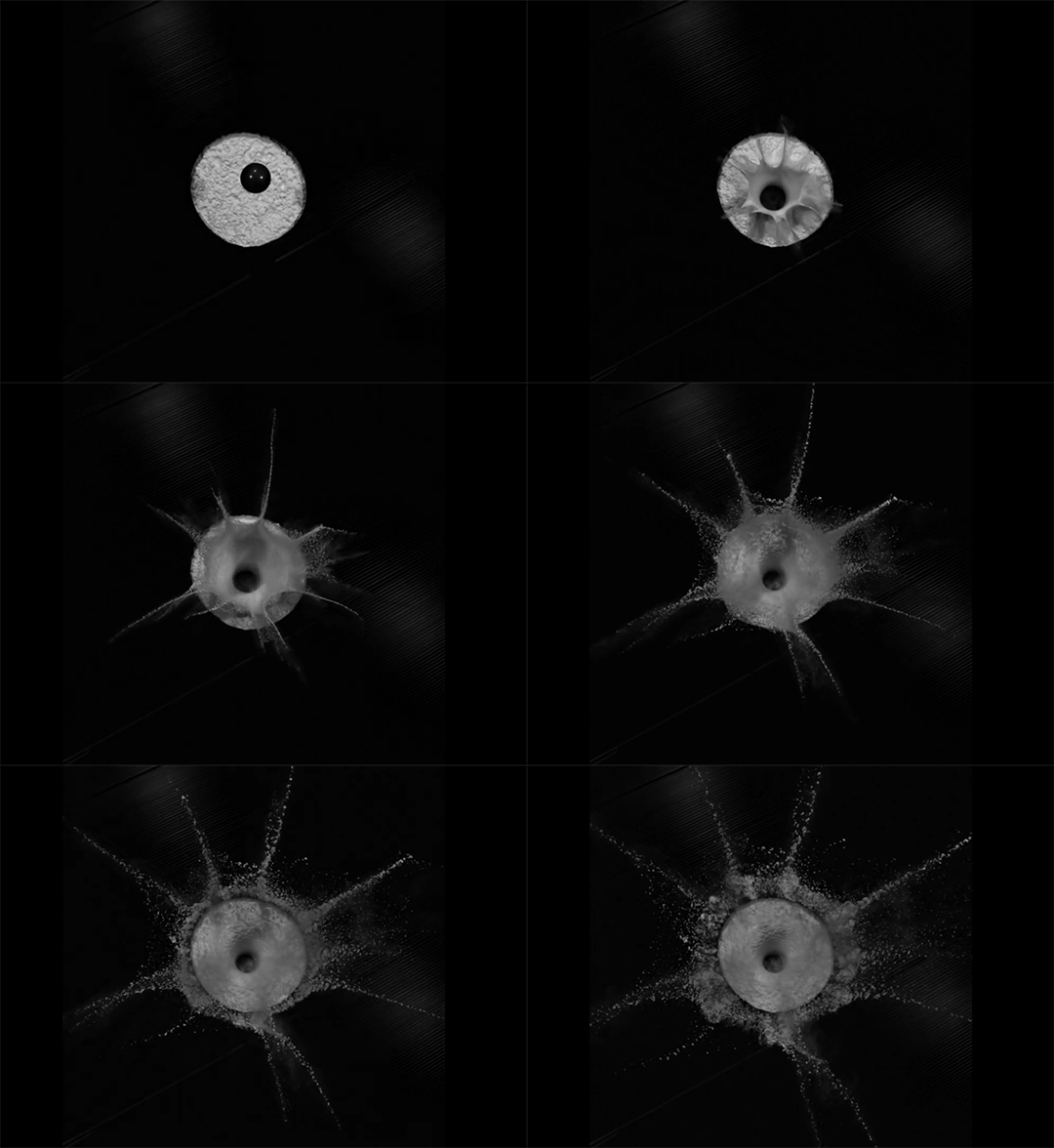
    What you see above is a homemade lava bomb. To systematically study what happens when groundwater meets lava, scientists melted basalt and created their own meter-scale explosion-on-demand. Inside the container, they can inject water and observe the resulting dynamics.

    Beneath the lava, the water forms what scientists call a domain. Thanks to the Leidenfrost effect, it can be protected from direct contact with the lava by a thin vapor layer that boils off it. If the water domain is large enough, buoyancy will pull it upward through the lava. Whether the water maintains a spherical shape or begins to distort and break up into smaller domains depends on the speed of its rise.

    At some point, though, either naturally or through an external trigger (like the sledgehammer you see above), the water and lava can contact, resulting in explosive vaporization of the water and an explosion. What’s visible at the surface depends on the depth at which the explosion takes place. Scientists are eager to characterize these variations, which will help them better predict the explosive danger of eruptions like Kilauea and Eyjafjallajökull. (Image and research credit: I. Sonder et al.; video credit: NYTimes; submitted by Kam-Yung Soh)

  • Featured Video Play Icon

    “The Empire of C”

    Filmmaker Thomas Blanchard has once again released a beautiful, fluid-filled short to captivate us. Built from paint, oil, and liquid soap, “The Empire of C” feels like it gives viewers a birds-eye perspective over a fantastical land. I was particularly drawn to two fluid dynamical aspects of the film. The first were the dendritic sequences in the opening, which feel a bit like watching river deltas form in real time. Despite their resemblance to the Saffman-Taylor instability, I think these fingers are interfacially driven – meaning that they result from differences in surface tension between the different liquids Blanchard is using. 

    The second thing that caught my eye and made me rewind the video over and over were the glittery droplets. The glitter acts like tracer particles, allowing you to see the flow inside the droplets. Check out that counter-circulation compared to the paint flowing by outside! It’s a reminder that even inside a seemingly still droplet, there’s lots going on. (Video and image credit: T. Blanchard)

  • Dip Coating

    Dip Coating

    Imagine dipping a rod into a liquid mixture filled with particles. When you pull the rod out, do particles stick to it? The answer depends on the relative importance of two sets of forces: the viscous drag as you lift the rod and adhesive power of surface tension. Scientists express this as a dimensionless ratio known as the capillary number.

    When the capillary number is small, viscous drag dominates, and any particles that try to stick to the rod get pulled away (upper left). But as you increase the capillary number, surface tension helps particles clump together and stick to the rod (lower left and right). If the surface tension forces are strong enough – meaning that the capillary number is high –  you can actually get multiple layers of particles adhering to the dipped surface. (Image and research credit: E. Dressaire et al.)

  • Water Anoles Breathe Underwater

    Water Anoles Breathe Underwater

    Meet the water anole, a small lizard native to the tropics of Central America. While studying these anoles, researchers discovered that they could flee underwater and remain submerged for 16 minutes or more at a time. Curious to see how the lizard manages this feat, they filmed them underwater, discovering that the anole seems to exhale a small bubble that sticks on its face and then re-inhale it.

    How exactly this built-in “scuba gear” works is still under investigation, but here’s my guess. Fresh oxygen can diffuse from water into a bubble; some insects use this to breathe underwater. The natural, random motion of molecules tends to cause chemicals to move from areas of high concentration to those of low concentration. But this molecular diffusion is extremely slow. That tiny bubble you see isn’t around long enough for any significant molecular diffusion of fresh oxygen. But what if the surface of the bubble is actually much larger?

    Notice the silvery shininess we see on the anole. That’s because most of the lizard isn’t actually wet. The anole is superhydrophobic, so its skin has trapped a thin layer of air that appears to extend over a large part of its body. I think perhaps the anole has fresh oxygen diffusing into the air layer across most of its skin, and the large bubble it inhales and exhales serves as a sort of pump to help draw that fresh oxygen through the air layer and into its body. That could help explain how the anole can stay submerged for so long.

    As researchers continue to investigate this little aquanaut, it will be interesting to discover just what its secrets are! (Image and video credit: L. Swierk; via Gizmodo)

  • Featured Video Play Icon

    Sonic Tractor Beam

    Acoustic levitation uses the radiation forces generated by sound waves to trap small, lightweight particles at the nodes of standing waves. We’ve seen this a number of times previously, both with solid objects and liquid droplets. What makes this example particularly impressive, though, is that these researchers use an array of speakers to manipulate multiple objects at once. Check out the video above for a whole series of clips from the research. (Video credit: Science; research credit: A. Marzo and B. Drinkwater)