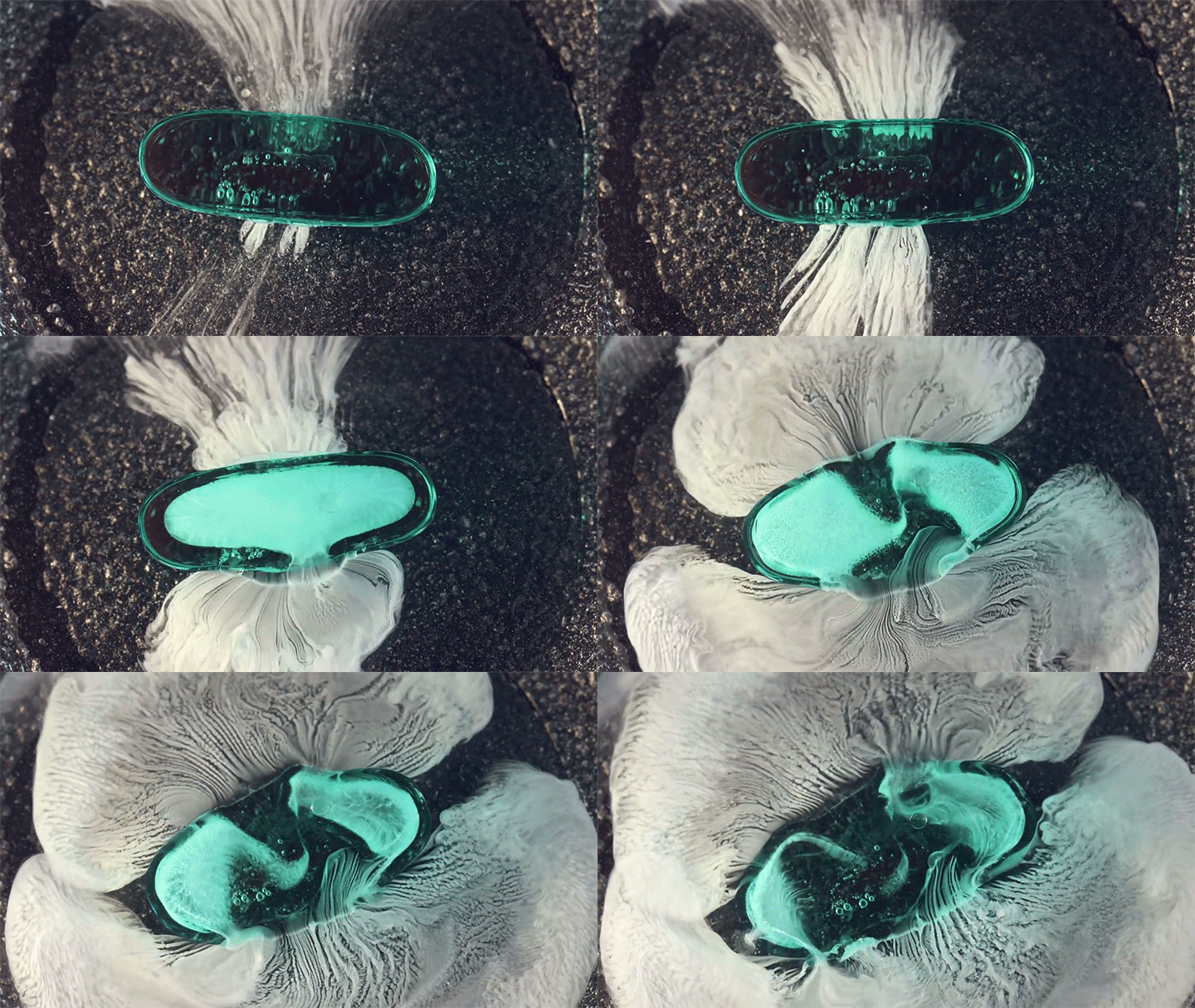
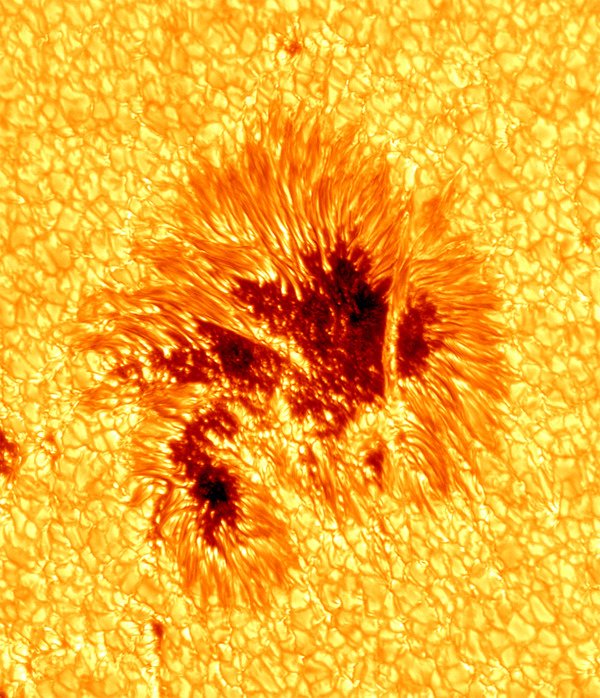
Each winter the Kolyma River in Siberia freezes to a depth of several meters. But by June the river thaws and discharges its annual 136 cubic kilometers of water into the Arctic. The dark color of the river comes from the sediment and organic material it carries. The Kolyma is the world’s largest river underlain with continuous permafrost. Parts of the river system’s permafrost date back to the Pleistocene more than 12,000 years ago. Since much of its organic matter comes from its permafrost, researchers expect the amount of organic material in the Kolyma’s discharge to increase as the permafrost degrades in our warming climate. (Image credit: NASA Earth Observatory)
Tag: physics

Recreating Volcanic Lightning
Some natural phenomena, like volcanic eruptions or tornado formation, don’t lend themselves to fieldwork — at least not at the height of the action. The danger, unpredictability, and destructiveness of these environments is more than our equipment can survive. And so researchers find clever ways to recreate these phenomena in controllable ways. The latest example comes from a lab in Germany, where researchers are recreating volcanic lightning.
To do so, they heat and pressurize actual volcanic ash in an argon environment and let the mixture decompress into a jet, like a miniature eruption. The lightning that accompanies the jet is thought to depend on friction between ash particles, which build up electric charges when rubbed, just like a balloon rubbed against one’s hair. When the charges get large enough, lightning discharges the build-up.
Small-scale experiments like this one allow researchers to vary the temperature and water content of the ash and observe how this changes the lightning. Drier ash generates more lightning, but it’s hard to distinguish whether this is inherent to the ash or the result of the denser jets that form without the added eruptive force of steam. (Image credit: eruption – M. Szeglat, lab lightning – Sönke Stern/Ludwig-Maximilians-Universität München/Gizmodo; research credit: S. Stern et al.; via Gizmodo)

The Best of FYFD 2019
2019 was an even busier year than last year! I spent nearly two whole months traveling for business, gave 13 invited talks and workshops, and produced three FYFD videos. I also published more than 250 blog posts and migrated all 2400+ of them to a new site. And, according to you, here are the top 10 FYFD posts of the year:
- The perfect conditions make birdsong visible
- Pigeons are impressive fliers
- The water anole’s clever method of breathing underwater
- 100 years ago, Boston was flooded with molasses
- The BZ reaction is some of nature’s most beautiful chemistry
- The labyrinthine dance of ferrofluid
- 360-degree splashes
- The extraordinary flight of dandelion seeds
- Dye shows what happens beneath a wave
- Bees do the wave to frighten off predators
Nature makes a strong showing in this year’s top posts with five biophysics topics. FYFD videos also had a good year: both my Boston Molasses Flood video and dandelion flight video made the top 10!
If you’d like to see more great posts like these, please remember that FYFD is primarily supported by readers like you. You can help support the site by becoming a patron, making a one-time donation, or buying some merch. Happy New Year!
(Image credits: birdsong – K. Swoboda; pigeon take-off – BBC Earth; water anole – L. Swierk; Boston molasses flood – Boston Public Library; BZ reaction – Beauty of Science; ferrofluid – M. Zahn and C. Lorenz; splashes – Macro Room; dandelion – N. Sharp; dyed wave – S. Morris; bees – Beekeeping International)

Behind the Bubbly
Carbonation and the fizzy bubbles that come with it are surprisingly popular among humans. Through fermentation or artificial introduction, carbon dioxide gas gets dissolved into a liquid under high pressure. Then, when the pressure is released to atmospheric levels, that gas comes out of solution, forming tiny bubbles that eventually grow large enough to rise buoyantly to the surface. There they will either pop – releasing carbon dioxide gas and aromatics – or form a layer of foam – like in beer – that insulates the liquid and makes it harder to spill. (Image credit: D. Cook; see also R. Zenit and J. Rodríguez–Rodríguez; via Jennifer O.)

Blowing Vortex Rings from Bubbles
When bubbles burst, we often pay attention to the retracting film and forming droplets, but what happens to the air that was inside? By placing a little smoke inside them, we can see. The air inside these bubbles is slightly pressurized compared to the ambient, and as such a bubble ruptures, its air gets pushed out the expanding hole. That momentum makes the air curl as it forces its way into the surrounding air, creating a stack of vortex rings. The researchers observed as many as six stacked vortices from bubbles just under 4 cm in diameter. (Image and research credit: A. Dasouqi and D. Murphy; video credit: Science; see also A. Dasouqi and D. Murphy)

Twirling Liquids
What do you get when you spin a splash? I expect the result is a lot like these whirling fluid structures captured by photographer Hélène Caillaud. I love the fantastical shapes she creates as sheets and filaments are flung outward. These liquid sculptures look like everything from the perfect martini glass to the skirts of a flamenco dancer. Check out the full gallery of images, and be sure to look around at Caillaud’s other stunning liquid art while you’re there. (Images credit: H. Caillaud)

Waltzing Defects
Liquid crystals are a peculiar state of matter with both liquid and crystalline properties. In this video, a microfluidic device breaks water into droplets surrounded by a shell of liquid crystal. Because the molecular structure of the liquid crystals is helical and cannot pack neatly in a spherical shell, there are visible defects in the liquid crystal shells. Given time, those defects can merge as the liquid crystal shell thickens. (Image and video credit: The Lutetium Project)

Inside the Fire Lab
Fire plays an important role in nature, one with which humanity must live without controlling fully. After several disastrous historic wildfires in the American West, the U.S. Forest Service established its own fire lab, where research foresters can study flames firsthand. This video takes us inside the Fire Lab for a look at the facilities and people responsible for helping us better understand this fundamental force of nature. (Video and image credit: Gizmodo + Atlas Obscura)

Kneading Dough
Kneading bread dough is something of an art. The process binds flour, water, salt, and yeast into a network that is both elastic and viscous. It also traps pockets of air that will determine the texture of the final loaf. Underknead and the bubbles won’t form; overknead and the result will be a dense loaf that doesn’t rise in the oven.
Capturing all of that physics in a realistic model is tough, but researchers have done so and validated their digital dough against experiments. The group focused on simulating industrial mixers, which knead dough with a moving, spiral-shaped rod rotating around a stationary vertical one. They found the industrial set-up did not mix as well as kneading by hand, but that could be improved by swapping the stationary rod for a second spiral one. (Image credit: G. Perricone; research credit: L. Abu-Farah et al.; via Physics World; submitted by Kam-Yung Soh)

Blooming Deposits
Evaporate a droplet full of silica nanoparticles, and you’ll get beautiful, flower-like films. As the water evaporates, dry nanoparticles build up in a solid deposit. The evaporation creates a pressure gradient that pulls toward the center of the drop, forcing the deposit to bend. As stress builds in the deposit, cracks form petal-like segments. The number of cracks is indicative of how much of the drop was solid material; the higher the volume fraction of particles is, the fewer cracks form and the less the deposit bends. (Image, video, and research credit: P. Lilin et al.)