Tag: oceanography

  • Rogue Waves

    Rogue Waves

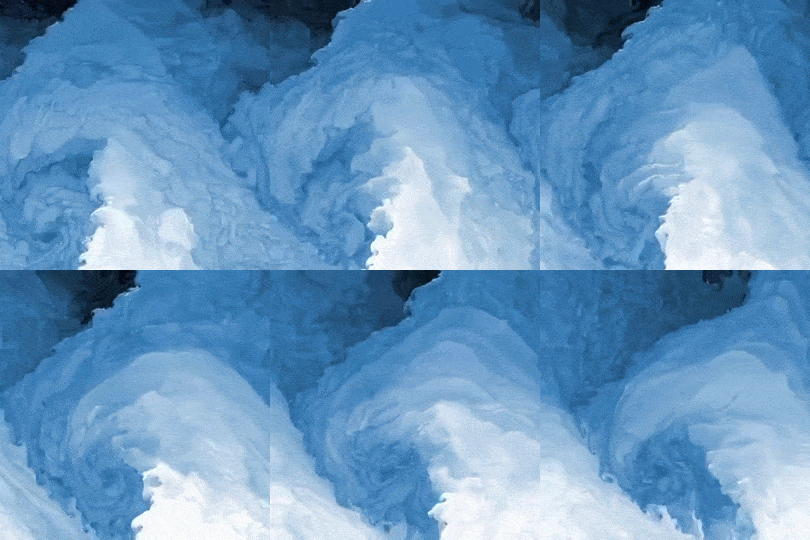
    After centuries of tales from sailors, in 1995 the Draupner off-shore platform recorded the first ever evidence of a freak wave – a single, wall-like wave steeper and taller than any other waves around it. Theories have been tossed back and forth for the last quarter century as to how the Draupner wave formed, but now a group of researchers report they have recreated a lab-scale version of this is famous wave. 

    They did so in a wave pool by making two smaller groups of waves cross one another at about 120 degrees (top). The interaction of those wave packets generated a much larger, steeper wave (bottom image sequence) that matched the profile of the Draupner wave. Recreating this past freak wave confirms that wave-crossing can lead to freak waves, which will hopefully help us forecast when conditions may be right for more to occur. (Image credit and research credit: M. McAllister et al., source; via Motherboard; submitted by Kam-Yung Soh)

  • Swirling Blooms

    Swirling Blooms

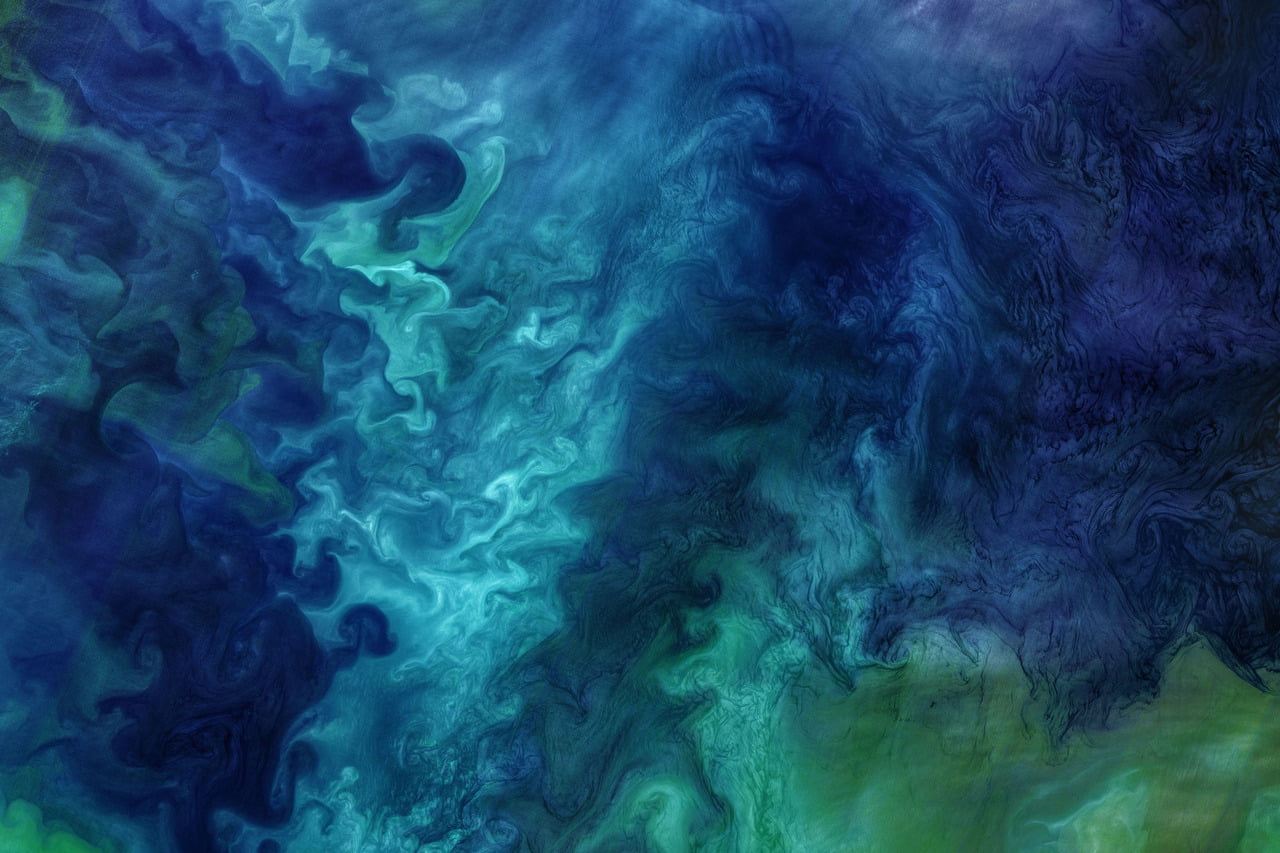
    Every summer, as the ice melts, the waters of the Chukchi Sea off the Alaskan coast come alive with phytoplankton blooms. In satellite images like this one, they can look like abstract paintings formed from swirling colors. In the Chukchi Sea, two main currents collide. One, water from the Bering Sea, is cold, salty, and nutrient-rich. This is the preferred home to phytoplankton known as diatoms, which are responsible for some of the greenish hues seen here.

    Coccolithophores, another variety of phytoplankton, prefer the warmer, less salty Alaskan coastal waters. Despite a relative lack of nutrients, the  coccolithophores thrive, creating the milky turquoise color seen in the image. Knowing these characteristics of the phytoplankton, observing the growth of blooms over time may tell scientists about how the flows in these areas shift and change from year to year. (Image credit: NASA; via NASA Earth Observatory)

  • Can Zooplankton Mix Oceans?

    Can Zooplankton Mix Oceans?

    Krill and other tiny marine zooplankton make daily migrations to and from the ocean surface. Previously, models of ocean mixing ignored these migrations; these animals are tiny, researchers argued, so any effects they could have would be too small to matter. But zooplankton make these migrations in huge swarms, and studies of a laboratory analog of their migrations (using brine shrimp rather than krill) reveal that, when moving en masse, these tiny swimmers create turbulent jets and eddies far larger than an individual. Their collective motion is enough to mix salty water layers 1000 times faster than molecular diffusion alone! Learn more in the latest FYFD video, embedded below. (Image and video credit: N. Sharp; research credit: I. Houghton et al.; h/t to Kam-Yung Soh)

  • Modons

    Modons

    The spin of the Earth creates myriad eddies in our oceans, most of which move slowly westward at a speed dependent on their latitude. You can see many in the animation above as green and red rings slowly marching to the left. According to theory, it’s possible for two of these eddies to combine to become more than the sum of their parts; under the right conditions, the two conjoined eddies could become a modon, which, like a vortex ring, is capable of traveling far faster than its parental eddies. Despite the theory, however, no one had ever observed a modon in nature.

    A new paper uses satellite imagery to identify nine modons in different locations around the world. One is shown above. Watch the eastern coast of Australia carefully, and you’ll see a modon form. It moves much faster than its surroundings, first southward toward Tasmania, then quickly eastward toward New Zealand. Thin black circles mark the two eddies that make up the modon. The strength and speed of these features makes them capable of pulling significant water mass with them. This suggests that they may play a role in ocean life, transporting water of different temperatures and nutrient content into regions it would not otherwise reach. (Image and research credit: C. Hughes and P. Miller; via Gizmodo)

  • Ocean Mixing

    Ocean Mixing

    Movement in Earth’s oceans is driven by a complicated interplay of many factors like temperature, salinity, and Earth’s rotation. Above are results from a numerical simulation of the top 100 meters of ocean contained within a 1 km x 1 km box.  The colors indicate surface temperature. Two major processes create the motion we see. The first is convection, in which water at the surface releases heat to the atmosphere and cools, causing it to then sink due to its greater density. Warmer water rises to replace it. This process happens quickly and dominates the early part of the simulation where we see the puffy convection cells shown on the left animation.

    A slower process is in effect as well. Because of variations in the water temperature, the density of the fluid at a given depth is not constant. We can already see that at the water surface, where the temperature (and thus density) is varying significantly. Those variations in density at the same depth combined with gravity’s tendency to shift fluids create what is known as a baroclinic instability. Put simply, this instability will cause warmer water to slide horizontally past colder water. The result is the large, spinning eddy motion seen in the animation on the right. To see how the whole system develops, check out the full video below.  (Image/video credit: J. Callies)

  • Featured Video Play Icon

    Mediterranean Currents

    Ocean currents play a major role in the weather and climate of our planet. This video shows a simulation of the surface ocean currents in the Mediterranean and Atlantic over an 11-month period. Each second corresponds to 2.75 days. You’ll see many swirling eddies in the Mediterranean and more flow along the coastlines in the Atlantic. One observation worth noting: near the end of the video, you’ll notice that flow through the Strait of Dover between England and France changes its direction, flowing back and forth depending on tidal forces. In contrast, flow through the Strait of Gibraltar is always into the Mediterranean (within the timescale of the simulation, at least). This net in-flow to the Mediterranean is due in part to the warm waters there evaporating at a higher rate than the cooler Atlantic. (Video credit: NASA; via Flow Viz; h/t to Ralph L)

  • Pancake Ice in the Sea

    Pancake Ice in the Sea

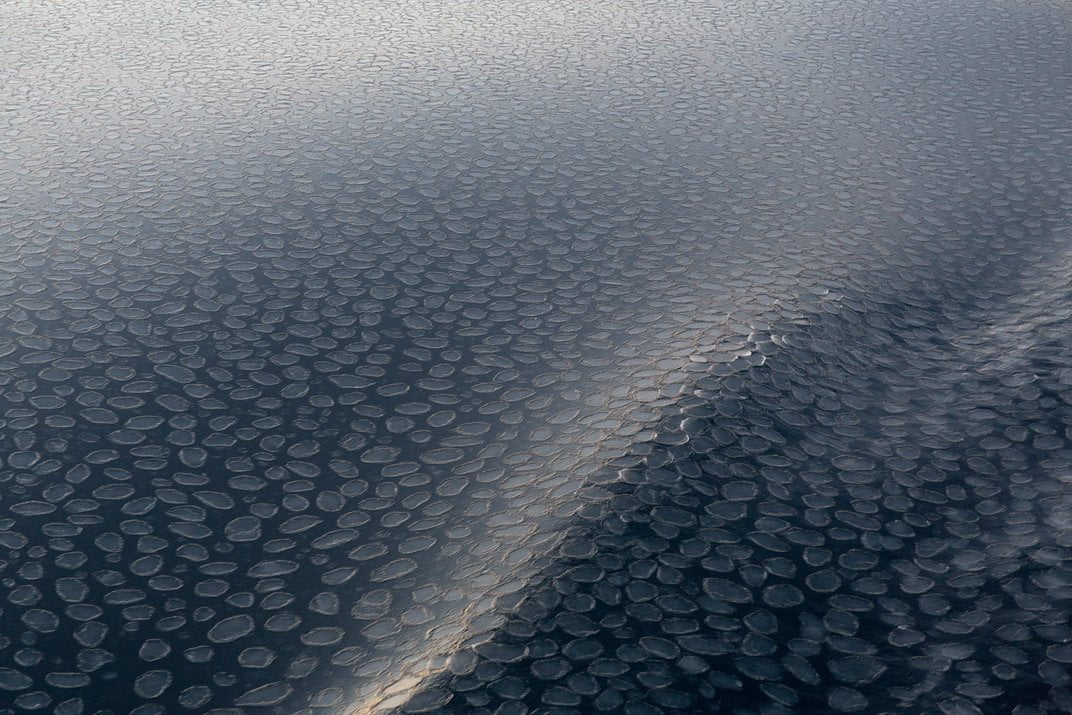
    Sea ice forms in patterns that depend on local ocean conditions. Pancake ice, like that shown in the above photo from the Antarctic Ross Sea, is formed in rough ocean conditions. Each individual pancake has a raised ridge along its edge, due to wave-induced collisions with other pieces of ice. Over time the smaller pieces of ice will merge together, forming large sheets. Evidence of its turbulent formation will persist, however, in the rough surface of the ice’s underside. For more, check out the National Snow and Ice Data Center. (Image credit: S. Edmonds; via Flow Visualization)

    Do you enjoy FYFD and want to help support it? Then please consider becoming a patron!

    Reminder: If you’re at the University of Illinois at Urbana-Champaign, I’m giving a seminar this afternoon. Not in Illinois? I’ve got other events coming up, too!

  • Featured Video Play Icon

    Salinity Near the Amazon

    This numerical simulation shows the variation of salinity in the Atlantic Ocean near the mouth of the Amazon River over the course of 36 months. The turbulent mixing of the fresh river water and salty ocean shifts with the ebb and flooding of the river. Salt content causes variations in ocean water density, which can strongly affect mixing and transport properties between different depths in the ocean due to buoyancy. Understanding this kind of flow helps predict climate forecasts, rain predictions, ice melting and much more. (Video credit: Mercator Ocean)

  • Featured Video Play Icon

    Rogue Wave Recreated

    For years, mariners have reported occurrences of rogue waves–sudden, isolated waves many times larger than the surrounding surface waves. Until 1995, when a rogue wave was first measured, debate raged as to whether such waves even existed. Scientists have since agreed that nonlinear models of wave interaction are the most likely source of the amplification necessary to create rogue waves. Since the Navier-Stokes equations that govern hydrodynamics are so difficult to solve, scientists have looked to simpler nonlinear wave equations, like the nonlinear Schroedinger equation that governs optics, to generate rogue-wave-like behavior. While the equation gives insight into how a given wave system will evolve, it is still necessary to determine what initial conditions can lead to the formation of a rogue wave. All manner of random conditions exist in the ocean, but to recreate the behavior in a simplified system, we must know which initial conditions are the right ones. Akhmediev et al presented a theoretical perspective on the initial conditions that might lead to rogue wave amplification, and now, for the first time, researchers have been able to create a rogue wave in a wave tank. That little blip that sinks the Lego pirate ship is a great accomplishment toward understanding a phenomenon whose very existence was in question less than twenty years ago. (Video credit: A Chabchoub, N Hoffmann, and N Akhmediev; via Gizmodo; for more, see APS Viewpoints and Akhmediev et al)