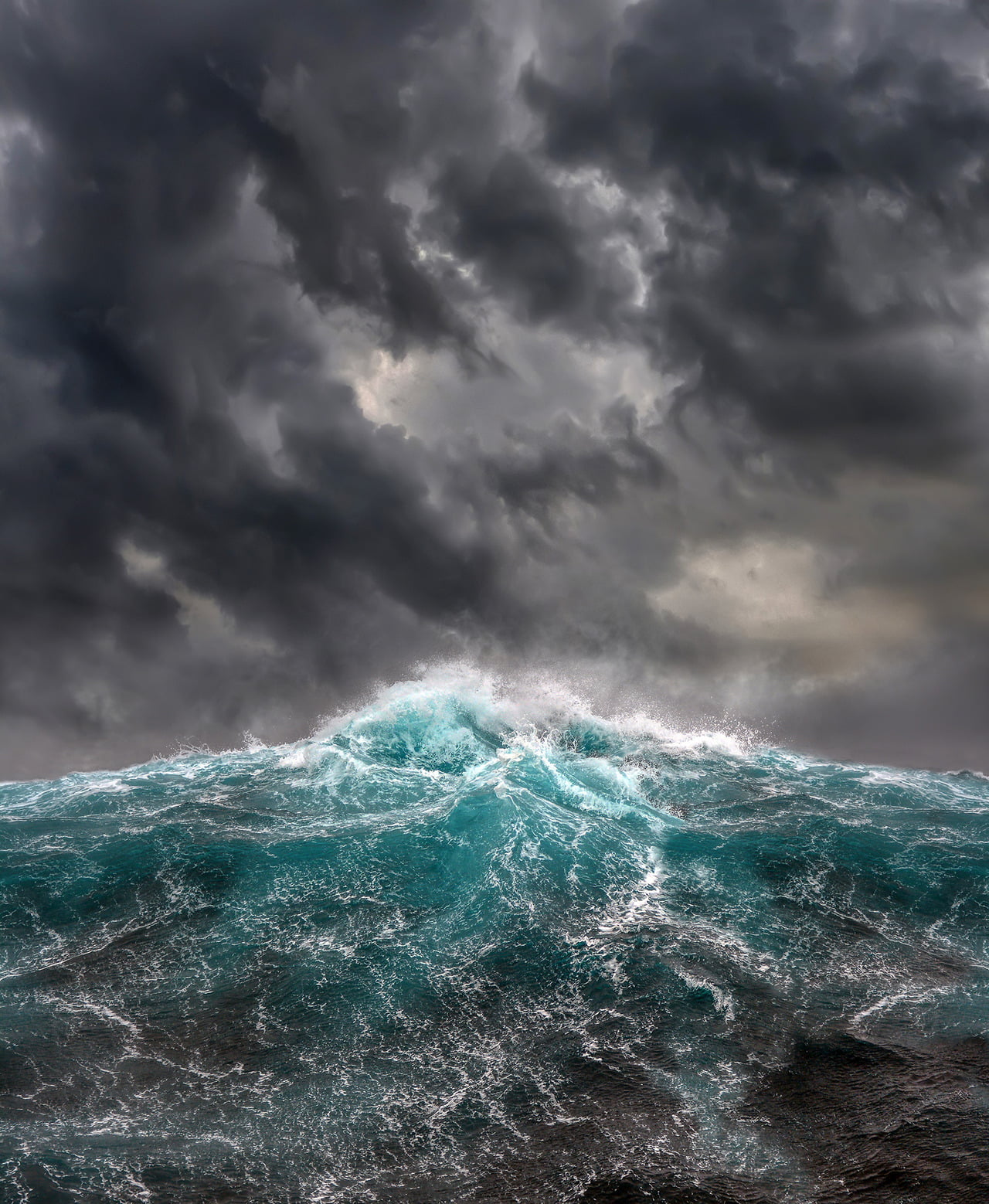
“In Perpetual Motion” follows adventure photographer Krystle Wright underwater where the roiling of the ocean sometimes makes time seem to stop, transporting her to another place entirely. To me, the underside of the ocean’s surface evokes storm clouds and memories of sitting at the bottom of the pool staring up at the way light played on the surface. How about you? What do you see when the waves roll overhead? (Video and image credit: K. Wright et al.)
Tag: ocean waves

Rogue Waves
After centuries of tales from sailors, in 1995 the Draupner off-shore platform recorded the first ever evidence of a freak wave – a single, wall-like wave steeper and taller than any other waves around it. Theories have been tossed back and forth for the last quarter century as to how the Draupner wave formed, but now a group of researchers report they have recreated a lab-scale version of this is famous wave.
They did so in a wave pool by making two smaller groups of waves cross one another at about 120 degrees (top). The interaction of those wave packets generated a much larger, steeper wave (bottom image sequence) that matched the profile of the Draupner wave. Recreating this past freak wave confirms that wave-crossing can lead to freak waves, which will hopefully help us forecast when conditions may be right for more to occur. (Image credit and research credit: M. McAllister et al., source; via Motherboard; submitted by Kam-Yung Soh)

Waves
Photographer Ray Collins is known for his striking portraits of waves, some of which I’ve featured on previous occasions. Collins is colorblind, so he focuses heavily on shape and texture in the wave, which produces some stunningly dramatic views of moving water frozen in time. There’s great power and beauty in breaking waves, and researchers are still actively learning just how significant they are to our planet’s cycles.
Note the spray blurring the edges of every wave here; these are some of the largest droplets the wave will make. As it crashes forward, the wave traps pockets of air, and, as those bubbles burst, they will create a spray of tinier droplets that carry moisture and salt into the atmosphere to seed clouds and, eventually, rain.
Collins’ work reminds us both of the ocean’s power and its fragility as it undergoes rapid changes due to humanity’s influence. For more photos as well as a great interview with Collins, check out My Modern Met. (Image credit: R. Collins; via My Modern Met and James H.)

Sunglinting Seas
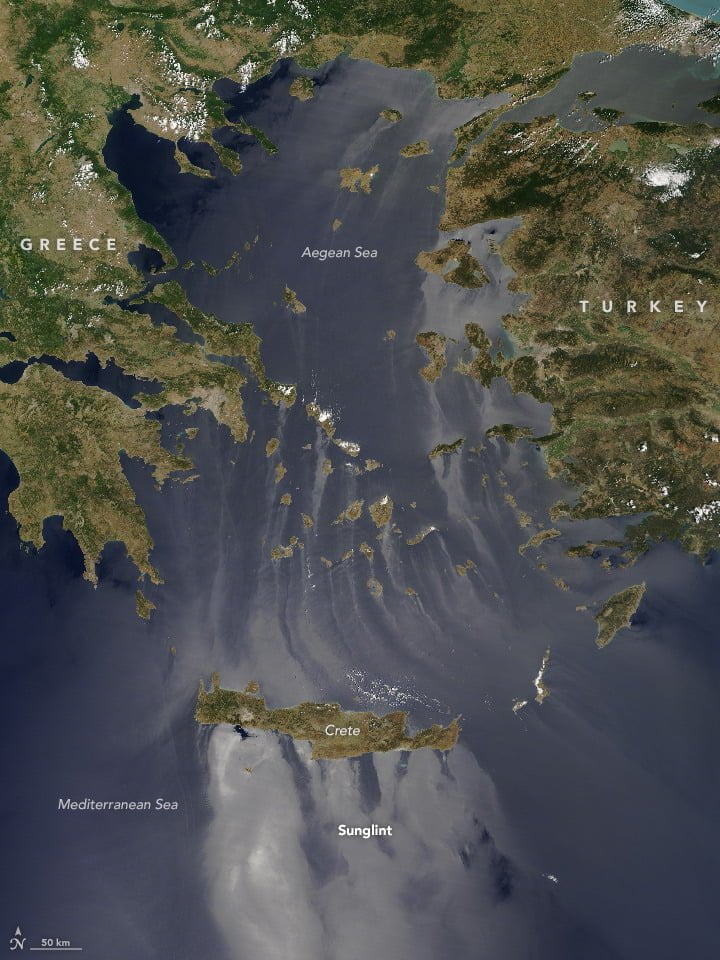
Sunlight reflecting off the Earth can reveal a remarkably rich picture of our planet’s activity. The silver-gray areas seen in this satellite image are sunglint, where lots of light is reflected back to space. Sunglint occurs in regions with very few waves; more waves – like in the bluer areas – mean more directions in which light can be scattered. The reason for these rough and smooth waters is atmospheric: the prevailing summer winds blow across the Aegean from the north. In open water, that wind drives up the waves, but rocky islands disrupt the flow, leaving “wind shadows” on their southern, leeward sides where the waves are smaller. (Image credit: J. Schmaltz; via NASA Earth Observatory)

Hawaii’s Lava
Sometimes the best way to appreciate a flow is standing still. In “Hawaii – The Pace of Formation” filmmakers explore how the Big Island is constantly changing, from fresh lava flows to towering waterfalls. Much of the footage presented is timelapse, which gives viewers a different perspective on familiar subjects; it highlights the similarities between clouds and the ocean, and it reminds us that a lava flow and the syrup flowing down a stack of pancakes have a lot in common. To me, this is one of the most beautiful parts of fluid dynamics: physics of flows on different length-scales and time-scales – even in different fluids – are still very much the same. (Video credit: A. Mendez et al.)

Breaking Wave
This animation shows a cinemagraph of a breaking wave photographed by Ray Collins. The motion was inferred and digitally added by a second artist, Jersey Maria. The result is hypnotic, as if we are traveling beside the wave and watching it tear apart ever so slowly. The wave seems to be poised on a tipping point, only breaking up along its back edge, when instinct tells us it will keep steepening and tipping forward until its top curl crashes down in a wave of white foam. Surf photography like Collins’ work shows us an alternative perspective on waves, their power frozen into a single instant. Reanimated, it feels like we’re seeing the wave in hyper-slow-motion, watching every tiny movement of water before everything crashes down. Even if it’s not physically realistic, it is an awesome view. (Image credit: R. Collins / J. Maria, source, original; via Iwan A.)

Breaking Soon
Australian photographer Warren Keelan captures spectacular photos of waves just before and during the moment they break. Fluid dynamics is defined by motion – specifically the motion of substances that do not hold a single form – but one thing I love about wave photography is how crisp and solid water appears when frozen in time. In a way, it feels like a reminder that, even though we classify matter into different states, ultimately those states have a lot in common. (Image credit: W. Keelan; via Colossal)

CYGNSS
Yesterday marked the launch of a new constellation of eight microsatellites, the Cyclone Global Navigation Satellite System (CYGNSS), designed to monitor hurricanes in Earth’s tropics. The constellation will provide unprecedented capability to monitor conditions inside hurricanes–information that will hopefully help scientists improve hurricane prediction models. Each CYGNSS microsat monitors GPS signals that it receives from the GPS satellite system and from the reflection of that signal off the Earth. By comparing these signals, the satellites can determine wave heights in the ocean, and from that wave information, they can measure surface wind speeds. By peering inside the hurricane as it forms and travels, scientists hope they will be better able to estimate not only a hurricane’s path but how strong it will be when it makes landfall. (Image credits: NASA)

Fluids Round-up
Time for another look at some of the best fluids content out there. It’s the fluids round-up – with a special focus this week on oceans!
– Ryan Pernofski spent two years filming the ocean in slow motion with his iPhone to make the short film “Slowmocean” seen above. It’s a gorgeous ode to the beauty of breaking waves.
– Oceans with higher salinity than Earth’s could drive global circulation that would make exoplanets more hospitable to life.
– Speaking of alien oceans that could harbor signs of life, there’s discussion afoot of how future missions to icy moons like Europa or Enceladus could collect samples from plumes ejected from beneath the ice.
– Wind and waves make harsh, erosive environments. This photo essay from SFGate shows how greatly the sands of Pacifica shift over time. (submitted by Richard)
Bonuses:
– New research explores how Martian mountains may have been carved out by the wind.
– Ever listened to an orchestra made from ice? You should! Learn about Tim Linhart, who builds and maintains ice instruments. (submitted by ashketchumm)
– MIT has demonstrated a new 3D-printing technique that allows for printing liquid and solid parts simultaneously, allowing would-be creators to rapid-prototype hydraulically-driven robotics.
Even more bonus bonus!
– ICYMI, the new FYFD video made Gizmodo!
If you’re a fan of FYFD, please consider becoming a patron. As a bonus, you’ll get access to this weekend’s planetary science webcast!

(Video credit: R. Pernofski; via Flow Visualization; Pluto image credit: NASA/APL)

Rogue Wave Recreated

If you look online, the term “rogue wave” gets thrown around a lot – a whole lot. And most of the videos you see of “rogue waves”, “freak waves”, and “monster waves” are just, in fact, big waves. What makes a deep-water ocean wave a rogue, scientifically speaking, is that it is extreme compared to its surroundings. One definition requires that a rogue wave be more than twice as tall as the height of average large waves in the area – like the rogue that takes out the Lego boat above. Outside the lab, this is a rare event – fortunately – because a true rogue wave has tremendous destructive power and seems to appear out of the blue.
This seemingly unpredictable behavior is thought to arise from nonlinear interactions between waves. Essentially, under the right conditions, a rogue wave grows monstrously large by sucking energy out of other surrounding waves. One way to try and predict rogue waves is to measure all the waves nearby and simulate their potential nonlinear interactions computationally – but this is time-consuming and requires a lot of computing power.
Instead, researchers have developed an alternative method, illustrated in the time series above. Instead of considering the rogue potential for all waves, they identify waves with characteristics that make them more likely to go rogue and focus on simulating those waves. In the animation, the wave packets are colored from green to red based on their increasing likelihood of turning into rogue waves. The algorithm is simple enough to run quickly on a laptop and can provide a couple minutes of warning to a ship’s crew – enough time to batten down before the wave hits. (Image credits: simulation – T. Sapsis et al., source; experiment: N. Ahkmediev et al., source; via The Economist and MIT News; submitted by 1307phaezr)