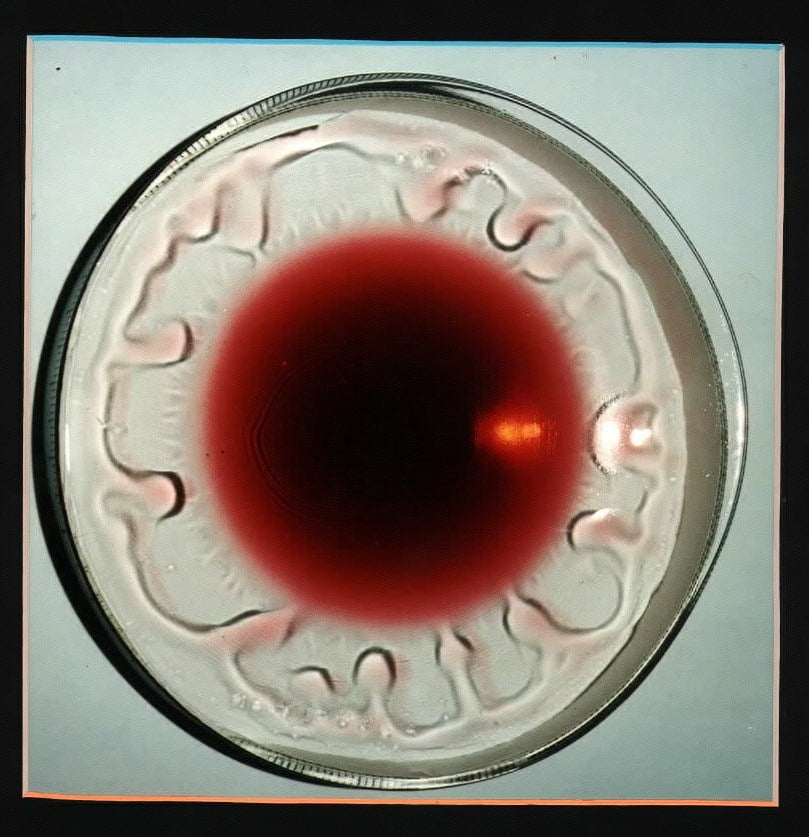
Droplets of oleic acid spread across a thin film of glycerol on a silicon wafer. The shapes here are driven by hydrodynamic instabilities, particularly Marangoni effects due to the differences in surface tension between the two fluids. (Photo credit: A. Darhuber, B. Fischer and S. Troian)
Tag: marangoni effect

The Disintegrating Bowl
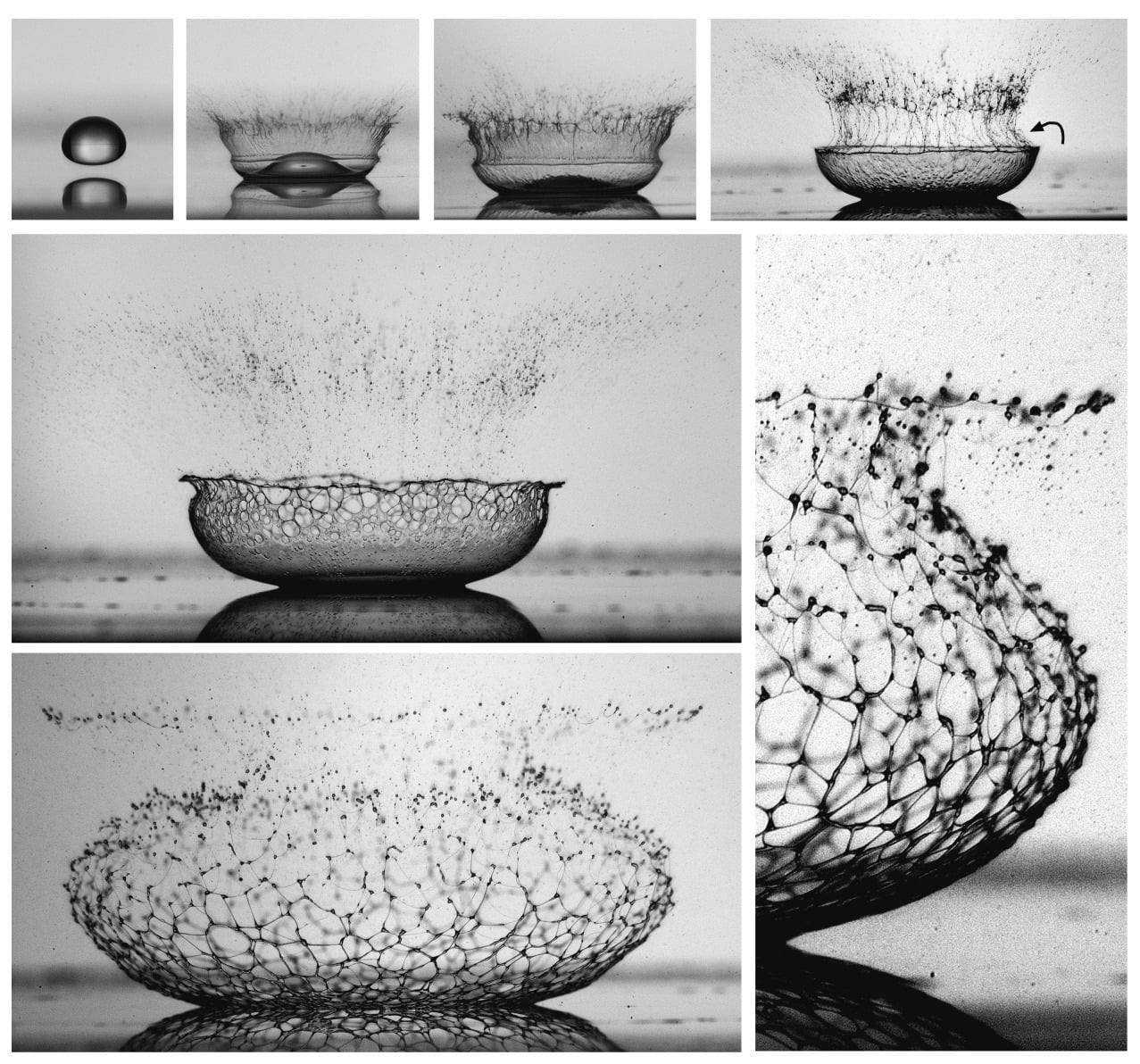
A viscous fluid droplet impacts a thin layer of ethanol, which has a lower surface tension than the viscous fluid. A spray of tiny ethanol droplets is thrown up while a bowl-shaped crown of the viscous fluid forms. As the ethanol droplets impact the bowl, the lower surface tension of the ethanol causes fluid to flow away from points of contact due to the Marangoni effect. This outflow causes holes to form in the crown, forming a network of thin fluid ligaments. For more, see this paper (PDF) and video. (Photo credit: S.T. Thoroddson et al)
Bill Nye Demos
[original media no longer available]
Have a little science enthusiasm from Bill Nye to brighten your Tuesday! This video includes demonstrations on thermodynamics (sucking the balloon into the flask), the Marangoni effect (driving the powder off the water surface and powering the glue boat by creating gradients in surface tension), and buoyancy (floating cans of cola).

Flowing Up a Waterfall
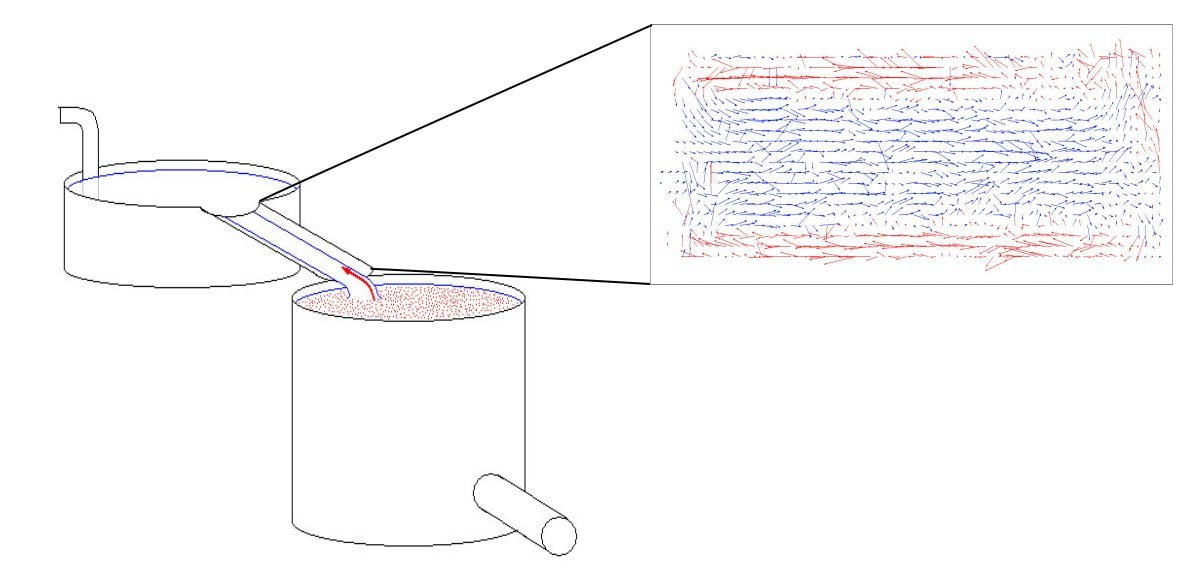
Tea-drinking physicists found that it’s possible for particles to flow up a short (< 1 cm) waterfall to contaminate pure upstream sources. Their apparatus is shown above, along with an inset showing the velocity field on the surface of the channel. The blue arrows indicate flow downstream and the red arrows indicate counterflow that carries particles upstream. The researchers suspect that Marangoni effects may play a role in setting up the counterflow. The finding could have implications for pollution control and manufacturing. # (submitted by Gabe)

Marangoni Effect
Dyed milk pulls away after a drop of acetone is added. The acetone creates a gradient in the surface tension, which causes mass flow due to the Marangoni effect. See a video of the effect (or try it yourself at home!) here.

Marangoni Convection in Space
In this Saturday Morning Science video, astronaut Don Pettit demonstrates Marangoni convection in microgravity using a water film with tracer particles, a soldering iron, and a flashlight. This same effect occurs on earth but is masked behind the much stronger effect of buoyant convection.

Microgravity Marangoni
Astronauts are preparing an experiment on the Marangoni effect, in which a variation in surface tension can cause mass flow, for flight aboard the International Space Station. The effect, also responsible for causing tears of wine, will benefit from study in microgravity because competing effects like gravity-induced sedimentation and buoyant convection will be negligible. Astronaut Ron Garan reports more on the upcoming experiment on the Fragile Oasis blog.

Tears of Wine
Tears of wine are caused by the Marangoni effect, in which a gradient in surface tension causes mass flow. The water in the wine has a higher surface tension than the alcohol in the wine, causing the wine to be drawn away from regions of higher alcohol concentration. #