Tag: low Reynolds number flow

  • Fighting a Viscous World

    Fighting a Viscous World

    Vaucheria is a genus of yellow-green algae (think pond scum), and some species within this genus reproduce asexually by releasing zoospores. Once mature, the zoospore has to squeeze out of a narrow, hollow filament in order to escape into the surrounding fluid (top). To do so, it uses tiny hair-like flagella on its surface. Despite the minuscule size of these micron-length flagella, they generate some major flows around the zoospore (middle and bottom). Even several body lengths away, the flow field shows significant vorticity. All this active entrainment of fluid from the surroundings helps the zoospore escape its confinement and swim away to start a new plant. (Image and research credit: J. Urzay et al., source)
  • Swimming Like a Balloon

    Swimming Like a Balloon

    For humans, swimming is relatively easy. Kick your legs, wheel your arms, and you’ll move forward. But for microswimmers, swimming can be more complicated. For them, the world is a viscous place, and the rules that we swim by can’t help them get around. In a highly viscous world, flows are reversible. Kick one limb down and you might move forward, but when you pull the limb up, you’ll be sucked right back to where you started. So microswimmers must use asymmetry in their swimming. In other words, their recovery stroke cannot be the mirror-image of their power stroke.

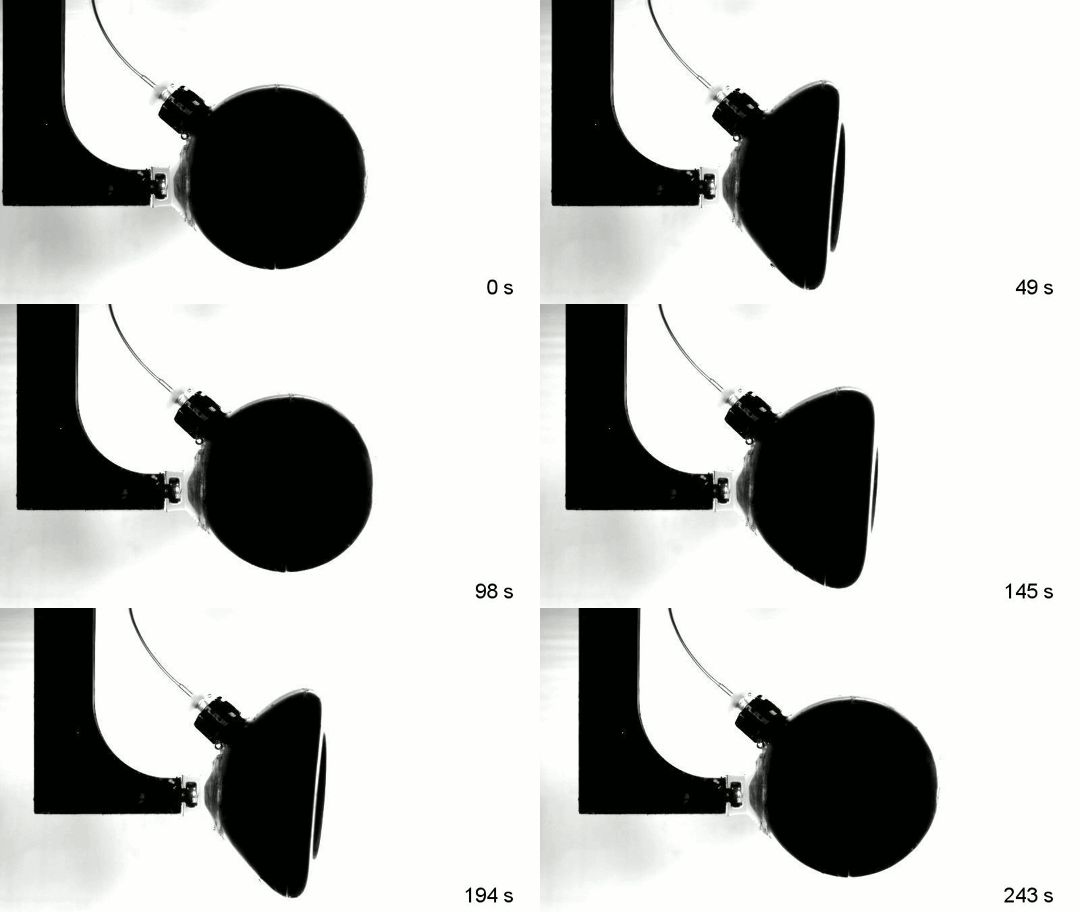
    A new study suggests that simple elastic spheres could make good microswimmers through cyclic inflation and deflation. When the sphere deflates, it buckles, making a shape unlike its inflating one. This difference in shape change is enough to propel the sphere a little with each cycle. Right now the test system is a macroscale one, but the researchers hope to continue miniaturizing. (Image and research credit: A. Djellouli et al.; via APS Physics; submitted by Kam-Yung Soh)

  • Swimming with Corkscrews

    Swimming with Corkscrews

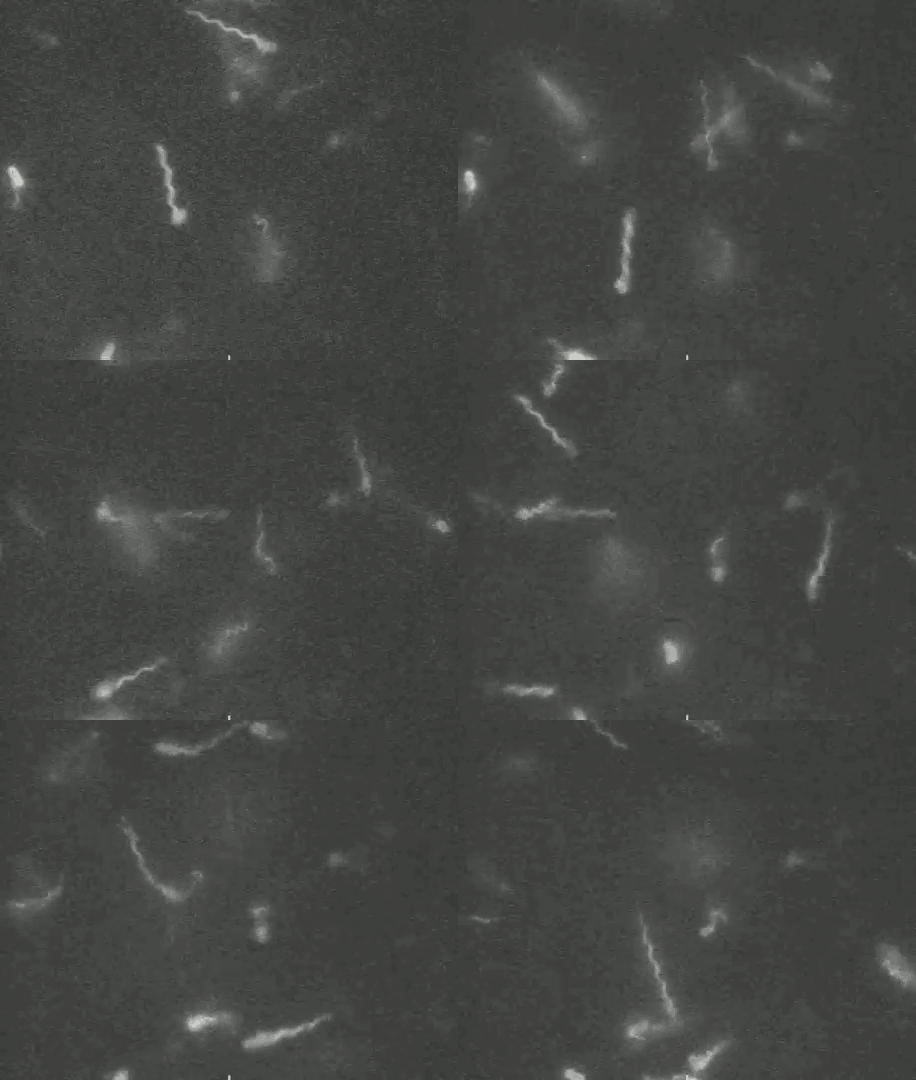
    E. coli, like many bacteria, swim using corkscrew-like appendages called flagella. Because the bacteria are extremely tiny – their flagella may be less than ten microns long – their swimming is overwhelmingly dependent on viscosity. (Inertial effects are 100 to 10,000 times smaller than viscous effects for swimming E. coli.) Rotating their helical flagella generates viscous drag along the surface of the corkscrew. Because the flagella is asymmetric when you add all of those drag components together, the net force is thrust that moves the bacterium forward. Watch carefully in the animation above and you’ll see that E. coli have multiple flagella and will swing one out to the side during maneuvers. (Image credit: L. Turner et al., source; reproduced in a review by E. Lauga, pdf)

  • Starfish Vortices

    Starfish Vortices

    Starfish larvae, like other microorganisms, use tiny hair-like cilia to move the fluid around them. By beating these cilia in opposite directions on different parts of their bodies, the larvae create vortices, as seen in the flow visualization above. The starfish larvae don’t use these vortices for swimming – to swim, you’d want to push all the fluid in the same direction. Instead the vortices help the larvae feed. The more vortices they create, the more it stirs the fluid around them and draws in algae from far away. The larvae actually switch gears regularly, using few vortices when they want to swim and more when they want to eat. Check out the full video below to see the full explanation and more beautiful footage.  (Image/video credit: W. Gilpin et al.)

  • Swimming at Microscale

    Swimming at Microscale

    Tiny organisms live in a world dominated by viscosity. There’s no coasting or gliding. If a microorganism stops swimming, friction will bring it to a halt in less than the space of a hydrogen atom! To make matters worse, simply flapping an appendage forward and backward will get them nowhere. As we’ve seen before, these highly viscous laminar flows are reversible, meaning that a backward power stroke is simply undone by a mirrored forward recovery stroke. Instead, microorganisms like the paramecium swimming above are covered in tiny hairlike cilia which beat asymmetrically. They extend to their full length during the power stroke, but they stay bent during the forward recovery stroke. That asymmetry guarantees that they move more fluid backward than forward, thereby letting the paramecium make progress. (Image credit: C. Baroud, source)

  • The Challenges of Micro Air Vehicles

    The Challenges of Micro Air Vehicles

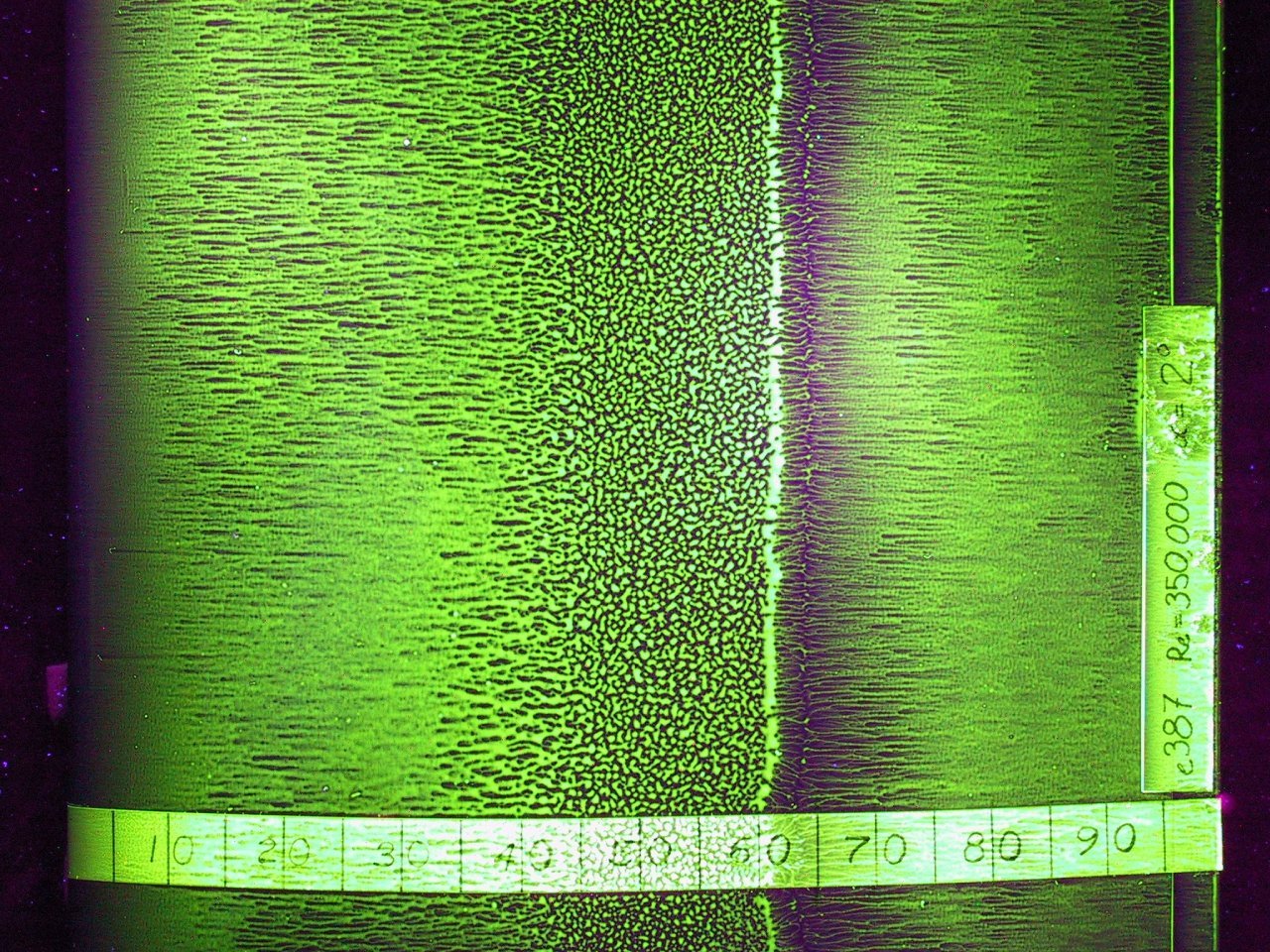
    Interest in micro-aerial vehicles (MAVs) has proliferated in the last decade. But making these aircraft fly is more complicated than simply shrinking airplane designs. At smaller sizes and lower speeds, an airplane’s Reynolds number is smaller, too, and it behaves aerodynamically differently. The photo above shows the upper surface of a low Reynolds number airfoil that’s been treated with oil for flow visualization. The flow in the photo is from left to right. On the left side, the air has flowed in a smooth and laminar fashion over the first 35% of the wing, as seen from the long streaks of oil. In the middle, though, the oil is speckled, which indicates that air hasn’t been flowing over it–the flow has separated from the surface, leaving a bubble of slowly recirculating air next to the airfoil. Further to the right, about 65% of the way down the wing, the flow has reattached to the airfoil, driving the oil to either side and creating the dark line seen in the image. Such flow separation and reattachment is common for airfoils at these scales, and the loss of lift (and of control) this sudden change can cause is a major challenge for MAV designers. (Image credit: M. Selig et al.)

  • Featured Video Play Icon

    The Reynolds Number Illustrated

    The dimensionless Reynolds number is a key concept in fluid dynamics, allowing scientists to distinguish regimes of flow between differing geometries and even different fluids. This video gives a great primer on the subject by examining the physics of swimming for a sperm versus a sperm whale. The Reynolds number is essentially a ratio between inertial forces (driven by velocity and size) and viscous forces, and its value can indicate how important different effects are. Sperm and other microbes live at very small Reynolds numbers, meaning that viscosity dominates as the force they must overcome to move. For more on the low Reynolds number world, check out how brine shrimp swim and what happens if a microbe tries to flap its tail. (Hint: it goes nowhere, and this is why.) (Video credit: A. Bhatia/TED Ed; via Jennifer Ouellette)

  • Featured Video Play Icon

    Brine Shrimp Swimming

    For small creatures, swimming is dominated by viscosity. Here researchers use particle image velocimetry (PIV) to explore the flow field around brine shrimp. Its motion is divided into two vorticity-generating phases–the wide power stroke where the shrimp generates most of its forward motion and the recovery stroke where the shrimp returns its starting position while generating as little motion and drag as it can. (Video credit: B. Johnson, D. Garrity, L. Dasi)

  • Featured Video Play Icon

    Viscous Fluid Falling on a Moving Belt

    In this video a very viscous (but still Newtonian) fluid is falling in a stream onto a moving belt. Initially, the belt is moving quickly enough that the viscous stream creates a straight thread. As the belt is slowed, the stream begins to meander sinusoidally and ultimately begins to coil. Aside from some transient behavior when the speed of the belt is changed very quickly, the behavior of the thread is very consistent within a particular speed regime. This is indicative of a nonlinear dynamical system; each shift in behavior due to the changing speed of the belt is called a bifurcation and can be identified mathematically from the governing equation(s) of the system. (Video credit: S. Morris et al)

  • Underwater Cloaking

    Underwater Cloaking

    Researchers have suggested that it may be possible to cloak submerged objects as they move through a fluid using layers of mesh and micro-pumps. By redirecting the fluid so that it enters and leaves the mesh surrounding the object in the same speed and direction that it entered, it is theoretically possible to have zero drag and no wake. So far researchers have only simulated this set-up computationally using a sphere with 10 layers of mesh. It’s also unfortunately limited in size and speed: a vehicle 1 cm across could only remain wake-free at speeds below 1 cm/s. (Photo credit: Michael J Rinaldi) #