The San Rafael Glacier, one of the fastest calvingglaciers in the world, sits above a fjord in Patagonia. About 10 – 25 meters of the glacier is lost to calving every day. Here, filmmakers take you behind-the-scenes to show what it takes to film in such a remote, unpredictable, and dangerous environment. (Image and video credit: BBC Earth)
A glacier’s snowline marks the location where the amount of summer melting and accumulated snowmass are equal. If, over the course of a season, a glacier experiences more snowfall than melting, its snowline will advance. If melting outweighs accumulation, then the snowline will retreat to higher altitudes. Tracking the snowline gives scientists important data about how the glacier is changing.
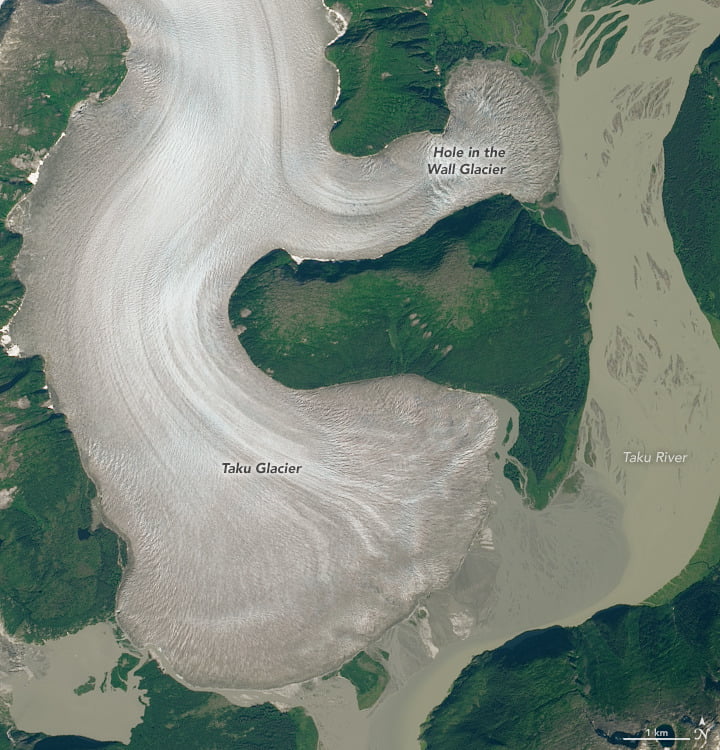
And that change is typically slow. When glaciers stop advancing, their snowlines can remain unmoving for decades. Or, at least, they used to. In recent years, Alaska’s Taku Glacier was one of the only alpine glaciers holding out against the warming Arctic. Its slow advance stopped in 2013–the left image shows Taku in 2014–and researchers hoped the massive glacier would maintain its mass for a few decades at least. Instead, the glacier was retreating by 2018 and doing so with the highest mass loss ever recorded at the glacier. The 2019 image on the right shows the glacier’s visible losses.
For such a massive glacier–the largest in Juneau Icefield at nearly 1.5 km thick–to reverse fortunes so quickly is disturbing and serves as yet more evidence of climate change overriding natural cycles of advance and retreat. (Image credit: L. Dauphin/USGS; via NASA Earth Observatory)
The movement of glaciers is driven by gravity. The immense weight of the ice causes it to both slide downhill and deform – or creep. As glacier melting speeds up, scientists have debated how glacier flow will respond: will the loss of ice cause the glaciers to move more slowly since they have less mass, or will the increase in meltwater help lubricate the underside of glaciers and make them flow even faster?
By analyzing satellite image data of Asian glaciers collected between 1985 and 2017, researchers are finally answering that question. Their research shows that these glaciers are slowing down as they lose mass and speeding up as they gain mass. Nearly all – 94% – of the flow changes they observed can be accounted for solely from ice thickness and slope. This is valuable information as scientists continue to monitor and predict the changes we must expect as the world continues to warm. (Image credit: J. Stevens; research credit: A. Dehecq et al.; via NASA Earth Observatory)
Glacial river veins wend and meander through these aerial photographs of Iceland by photographer Stas Bartnikas. Rivers naturally change their course over time, but here seasonal melts and the slow grinding of glaciers adds further chaos to the scene. Captured from above, these landscapes show the scars of past flows. (Image credit: S. Bartnikas; via Colossal)
The birth of icebergs from a glacier is known as calving. Although it’s extremely common for chunks of ice to break off a glacier’s terminus, the process is not well understood. In large calving events like the one shown above, the breakaway is preceded by the formation of a crack or crevasse in the main body of the glacier. How quickly that crack grows depends on many factors, including the presence (and temperature) of water in the crack, the topology of the underlying rock, and friction between the glacier and ground beneath. Once the crack is large enough that the glacier can’t support the weight of the ice at the terminus, the ice will break off, generating new icebergs and, potentially, large waves. (Image credit: T. James et al., source)
Glacial ice is constantly flowing but at speeds we don’t notice by eye. That doesn’t mean there aren’t signs, though! Crevasses, narrow fractures in the ice that may be tens of meters deep, are a sign of those flows. Crevasses form in areas where the ice is under high stress. That could be a spot where the ice is flowing down a steeper incline or a place where multiple ice flows merge. Researchers can even use ice-penetrating radar to locate buried crevasses deep inside the ice. These are remnants of past flow conditions and provide hints at how the ice flows have changed over time. Crevasses are also a path for meltwater to penetrate deep into the ice, which can change slip conditions at the base of the glacier and increase both flow and melt rates. (Image credit: NASA/Digital Mapping Survey; via NASA Earth Observatory)
Glaciers are kind of bizarre. Despite being very solid, they still flow, sometimes on the order of a meter a day. This flow is driven by gravity and the incredible weight of the dense ice. Near the base of the glacier, the pressure is great enough to cause some localized melting. (Very high pressures actually decrease the melting point of water.) Glaciers also move through plastic deformation – this is the internal slippage Joe refers to in the video when he compares glaciers to a deck of cards. Despite their vast differences from typical fluid flows, glacial flows are often still described by the same equations of motion used in the rest of fluid dynamics! (Video credit: It’s Okay to Be Smart; via PBS Digital Studios)
The high walls of this alpine canyon were cut by flowing glacial ice. This type of amphitheater-shaped valley is known as a cirque. The photo shows one of the Chicago Lakes on Mount Evans in the Colorado Rockies. The glacier that once sat here carved the steep walls you see in the background but also hollowed out a series of depressions like the ones shown in the figure below. When temperatures warmed and the glacier melted, it left behind a series of three small lakes, or tarns, like the one in the photo above. Cirques are found throughout the mountain ranges of the world. (Image credit: Mt. Evans – J. Shoer; cirque formation – DooFi)
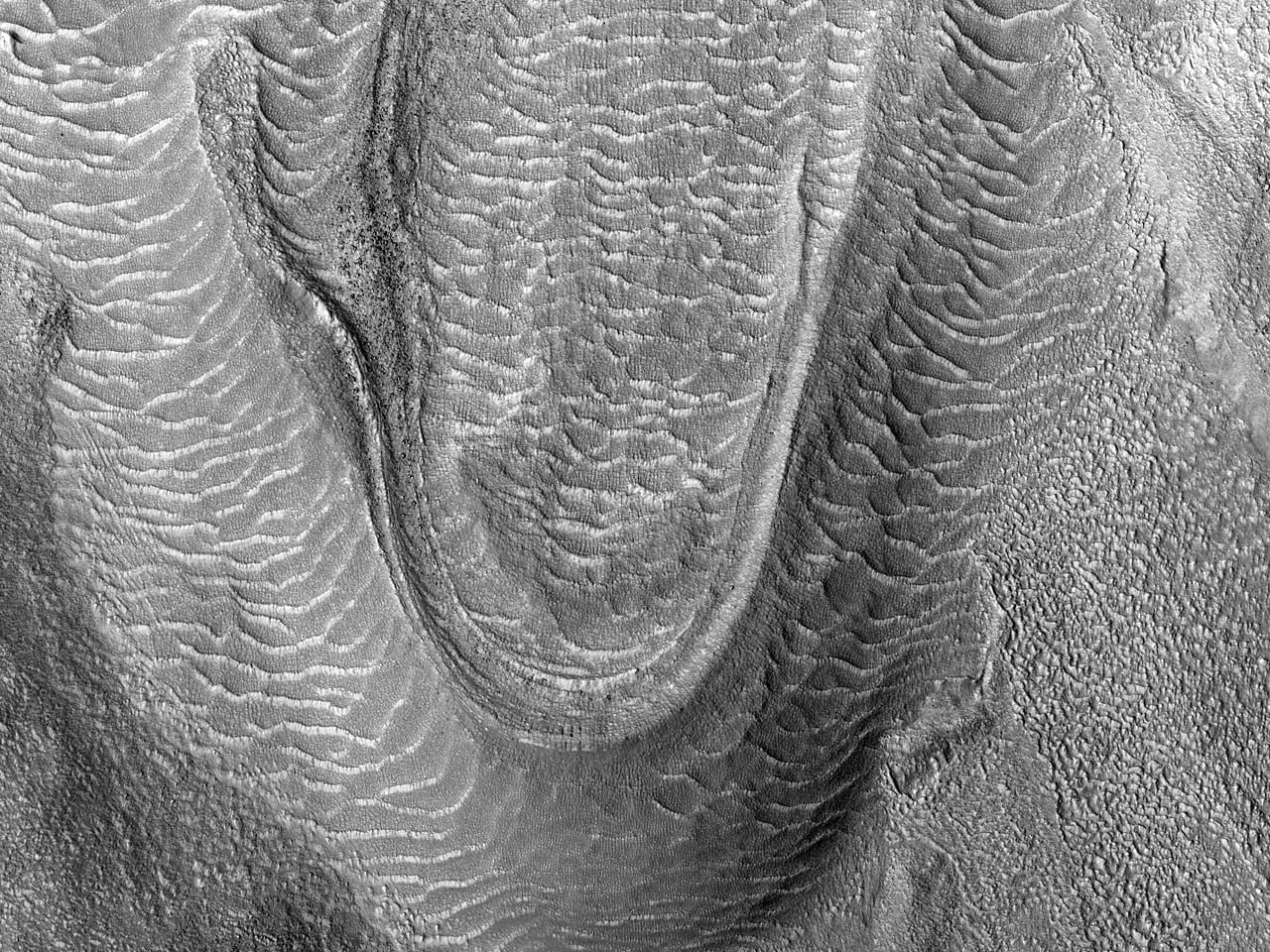
These images from the Mars Reconnaissance Orbiter show what are called viscous flow features. They are the Martian equivalent of glacial flow. Such features are typically found in Mars’ mid-latitudes.
Ground-penetrating radar studies of Mars have shown that some of these features contain water ice covered in a protective layer of rock and dust, making them true glaciers. Another study of similar Martian surface features found that their slope was consistent with what could be produced by a ~10 m thick layer of ice and dust flowing superplastically over a timescale equal to the estimated age of the surface features. Superplastic flow occurs when solid matter is deformed well beyond its usual breaking point and is one of the common regimes for glacial ice flow on Earth. (Image credit: NASA/JPL/U. of Arizona; via beautifulmars)
To the naked eye, glaciers don’t appear to move much, but appearances can be deceiving. Like avalanches and turbidity currents, glaciers flow under the influence of gravity. They typically move at speeds around 1 meter per day, but some glaciers, like those shown above in Pakistan’s Central Karakorum National Park, can briefly surge to speeds a thousand times higher than their usual. The animation above shows 25 years worth of Landsat satellite imagery, enabling one to more easily observe the motion of these slow giants. Try picking out a feature along one of the glaciers and watch it move year-by-year. The glaciers just right of the image centerline are some of the best! (Image credit: J. Allen; via NASA Earth Observatory; submitted by Vince D)