Tag: geology

  • Martian Landslides

    Martian Landslides

    Sometimes there are advantages to studying planetary physics beyond Earth. Mars does not have plate tectonics, vegetation, or the level of erosion we do, allowing geological features like those left behind by landslides to persist undisturbed for millions of years. And, thanks to a suite of orbiters, we’ve mapped most of Mars at a resolution better than many parts of our own planet. All together, this gives researchers a treasure trove of geological data from our nearest neighbor.

    One peculiar feature of many landslides is their long runout. Even over relatively flat ground, some landslides cover extreme distances from their point of origin. On Earth, we often see this behavior near glaciers, so scientists theorized that the presence of ice was somehow necessary for the landslide to cover such a long distance. But previous laboratory experiments with dry, ice-free grains showed the same behavior: long runouts marked with ridges running parallel to the flow. The mechanism behind the ridges is still somewhat unclear, but it seems to be connected to fluid dynamical instabilities that form between fast-flowing particles of differing density. But such results have been confined to lab-scale experiments and numerical simulations.

    A new report, however, shows that landslides on Mars share the same characteristic spacing and thickness between their ridges. This evidence suggests that the same ice-free mechanism could account for the long run-out of landslides on Mars and other planets. (Image credit: NASA/JPL-Caltech/University of Arizona; research credit: G. Magnarini et al.; via The Conversation; submitted by Kam-Yung Soh)

  • Falling Drops and Forming Stalagmites

    Falling Drops and Forming Stalagmites

    The vast stalactites and stalagmites found in caves take millennia to form. Mineral-rich water seeps down the icicle-like stalactites and then drips onto stalagmites below, each drop depositing a little more calcite onto the growing rock. By observing this dripping action first-hand, researchers found that most falling drops create a splash that’s much smaller than the width of the stalagmite they fall onto. So how do stalagmites end up so wide?

    It turns out that there’s a large variance in where drops hit the stalagmite. There’s no wind in these caves to push the droplets, so researchers concluded the drop’s trajectory depends on the vortices it sheds as it falls. A drop that falls from a short height will have a vertical trajectory. But once the drop is falling tens of meters, it can end up as many as several centimeters to the side of where it would fall in a vacuum. This scatter-shot variation in drop impacts is what enables stalagmites to grow so wide. (Image and research credit: J. Parmentier et al., source; via NYTimes; submitted by Kam-Yung Soh)

  • Inside the Earth’s Mantle

    Inside the Earth’s Mantle

    Plate tectonics is a relatively young scientific theory, only gaining traction among geologists in the late 60s and early 70s. One key tenet of the theory is subduction where plates meet and one is forced down into the mantle, like in this illustration of the subduction zone near Japan. In early incarnations of the theory what happens to that subducting slab of rock once it’s in the mantle were ignored. But over the decades, geologists have built maps of the interior of our planet through the seismic waves they record. What they’ve found is that the continental chunks that break off and sink can have long-lasting effects.

    Beneath the Earth’s crust, the mantle behaves like an extremely slow-moving fluid under incredibly high temperatures and pressures. It can take tens of millions of years, but those broken slabs sink through the mantle, dragging fluid with them. This creates a large-scale flow known as a mantle wind, which can have far-reaching effects at the Earth’s surface. Through modeling and simulation, geologists have found these deep mantle flows may explain why mountain ranges like the Himalayas and Andes didn’t grow until millions of years after their plates collided and why earthquakes sometimes occur far from plate boundaries. For more, check out this great article from Ars Technica. (Image credit: British Geological Survey; via Ars Technica; submitted by Kam-Yung Soh)

  • Anak Krakatoa Landslide

    Anak Krakatoa Landslide

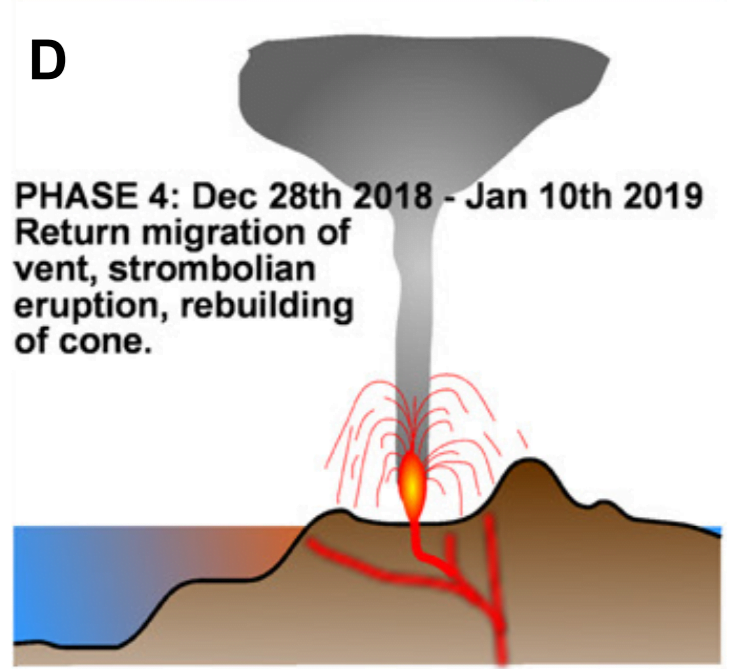
    Last December, the collapsing flank of the Anak Krakatoa volcano caused a deadly tsunami in Indonesia. Using satellite imagery, scientists have now constructed a timeline of the island’s dramatic restructuring. In the process, they found that the landslide that triggered the tsunami was likely much smaller than originally estimated.

    Their evidence shows that the landslide and tsunami (Image B) occurred before the eruption that destroyed the volcano’s cone. In fact, the landslide seems to have created a vent that opened directly underwater, which explains the increased violence of the eruption in late December and the eventual destruction of the volcano’s cone (Image C). After that, the underwater vent closed off and the eruption returned to its quieter state as the volcano began rebuilding its cone (Image D).

    The key finding here is that the initial landslide contained roughly a third of the material originally estimated. That means our tsunami models have been seriously underestimating the catastrophic potential of smaller volcanic landslides. Hopefully the lessons we learn from Anak Krakatoa will help us avoid future tragedies. (Image and research credit: R. Williams et al.; via BBC; submitted by Kam-Yung Soh)

  • Volcanic Plume

    Volcanic Plume

    Astronauts aboard the International Space Station captured this dramatic image of Raikoke Volcano’s eruption in late June. This uninhabited Pacific Island is part of the Kuril Islands off mainland Russia. The hot plume of ash and volcanic gas rose until its density matched that of the surrounding air, at which point it could only expand horizontally. This is why the plume appears to have such a flat top. It’s similar to the cumulonimbus clouds we associate with severe thunderstorms. Scientists speculate that the white ring around the plume’s base might be water vapor condensed from ambient air pulled in to the plume’s base or a side-effect of magma flowing into the surrounding sea. (Image credit: NASA; via NASA Earth Observatory)

  • Pluto’s Subsurface Ocean

    Pluto’s Subsurface Ocean

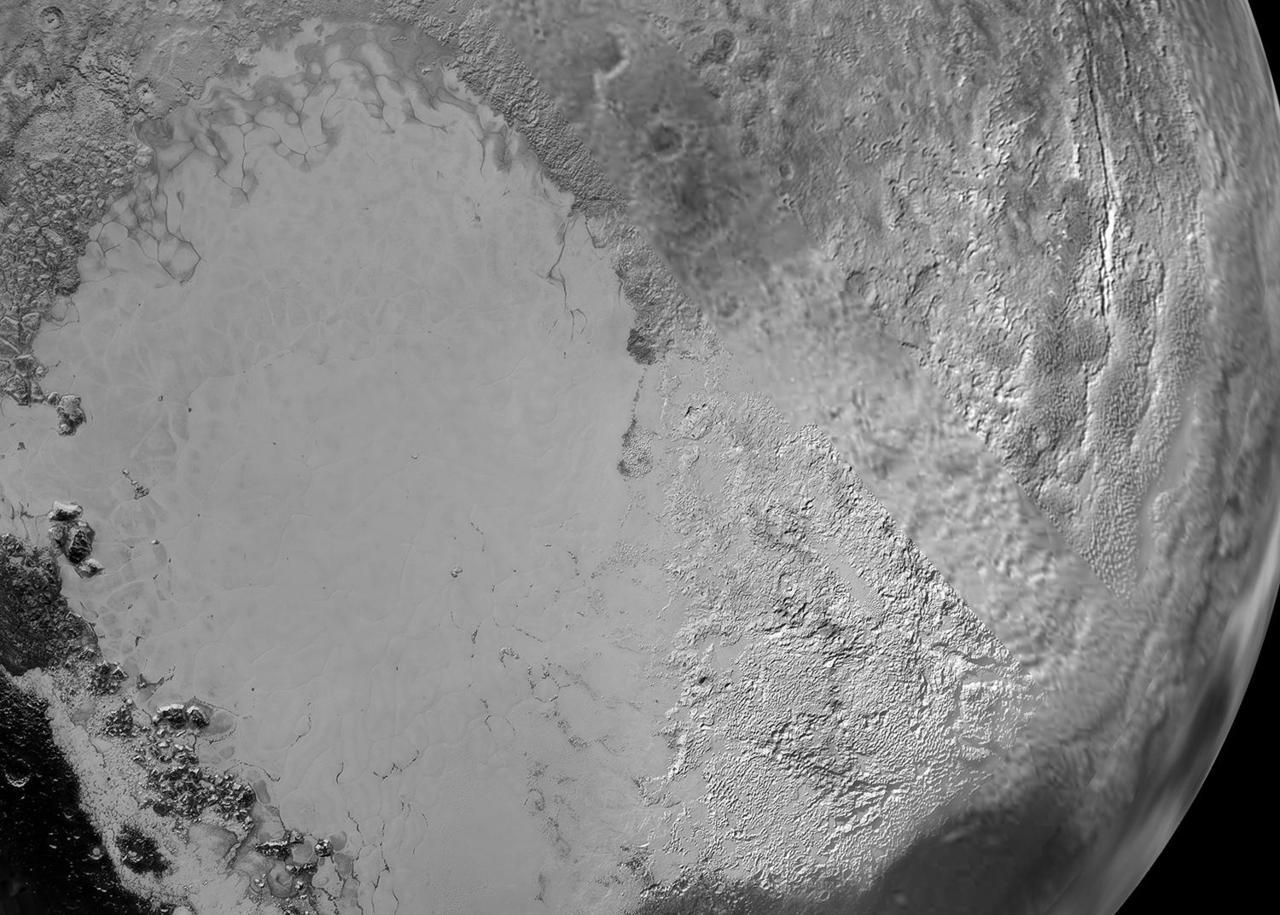
    Since the New Horizons probe visited Pluto in 2015, scientists have suspected that Sputnik Planitia (a.k.a. Pluto’s Heart), shown above, may hide a subsurface ocean. But it’s tough to explain how that ocean could stay warm enough to be liquid while the surface ice remains cold and viscous enough to support the variations in thickness we see. One theory cites the possibility of ammonia in the ocean, essentially serving as anti-freeze, but that would require much higher concentrations of ammonia than have been observed in comets – which, like Pluto, spend most of their time in the icy, frigid regions of the Kuiper Belt.

    A new study suggests another theory: a layer of gas-trapping hydrates between the liquid ocean and its icy cap. A thin layer of clathrate hydrates, as proposed by the authors, would trap gases like methane and create a thermally-insulating layer between a warm ocean and much colder ice cap. Because heat would struggle to cross the insulation layer, the water beneath would stay above the freezing point without the cold ice above leeching all of its warmth away.

    It would likely require future missions to Pluto or other potential ocean worlds to confirm the presence of such a hydrate layer, but, for now, the theory provides a possible new explanation for how icy objects like Pluto maintain liquids. (Image credit: NASA/JHU Applied Physics Laboratory/SwRI; research credit: S. Kamata et al.; via Gizmodo)

  • Earth, Moon, and Magma Ocean

    Earth, Moon, and Magma Ocean

    Among objects in our solar system, the Moon is rather unusual. It’s the only large moon paired with a rocky planet, and only Pluto’s Charon boasts a larger size relative to its planet. Chemically speaking, the Moon is also extremely similar to the Earth, which is part of why scientists theorized that the moon coalesced after the proto-Earth collided with a Mars-sized object. But lingering questions remained, like why the Moon is rich in iron oxide compared to the Earth.

    A new study tweaks the idea of the giant impactor by adding a magma ocean to the proto-Earth. In the early days of the solar system, collisions were so common that larger bodies (> 2*Mars) probably maintained a molten ocean. By simulating collisions with and without a magma ocean and studying the final composition of these simulated Earth-Moon-systems, the researchers found that a molten ocean not only matches the expected size and orbital characteristics of the two bodies, but the results reflect the actual chemical make-up of the  real Earth and Moon, too! (Image credits: moon – N. Thomas, impact simulation – N. Hosono et al.; research credit: N. Hosono et al.; via Ars Technica; submitted by Kam-Yung Soh)
  • Rays in Craters

    Rays in Craters

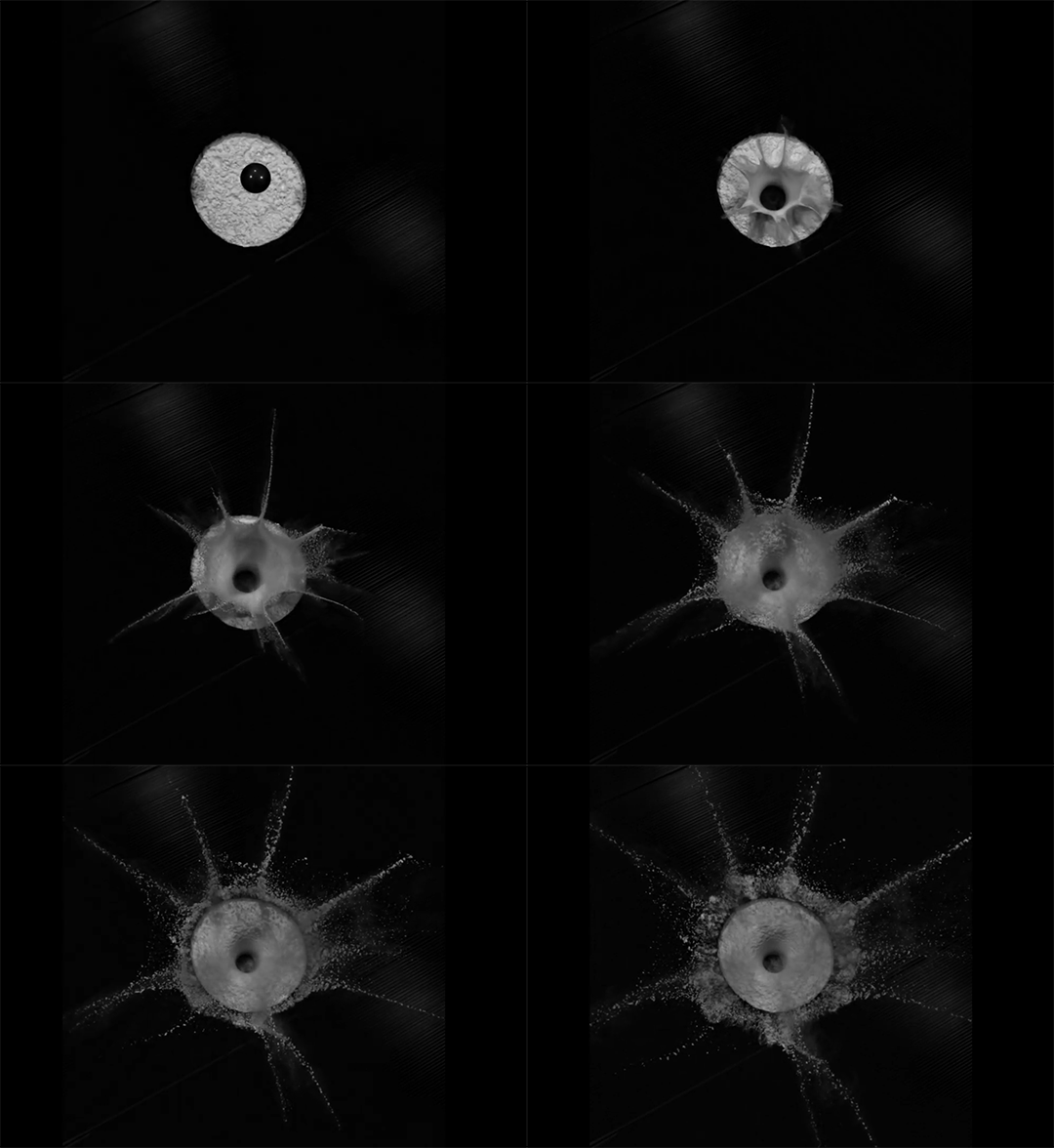
    On bodies around the solar system, there are craters marking billions of years’ worth of impacts. Many of these craters have rays–distinctive lines radiating out from the point of impact. But if you drop an object onto a smooth granular surface (upper left), the ejecta form a uniform splash with no rays. The impactor must hit a roughened surface (upper right) in order to leave rays. 

    Through experiment and simulation, researchers found that the rays emanate from valleys in the surface that come in contact with the impactor. Moreover, the number of rays that form depends only on the size of the impactor and the undulations of the surface. That means that, by knowing the topography of a planetary body and counting the number of rays left behind, scientists can now estimate what the size of the object that struck was! (Image, video, and research credit: T. Sabuwala et al.)

  • Anak Krakatoa Tsunami

    Anak Krakatoa Tsunami

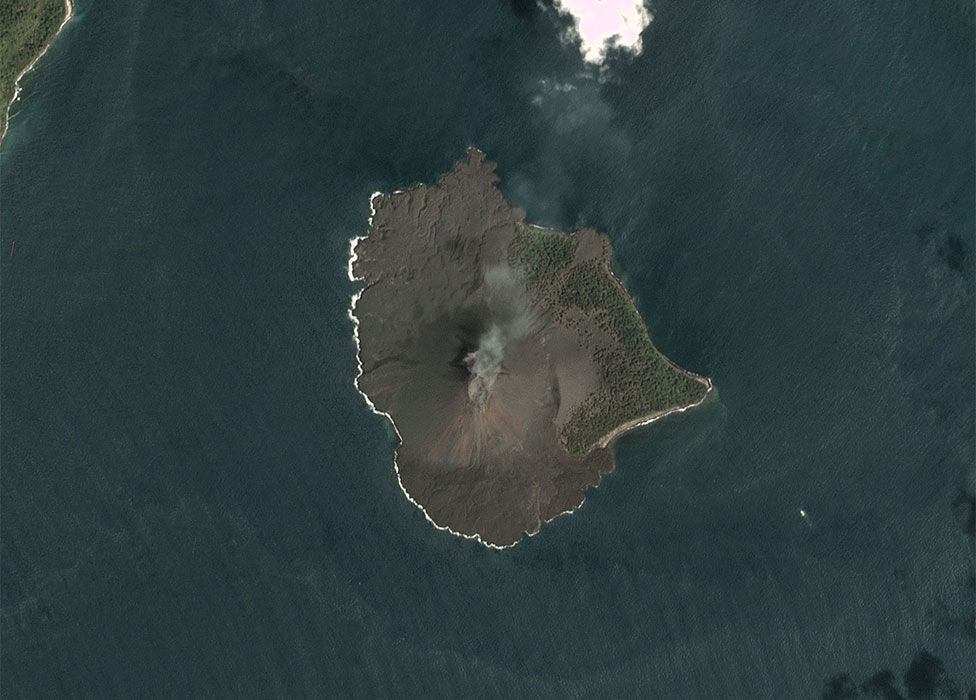
    In late December 2018, a landslide on the island Anak Krakatoa triggered a deadly tsunami in Indonesia. The island (upper left, pre-landslide) lost an estimated 300 meters of height in the landslide, dramatically altering its appearance (upper right; post-landslide). Much of the slide occurred underwater, dumping material into a crater left by the famous 1883 eruption of Krakatoa

    The slide displaced a massive amount of water, creating a tsunami that spread, refracting around nearby islands and reflecting off shorelines in complicated patterns. A new numerical simulation, shown above, models the post-slide tsunami based on terrain data and fluid physics. Its wave predictions match well with the high-water readings from nearby islands. The scientists hope that such models, combined with monitoring, will help save lives should a future eruption trigger more tsunamis.

    For a full picture of both the recent Anak Krakatoa eruption and its famous predecessor, check out this video. (Image credits: satellite views before and after landslide – Planet Labs; simulation – S. Ward, source; via BBC News; submitted by Kam-Yung Soh)

  • Featured Video Play Icon

    Recreating Pyroclastic Flow

    One of the deadliest features of some volcanic eruptions is the pyroclastic flow, a current of hot gas and volcanic ash capable of moving hundreds of kilometers an hour and covering tens of kilometers. Since volcanic particles have a high static friction, it’s been something of a mystery how the flows can move so quickly. Using large-scale experiments (top), researchers are now digging into the details of these fast-moving flows.

    What they found is that the two-phase flow results in a pressure gradient that tends to force gases downward. This creates a gas layer with very little friction near the bottom of the pyroclastic flow (bottom), essentially lubricating the entire flow with air. This helps explain why pyroclastic flows are so fast and long-lived despite their inherent friction and the roughness of the terrain over which they flow. (Image and research credit: G. Lube et al.; video credit: Nature; submitted by Kam-Yung Soh)