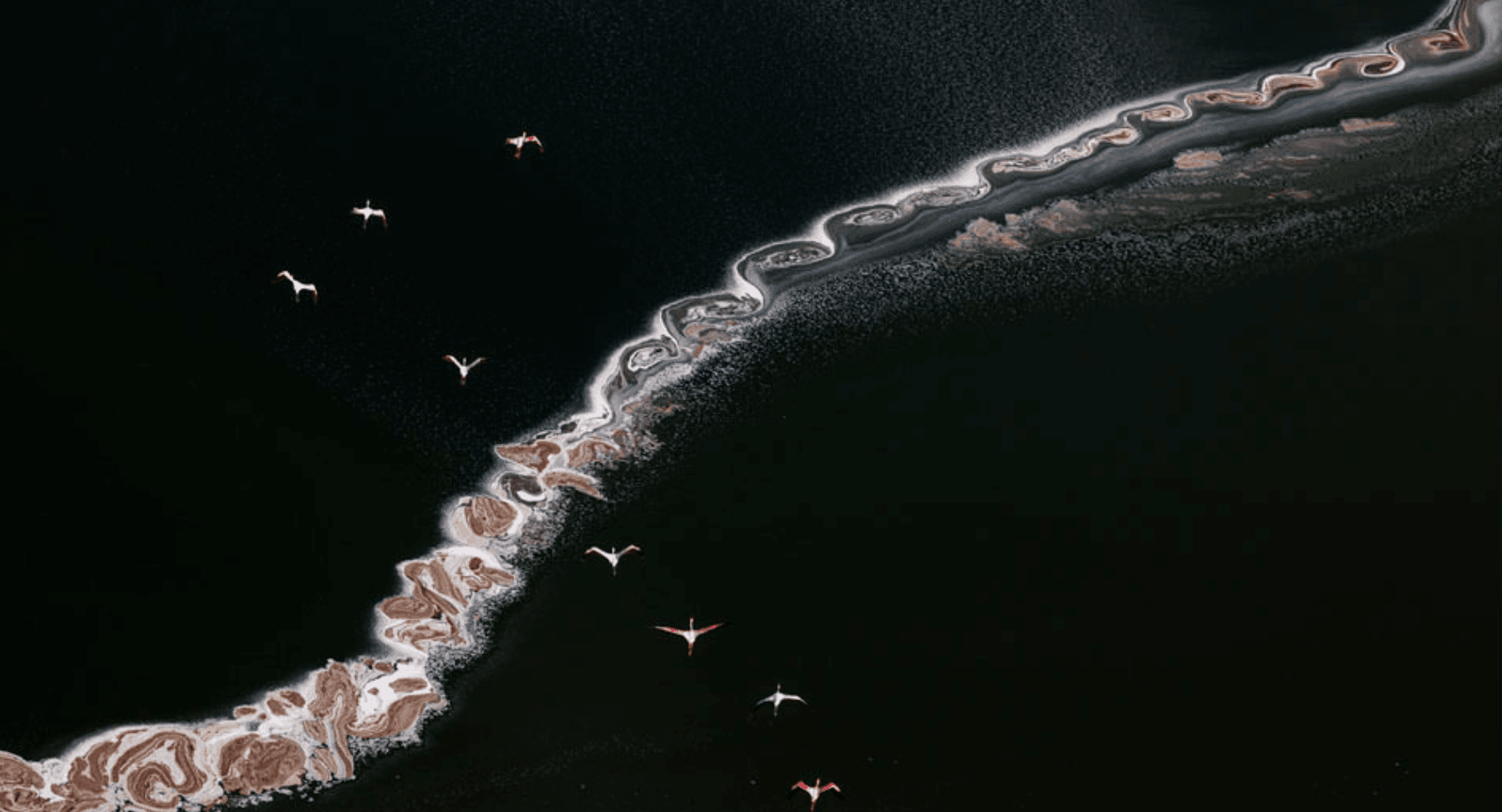
Flamingos soar over swirls of salt and algae in a lake in Kenya’s Rift Valley. Shaped by winds, currents, physics, and chemistry these eddies reflect the motion of the water, evaporation patterns, and more. Without more information, it’s hard to say exactly what shapes the pattern, but it does appear reminiscent of a Kelvin-Helmholtz instability in places. (Image credit: B. Hayden/IAPOTY; via Colossal)
Tag: fluids as art

“Sensations”


Beautiful colors, subtle flows, and sudden fractals animate Thomas Blanchard’s “Sensations,” which, like his other short films, is entirely CGI-free. It’s a lovely exploration of droplets, liquid lenses, Marangoni effects, and fingering instabilities. (Video and image credit: T. Blanchard)
Fediverse Reactions
-

A Sandy Spine
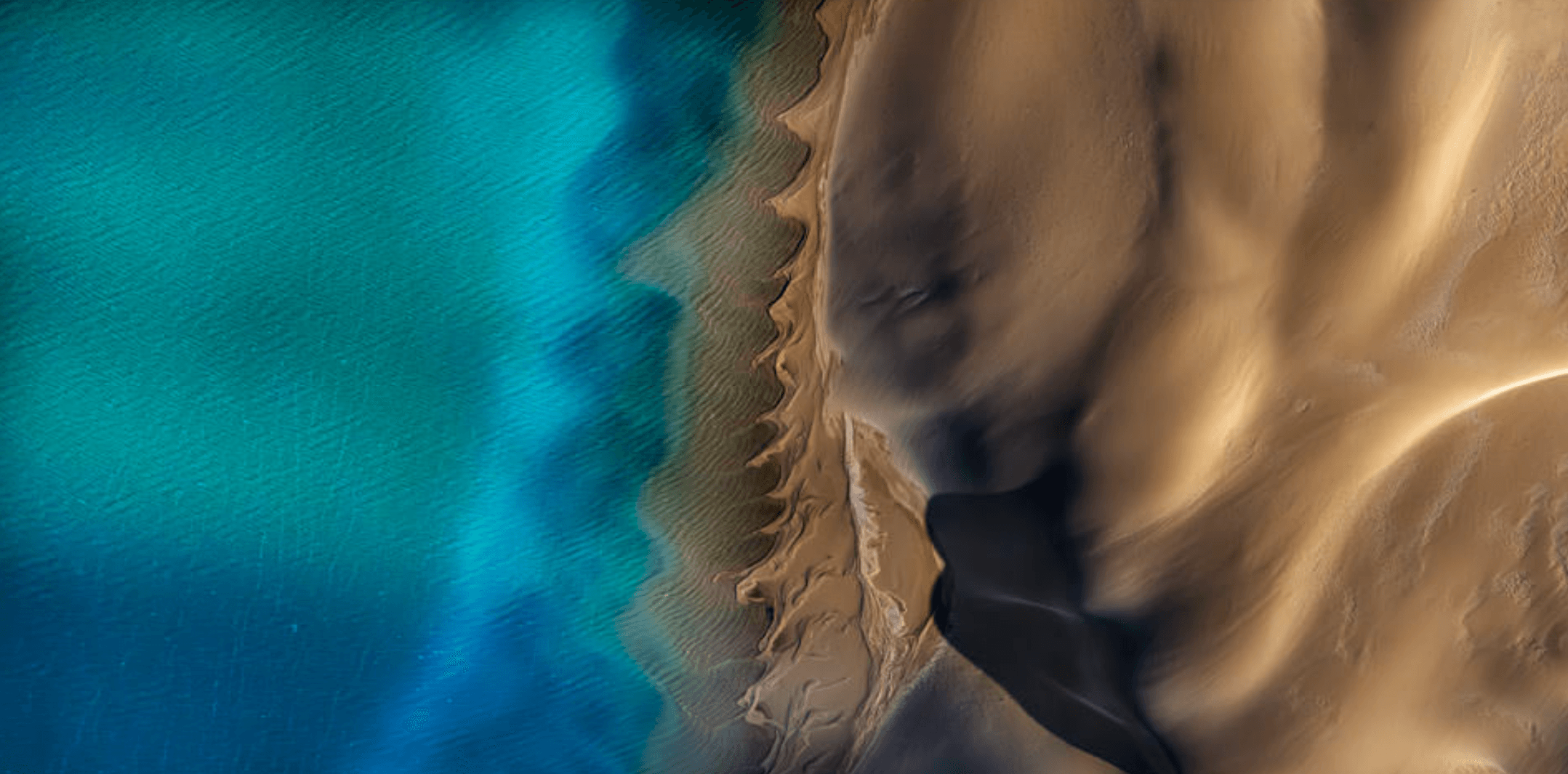
Where sea and sand meet, Gaia’s spine rises. Photographer Satheesh Nair captured this striking image in western Australia, where wind and wave action have dragged a dune into vertebrae-like cusps. Notice how the size and shape of the curves differs between the under- and above-water sections. Those differences reflect the differing forces that shape them — just water for one set, water and air for the other. (Image credit: S. Nair/IAPOTY; via Colossal)
Fediverse Reactions
-

Glacier Timelines

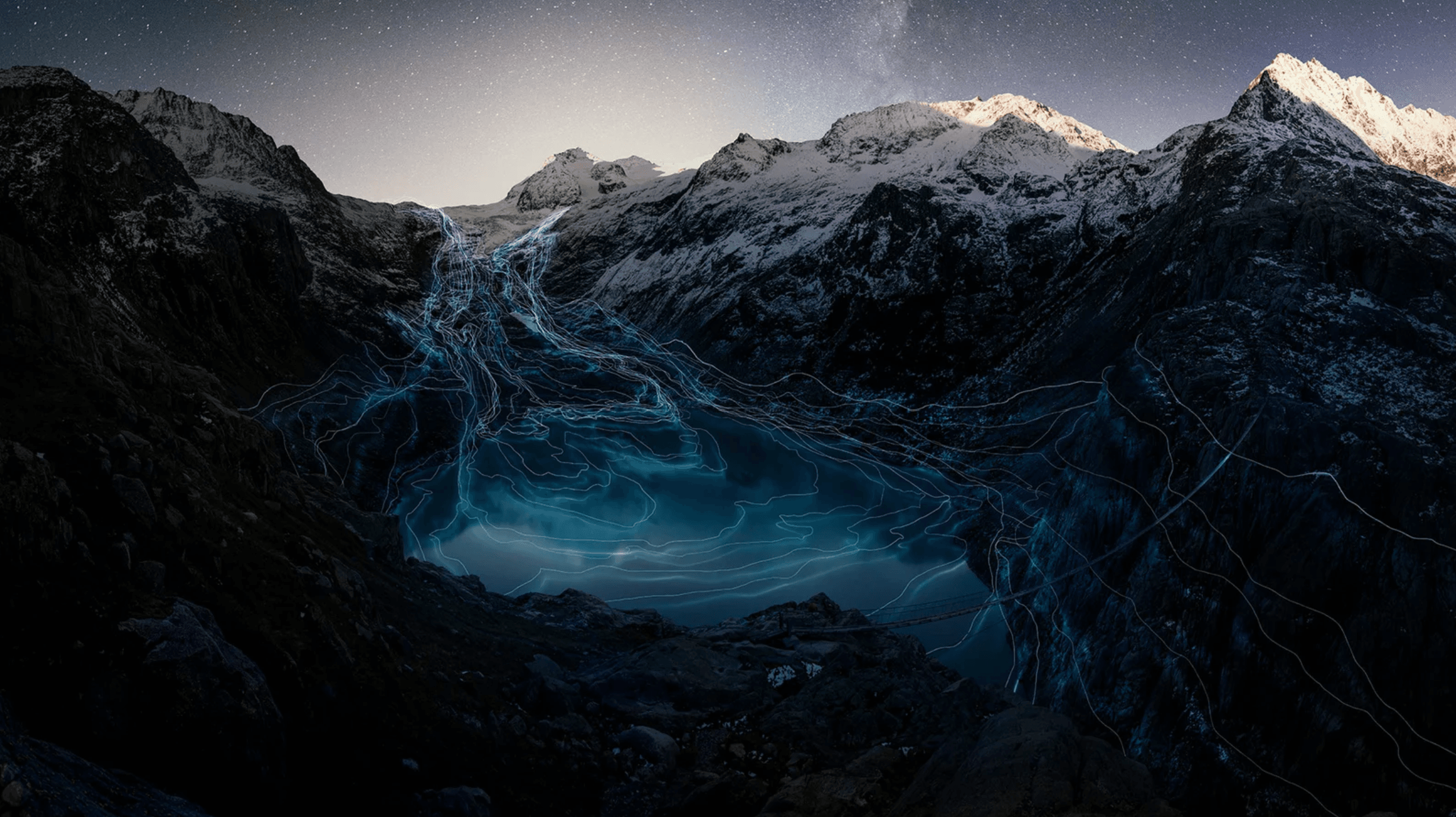
Over the past 150 years, Switzerland’s glaciers have retreated up the alpine slopes, eaten away by warming temperatures induced by industrialization. But such changes can be difficult for people to visualize, so artist Fabian Oefner set out to make these changes more comprehensible. These photographs — showing the Rhone and Trift glaciers — are the result. Oefner took the glacial extent records dating back into the 1800s and programmed them into a drone. Lit by LED, the drone flew each year’s profile over the mountainside, with Oefner capturing the path through long-exposure photography. When all the paths are combined, viewers can see the glacier’s history written on its very slopes. The effect is, fittingly, ghost-like. We see a glimpse of the glacier as it was, laid over its current remains. (Image credit: F. Oefner; video credit: Google Arts and Culture)
Fediverse Reactions
-

Branching Dendrites
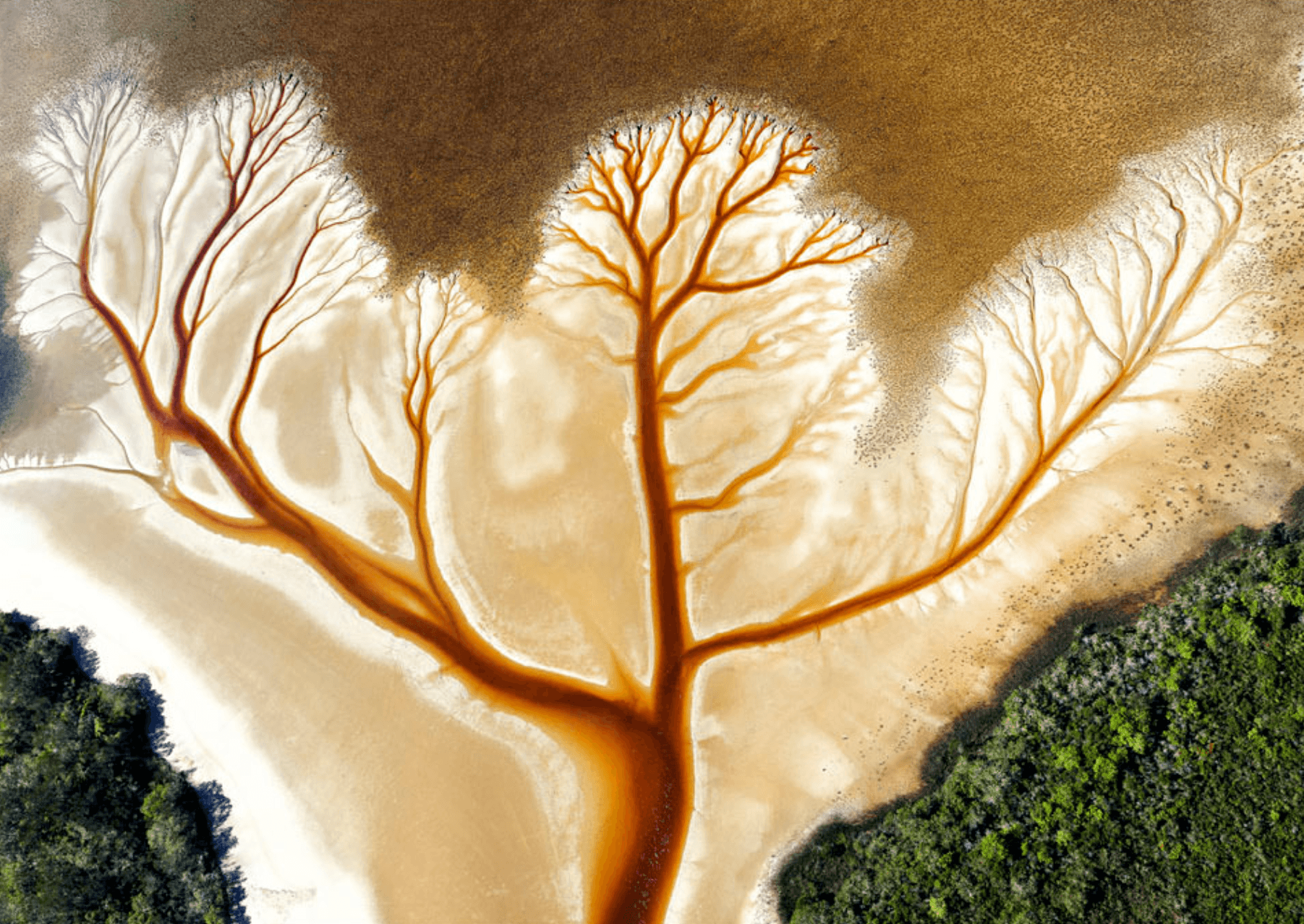
This award-winning aerial image by photographer Stuart Chape shows a tidal creek in Lake Cakora, New South Wales, Australia. At first glance, it looks much like any river delta, with branching dendritic paths that split into smaller and smaller waterways. That’s deceptive, though, because very different forces shape this creek. Because tides move in and out, a tidal creek is home to flows that move both directions — toward and away from the branches. That also means that flow speeds can change rapidly as the tides shift, which in turn changes which sediments get lifted, dropped, and moved around the creek bed. (Image credit: S. Chape/IAPOTY; via Colossal)
Fediverse Reactions
-
“Creation”


Videographer Vadim Sherbakov’s short film “Creation” is full of glittery vistas created under a macro lens. Shifting, particle-seeded flows shimmer in bright colors. Glistening deltas shift and form, and Marangoni flows generate feathers and tree-like dendritic arms. Macro flows never cease to fascinate. (Video and image credit: V. Sherbakov; via Colossal)

Bright Night Lights
A coronal mass ejection from the Sun set night skies ablaze in mid-October 2024. This composite panorama shows a busy night sky over New Zealand’s South Island. A widespread red aurora was joined by a green picket-fence aurora and a host of other magnetohydrodynamic phenomena. To the left shines a bright Stable Auroral Red (SAR) arc. On the right near the Moon hangs the purple arc of a STEVE — strong thermal emission velocity enhancement. All of these auroras (and aurora-adjacent phenomena) take place when high-energy particles from the solar wind interact with molecules in our atmosphere. Which molecules they encounter determines the color of the aurora, and the shape depends, in part, on which magnetic lines the particles get funneled down. With strong solar storms like this one, auroras can reach far from the poles, and, as seen here, can show up in many varieties. (Image credit: T. McDonald; via APOD)
Fediverse Reactions
-
“Now I See – The Collection Vol. 2”


In the next video of his current collection, Roman De Giuli takes us flying over liquid landscapes that look like our Earth in miniature. Many of them have the feeling of river deltas or glaciers. Sharp-eyed viewers will notice bubbles and flotsam in some of these streams. If you follow them, you can see how the flows vary — wiggling around islands, speeding up through constrictions and slowing down when the stream widens. It is, as always, a beautiful form of flow visualization. (Video and image credit: R. De Giuli)
Fediverse Reactions
-
“C R Y S T A L S”
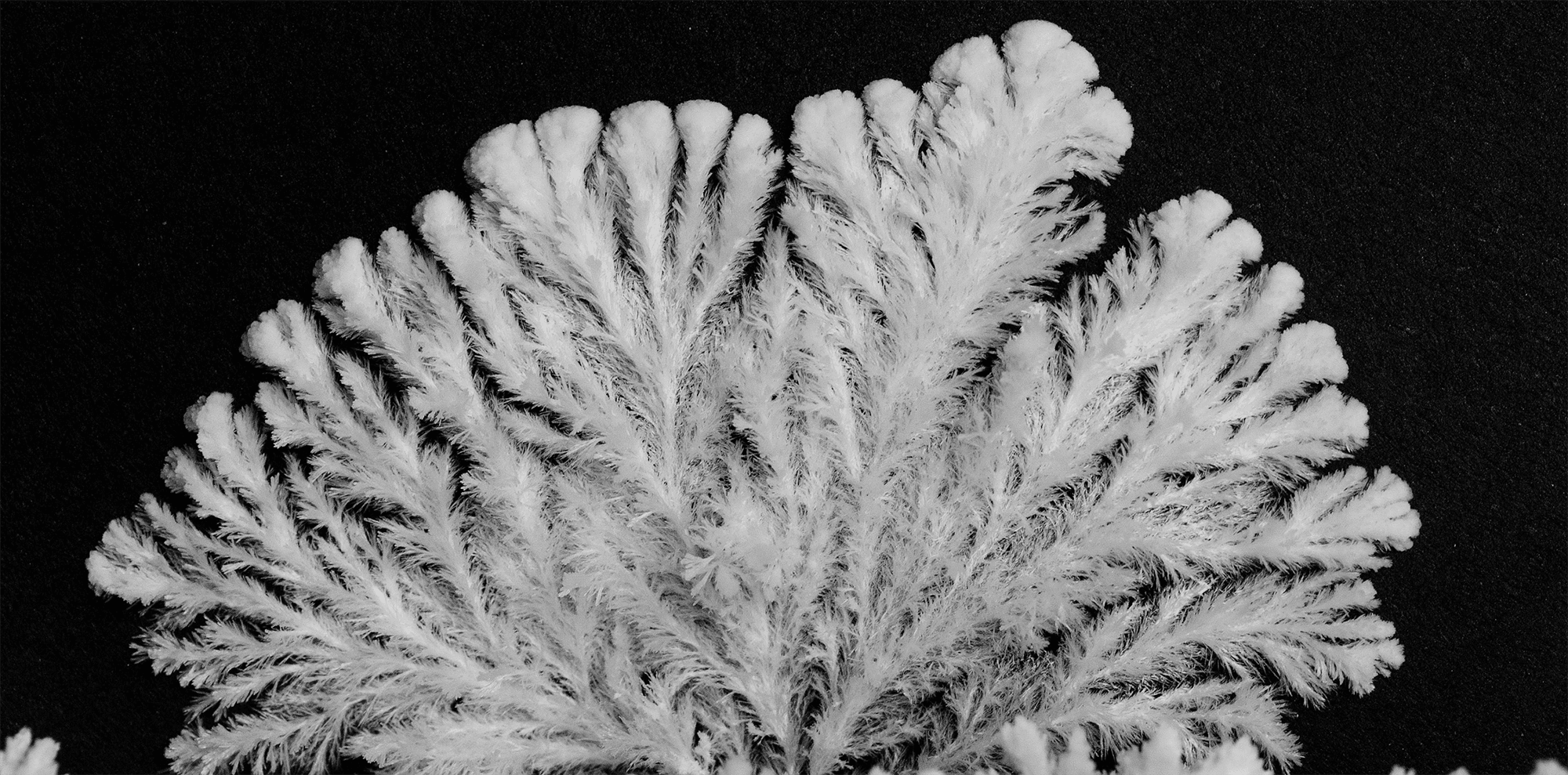


In “C R Y S T A L S,” filmmaker Thomas Blanchard captures the slow, inexorable growth of potassium phosphate crystals. He took over 150,000 images — one per minute — to document the way crystals formed as the originally transparent liquid evaporated. Some crystals branch into fractals. Others bulge outward like a condensing cloud or a sprouting mushroom. (Video and image credit: T. Blanchard)
Fediverse Reactions
-

Stunning Interstellar Turbulence
The space between stars, known as the interstellar medium, may be sparse, but it is far from empty. Gas, dust, and plasma in this region forms compressible magnetized turbulence, with some pockets moving supersonically and others moving slower than sound. The flows here influence how stars form, how cosmic rays spread, and where metals and other planetary building blocks wind up. To better understand the physics of this region, researchers built a numerical simulation with over 1,000 billion grid points, creating an unprecedentedly detailed picture of this turbulence.
The images above are two-dimensional slices from the full 3D simulation. The upper image shows the current density while the lower one shows mass density. On the right side of the images, magnetic field lines are superimposed in white. The results are gorgeous. Can you imagine a fly-through video? (Image and research credit: J. Beattie et al.; via Gizmodo)
Fediverse Reactions
-