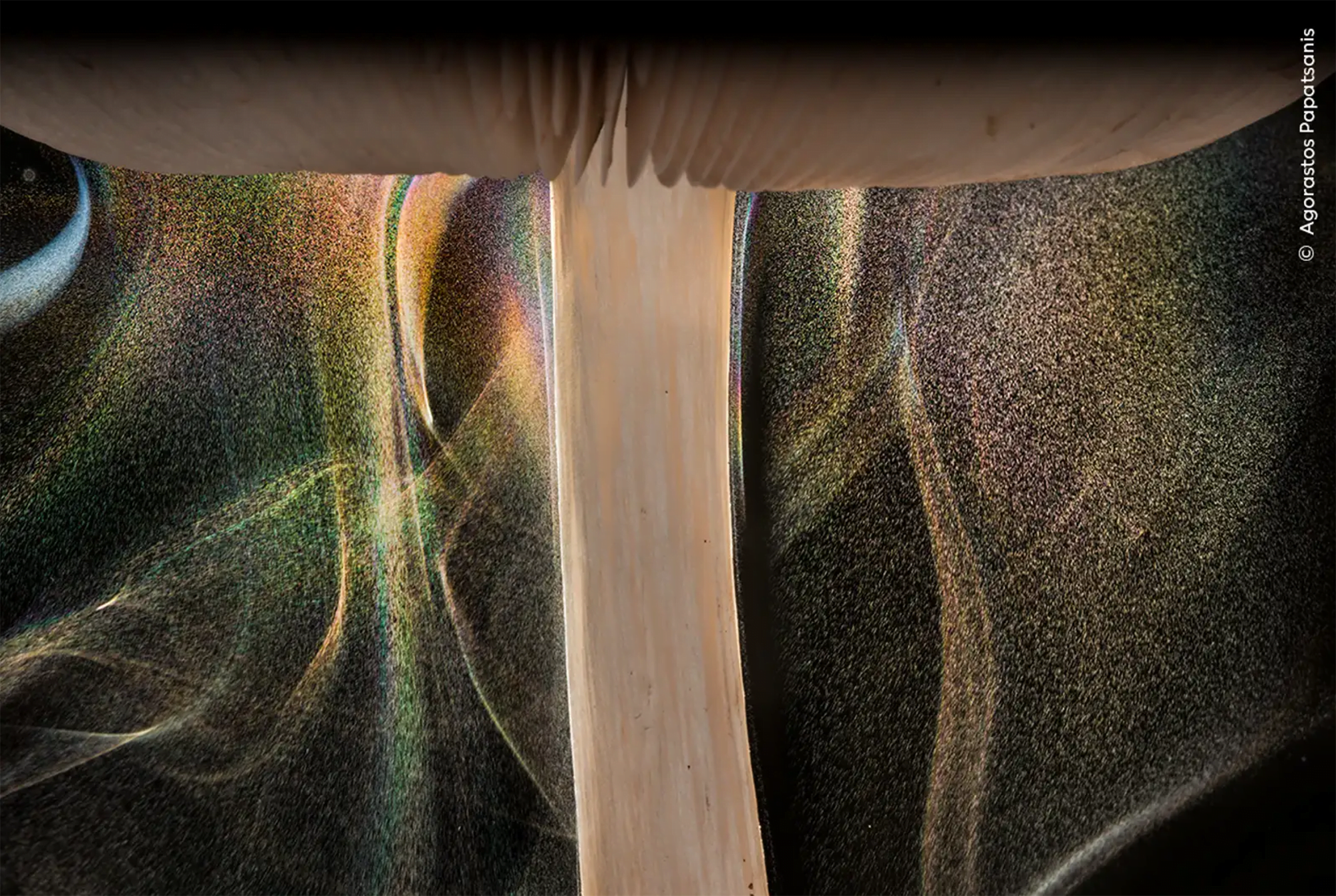
Bright colors mark this slowly draining soap film. The film sits slightly off-horizontal, so flow shifts over time from the top of the frame to the bottom. The fluid is also evaporating. All the faster shifts are caused by ambient air currents from the room. The colors of the film are directly related to the local thickness; as the film thins and evaporates, the bright colors shift to darker ones. Eventually, that black region at the top will expand and the film will break up. (Video credit: B. Sandnes/Complex Flow Lab)
Tag: fluids as art

“Space Iris”
Ruslan Khasanov’s “Space Iris” explores the similarities between nebulae and eyes. Made entirely with common fluids like paint, soap, and alcohol, the film shows off the gorgeous possibilities of surface-tension- and density-driven instabilities. Marangoni flows abound! I even see some hints of solutal convection, perhaps? (Video and image credit: R. Khasanov; via Colossal)

“The Beauty in Creation”
Volcanoes are endlessly fascinating to watch, especially in this era of drone photography. Joey Helms’s short film “The Beauty in Creation” shows the Fagradalsfjall eruption in Iceland. Sail over rivers of lava, watch fountains spurting, and even see lava dripping back into the caldera. They’re views that no human gets to witness directly, but they certainly do highlight the peculiar collision of destruction and creation inherent in volcanic eruption. (Video credit: J. Helms)

Marshy Veins
From above, the salt marshes of Alviso Marina County Park look like veins and capillaries in this photo from Tayfun Coskun. The waterways curve and branch, forming fractal patterns only apparent from the air. Although the mechanisms that form these dendritic patterns vary, they are very common in fluids, appearing over and over at many scales. (Image credit: T. Coskun; via Gizmodo)

Glowing Skies
Not every experiment turns out as expected. Photographer Julien Looten expected to capture the Milky Way arching across the sky above this French chateau. But the photo’s most striking feature is instead the airglow suffusing the sky. The psychedelic colors result from air high in Earth’s atmosphere getting excited by sunlight and producing a faint glow of its own. Such airglow is common, though not always easily seen. If you watch videos from the ISS, you may notice the orange arc of airglow over the atmosphere. (Image credit: J. Looten; via APOD)

“Níłtsą́”
Living in the central and western United States, it’s easy to dismiss summer weather as just another storm, but the truth is that this region sees some of the most majestic and spectacular thunderstorms in the world. And no one captures that grandeur better than storm-chasing photographer Mike Olbinski. His latest film is named for the Navajo word for rain and features over 12 minutes of the best storms from 2021 and 2022. Towering turbulent clouds grow by convection, lightning splits the night sky, and microbursts pour down from above. As always, it’s a stunning depiction of the power of atmospheric fluid dynamics. (Image and video credit: M. Olbinski)

“Eternal Spring”
With every spring comes the thaw. Warming temperatures melt winter’s ice, carving it away to reveal the surfaces beneath. Christopher Dormoy’s macroscale timelapse “Eternal Spring” captures this dynamic, showing the process drop-by-drop and rivulet-by-rivulet. It’s also a commentary on melting in general as human-driven climate change chips away at ice that formed over millennia. (Video and image credit: C. Dormoy)

Fog in the Blue Ridge Mountains
Fog blankets the forest of the Blue Ridge Mountains in this photo by Tihomir Trichkov. It gives the photo the quality of an Impressionist painting. Rain from the day before left lots of moisture in the air and soil, contributing to the ethereal condensation lit by the sunrise. (Image credit: T. Trichkov; via Gizmodo)

“Water in Dripping”
Zheng Lu’s stainless steel sculptures capture elaborate splashes in action. In some of the pieces, thousands of Chinese characters cover the sculpture’s surface; these are quotes from historical texts and poems, an homage to early Chinese philosophers who studied the principles of the natural world. See more examples of the artist’s work here. (Image credit: Z. Lu; via Colossal)

Runescapes
Drying fluids can leave behind all kinds of fascinating patterns, as we’ve seen before with whiskey, coffee, and even blood. Here researchers study patterns left behind by lipids, dyes, and other fluids. They place their mixture in a rotating flask kept in a warm bath. For a few hours, the fluids mix, chemically react, and evaporate. The complex interactions that take place in that time leave behind fascinating, rune-like patterns, seen here under a microscope. It’s a bit like looking at photos of Martian landscapes! (Image credit: M. Murali and L. Shen)