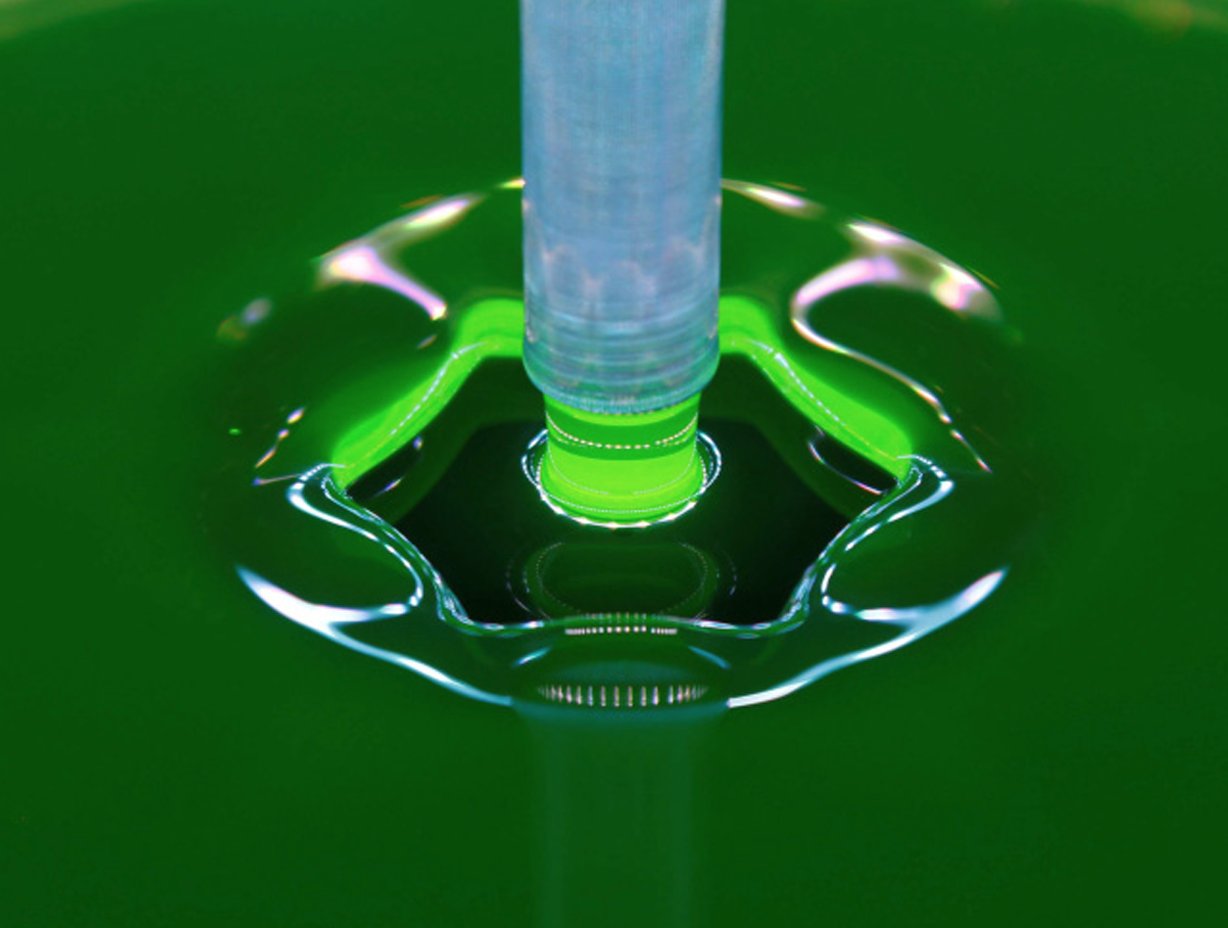
When you turn on your kitchen faucet, you may have noticed a big circle that forms on the bottom of the sink. This is a hydraulic jump, a region where fast-moving, shallow flow shifts to a slower-moving, deeper flow. Although these jumps start out circular, if the fluid is deeper than a critical value, the jump will break down and form polygons, like the one above. Exactly what shape the jump forms depends on many factors: flow speed, fluid depth, and flow history. The same flow conditions can even form more than one shape. But all of these shapes have one thing in common: their corners are universally around 114 degrees with a radius of 3.5 millimeters. (Image and research credit: S. Tamim et al.; via PRF)
Tag: fluid dynamics

Walking in the Wake of a Cylinder


A cylinder in a flow produces a series of alternating vortices known as a von Karman vortex street. Changing the flow speed and rotating the cylinder both allow researchers to tune the frequency of these shed vortices. What happens to an object in the wake?
For a simple hydrofoil tethered to the cylinder, the object wends back and forth along the vortices. But when that hydrofoil sits at the end of a double-pendulum, something very interesting happens. The whole apparatus follows a consistent trajectory similar to a human walking gait. Researchers are using this motion to build a robot that will help physical therapy patients regain a natural walking style. (Image and video credit: A. Carleton et al.)

100 For the Ocean


One hundred photographers of all genres are coming together this month to raise money for ocean conservation in “100 For the Ocean.” Through the end of this month, they’re selling prints of these and other images, starting at $100 apiece. All proceeds will go to ocean conservation. Check out all the prints here, and if your wall has a bare spot, now’s a great time to add some artwork on a fluidsy nature. (Image credits: 100 For the Ocean, individual photographers listed in gallery titles; via Colossal)
Disclosure: I have no affiliation whatsoever with this fundraiser. I just like great photos and preserving nature.

Flow Over an AT-AT
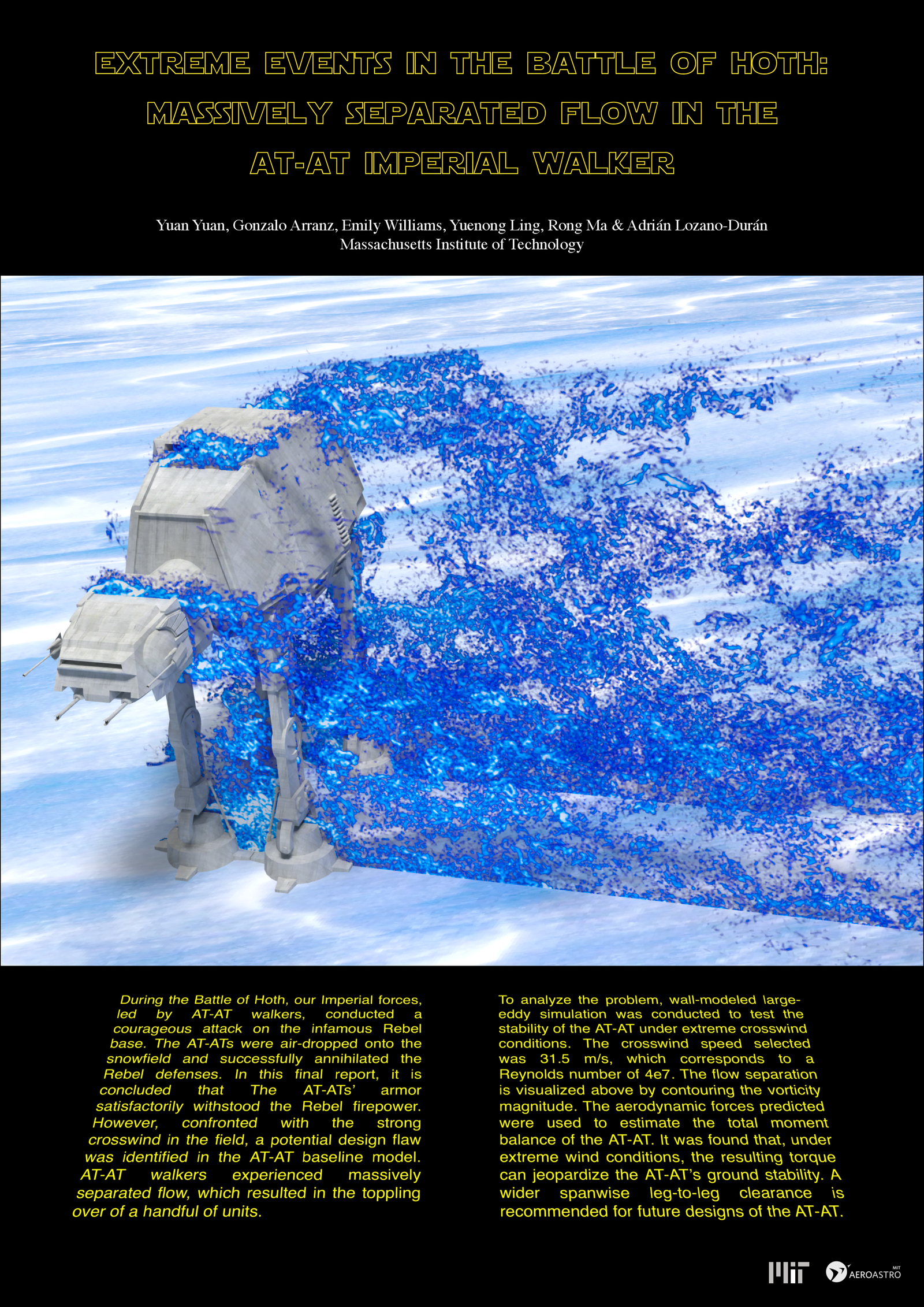
Having previously examined the re-entry characteristics of an X-Wing, a group of engineers are back to look at Imperial vehicle physics. In this poster, they look at what happens to the AT-AT walker when strong crosswinds, like those seen in the Battle of Hoth, blow across the vehicle’s path. Given its boxy body and gangly legs, it will come as no surprise that the AT-AT is not at all streamlined and instead causes lots of separated flow. Those flow separations come with strong side forces that can tip the walkers.
Be sure to take a closer look at the text on the poster. It’s written from the perspective of Imperial engineers, complete with recommendations for the next generation of AT-AT. (I don’t think those got built, at least not by the Empire!) May the 4th be with you! (Image credit: Y. Yuan et al.)

Giant Droplet Splashes
When droplets get larger than 0.27 cm, they no longer stay spherical as they fall. Here, researchers look at very large droplets (equivalent to 3.06 cm in diameter) falling into water. On their way to the pool, the droplets oscillate — some lengthening, some flattening, and some bulging into a bag. The droplet’s shape at impact (and its speed) determine what shape of splash and cavity form. Wider drops make wider and shallower cavities. (Image credit: S. Dighe et al.)

Honeybee Feeding
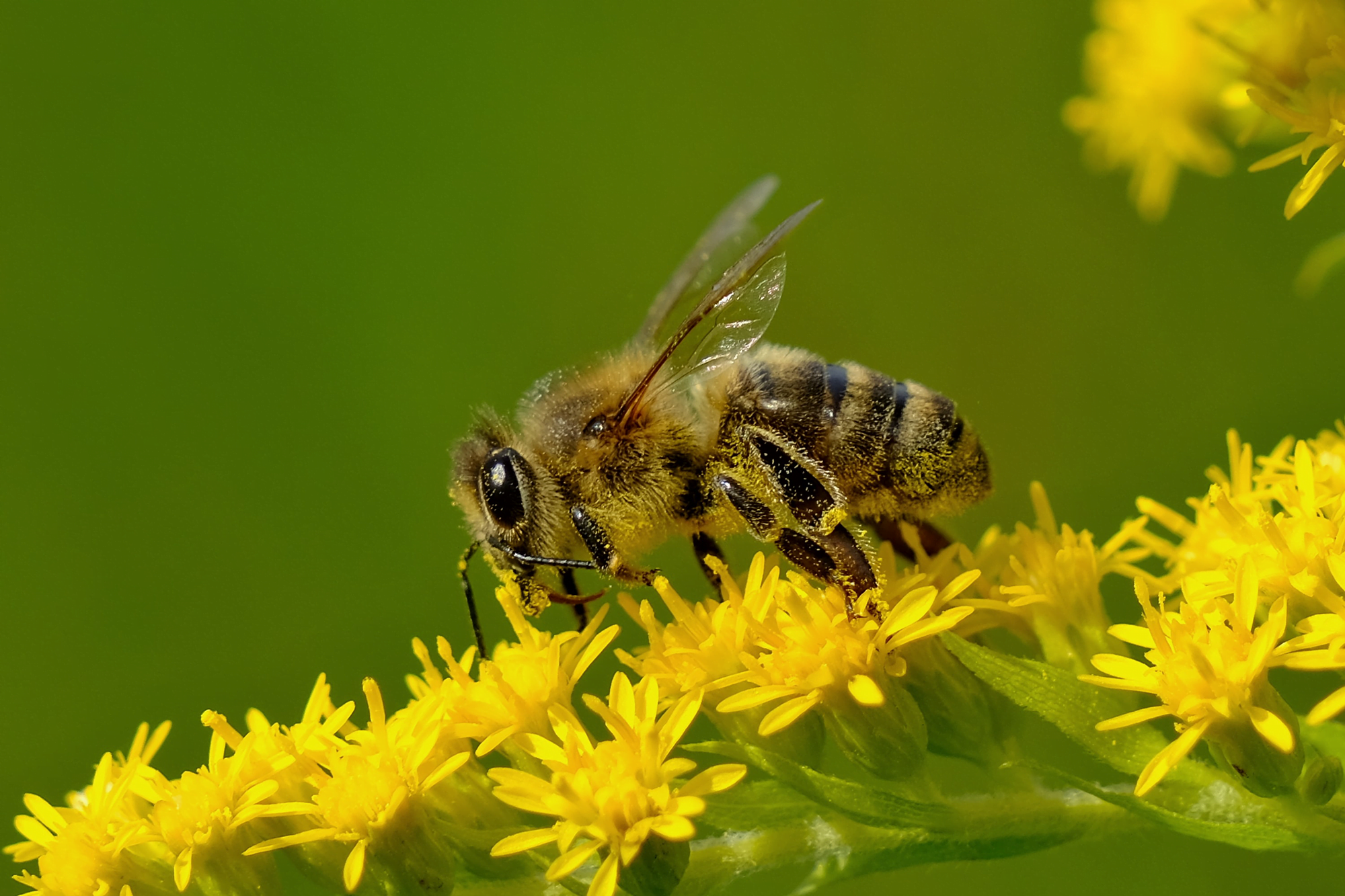
Busy bees feed on millions of flowers for each kilogram of honey they produce. To gather nectar, bees use their hairy tongues, which project out of a sheath-like cover. Protraction (i.e., sticking their tongue out) is relatively fast because all the hairs on the tongue initially lie flat. In the nectar, those hairs flare out, creating a miniature forest that traps viscous nectar and drags it back into the bee during retraction.

Bees feed by projecting their tongues into nectar. Tongue extension is faster because the tongue’s hairs lie flat. During the slower retraction phase, the hairs flare out, trapping nectar and pulling it back into the bee. Through modeling and experiments, researchers found that the time it takes a bee to retract its tongue depends on the bee’s overall mass. Smaller bees are slower to the retract their tongues, likely to allow enough time for their shorter tongues to capture enough nectar. With bee populations on the decline, the team’s predictions may help communities select flowers with nectar concentrations that best fit their local bees’ needs. (Image credits: top – J. Szabó, bee eating – B. Wang et al.; research credit: B. Wang et al.; via APS Physics)

Ominous Mammatus
Mammatus clouds are fairly unusual and often look quite dramatic. Most clouds have flat bottoms, caused by the specific height and temperature at which their droplets condense. But mammatus clouds have bubble-like bottoms that are thought to form when large droplets of water or ice sink as they evaporate. Although they can occur in the turbulence caused by a thunderstorm, mammatus clouds themselves are not a storm cloud. They appear in non-stormy skies, too. The clouds are particularly striking when they’re lit from the side, as in the image above. (Image credit: J. Olson; via APOD)

Snow-Covered Trees


In the Hakkōda Mountains of Japan, snow encases the trees, transforming the ski slopes into a hoodoo-filled winter wonderland. Photographer Sho Shibata captured these images while journeying through the area a few years ago. The combination of wind and snow sculpts the trees into surprisingly similar shapes! (Image credit: S. Shibata; via Colossal)
Water-Jumping Springtails


Springtails are small, jumping insects. Semiaquatic varieties use their tails to jump off water in order to move around and escape predation. Among these water jumpers, results vary; some, like in the third image, have little to no control over their landings and will frequently faceplant or land on their backs. But some species in the family have a better technique.
These springtails grab a water droplet with their hydrophilic ventral tube (seen in the second image with a red identifying arrow) during take-off. This tiny water droplet serves several purposes. First, it adds extra weight to the insect, allowing it to better orient its body to land belly-down. Second, the drop gives the insect a way to adhere to the water during landing, preventing it from bouncing. Check out the video to see lots of high-speed video of these tiny acrobats! (Video and image credit: A. Smith/Ant Lab; research credit: V. Ortega-Jimenez et al.)
Why Rivers Shift


In their natural state, rivers are variable in their course, shifting and meandering. Sometimes they deposit sediment, and sometimes they erode it. In this video, Grady from Practical Engineering digs into the principles behind these changes. With help from Emriver‘s stream tables, which demonstrate years of changes in a river over minutes, Grady shows how changing the sediment load, flow rate, and other factors in a river affect its course. (Video credit: Practical Engineering)