Tag: fluid dynamics

  • Gravity Changes Droplet Shapes

    Gravity Changes Droplet Shapes

    With small droplets, gravity usually has little effect compared to surface tension. An evaporating water droplet holds its spherical shape as it evaporates. But the story is different when you add proteins to the droplet, as seen in this recent study.

    The protein-filled sessile drop starts out largely spherical, but as the drop evaporates, the concentration of proteins reaches a critical point and an elastic skin forms over the drop. From this point onward, the drop flattens.
    The protein-filled sessile drop starts out largely spherical, but as the drop evaporates, the concentration of proteins reaches a critical point and an elastic skin forms over the drop. From this point onward, the drop flattens.

    As a protein-doped droplet sitting on a surface evaporates, it starts out spherical, like its protein-free cousin. But, as the water evaporates, it leaves proteins behind, gradually increasing their concentration. Eventually, they form an elastic skin covering the drop. As water continues to evaporate, the droplet flattens.

    For a hanging droplet, the shape again starts out spherical. But as the drop's water evaporates and the proteins concentrate, it also forms an elastic skin. As the drop evaporates further, the skin wrinkles.
    For a hanging droplet, the shape again starts out spherical. But as the drop’s water evaporates and the proteins concentrate, it also forms an elastic skin. As the drop evaporates further, the skin wrinkles.

    In contrast, a hanging droplet with proteins takes on a wrinkled appearance once its elastic skin forms. The key difference, according to the model constructed by the authors, is the direction that gravity points. Despite these droplets’ small size, gravity makes a difference! (Image, video, and research credit: D. Riccobelli et al.; via APS Physics)

  • Staying Cool in the Sun

    Staying Cool in the Sun

    For humans, staying cool in the summer heat often means expending energy on air conditioners, fans, and other cooling devices. But scientists are exploring other, less energy-intense options for beating the heat. At a conference, researchers recently unveiled a plant-based bi-layer film that’s able to stay about 7 degrees Fahrenheit cooler than its surroundings while illuminated by the sun.

    The film uses passive daytime radiative cooling, which means that it emits its heat into space (without getting absorbed by the air nearby) without any external power source. A square meter of the film generates over 120 watts of cooling power, comparable to many residential air conditioners. Even better, the films are built from layered cellulose, a sustainable and renewable resource, and can be made in a variety of colors.

    The team hopes to transition their films to commercial manufacturing, where they can be incorporated into buildings and automobiles to provide some passive cooling, thereby limiting reliance on air conditioners. (Image and research credit: Q. Shen et al.; via Ars Technica)

  • Featured Video Play Icon

    Fresh Fissures

    North of Iceland’s Fagradalsfjall, a new volcanic fissure opened in July 2023. This drone footage from Isak Finnbogason captures that fissure on its first night. Lava fountains jet from the earth, forming a complex, slow-moving river. The similarities between flowing lava and more common liquids like water never ceases to fascinate me. Even with the vast differences in temperature and viscosity, so much of their physics remains recognizably the same. (Image and video credit: I. Finnbogason; via Colossal)

  • Testing Turbulence’s Limits

    Testing Turbulence’s Limits

    Understanding chaotic, turbulent flows has long challenged scientists and engineers due to their sheer complexity. In turbulent flows, energy cascades from the largest scales — like the kilometer-size cross-section of a cloud — to the very smallest scales, less than a millimeter in size, where viscosity transforms the flow’s motion to heat. For nearly a century, our theoretical understanding of turbulence has posited that there are certain universal behaviors in the statistics of a turbulent flow — essentially that, due to this energy cascade, some aspects of every turbulent flow are the same from clouds to ocean currents to your coffee cup.

    Accordingly, experimentalists have tried for decades to measure this expected universality. Often, there are some signs of agreement, and any deviation was attributed to the finite difference between the large and small scales of the flow. (The theory assumes the difference in these scales’ size is effectively infinite.) But now researchers have achieved the largest range of scales yet — comparable to those found in the atmosphere — and the gaps between theory and experiment remain. The new study does show signs of universality but in a different way than existing theory predicts. As the authors point out, we’ll need new theories to explain these findings. (Image credit: D. Páscoa; research credit: C. Küchler et al.; via APS Physics)

  • Atlantic Blooms

    Atlantic Blooms

    In April 2023, swirls of green and turquoise burst into vivid color in the Atlantic. Much of the color comes from a phytoplankton bloom. Although phytoplankton are individually microscopic, they form eddies a hundred kilometers across that are visible from space. In detailed images like the one above (available here in full resolution) these swirls have amazing turbulent details. Some of the brightest sections almost look like a field of sea ice! (Image credit: L. Dauphin; via NASA Earth Observatory)

    This wider view shows the bloom's location off of the northeastern U.S.
  • Sliding on Sand

    Sliding on Sand

    Getting around on sandy slopes is no easy feat. On steep inclines, even small disturbances will cause an avalanche. The predatory antlion takes advantage of this fact by building a conical pit that makes ants that walk in slide down into its waiting jaws. But a new study shows that it’s more than just pressure that determines when an object slides down the slope.

    To simulate hapless ants sliding into an antlion’s pit, researchers used plexiglass disks with four smaller disks that act as legs on the granular slope. By varying the distance between these points of contact, researchers found that stance also affects when a slide starts. The closer together the contacts are, the more likely the disk would slide. In contrast, spreading the points of contact increased stability, meaning that adopting a wider stance could keep an animal, human, or robot from sliding as easily. (Image credit: NEOM; research credit: M. Piñeirua et al.; via APS Physics)

  • Jovian Swirls

    Jovian Swirls

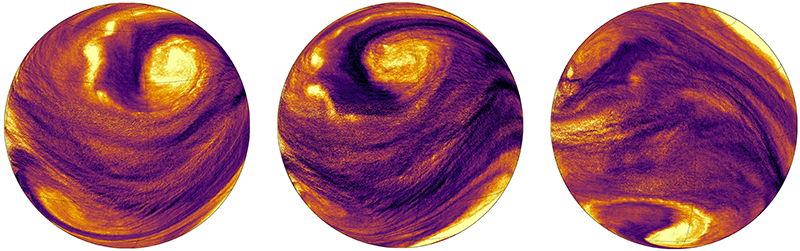
    Jupiter, our solar system’s stormiest planet, shares many similarities with Earth. But where Earth’s strongest storms are cyclones centered on low-pressure regions, Jupiter’s longest and strongest storms are anti-cyclones, driven by areas of high pressure. They’re often massive — larger than the entire Earth — and persist for weeks, months, or years. This processed image comes from the JunoCam instrument and shows some of the incredible cloud structure in Jupiter’s atmosphere. Jupiter’s highest altitude clouds tend to be the lightest, while darker clouds remain lower. (Image credit: NASA/JPL-Caltech/SwRI/MSSS/K. Gill; via APOD)

  • Featured Video Play Icon

    “Discovery”

    Colors stream and mix in Rus Khasanov’s short film “Discovery.” Droplet-like liquid lenses float in the mixture until ethanol or other ingredients cause them to spontaneously rupture, sending their interior flowing outward until the lens reaches a new equilibrium. Gradients in surface tension guide Marangoni flows across the screen. There’s never-ending beauty in the world of macro fluids. (Video and image credit: R. Khasanov)

  • Bubble Growth, Inspired By Art

    Bubble Growth, Inspired By Art

    Eighteenth- and nineteenth-century French painters like Chardin and Manet had a certain fascination with bubble-blowing physics. Both left behind artwork depicting children blowing soap bubbles through straws. Now researchers are exploring this bubble-making method in a recent study.

    To blow a bubble from a straw or other narrow constriction, there are three basic stages. In the first, the soapy interface bulges and takes on a spherical shape. That’s followed by a period of rapid growth in less than 100 milliseconds. And, finally, the bubble will pinch off and detach from the straw. So far, most studies have focused on that third phase. Instead, this team focused on those early stages.

    In that first stage, the bubble’s growth depends on air getting forced out of an attached reservoir. For children, that’s their lungs reducing in volume as they blow air into the straw. In their experiments, the team found that the initial volume of the air reservoir is an important (and previously overlooked) factor in controlling bubble growth. (Image credit: J. Chardin; research credit: M. Grosjean and E. Lorenceau; via Ars Technica)

  • Featured Video Play Icon

    The Physics of Vowels

    Blow across the top of a glass bottle, and you’ll get a whistle-like sound. Put some liquid in there and the pitch of the sound changes. Our vocal tracts are basically the same thing: a tube with a hole at the end. But as Joe Hanson shows in this Be Smart video, our ability to change the shape and resonance of our vocal tract by moving our tongues and lips enables us to make a wide range of vowel sounds. Enjoy this dive into the world of linguistic physics! (Video and image credit: Be Smart)