Every four years, Adidas creates a newly designed ball for the World Cup. This year’s version is the Telstar 18, which features six glued panels (no stitching!) with a slightly raised texture. That subtle roughness is an important feature for the ball’s aerodynamics. It helps ensure that flow around the ball will become turbulent at relatively low speeds. Some previous designs, notably the 2010 Jabulani, were so smooth that flow near the ball would not become turbulent until much higher speeds. In fact, one side of the ball might have laminar flow while the other was turbulent, causing the ball to wobble and misbehave. To learn more about World Cup aerodynamics and the importance of a little surface roughness to the ball’s behavior, check out the Physics Girl video below. (Image credit: Adidas; via APS News; video credit: Physics Girl)
Tag: fluid dynamics

The Fluid Dynamical Sewing Machine


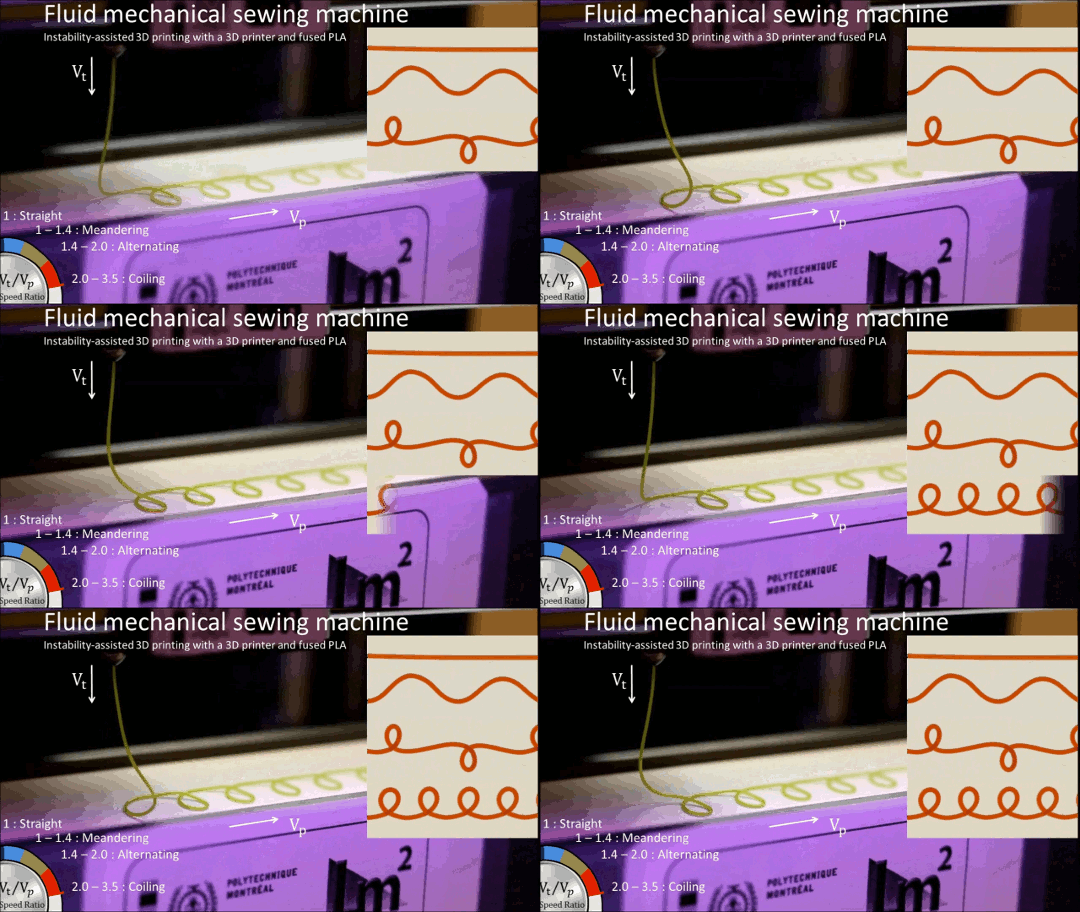
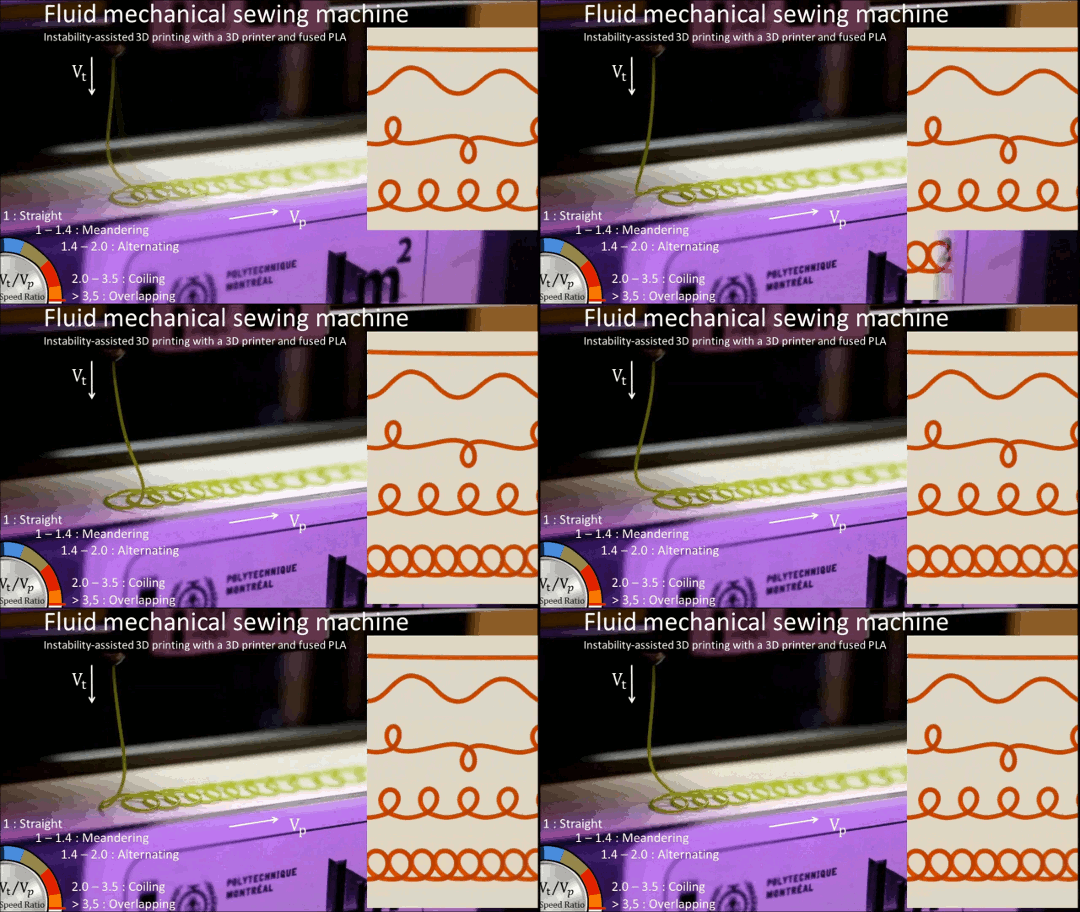
If you’ve drizzled viscous liquids like honey or syrup, you’ve no doubt witnessed their ability to coil. Combine that coiling with a moving platform and you form a system known as the fluid dynamical sewing machine, which creates different consistent patterns of loops and curves depending on the speed at which the liquid falls and the velocity of the moving platform. The predictability of these patterns makes them especially useful for 3D printing. Previously a group at MIT developed a glass printer that could use the instability, and here a group from Montreal demonstrates how they can build solid coils at various scales. Their video also explores what the structural properties of such coils are after they solidify. (Image, video, and research credit: R. Passieux et al.)

Spinning Droplet Galaxies
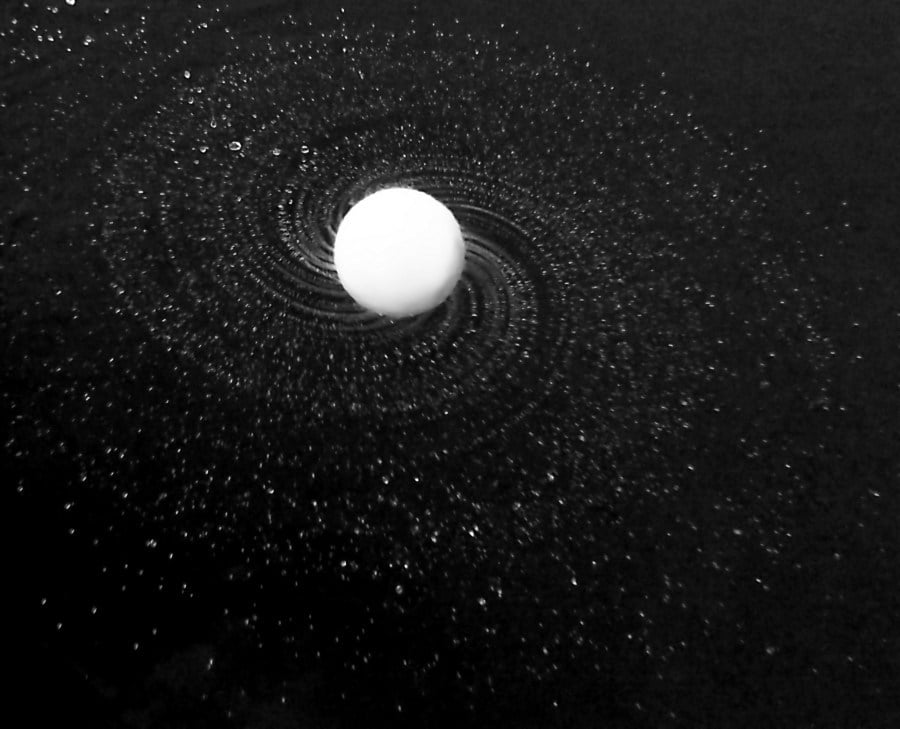
Water flung from a spinning tennis ball takes on a shape reminiscent of a spiral galaxy. As it detaches, water leaves the surface with both the tangential velocity of the spinning ball and a radial velocity due to the centrifugal force flinging it. The continued spin of the ball makes the thin ligaments of water still attached to it spiral and stretch. Eventually, surface tension can no longer hold the water together against the centrifugal forces, and the ligaments split into a spray of droplets. (Image credit: W. Derryberry and K. Tierney)

Flying Backwards


Spend a summer afternoon floating in a kayak and chances are you’ll see some impressive aerial acrobatics from dragonflies. One of the dragonfly’s superpowers is its ability to fly backwards, which helps it evade predators and take-off from almost any orientation. To do this, the dragonfly rotates its body so that it is nearly vertical, thereby changing the direction it generates lift. In engineering terms, this is “force-vectoring,” similar to the techniques used by helicopters and vertical-take-off jets.
Scientists found that backwards-flying dragonflies could generate forces two to three times their body weight, in part due to the strong leading-edge vortices (bottom image) formed on the forewings. They also found that the hind wings are timed so that their lift is enhanced by catching the trailing vortex of the first pair of wings. Engineers hope to use what they’re learning from insect flight to build more capable flying robots. (Image and research credit: A. Bode-Oke et al., source; via Science)

Craters and Rays
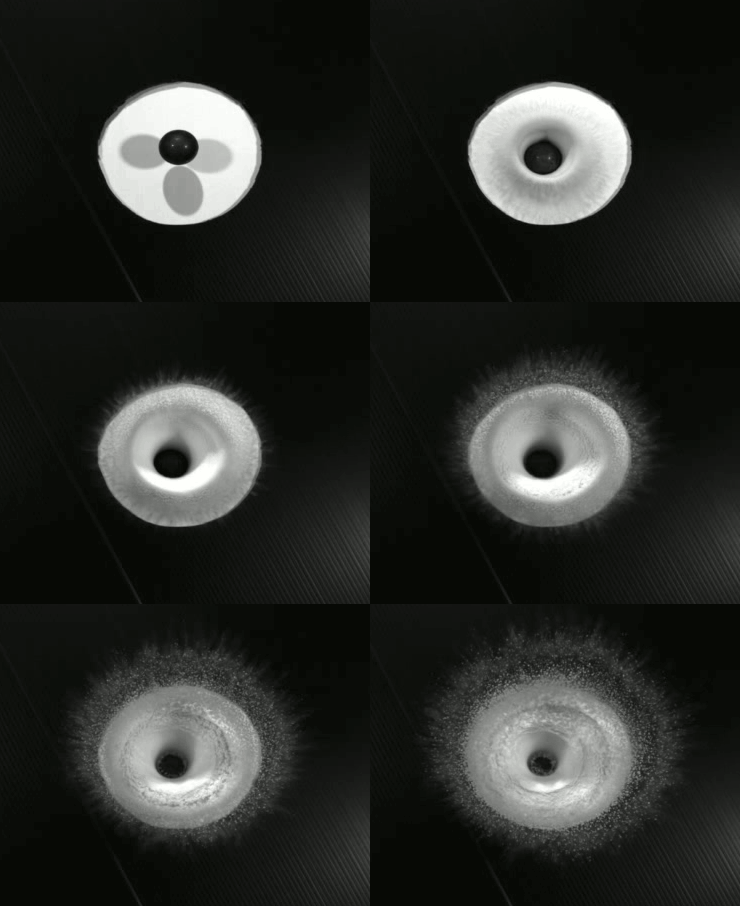
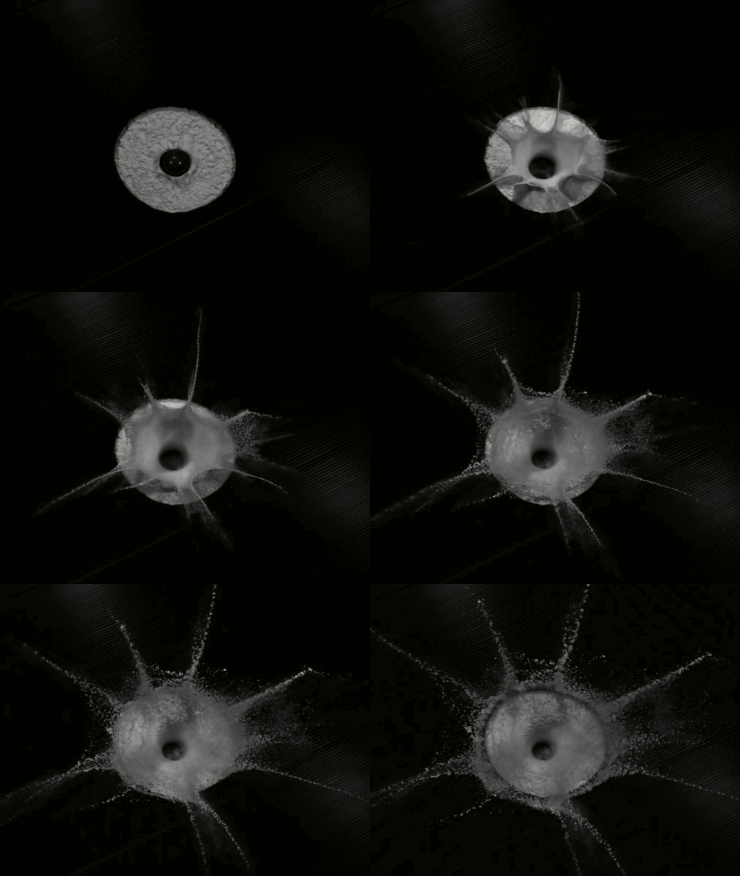

The history of our solar system is written in impact craters, but these craters have been remarkably mysterious for years. Scientists knew that you could recreate many of their features by dropping solid objects into granular materials like sand, but this did not produce the distinctive rays that we see around many real craters (bottom image, Mars). It was only by watching videos of schoolchildren recreating these experiments that scientists discovered what they’d been doing wrong: they’d smoothed the sand’s surface first.
It turns out that when you smooth the sand before impact (top left), you get an even ejecta curtain with no rays. But when the surface is uneven, as it is in kids’ experiments or on actual planetary bodies, suddenly rays form (top right). The object’s impact creates a shock wave in the granular medium, which becomes a rarefaction (i.e., expansion) wave when it reaches the surface. This is what actually ejects material. The uneven surface focuses those rarefaction waves, creating the distinctive ejecta rays. (Image credit: T. Sabawala et al., source; NASA; research credit: T. Sabawala et al.; via Jennifer O.)
Lava Balls
The continuing eruption of Kilauea is revealing phenomena rarely seen by those of us who are not volcanologists. One of the most surreal examples so far is colloquially known as a “lava boat,” seen above floating its way down a river of lava emanating from Fissure #8. The more technically accurate term is “accretionary lava ball,” but the colloquialism seems rather fitting, as long as this partially-solidified chunk of lava is still floating down the channel.
These lava balls form in a’a lava channels, which tend to be faster-moving and more turbulent. As chunks of lava solidify in the channel, they roll and gather more material, allowing them to get larger and larger. When broken open, the lava balls usually have a spiral interior as a result of this rolling formation. It’s essentially the lava equivalent of making a snowball. (Video credit: I. Marzo via M. Lincoln; via Ryan A.)
Vortex Ring Collisions
One of the most enduringly popular submissions I receive is T. Lim’s experimental footage of two vortex rings colliding head-on. It’s an devilishly tough experimental set-up to master because perfectly aligning the rings is incredibly difficult. The pay-off, however, is huge because the breakdown of the colliding rings and their transformation into secondary rings is breathtaking. Destin at Smarter Every Day and his team have worked hard to recreate the experiment (top video), but they’re not the only ones – nor are they the first in decades – to do so.
Ryan McKeown and a team at Harvard have a set-up of their own for vortex ring collisions, and you can see a little of it in action in the middle video. Ryan’s set-up is, frankly, incredible. It scans a light sheet through the vortex rings at high-speed, allowing him to capture the collision and break-up in minute detail in both space and time. What you see in the latter half of his video is a digital reconstruction of that data – not a simulation but real data! His work is capturing vortex collisions in unprecedented detail, allowing researchers to probe the smallest scales of the phenomenon.
When two vortex rings approach one another, they can undergo what’s known as a vortex reconnection event. Bubbles rings are a great place to see this. The vortex cores get distorted when they’re close to one another due to the influence of the other vortex ring’s velocity field. This often stretches and flattens the vortex core. It’s impossible for the rings to simply break apart, though, (per Helmholtz’s second theorem). So when the original vortex rings thin to the point of breaking, they immediately reconnect to a piece of the other ring, creating a series of small vortex rings around the remains of the originals. The exact details of how this works are what investigators like Ryan and his colleagues are trying to understand. You can hear a little more about their work in my interview with Ryan in the bottom video, starting at ~2.54. (Video credits: Smarter Every Day, R. McKeown et al., and N. Sharp and T. Crawford; submission credit: a huge number of readers)

2D Turbulence


Turbulence, the chaotic regime of fluid dynamics, is a complicated beast. It’s hard to analyze or predict, but we do understand some general ideas about it, like the fact that energy starts out in large eddies, cascades down smaller and smaller ones, and finally gets dissipated at the smallest scales, where viscosity snuffs them out. But that’s only true in three dimensions.
Two-dimensional turbulence – what you get when you confine your fluid to a flat plane – is even weirder. When turbulence is flat, you can actually get an inverse energy cascade, where the energy of small eddies can add up to feed bigger ones. For awhile, this was treated as a mathematical curiosity; after all, we live in a three-dimensional world. But there are situations in life that are nearly two-dimensional, like the surface of a soap bubble or the atmosphere of a planet (which is typically exceptionally thin compared to the planet’s radius). And, little by little, scientists are collecting evidence that this inverse cascade – a flow of energy from small scales to larger ones – does actually happen in the real world. Understanding how this works may explain why hurricanes can intensify even when conditions are “wrong” and how Jupiter’s Great Red Spot has persisted for centuries. To learn more, check out Quanta Magazine’s full article on the work. (Image credit: NASA et al., M. Appel; via Quanta; submitted by Kam-Yung Soh)

Visualizing Turbulence


Turbulence, the seemingly random and chaotic state that fluids often tend toward, can be difficult to wrap one’s head around. Turn your faucet on high or pour milk into your coffee, and the flow just looks like a completely unpredictable mess. But there are important patterns to be found.These flows have many different lengthscales and timescales to them. Think of a cloud. There are very large-scale motions that are close to the size of the entire cloud, but there are also very small ones that may be only a centimeter or so in size.
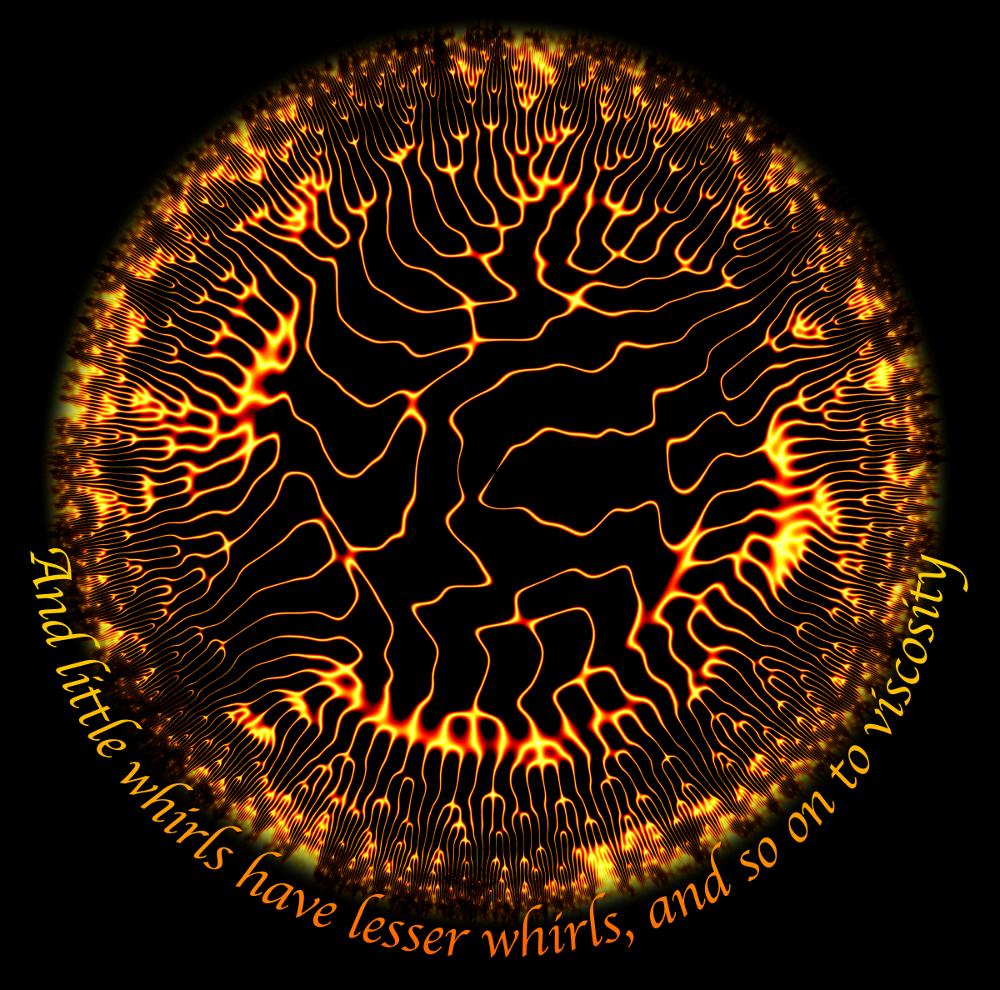
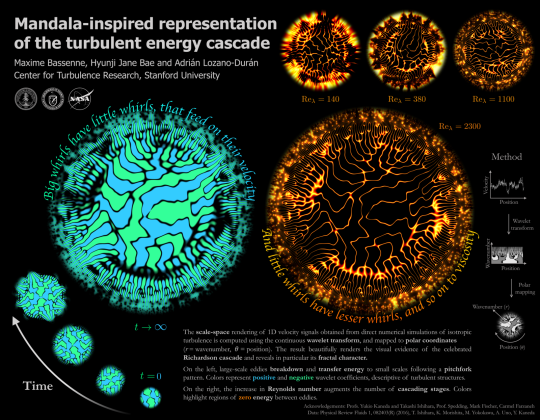
Our best understanding of turbulence so far says that energy starts out in these large scales and slowly works its way down to the smaller ones, where viscosity (essentially friction, in this case) can transform that motion into heat. Above you see a creative way to display this fact. Using data from a numerical simulation, the authors transformed velocity information into these mandala-like patterns. The center of the image represents the large lengthscales, where energy is added. Moving around the circle, like a clock’s hand does, shows different positions in space. Moving radially from the center outward takes you through different lengthscales from large to small.
Notice how the large lengthscales break into smaller and smaller ones as you move outward. The pattern looks like a set of fractal pitchforks, with each lengthscale fracturing into smaller and smaller ones as the turbulence breaks down further. There’s lots more to see in the original poster, below, but you should really click here for the glorious full-size original. The poem, by the way, is the work of physicist Lewis Richardson, who wrote it to summarize how turbulence works. (Image credit: M. Bassenne et al.)


Star Wars Aerodynamics
Science fiction is not always known for hewing to scientific fact, so it will probably come as little surprise that Star Wars’ ships have terrible aerodynamics. But it’s nevertheless fun to see EC Henry’s analysis of drag coefficients of various Rebel and Imperial ships and just how poorly they fare against our own designs.
Drag coefficients really only give a tiny piece of the story, though. We don’t know what speed Henry is testing the ships at, and we get no information about properties like lift or lift-to-drag ratio, which can be even more important than just the drag when it comes to evaluating an aircraft.
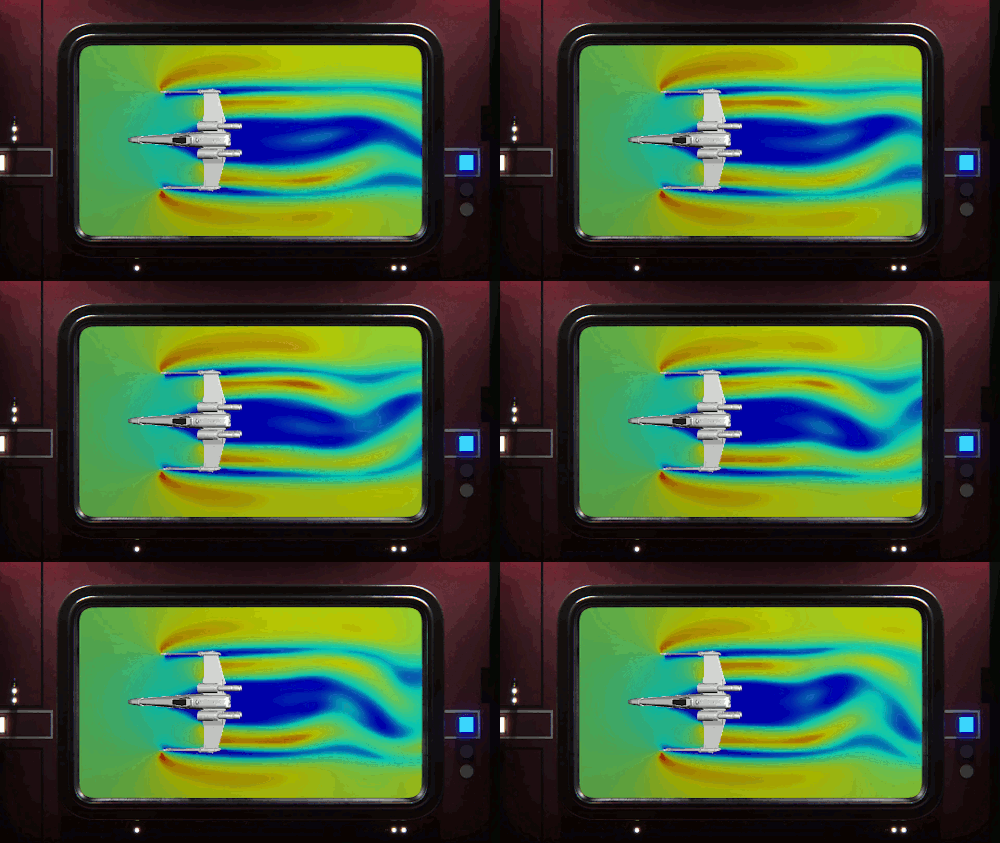
There are some intriguing hints about other aerodynamic properties in the clips of flow around an X-wing and TIE fighter, though. Notice that the wake of both ships meanders back and forth. This is an indication of vortex shedding, and it means that both spacecraft would tend to be buffeted from side-to-side when flying in an atmosphere. Either the ships would need some kind of active control to counter those forces, or pilots would need iron constitutions to operate under those conditions! (Video and image credit: EC Henry)
[original video no longer available]