Tag: fluid dynamics

  • Vortex Collisions Leave Clues to Turbulence

    Vortex Collisions Leave Clues to Turbulence

    Vortex ring collisions have long been admired for their beauty, but they’re now shedding light on the fundamental interactions that lead to turbulence. By dying just the cores of colliding vortex rings (Image 2), researchers observed anti-symmetric perturbations that develop along each core as they interact. These are indicative of what’s known as the elliptical instability.

    But the breakdown doesn’t stop there. Instead, as the elliptical instability develops, it generates a set of secondary vortex filaments that wrap around the original cores (Image 3). Just like the original vortex cores, those counter-rotating secondary filaments interact with one another, develop their own elliptical instability, and generate a set of smaller, tertiary filaments (Image 4).

    What’s exciting is that this process gives us a physical mechanism for the turbulent energy cascade. Researchers have talked for decades about energy passing from large-scale eddies to smaller and smaller ones, but this work lets us actually observe that cascade in the form of smaller and smaller pairs of vortex filaments interacting. To see more, check out some of our previous posts on this work. (Image and research credit: R. McKeown et al.; via Cosmos; submitted by Ryan M. and Kam-Yung Soh)

  • Levitation Without Boiling

    Levitation Without Boiling

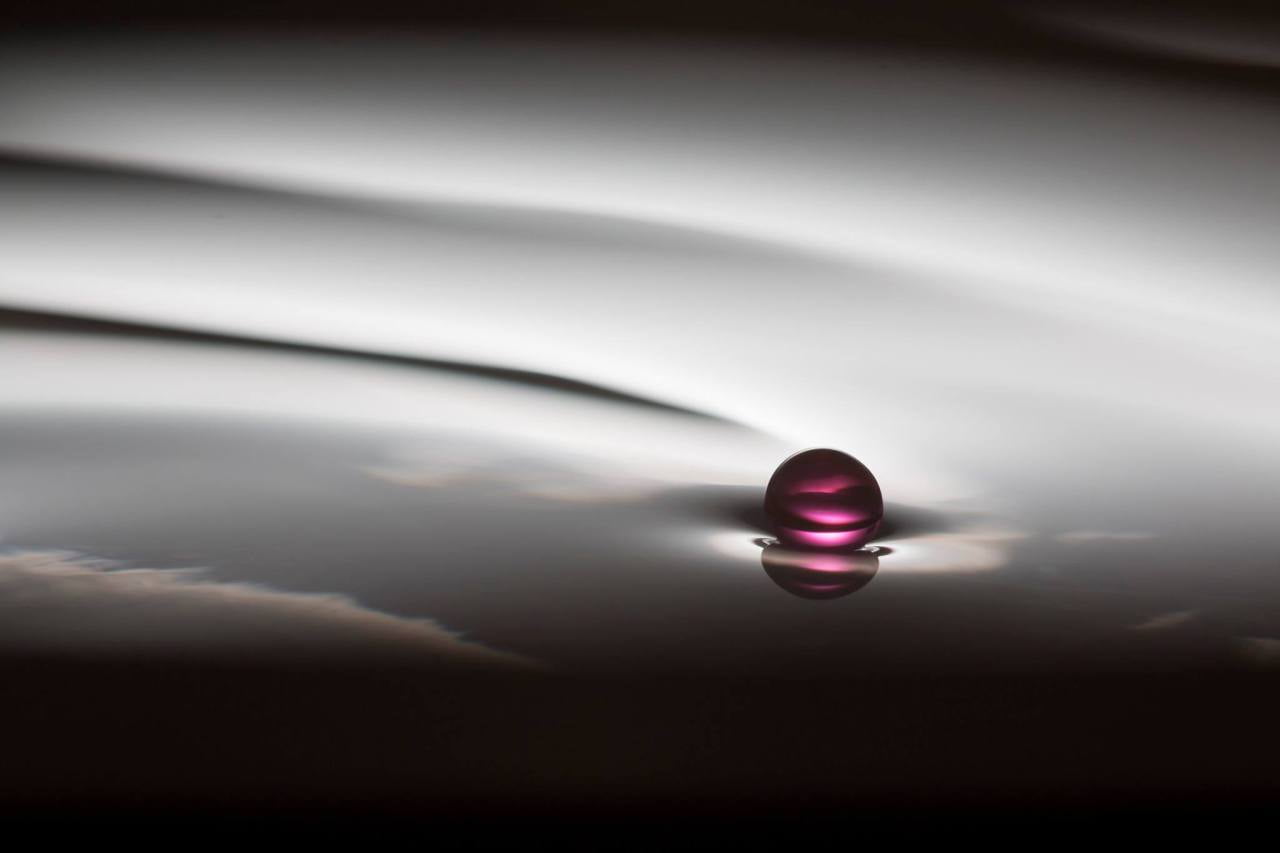
    One way to levitate droplets is to place them on a surface heated much higher than the droplet’s boiling point. This creates the Leidenfrost effect, where a droplet levitates on a thin layer of its own evaporating vapor. In this study, the situation is quite different.

    Although the underlying pool of liquid — here, silicone oil — is heated, its temperature is well below the boiling point of the water droplet. But the droplet still levitates over the pool, thanks to an air layer fed by convection. Aluminum powder in the oil reveals large-scale convection in the pool; note how the oil moves radially toward the droplet. That movement drags the air in contact with the oil with it, which forms the vapor layer keeping the droplet aloft.

    One side effect of this convection-driven levitation is that the droplet hovers over the coldest point in the oil. That fact suggests that users can manipulate the droplet’s motion by tuning the underlying heating. (Image and research credit: E. Mogilevskiy)

  • Featured Video Play Icon

    “It’s All About Flow”

    Fluid dynamicists, like other scientists, have lives and interests well beyond our research. Ivo Nedyalkov, for example, is a professional rapper in addition to a PhD-level fluid dynamicist. In “It’s All About Flow,” Dr. Ivo brings those areas of expertise together with a rap all about fluid dynamics. The version embedded here is a bit shorter than the full version, which digs not only into experimental fluid dynamics but into computational work as well.

    Check it out, and if you’d like to see the full lyrics and explanation behind them, he’s posted those as well. You can also ping me here or on Twitter if you’d like to know more about the phenomena he discusses. (Video and image credit: I. Nedyalkov/ASME; full video here; lyrics and explanation)

  • A Microfluidic Zoo

    A Microfluidic Zoo

    Microfluidic channels are excellent at creating a steady supply of droplets. But depending on the characteristics of the two viscous fluids being used, as well as factors like flow rate and channel geometry, the results can be anything from well-defined and separated drops to steady jets to wild instabilities. The image above shows a series of different outcomes, including waves that break on the edges of drops and ligaments that stretch around the central fluid. (Image and research credit: X. Hu and T. Cubaud)

  • To Beat Surface Tension, Tadpoles Make Bubbles

    To Beat Surface Tension, Tadpoles Make Bubbles

    For tiny creatures, surface tension is a formidable barrier. Newborn tadpoles are much too small and weak to breach the air-water surface in order to breathe. Researchers found that, instead, the 3 millimeter creatures place their mouths against the surface, expand their mouth to generate suction, and swallow a bubble consisting largely of fresh air.

    When they’re especially small, some of these species are essentially transparent (Image 1), allowing researchers to see the bubble directly. But even as the tadpoles aged (Images 2 and 3) and grew strong enough to breach the surface, they observed many instances in which the tadpoles continued this bubble-sucking method to breathe. (Image and research credit: K. Schwenk and J. Phillips; via Cosmos; submitted by Kam-Yung Soh)

  • Surface Jets in Coalescing Droplets

    Surface Jets in Coalescing Droplets

    What goes on when droplets merge is tough to observe, even with a high-speed camera. There are many factors at play: any momentum in the droplets, surface tension, gravity, and Marangoni forces, to name a few. A new study that simultaneously records multiple views of coalescence is shedding some light on these dynamics.

    The results are particularly interesting for droplets that are somewhat physically separated so that they only coalesce after one drop impacts near the other. In this situation, with droplets of equal surface tension, researchers observed a jet that forms after impact (Image 1) and runs along the top surface of the coalescing drops (Image 2). That location is a strong indication that the jet is created by surface tension and not other forces.

    To test that further, the researchers repeated the experiment but with droplets of unequal surface tension. They found that when the undyed droplet’s surface tension was higher (Image 3), Marangoni forces enhanced the surface jet, as one would expect for a surface-tension-driven phenomenon. But if the dyed droplet had the higher surface tension (Image 4), it was possible to completely suppress the jet’s formation. (Image, research, and submission credit: T. Sykes et al., arXiv)

  • Featured Video Play Icon

    Paint Versus Hydrogel

    In this bizarre short film, we get to see a battle between dissolution and absorption. I think the Chemical Bouillon team has coated hydrogel beads in a layer of paint and then immersed them in water. As the beads absorb water, they expand and grow, tearing their fragile outer layer of paint to smithereens.

    One thing that struck me when watching several of the sequences is just how regular the hole spacing in the paint is for the round hydrogels. That hints at an orderly breakdown in the solid paint layer while the interior hydrogel polymer symmetrically expands. It’s a little like watching holes grow in a splash curtain. (Video and image credit: Chemical Bouillon)

  • Using Electric Fields to Avoid Dripping

    Using Electric Fields to Avoid Dripping

    Anyone who’s painted a room at home is familiar with the frustration of drips. At certain inclinations, practically every viscous liquid develops these gravity-driven instabilities. They’re troublesome in manufacturing as well, where viscous films are often used to coat components and unexpected drips can ruin the process.

    To avoid this, researchers are adding electric fields into the mix. For dielectric fluids — liquids sensitive to electric fields — this addition acts like extra surface tension, stabilizing the film and preventing drips from forming. The researchers’ mathematical models predict the electric field strength necessary for a given fluid layer depending on its inclination. (Image credit: stux; research credit: R. Tomlin et al.; via APS Physics)

  • Ice Patterns

    Ice Patterns

    Periods of freezing and thawing can leave complicated patterns in ice, as seen in this aerial photo of Binnewater Lake in New York. Ice rarely forms evenly on large bodies like this, so there are always underlying weaknesses. A hard freeze may have caused the ice to contract, forming the initial radial pattern. Then warmer periods of melting allowed water to rise into the cracks and expand them. As the process repeats, the visible pattern emerges.

    Also note the star-like crack patterns near the shore. These may have formed in spots where something like a stick protruding from the water’s surface allowed warmer water up onto the ice to melt the snow sitting atop it. (Image credit: D. Spitzer; via EPOD; submitted by Kam-Yung Soh)

  • Inferring Flows with Neural Networks

    Inferring Flows with Neural Networks

    Fluid dynamicists have long used flow visualization methods to get a qualitative sense for flows, but it’s rare to derive much quantitative data from this imagery. But that may soon change thanks to a new computational technique, called Hidden Fluid Mechanics, that uses data from flow visualizations combined with physics-informed neural networks to derive the underlying velocities and pressures in a flow.

    The technique relies on two important ideas. One is that the dye, smoke, or other method of visualizing the flow does not alter the underlying flow; it’s just something carried along by the fluid. In other words, the flow behaves exactly the same whether or not you inserted dye or smoke.

    The second key idea is that the Navier-Stokes equations — which are derived from conservation of mass, momentum, and energy — accurately describe the physics of a flow. That assumption is critical to the technique since it uses those equations to constrain the flow fields the algorithm reconstructs.

    So here, roughly speaking, is what the algorithm actually does: researchers feed it concentration data from a flow visualization — essentially how much smoke or dye is present at every point in space and time — and the neural network reconstructs, based on the Navier-Stokes equations, what velocity and pressure field would produce that concentration data.

    The researchers demonstrate the capabilities of their algorithm by comparing its results to flows where all the information is known. The first image in the gallery above shows concentration data for the flow in an aneurysm. The full flow field is known already from a numerical simulation, but the researchers gave their new algorithm only the concentration data. From that, it reconstructed the streamlines for the aneurysm’s flow, shown in the second image as “Learned”. The “Exact” streamlines on the left are taken from the original numerical simulation data. As you can see, the results are remarkably similar. (Image credit: drawings – L. da Vinci, others – M. Raissi et al.; research credit: M. Raissi et al.; submitted by Stuart H.)