Tag: fluid dynamics

  • Featured Video Play Icon

    Ferrovolcanism

    Beyond Earth, scientists expect to find objects formed by a volcanism much different than what we typically see here. Researchers used Syracuse University’s Lava Project apparatus to simulate ferrovolcanism — in this case with a mixture containing both metallic lava and silicate lava. Interestingly, the team found that the two types of lava flow largely independently of one another. The silicate lava is much more viscous but less dense and flows relatively slowly. The metallic lava is far less viscous and flows about 10 times faster, but it’s also denser, so most of it flows beneath the silicate lava, with only a few fingers that burst out atop the other lava or erupt in braided flows from the leading edge of the flow.

    The upcoming Psyche mission will explore a metal asteroid (of the same name) that’s thought to be the remains of an early planet’s nickel-iron core. Studies like this one are giving planetary physicists new insight into the kinds of geological features await us there. (Video and research credit: A. Soldati et al.; via AGU Eos; submitted by Kam-Yung Soh)

  • Featured Video Play Icon

    Kinetic Sculptures by Anthony Howe

    These mesmerizing kinetic sculptures built by Anthony Howe are entirely wind-driven. It’s not necessarily apparent in these images, but these sculptures are several meters tall and weigh hundreds of kilograms, but they’re engineered so precisely that the slightest breeze sets them silently spinning. See more of Howe’s art in action on his YouTube channel. (Video and image credits: A. Howe; via Colossal)

  • Featured Video Play Icon

    Challenges of Commercial Supersonic Flight

    Years ago as I sat on a plane taxiing at Heathrow, I caught a glimpse of a Concorde out on the tarmac. My classmates couldn’t understand why I was so excited to see that funny looking plane, but even as a high schooler, I was fascinated by the prospect of flying faster than sound.

    Unfortunately, there are a lot of challenges to overcome in making supersonic flight widely available — fuel efficiency, cost effectiveness, and sonic boom control, to name a few. This video delves into some of the major issues and touches on some of the recent work at NASA and other organizations studying the problem. Perhaps as new technologies develop and mature we’ll once again see faster-than-sound air travel outside of rocket launches and military jets. (Video and image credit: TED-Ed)

  • Brace For Impact

    Brace For Impact

    What happens in the moment before an object hits the water? That’s the question at the heart of a new study exploring how water deforms before an object’s impact. The researchers dropped circular disks onto a pool of water and, using a new reflection-based technique, measured micron-sized deflections in the water’s surface before impact, as seen below.

    Animation showing the deflection of the water's surface just before a circular disk impacts it.
    Movie of the water surface’s deflection as the circular disk approaches. Look for distortions in the grid pattern.

    The deflections are caused by the air getting squeezed out of the space between the oncoming object and the water surface. The team found that the deformation isn’t uniform. The air squeezing out along the edges moves fast enough to trigger a Kelvin-Helmholtz instability and actually pull up the water surface. So when the disk hits, it impacts along its edges first and traps an air bubble underneath. (Image credits: divers – E. Carter, experiment – U. Jain et al.; research credit and submission: U. Jain et al.)

  • Blue Dunes

    Blue Dunes

    This false-color image shows a Martian dune field near the northern polar cap. The image itself covers an area 30 kilometers wide, but the dune field stretches over an area the size of Texas. In the photo cooler areas have been rendered in bluer tints, while warm areas are shown in yellow and orange. The sun warms the wind-sculpted dunes more than in the valleys that lie between. Complex dune networks like these build up over time as consistent winds push sand and create interactions between individual dunes. (Image credit: NASA/JPL-Caltech/ASU; via Colossal)

  • Tiny Symmetric Swimmers

    Tiny Symmetric Swimmers

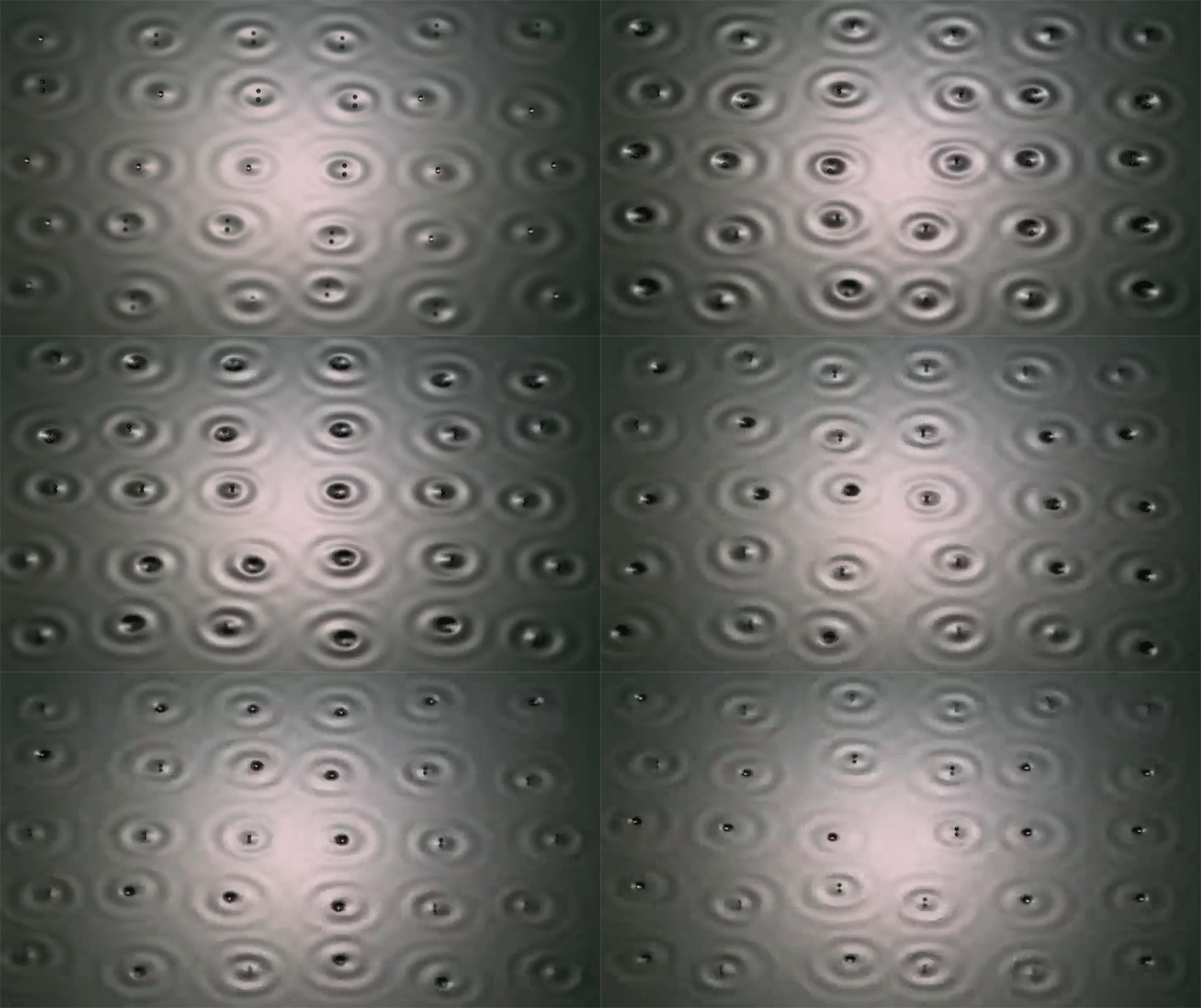
    Microswimmers live in a world dominated by viscosity, and in viscous fluids, symmetric motion provides no propulsion. That’s why bacteria and other tiny organisms use cilia, corkscrew flagella, and other asymmetric means to swim. But a new study decouples the symmetry of a swimmer’s motion from the motion of the fluid, thereby creating a tiny symmetrically-driven swimmer that does swim.

    Their microswimmer consists of two beads, which attract one another via surface tension and are repelled using external magnetic fields. This effectively creates a spring-like connection between the two beads, making them move in and out symmetrically in time. But since one bead is larger than the other, its greater inertia makes it slower to start moving and slower to coast to a stop. This inertial imbalance between the two is significant enough for the beads to swim. The key here is that though the beads’ motion relative to one another is symmetric, their motion relative to the fluid is not! (Image and research credit: M. Hubert et al.; via Science; submitted by Kam-Yung Soh)

  • Featured Video Play Icon

    “Stream”

    Roman De Giuli’s short film “Stream” explores a macro world of color and flow, with a few glimpses behind-the-scenes at how the visuals get made. The artistic canvas here is a glass plate; the materials are oil, ink, and water. As simple as the ingredients are, though, the view is complex and enchanting. It’s amazing to see just how much goes on in an area the size of one’s thumb. (Image and video credit: R. De Giuli)

  • Featured Video Play Icon

    The Mobile Mud Spring of Niland, CA

    What’s part geyser, part mud pot, and all creeping, unstoppable natural disaster? The Niland Geyser, known as the world’s only moving mud spring. Dianna explores this geological mystery in the video above. Although the mud spring has been known for years, it was only in 2016 that it started moving toward railroad tracks and a state highway. So far engineering efforts to stop it have failed, so engineers are instead working to mitigate its effects on infrastructure.

    That’s a tall order when dealing with a pit of unknown depth that’s constantly bubbling with deadly carbon dioxide. The spring managed to move past a 75-foot-deep wall and, on another occasion, sent heavy drilling mud flying skyward from its built-up pressure. Check out the full video to learn more. (Image and video credit: Physics Girl)

  • Skipping Stone Physics

    Skipping Stone Physics

    Skipping stones across water has fascinated humans for millennia, but incredibly, we’re still uncovering the physics of this game today. A recent paper built and experimentally validated a mathematical model of a spinning, skipping disk. The authors found that, in order to skip, a stone needs to generate upward acceleration greater than 3.8 times gravity.

    To get that lift, the stone needs both the Magnus effect and the gyro effect. The Magnus effect is an aerodynamic force generated by an object spinning in a fluid that curves it away from its direction of travel — it’s what curves a corner kick into the goal in a soccer match. The gyro — or gyroscopic — effect also has to do with spinning, but it’s a result of conservation of angular momentum. Essentially, when you try to shift the axis that a rotating object spins around, there’s a force that resists that change. (The classic demo for this uses a spinning bicycle wheel.)

    In stone skipping, the gyro effect helps stabilize the stone’s bounce and, if it’s spinning fast enough, keeps its direction of travel straight. Once the stone’s spinning slows, the Magnus effect can start to curve its trajectory. (Image credit: B. Davies; research credit: J. Tang et al.; via Physics World; submitted by Kam-Yung Soh)

  • The Intermittent Spring of Afton, WY

    The Intermittent Spring of Afton, WY

    Yellowstone may get top billing, but Wyoming is home to more fluid dynamical wonders, like the world’s largest rhythmic spring. Located a little outside Afton, WY, Intermittent Spring — as the name indicates — runs for roughly 15 minutes, stops for the same length, then starts up again. The leading theory for this periodic flow depends on the siphon effect. Essentially, water runs continuously into a cavern underground, but to get to the surface, it must traverse a narrow tube with a high point that lies above the spring’s eventual exit. When the water level reaches that high point, it creates a siphon, sucking water out of the cavern and making the spring flow. But eventually the water level drops to the point where air rushes in, breaking off the flow until the water level recovers. That’s consistent with the spring’s behavior; it only runs in this intermittent fashion from late summer to fall, when groundwater levels are lower. (Image credit: Wikimedia Commons; video credit: University of Wyoming Extension; submitted by Kam-Yung Soh)