Tag: fluid dynamics

  • Featherwings in Flight

    Featherwings in Flight

    The featherwing beetle is tiny, less than half a millimeter in length. At that scale, flying is a challenge, with air’s viscosity dominating the forces the insect must overcome. The featherwing beetle, as its name suggests, has feather-like wings rather than the membranes larger beetles use. But a new study shows that these odd wings work surprisingly well.

    The beetle’s bristled wings flap with an exaggerated figure-8 motion, with the wings clapping together in front of and behind the insect. The beetle expends less energy moving its feathery wings than it would if they were solid, and it moves its wing covers at the same time to counter each stroke and keep its body steady. (Image and research credit: S. Farisenkov et al.; video credit: Nature; submitted by Kam-Yung Soh)

  • Turquoise Eddies

    Turquoise Eddies

    During the summer months, the Barents Sea between Norway and Russia is streaked with blue and teal swirls. These beautiful patterns are the result of a phytoplankton bloom, as viewed by earth-observing satellites (with a little color enhancement). Although each cell in the bloom is only nanometers across, their collective presence is visible from space! They also act as tracers in the water, revealing the swirling flow patterns present there. (Image credit: J. Stevens/NASA Earth Observatory)

  • Raindrops on the Windshield

    Raindrops on the Windshield

    When I was a child, I was fascinated by the raindrops that shimmied along the windshield of our car. Some would slide up the glass. Some would run down. And some just seemed to wiggle in place, until the car’s speed changed. As common as this sight is, the physics of these droplets is quite complicated and not completely understood.

    Each droplet has a host of forces on it: gravity flattening it or pulling it down an incline; a drag force from the wind flowing over it; and friction between the drop and the surface trying to pin it in place. Recently, scientists have developed a new mathematical model that captures some of the behaviors behind these drops. The work describes the wind speed necessary to move a drop of a given size sitting on a flat surface. The authors also explored how that critical wind speed changes when a drop sits on a tilted surface aligned or against the wind. (Image credit: P. Gupta; research credit: A. Hooshanginejad and S. Lee; via Science News; submitted by Kam-Yung Soh)

  • Featured Video Play Icon

    Double Diffusive Flow

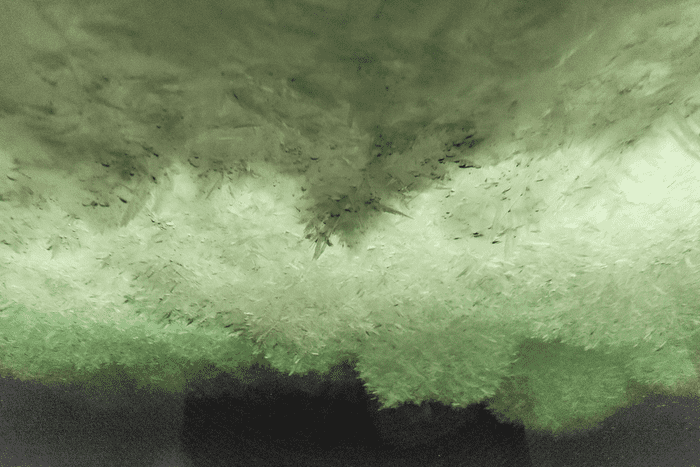
    Diffusion is the tendency for differences in a fluid — in density, temperature, or concentration — to even out over time. Think about a drop of food coloring in a glass of water. Even without stirring, that dye will eventually disperse throughout the glass through diffusion. But when there is more than one factor controlling diffusion — like temperature and salinity — things get more complicated. In the ocean, for example, this double-diffusion causes salt fingers like those shown in the first image.

    But what happens when the two diffusing fluid layers are flowing? That’s the question at the heart of this video, which explores the intricate mixing that takes place between doubly-diffusing liquids in a channel. (Video and image credit: A. Mizev et al.)

  • Featured Video Play Icon

    Strandbeest Evolution

    Each spring, artist Theo Jansen releases his latest batch of wind-driven kinetic sculptures — known as Strandbeests — on a Dutch beach. This video compilation shows some of the newest strandbeests, including a variety of flying strandbeest. I find their motion mesmerizing. Some stroll, some undulate, some galumph their way across the the sands. Given their size — much larger than a person and often weighing 180 kilograms — it’s amazing to see them driven entirely by the wind through their sails. (Video and image credit: T. Jansen; via Colossal)

  • Using Turbulence in Flight

    Using Turbulence in Flight

    When small, heavy particles are in a turbulent flow, they settle faster than in a quiescent one. Their interactions with turbulent eddies sweep them along, extracting energy that lengthens their overall path but reduces the time necessary for them to fall. Using the same principles, researchers are finding ways for rotorcraft and other vehicles to extract energy from turbulence for more efficient flight.

    The technique forces a vehicle to behave like a heavy particle by sensing turbulent gusts from its own accelerations and adding forcing to those accelerations when they are in the desired direction of flight. In essence, the vehicle uses the turbulence of its surroundings to find helpful tailwinds. (Image credit: A. Soggetti; research and submission credit: S. Bollt and G. Bewley)

  • Brilliant Auroras

    Brilliant Auroras

    Glowing auroras billow across Canada in this satellite image from a recent geomagnetic storm. As our sun enters a more active part of its solar cycle, we can expect more space weather as the high-energy particles of the solar wind interact with our planet’s magnetic field. The auroras themselves are light released by energetically excited atoms of oxygen and nitrogen high in the upper atmosphere.

    Earth is not the only place in the solar system to experience these light shows. With their strong magnetic fields, Jupiter and Saturn have auroras that make Earth’s look paltry in comparison. (Image credit: J. Stevens; via NASA Earth Observatory)

  • How Fabric Dries

    How Fabric Dries

    How do damp clothes dry in air? Such a seemingly simple question has vexed physicists for years because it’s extremely difficult to observe what happens inside the cloth fibers. Now researchers have used magnetic resonance techniques to track the material’s drying process.

    Inside wet fabric, water exists in one of two states: it can be bound to the fabric fibers through hydrogen bonds or it circulates as a vapor in the voids between. Before this study, scientists had no way of confirming the relationship between these two states. Models simply assumed that most of the drying took place as water vapor left the fabric.

    In their measurements, the team watched textiles dry in open-topped containers exposed to dry air. With their magnetic resonance technique, they could track the bound water in the textile over time. They found that the model that fit their data the best is one in which the bound water and water vapor reach equilibrium instantaneously. (Image credit: K. Cao; research credit: X. Ma et al.; via APS Physics; submitted by Kam-Yung Soh)

  • Deciphering Krakatau

    Deciphering Krakatau

    In 1883, the eruption of Krakatau (also called Krakatoa) shook the world, sending shock waves and tsunamis ricocheting across the globe. Some of the smaller waves hit shorelines in the Atlantic and Pacific that were entire continents and ocean basins away from the original explosion. At the time, scientists were so perplexed by the phenomenon that they blamed coincidental earthquakes for the wave action.

    Only when Tonga experienced a similarly devastating volcanic eruption earlier this year were scientists able to verify what they’d long suspected: these smaller tsunamis were not caused by solid material displacing water; instead they are the result of atmospheric pressure waves coupling to the ocean. Follow the full story over at Quanta. (Image credit: M. Barlow; via Quanta; submitted by Kam-Yung Soh)

  • Stormy Skies

    Stormy Skies

    Photographer Mitch Dobrowner captures the majestic and terrifying power of storms in his black and white images. Towering turbulence, swirling vortices, and convective clouds abound. See more of his work at his website and Instagram. (Image credit: M. Dobrowner; via Colossal)