Tag: fluid dynamics

  • Measuring Drag

    Measuring Drag

    After a noticeable rise in the prevalence of home runs beginning in 2015, Major League Baseball commissioned a report that found the increase was caused by a small 3% reduction in drag on the league’s baseballs. When such small differences have a big effect on the game, it’s important to be able to measure a baseball’s drag in flight accurately.

    In the past, that measurement has often been done in a wind tunnel, but the mounting mechanisms used there result in drag measurements that are a little higher than what’s seen from video tracking in actual games. Now researchers have developed a new free-flight method for measuring a baseball’s drag. The drag measurements from their new method are lower than those for wind-tunnel-mounted baseballs and in better agreement with video-based methods. The authors’ method should be adaptable to other sports like cricket and tennis, which will hopefully provide new insight into the subtleties of their aerodynamics. (Image credit: T. Park; research credit: L. Smith and A. Sciacchitano; via Ars Technica; submitted by Kam-Yung Soh)

  • Featured Video Play Icon

    Whistle Physics

    Ever wondered how whistles work? Depending on the type of whistle, there are a few different phenomena in play, but the most fundamental one is the oscillation of a fast-moving air stream. Any small deviation in the air stream can set up a situation where the flow shifts side-to-side, and most whistles use this oscillation to drive the sound they produce.

    Many whistles direct the air flow onto a wedge-shape to strengthen the oscillation; then they have a cavity that amplifies the sound using resonance. Water whistles — which warble in a bird-like way — do the same thing, but the water inside them creates a shape-changing cavity, thereby changing the pitch to create an unsteady, warbling sound. You can see all these whistles and more deconstructed in Steve’s video. (Video and image credit: S. Mould)

  • Acidic Aerosols

    Acidic Aerosols

    As ocean waves crash, they generate aerosols — tiny liquid and solid particulates — that interact with the atmosphere. Curious about the chemistry of these tiny drops, researchers set out to measure their acidity. That’s easier said than done. Over time, aerosol droplets acidify as they interact with acidic gases in the atmosphere and capturing fresh aerosols in the field is next to impossible.

    To tackle these challenges, researchers instead moved the aerosols to the laboratory, filling a wave channel with seawater and agitating it to generate aerosols they could then measure. They found that the smallest aerosols become a million times more acidic than the bulk ocean in only two minutes! Find out more about their experiment and its implications over at Physics Today. (Image credit: E. Jepsen; research credit: K. Angle et al.)

  • Featured Video Play Icon

    Self-Stopping Leaks

    A leak can actually stop itself, as shown in this video. To demonstrate, the team used a tube pierced with a small hole. When filled, water initially shoots out the hole in a jet. The pressure driving the jet comes from the weight of the fluid sitting above the hole. As the water level drops, the pressure drops, causing the jet to sag and eventually form a rivulet that wets the side of the tube. As the water level and driving pressure continue to fall, the rivulet breaks up into discrete droplets, whose exact behavior depends on how hydrophobic the tube is. Eventually, a final droplet forms a cap over the hole and the leak stops. At this point, the flow’s driving pressure is smaller than the pressure formed by the curvature of the capping droplet. (Image and video credit: C. Tally et al.)

  • Featured Video Play Icon

    “Volcano Pilot”

    Today’s video is something a little different. Rather than looking at fluids and their physics directly, we’ll take a step back and think about how people relate to the subject. This short film, “Volcano Pilot,” follows Haraldur Unason Diego as he reflects on his life’s work. It’s a beautiful and moving glimpse of the life and philosophy of a small aircraft pilot. Many people never have the opportunity to see the world from cockpit of a Cessna or similar small aircraft, and I think there are few experiences that can better connect someone to the fluids-in-action that is aviation. (Image and video credit: M. Aberra et al.)

  • Dripping Impact

    Dripping Impact

    How does water drip, drip, dripping onto stones erode a crater? Water is so much more deformable that it seems impossible for it to wear harder materials away, even over thousands of impacts. To investigate this, a team of researchers developed a new measurement technique: high-speed stress microscopy. In the process, they found that water owes its incredible erosive power to three factors: 1) The drop’s impact creates surface shock waves along the material, which helps increase erosive power; 2) After the shock wave passes, a decompression wave in the material helps loosen surface matter; and 3) The spreading drop sends a non-uniform wave of stress across the material that simultaneously presses and scrubs at the surface. Together, these factors enable simple, repetitive droplet impacts to wear away at hard surfaces. (Image credit: cottonbro; research credit: T. Sun et al.; via Cosmos; submitted by Kam-Yung Soh)

  • Featured Video Play Icon

    Inside Viscous Fingers

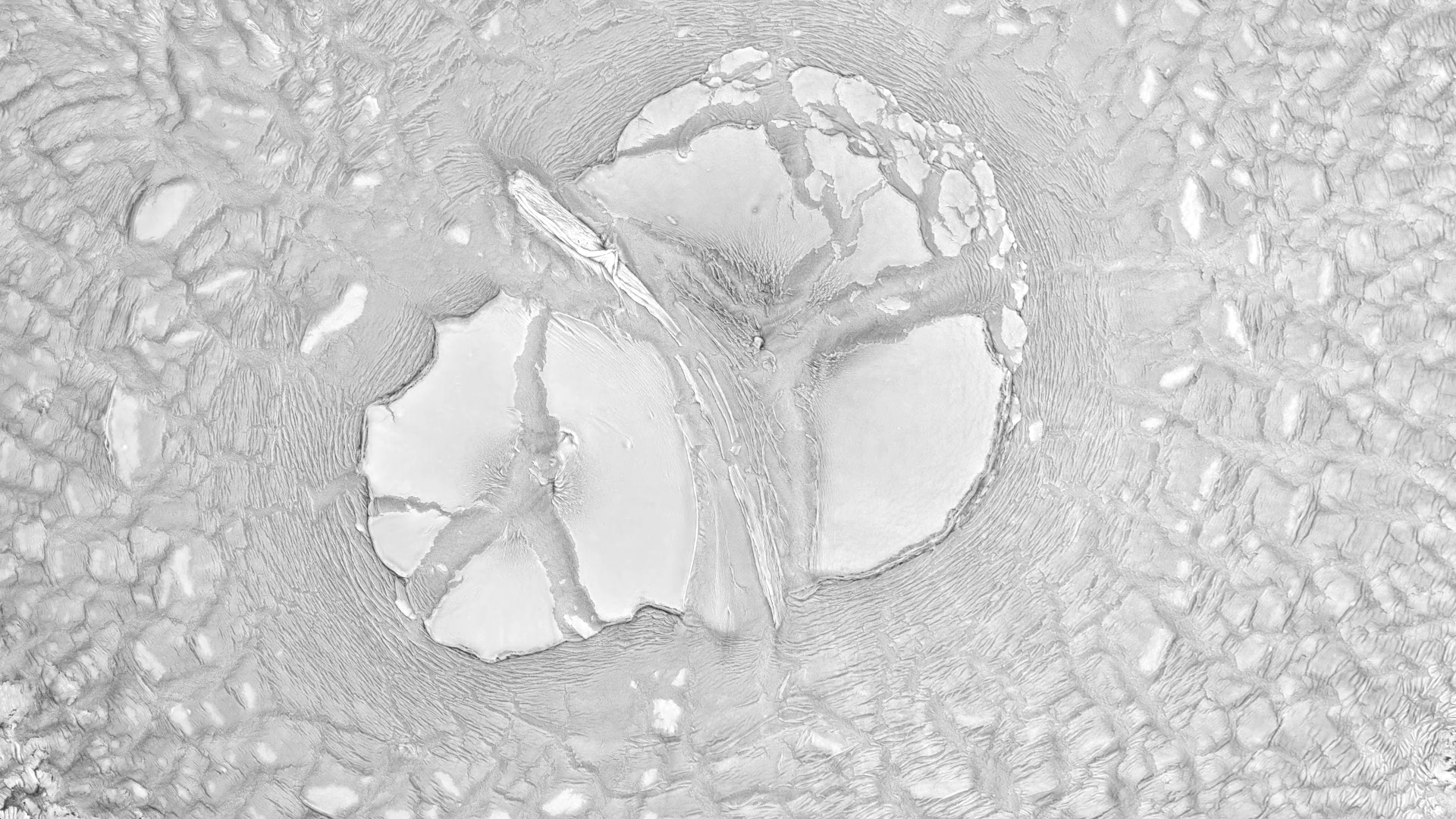
    Sandwich a viscous fluid between two transparent plates and then inject a second, less viscous fluid. This is the classic set-up for the Saffman-Taylor instability, a well-studied flow in which the interface between the two fluids forms a wavy edge that develops into fingers. Despite its long history, though, there is still more to learn, as shown in this video. Here, researchers alternately injected a dyed and undyed version of the less viscous fluid. The result (Image 3) is a set of concentric dye rings that show how the fluid moves far from the fingers along the edge. Notice that the waviness of the fingers appears in the flowing fluid well before it approaches the interface. (Image and video credit: S. Gowan et al.)

  • Coalescence Symmetry

    Coalescence Symmetry

    When droplets coalesce, they perform a wiggly dance, gyrating as the capillary waves on their surface interfere. When the droplets have matching surface tensions, like the two water droplets in the animation on the lower left, the coalescence dance is symmetric. But for differing droplets, like the water and ethanol droplets merging on the lower right, coalescence is decidedly asymmetric.

    The asymmetry arises from the droplets’ different surface tensions. The size and speed of the capillary waves that form on a droplet depend on surface tension, so droplets of different liquids have inherently different capillary waves. During merger, the interference of these capillary waves causes the asymmetry we see. (Image credit: top – enfantnocta, coalescence – M. Hack et al.; research credit: M. Hack et al.)

  • Blowing Up Euler

    Blowing Up Euler

    The mathematics of fluid dynamics still have many unknowns, which makes them an attractive playground for mathematicians of all stripes. One perennial area of interest is the Euler equations, which describe an ideal (i.e., zero viscosity), incompressible fluid. Mathematicians suspect that these equations may produce impossible answers — vortices with infinite velocities, for example — under just the right circumstances, but so far no one has been able to prove the existence of such singularities.

    A recent Quanta article delves into this issue and the race between researchers using traditional methods and those using new deep learning techniques. Will the singularities be found and who will get there first? It’s well worth a read, whether theoretical mathematics is your thing or not. (Image credit: S. Wilkinson; see also Quanta; submitted by Jo V.)

  • Featured Video Play Icon

    Martian Flyover

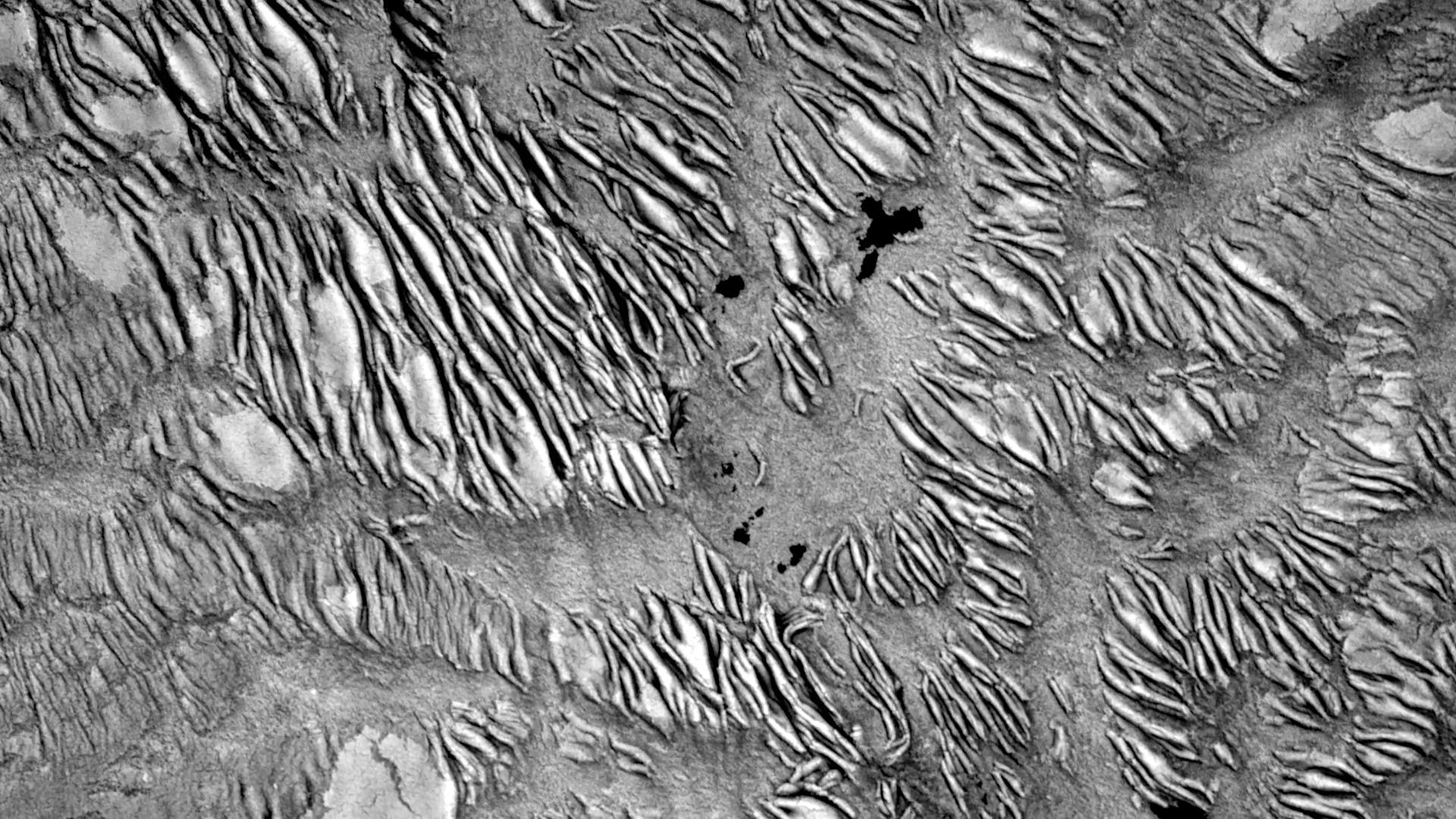
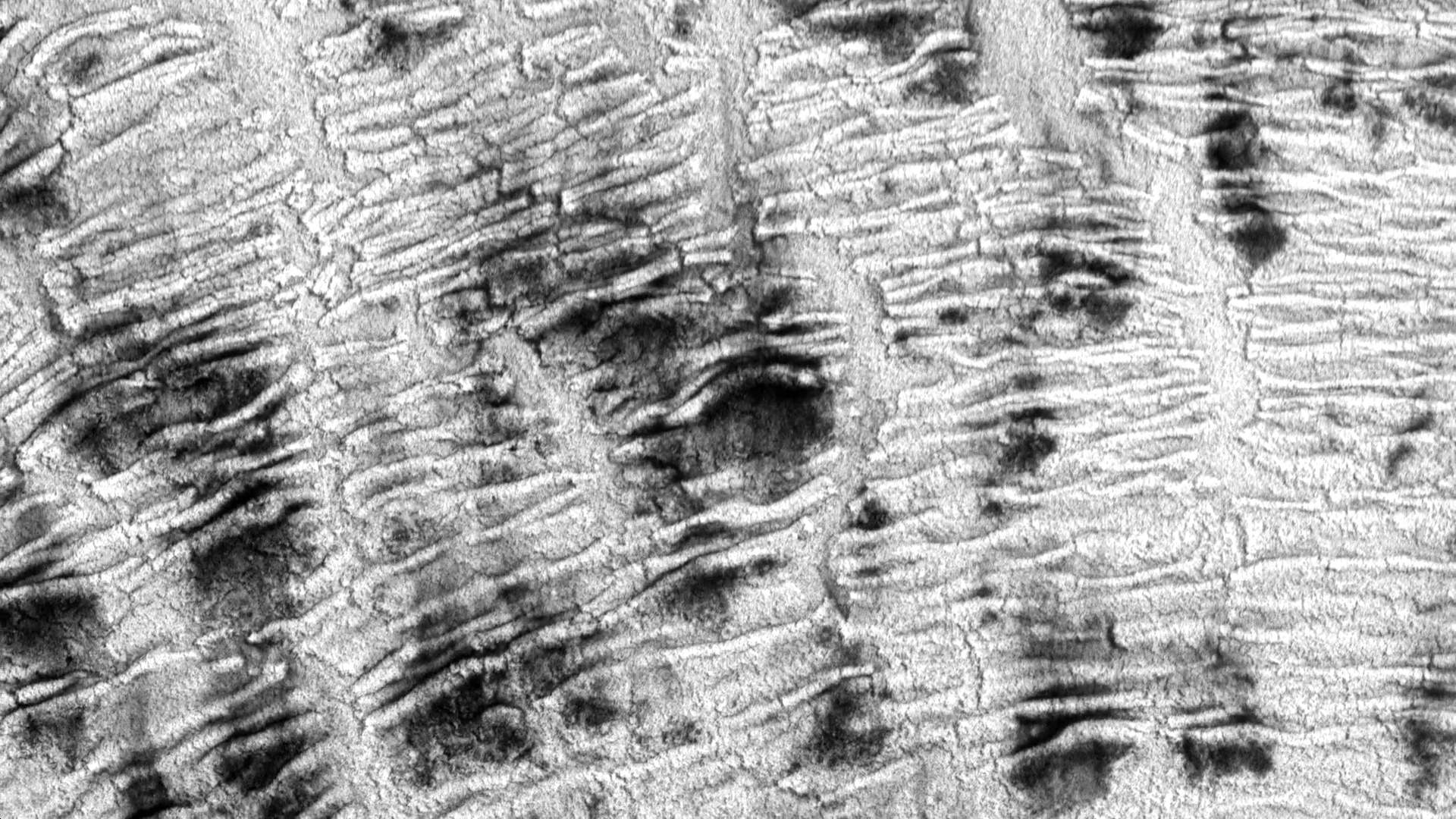
    Fly over a Martian crater in this incredibly detailed 8K video built from Mars Reconnaissance Orbiter imagery. Like Earth’s deserts, Mars is largely shaped by wind, and we get some fantastic views of sand ripples in this flyover. For reference, the vertical scale covered in the video image is roughly 1 kilometer. It’s pretty astounding to see this kind of detail from a spacecraft 250 kilometers away! (Video and image credit: S. Doran/NASA; via Colossal)