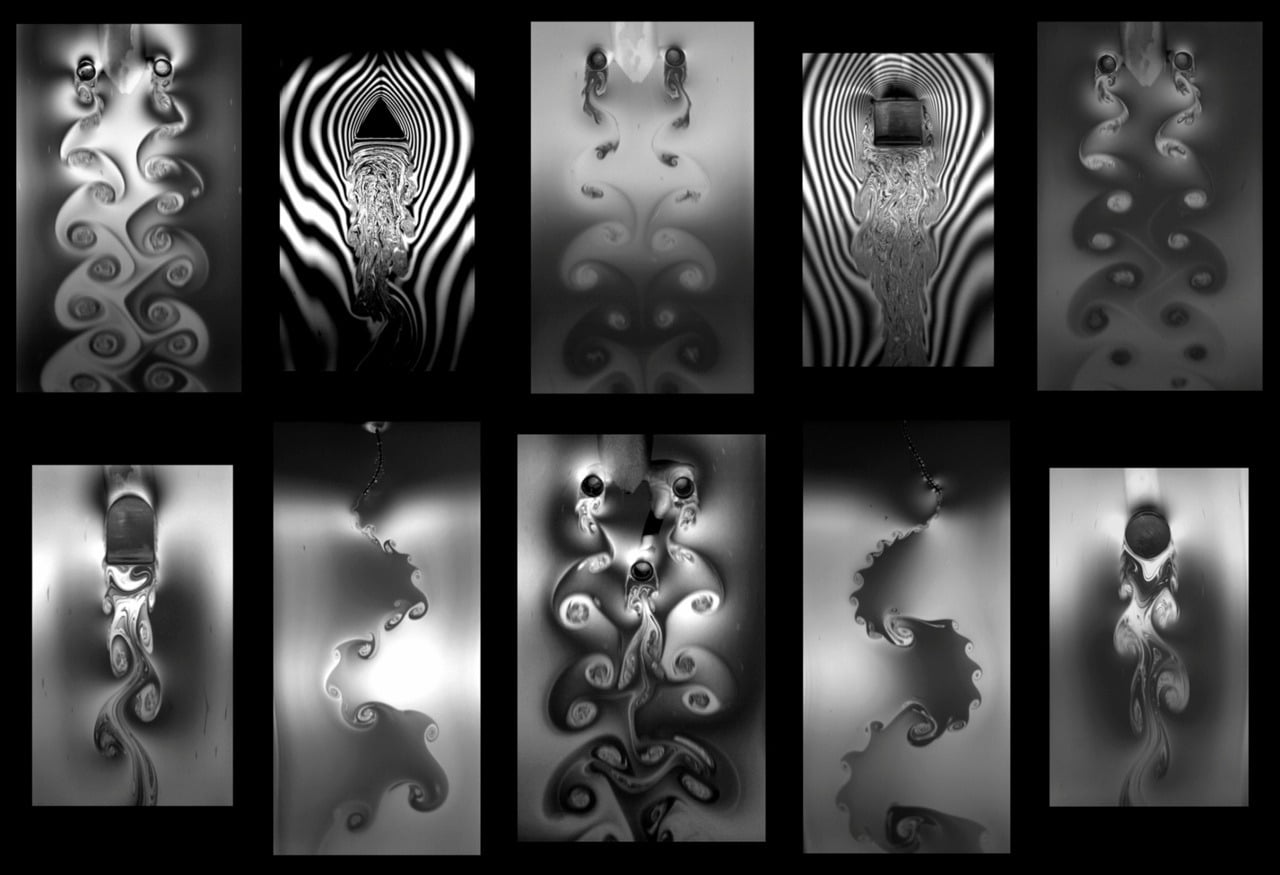
Flowing soap films provide an educational and beautiful method for visualizing the wakes of objects in two-dimensional flows. High-speed photography highlights the interference patterns on the soap film, providing detail without the necessity for the particulate tracking of other flow visualization methods. Highlights here include wakes behind bluff bodies, interacting cylinders, and flapping flags. (pdf) #
Tag: flow visualization

Flow Around a Delta Wing
Smoke visualization in a wind tunnel shows the vortices wrapping around and trailing behind a delta wing. As with more commonly seen rectangular or swept wings, the vortices that form around delta wings affect lift, drag, and control of an aircraft. They can also be hazardous to aircraft nearby. Note that, although delta wings are often seen on supersonic aircraft, this visualization only applies at subsonic speeds. The flow field changes drastically above the speed of sound.

Airfoil Boundary Layer
This video shows the turbulent boundary layer on a NACA 0010 airfoil at high angle of attack (15 degrees). Notice how substantial the variations are in the boundary layer over time. At one instant the boundary layer is thick and smoke-filled and in another we see freestream fluid (non-smoke) reaching nearly to the surface. This variability, known as intermittency, is characteristic of turbulent flows, and is part of what makes them difficult to model.

Water Spray from a Tire
The spray thrown up by a rolling tire is simulated in the lab by running a single-grooved tire (top) against a smooth tire (bottom) that simulates the road. A supply of water flows from the left at the speed of the rolling tires (6 m/s). The resultant sheet of water is a familiar site to motorists everywhere. Holes in the the sheet of water collide to form the smallest droplets, whose diameters are comparable to the thickness of the sheet, of the order of 100 microns. Thicker parts of the sheet form ligaments and break down into large droplets through the Plateau-Rayleigh instability. (Photo credit: Dennis Plocher, Fred Browand and Charles Radovich) #

Toroidal Vortex
When instabilities exist in laminar flow, they do not always lead immediately to turbulence. In this video, a viscous fluid fills the space between two concentric cylinders. As the inner cylinder rotates, a linear velocity profile (as viewed from above) forms; this is known as Taylor-Couette flow. If any tiny perturbations are added to that linear profile–say there is a nick in the surface of one of the cylinders–the flow will develop an instability. In this type of flow, an exchange of stabilities will occur. Rather than transitioning to turbulence, the fluid develops a stable secondary flow–the toroidal vortex highlighted by the dye in the video. If the rotation rate is increased further other instabilities will develop.
Aircraft Contrails
[original media no longer available]
Under the right atmospheric conditions, condensation can form, even at low speeds, as moist air is accelerated over airplane wings. This acceleration causes a local drop in pressure and temperature, which can cause water vapor in the air to condense. The condensation can sometimes get pulled into the wingtip vortices shed off of the wings, tail, and ailerons of an aircraft, as in the video above, making the aerodynamics of the airplane visible to the naked eye.

Shuttlecock Flow Viz
The flow around a shuttlecock is visualized in a water channel using fluorescent dye illuminated by laser light ultraviolet LEDs. Note the recirculation zone on the upper shoulder. Experimenters can match flow characteristics in water to that in air by matching the Reynolds numbers. (Photo credit: Rob Bulmahn)
Updated, thanks to information from the photographer. Thanks!

Flow Viz of a Locust
Smoke visualization in a wind tunnel reveals the airflow over a flying locust. Researchers are unraveling the aerodynamics of insect flight in order to produce better Micro Air Vehicles (MAVs) and miniature flying robots. #

Smoke Visualization on an F-16
Flow around an F-16XL Scamp model is visualized using smoke illuminated by laser sheets. Lasers are common equipment in fluids laboratories; they’re useful for flow visualization and for many velocimetry techniques.

Aerodynamics with Bill Nye and Samuel L. Jackson
Bill Nye, Samuel Jackson, golf balls, Reynolds number, dimples, and boundary layers. It doesn’t get much better than this. – Khristopher O (submitter)
It definitely beats Jackson’s other foray into aerodynamics! The dimples on a golf ball cause turbulent boundary layers, which actually decrease drag on the ball and make it fly farther. Why bluff bodies experience a reduction in drag as speed (and thus Reynolds number) increases was a matter of great confusion for fluid mechanicians early in the twentieth century, but it’s not too hard to see why it happens with some flow visualization.

On the top sphere, the laminar boundary layer separates from the sphere just past its shoulder. This results in a pressure loss on the backside of the sphere and, thus, an increase in drag. On the bottom sphere, a trip-wire placed just before the shoulder causes a turbulent boundary layer, which separates from the sphere farther along the backside. This late separation results in a thinner wake and a smaller pressure loss behind the sphere, thereby reducing the overall drag when compared to the laminar case. (Photo credit: An Album of Fluid Motion)