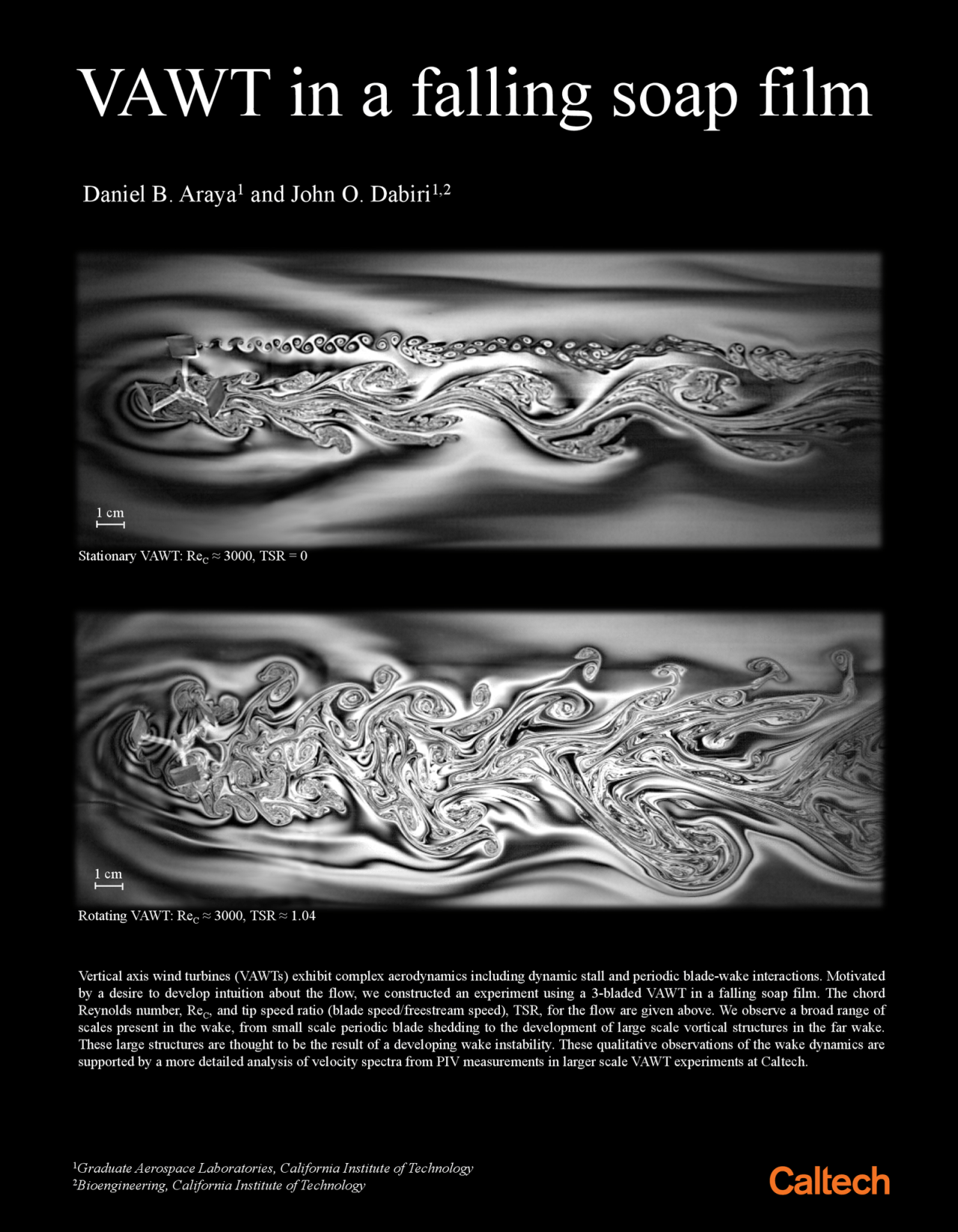
Vertical-axis wind turbines (VAWT) are an alternative to traditional wind turbine designs. Unlike their more common cousins, VAWTs rotate about a vertical axis and are omni-directional, meaning that they do not have to be pointed into the wind to produce power. While their size allows VAWTs to be packed much closer to one another than traditional turbines, a clear understanding of the flow around the turbines is needed in order to place the turbines for effective and efficient operation. The images above show the complicated and turbulent wake of a three-bladed VAWT when stationary (top) or rotating (bottom). The flow is visualized using a gravity-driven soap film (flowing left to right in the images) pierced by a model VAWT (seen at the left). The wakes contain many scales from simple, periodically-shed vortices off a blade to very large-scale vortical structures forming downstream of the turbine. This work originally appeared as a poster in the Gallery of Fluid Motion at the 2014 APS DFD Annual Meeting. (Image credit: D. Araya and J. Dabiri)
Tag: flow visualization

Filter-Feeding
Sponges are filter-feeding marine animals that rely on water flow to obtain their nutrients and remove waste. By injecting non-toxic fluorescein dye at their base, one can visualize the flow they induce in the water. Only seconds after the dye is introduced, the sponges have pumped it in, through, and out. Different parts of the sponge filter particles of various sizes for food. Oxygen and carbon dioxide are transported, respectively, into and out of cells via diffusion. In this way, the sponge’s pumping fulfills digestive, respiratory, and excretory functions. (Image credit: Jonathan Bird’s Blue World, source video; submitted by Jason C)

Light Paintings
Photographer Stephen Orlando uses programmable LEDs to create light paintings. Here floating LEDs illuminate a track down a waterfall. In flow visualization terms, this is a pathline because it records the trajectory a particular particle followed through the flow. Streamlines, streaklines, and pathlines are all important concepts for interpreting fluid flow through visualization. To see more of Orlando’s light paintings, including some wonderful portraits of canoeing and kayaking, be sure to check out his galleries. (Photo credit: S. Orlando; via Colossal)

Colonial Life


Hydroids are small underwater animals that often live in colonies made up of individual polyps. The colony is interconnected through the gastrovascular system, which is responsible for both digestion and respiration. In the images above, a single polyp in the colony has been fed food dyed with a fluorescent tracer. The polyp serves as a circulating pump and, as the food is digested and the tracer released, more and more of the colony becomes visible. Watch the full video and read more about the experiment. (Video credit and submission: L. Buss Lab)

Von Karman Vortex Streets
The wake of a cylinder is a series of alternating vortices shed as the flow moves past. This distinctive pattern is known as a von Karman vortex street. The speed of the flow and the size of the cylinder determine how often vortices are shed. Incredibly, this pattern appears at scales ranging from the laboratory demo all the way to the wakes of islands. Von Karman vortex streets can even be seen from space. (Image credit: R. Gontijo and W. Cerqueira, source video)

The Hidden Complexities of the Simple Match
Striking a match and blowing it out seems rather simple to the naked eye. But with high-speed video and schlieren photography, the act takes on new complexity. Schlieren photography is an optical technique that is incredibly sensitive to changes in density, which makes it a prime choice for visualizing flows with temperatures variations or shock waves. Here it shows the hot gases generated as the match is lit. Once the match ignites, the flow calms somewhat into a gently rising plume of exhaust and hot air. When someone enters the frame to blow out the match, the frame rate increases to capture what happens next. The flow field around the match becomes very complex as the air and flame interact. The range of length scales in the flow increases, from scales of several centimeters down to those less than a millimeter. This complexity and range of sizes is a hallmark of turbulence. (Video credit: V. Miller et al.)
“Courants et Couleurs”
Although flow visualization is a scientific technique, there is very much an art to it. Flow structures are, by their nature, ephemeral. To capture them, one must design an experiment that introduces dye into regions of interest without altering the flow significantly and without either ignoring or obscuring important physics. One of the great masters of this scientific art was Henri Werlé, whose extensive flow visualization work at France’s national aerospace lab is documented in the short film above. The film includes examples of simple geometries, full aircraft models, subsonic flow, shock waves, and more. eFluids has a whole gallery of Werlé images, too. Take a few minutes to enjoy the mesmerizing beauty of these experiments and appreciate the talents of those who made them possible. If you have questions about specific clips, feel free to ask! (Video credit: H. Werlé/ONERA; via J. Hertzberg)

The Marangoni Effect
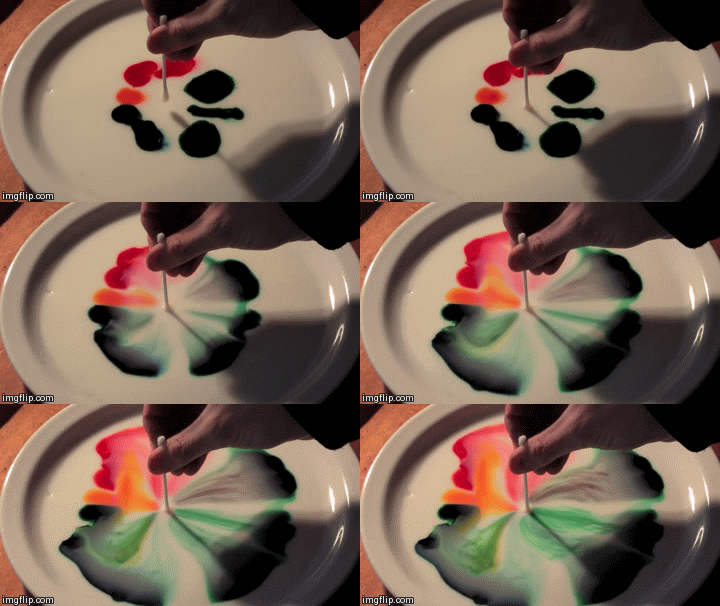
Differences in surface tension can create Marangoni flow along an interface. Imagine a shallow bowl filled with a liquid. In the middle of the fluid, every molecule is surrounded on all sides by like molecules, which push and pull it equally in all directions. But at the surface, the fluid molecules are only acted on by similar molecules in some directions. This imbalance in molecular forces is what creates surface tension. When the surface tension is constant, the fluid surface is like a taut rubber sheet. Poke a hole in that sheet, and everything pulls away from the hole. Likewise, when the surface tension varies, fluid will move from areas of low surface tension toward areas of higher surface tension. This effect is easily demonstrated at home in a setup like the animation above. Pour milk (higher fat content is better) and food coloring in a shallow container. Then lower the local surface tension using dish soap or rubbing alcohol and watch the colors run away! (Image credit: Flow Visualization at UC Boulder, source video)

Phytoplankton Bloom
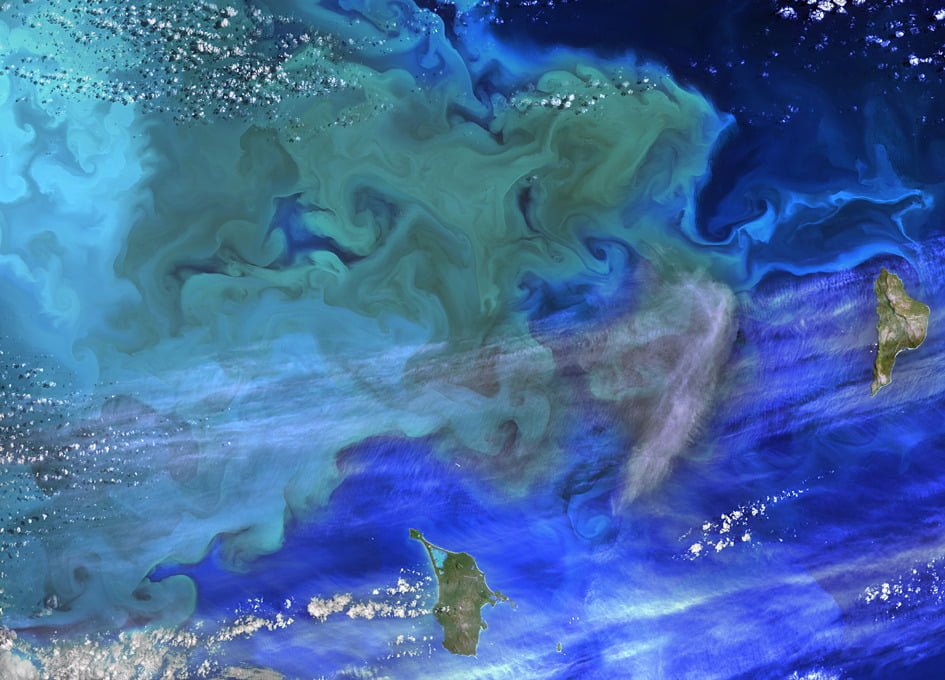
In satellite imagery the blue and green whorls of massive phytoplankton blooms stand out against the ocean backdrop. These microscopic organisms are part of a delicate predator-prey balance and can be very sensitive to nutrient concentrations and other environmental conditions. Their individual size is negligible, but in a bloom phytoplankton are numerous enough that they act as seed particles for the flow. As a result, differing concentrations of phytoplankton reveal the swirling, turbulent mixing of ocean waters. (Image credit: NASA/USGS; via SpaceRef; submitted by jshoer)
Turbine Blade Separation
[original media no longer available]
Maintaining consistent air flow along the contours of an object is key to aerodynamic efficiency. When air flow separates or forms a recirculation zone, the drag increases and efficiency drops. On wind turbine blades, flow often separates on the root end of the blade near its attachment point. This behavior is apparent in the video above at 0:34. The tufts in the foreground on the turning blade flap and flutter with no clear pattern because the air flow has separated from the surface. In the subsequent clip, a line of vortex generators has been attached near the leading edge of the blade. These structures–also commonly seen on airplanes–trail vortices behind them, mixing the flow and generating a turbulent boundary layer which is better able to resist flow separation. The effect on the flow is clear from the tufts, most of which now point in a consistent direction with little to no fluttering, indicating that the air flow has remained attached. (Video credit: Smart Blade Gmbh/Technische Universität Berlin)
(Source: /)