A cylinder standing upright in a flow creates a complicated system of vortices and recirculation. In the photo above, the flow is left to right. The cylinder itself is somewhat hard to see but is located in the center of the image; we see it from above. The colored streaks of dye show the flow path around the cylinder. In yellow, we see a spiraling vortex that forms just ahead of the cylinder and stretches downstream on either side. Because of its shape, this is called a horseshoe vortex. Its sense of rotation is such that it tends to pick up loose material in front of the cylinder; in other words, it can erode that area. This is often seen around the pilings of bridge supports and must be accounted for in designs. You also see the effects of this horseshoe vortex digging out material at the base of trees after snowfalls in areas with a dominant wind direction, and here’s an example with a snow roller. (Image credit: H. Werlé; via eFluids)
Tag: flow visualization

Impressionist Gibraltar
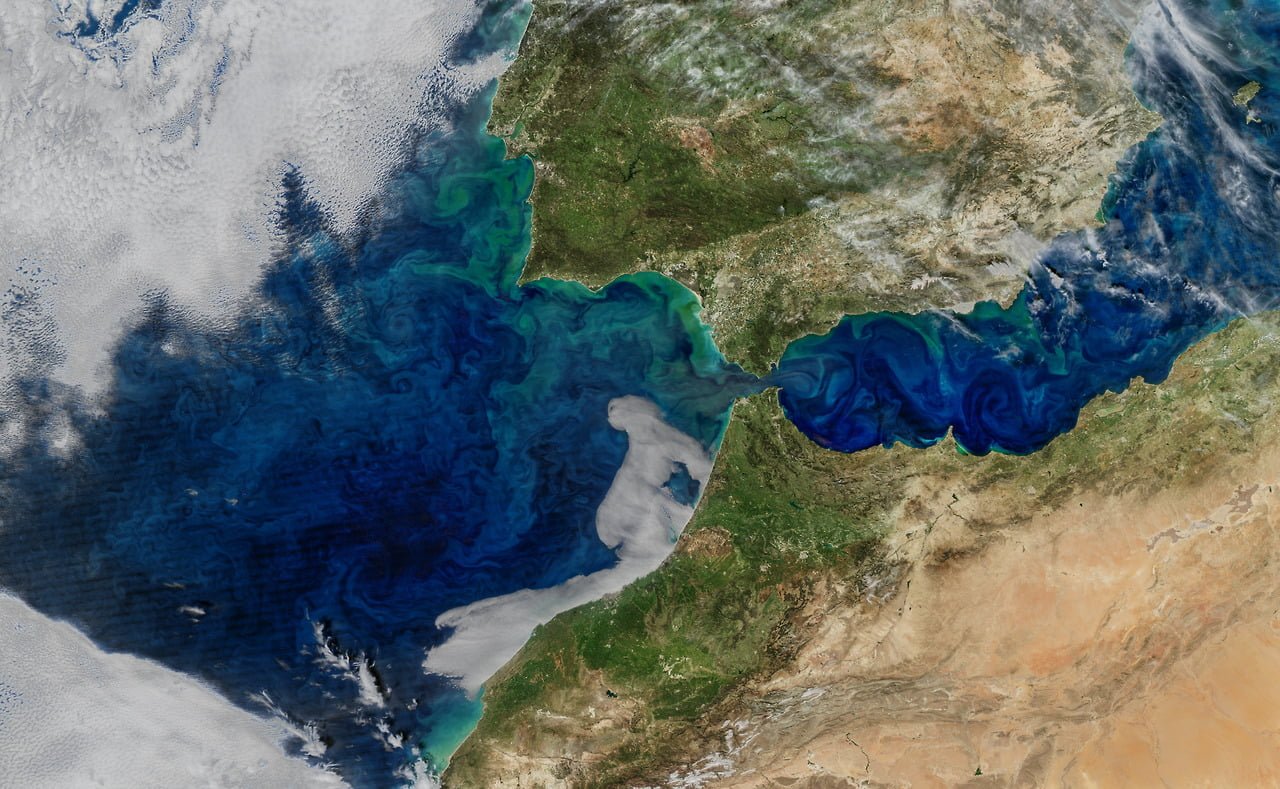
Swirls of phytoplankton make this satellite image of Gibraltar look like an Impressionist painting. The photo is a composite of data from several instruments, with colors enhanced to highlight features of the phytoplankton blooms. The tiny plankton act as tracer particles that reveal some of the complex flow between the North Atlantic and the Mediterranean. Although narrow, the Strait at Gibraltar has deep and complex terrain that was formed during a breach flood event millions of years ago. Water flowing through that terrain sets up enormous and complicated waves well beneath the ocean surface. These drive some of the turbulence that we see here as the blue swirls east of the Strait. (Image credit: NASA/N. Kurig; via NASA Earth Observatory)

Kelvin-Helmholtz Instability
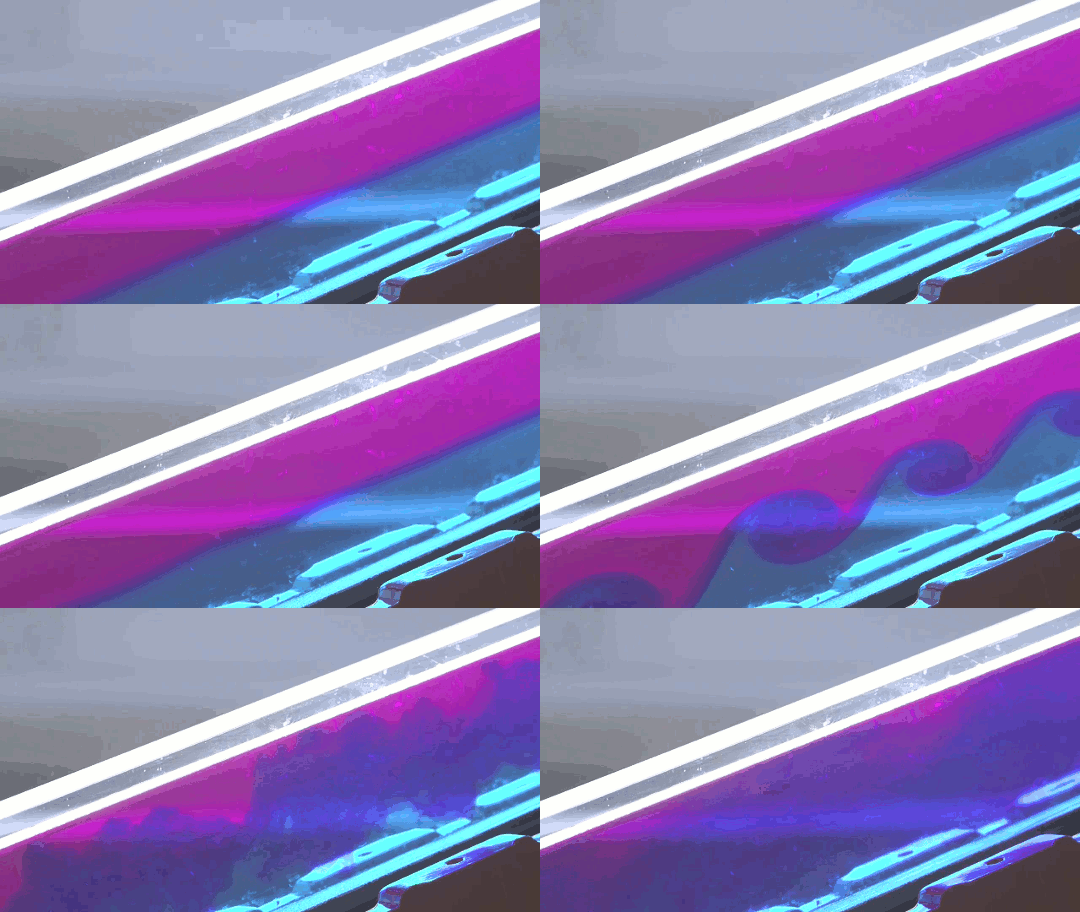
Sixty Symbols has a great new video explaining the laboratory set-up for demoing a Kelvin-Helmholtz instability. You can see a close-up from the demo above. Here the pink liquid is fresh water and the blue is slightly denser salt water. When the tank holding them is tipped, the lighter fresh water flows upward while the salt water flows down. This creates a big velocity gradient and lots of shear at the interface between them. The situation is unstable, meaning that any slight waviness that forms between the two layers will grow (exponentially, in this case). Note that for several long seconds, it seems like nothing is happening. That’s when any perturbations in the system are too small for us to see. But because the instability causes those perturbations to grow at an exponential rate, we see the interface go from a slight waviness to a complete mess in only a couple of seconds. The Kelvin-Helmholtz instability is incredibly common in nature, appearing in clouds, ocean waves, other planets’ atmospheres, and even in galaxy clusters! (Image and video credit: Sixty Symbols)

How Smoke Rings Work
Vortices are a ubiquitous part of life, whether they’re draining down your bathtub or propelling underwater robots. In the latest video from the Lib Lab project, you can learn about how vortex rings form, what makes them last so long, and even make a vortex generator of your own. I can personally attest that vortex cannons are good for hours of entertainment, no matter your age. They’re even more fun with friends, as the Oregon State drumline demonstrates in the video. Want even more vortex fun? Check out leapfrogging vortices, vortex rings colliding head-on, and a giant 3 meter wide vortex cannon in action. (Video and image credit: Lib Lab)


Schooling in Soap Films
In sports, flocks of birds, and schools of fish, we’re accustomed to thinking that the followers get an aerodynamic or hydrodynamic advantage over the leaders, but this may not always be the case. Here are two flags placed one after another in a soap film flowing from top to bottom. The flags are passive, meaning that their motion is entirely dependent on the flow around them; they cannot exert any resistive force of their own. In this case, scientists observe an effect known as inverted drafting. The lead flag actually experiences less drag – by as much as 50% – than the following flag. This seems to be a result of flow around the second flag having an upstream influence on the motion of the first. (Image and research credit: L. Ristroph and J. Zhang, pdf)

How Cycling Position Affects Aerodynamics


New FYFD video! How much does a rider’s position on the bike affect the drag they experience? To find out I teamed up with folks from the University of Colorado at Boulder and at SimScale to explore this topic using high-speed video, flow visualization, and computational fluid dynamics.
Check out the full video below, and if you need some more cycling science before the Tour de France gets rolling, you can find some of my previous cycling-related posts here. (Image and video credit: N. Sharp; CFD simulation – A. Arafat)
ETA: Please note that the video contained in this post was sponsored by SimScale.

Watching Radiation
We’re used to radiation being invisible. With a Geiger counter, it gets turned into audible clicks. What you see above, though, is radiation’s effects made visible in a cloud chamber. In the center hangs a chunk of radioactive uranium, spitting out alpha and beta particles. The chamber also has a reservoir of alcohol and a floor cooled to -40 degrees Celsius. This generates a supersaturated cloud of alcohol vapor. When the uranium spits out a particle, it zips through the vapor, colliding with atoms and ionizing them. Those now-charged ions serve as nuclei for the vapor, which condenses into droplets that reveal the path of the particle. The characteristics of the trails are distinct to the type of decay particle that created them. In fact, both the positron and muon were first discovered in cloud chambers! (Image credit: Cloudylabs, source)

Flow in a Turbine
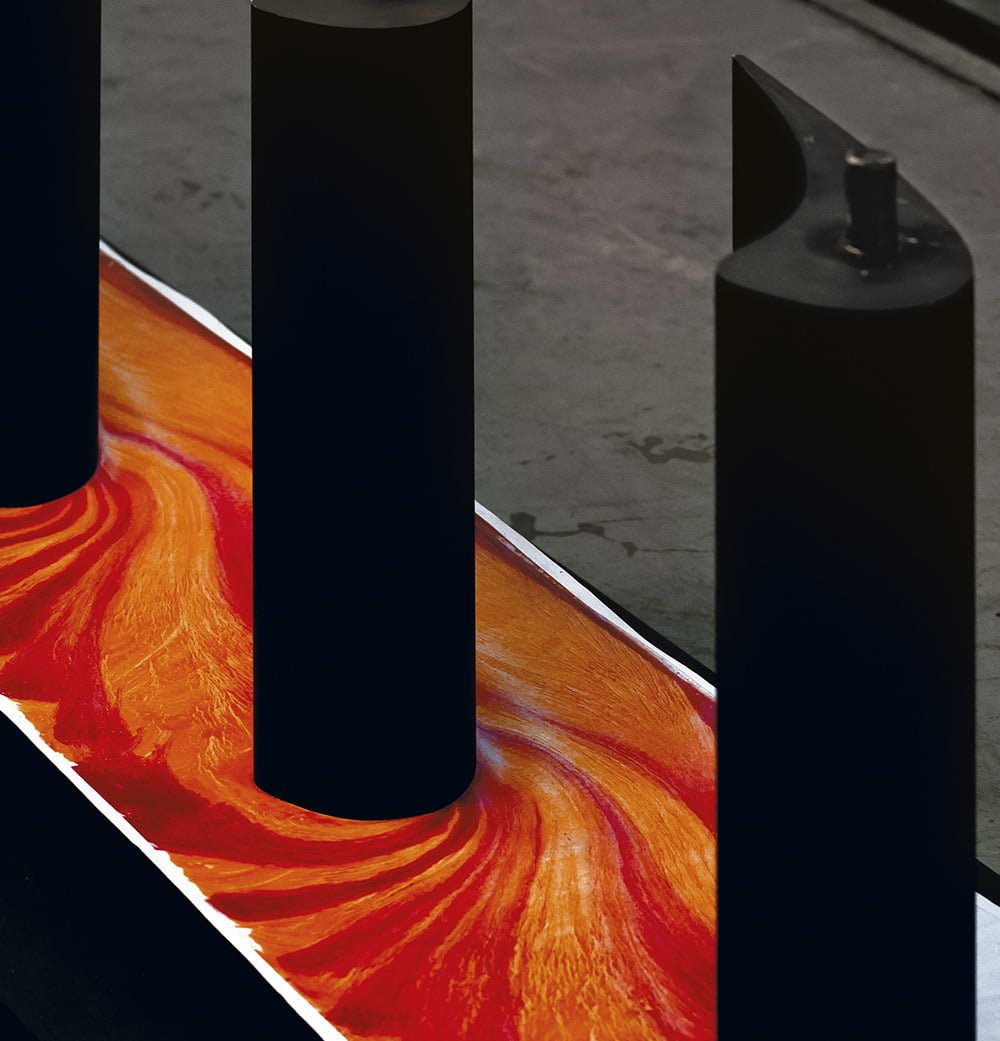
Fluid flows are complex, complicated, and ever-changing. Researchers use many techniques to visualize parts of a flow, which can help make what’s happening clearer. One technique, shown above, uses oil and dye to visualize flow at the surface. The vertical, black, airfoil-shaped pieces are stators, stationary parts within a turbine that help direct flow. After painting the stator mount surface with a uniform layer of oil, the model can be placed in a wind tunnel (or turbine) and exposed to flow. Air moving around the stators drags some of the oil with it, creating the darker and lighter streaks seen here. Notice how the lines of oil turn sharply around the front of the stator and bunch up near its widest point. Those crowded flow lines tell researchers that the air moves quickly around this corner. (Image credit: D. Klaubert et al., source)
Shadows of Flow
In the latest Veritasium video, Derek demonstrates how to see gas motions that are normally invisible using a schlieren photography set-up. Schlieren techniques have been important in fluid dynamics for well over a century, and Derek’s set-up is one of the two most common ways to set up the technique. (The other method uses two collimating mirrors instead of a single spherical or parabolic one.) As explained in the video, the schlieren optical set-up is sensitive to small changes in the refractive index, making density changes or differences in a gas visible. This makes it possible to distinguish gases of different temperatures or compositions and even lets you see shock waves in supersonic flows. (Video and image credit: Veritasium; submitted by Paul)

Reconnecting
Vortices are a common feature of many flows. Here we see a helical vortex tube spinning in a swirling flow. The vortex itself is visible thanks to air trapped in its low-pressure core. As the vortex spins, two sections of it come together. This results in what’s known as vortex reconnection: the vortex lines break apart and rejoin in a new configuration – as a small independent vortex ring and a shorter section of helical vortex. Events like this are common but usually hard to observe directly. They’ve been previously visualized using vortex knots and have even been sighted in the quantum vortices of superfluid helium. (Image credit: S. Skripkin, source; research credit: S. Alekseenko et al., pdf)