Tag: flow visualization

  • Sea Swirls by the Shore

    Sea Swirls by the Shore

    Water and sediments swirl in these enhanced satellite photos of China’s Leizhou Peninsula. Color-filtering algorithms have drawn out the details of the flows, but the patterns themselves are real. Tides, currents, sediment, and human activity combine to form these complex flows along the peninsula’s shores. The straight parallel lines seen off Liusha Bay, for example, are likely the result of a traditional fishing method using nets suspended off poles anchored into the seabed. (Image credit: N. Kuring; via NASA Earth Observatory)

  • Inside Hydroplaning

    Inside Hydroplaning

    When a tire spins over a wet roadway, pressure at the front of the tire generates a lifting force; if that lift exceeds the weight of the car, it will start hydroplaning. To prevent this, the grooves of a tire’s tread are designed to redirect the water. Now researchers have visualized flow inside these grooves for the first time, using a version of particle image velocimetry (PIV). PIV techniques use fluorescent particles to track the flow.

    The results reveal a complicated, two-phase flow inside the tire grooves. As seen in the images above, bubble columns form inside the tire grooves. The team’s results suggest that the bubble columns depended on groove width, spacing, and intersections with other grooves. They also saw evidence of vortices inside some grooves. (Image credit: tires – S. Warid, others – D. Cabut et al.; research credit: D. Cabut et al.; via Physics World; submitted by Kam-Yung Soh)

  • Featured Video Play Icon

    “Geodaehan”

    In “Geodaehan” Roman De Giuli’s macro fluid art mimics massive landscapes. The film takes us over deltas, rivers, glaciers, and landslides. Some look like earthbound locations, others look like something from Mars or Titan. All are, in fact, paint, ink, and glitter on paper! It’s truly incredible how artists capture large-scale fluid physics on such a tiny canvas. (Image and video credit: R. De Giuli)

  • Decelerating Jets

    Decelerating Jets

    For more than a century, scientists have been fascinated by the jet that forms after a drop impacts a liquid. In this study, researchers tracked fluorescent particles in the fluid to understand the velocity and acceleration of flow inside the jet. They found that, within the first 10ms after the jet appears, it decelerates at up to 20 times the gravitational acceleration. That’s much too fast for gravity to cause, pointing instead to the critical importance of surface tension in dictating the behavior of these fast-moving jets. (Image and research credit: C. van Rijn et al.; via APS Physics; submitted by Kam-Yung Soh)

  • Wrinkles on Collapsing Bubbles

    Wrinkles on Collapsing Bubbles

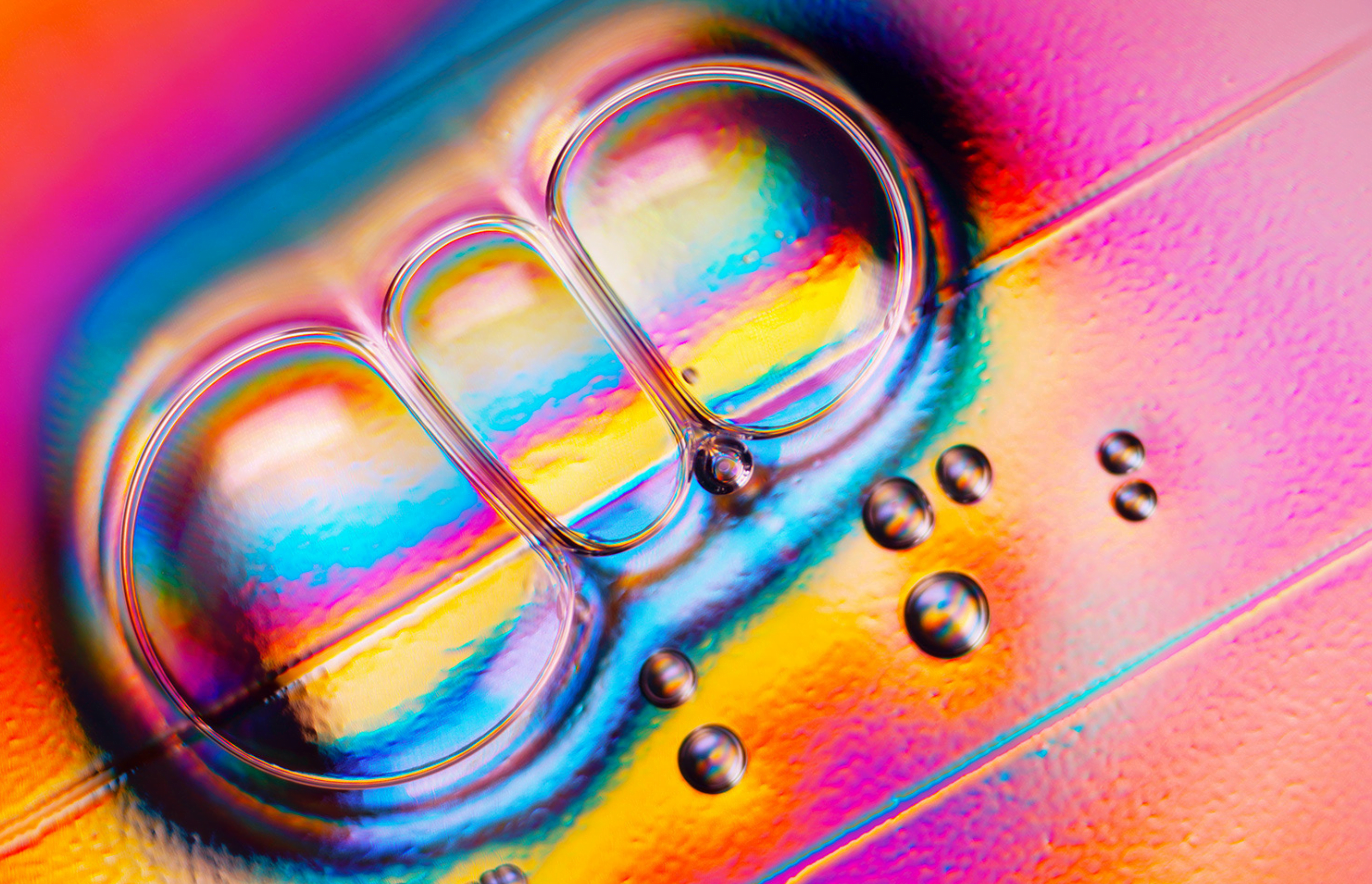
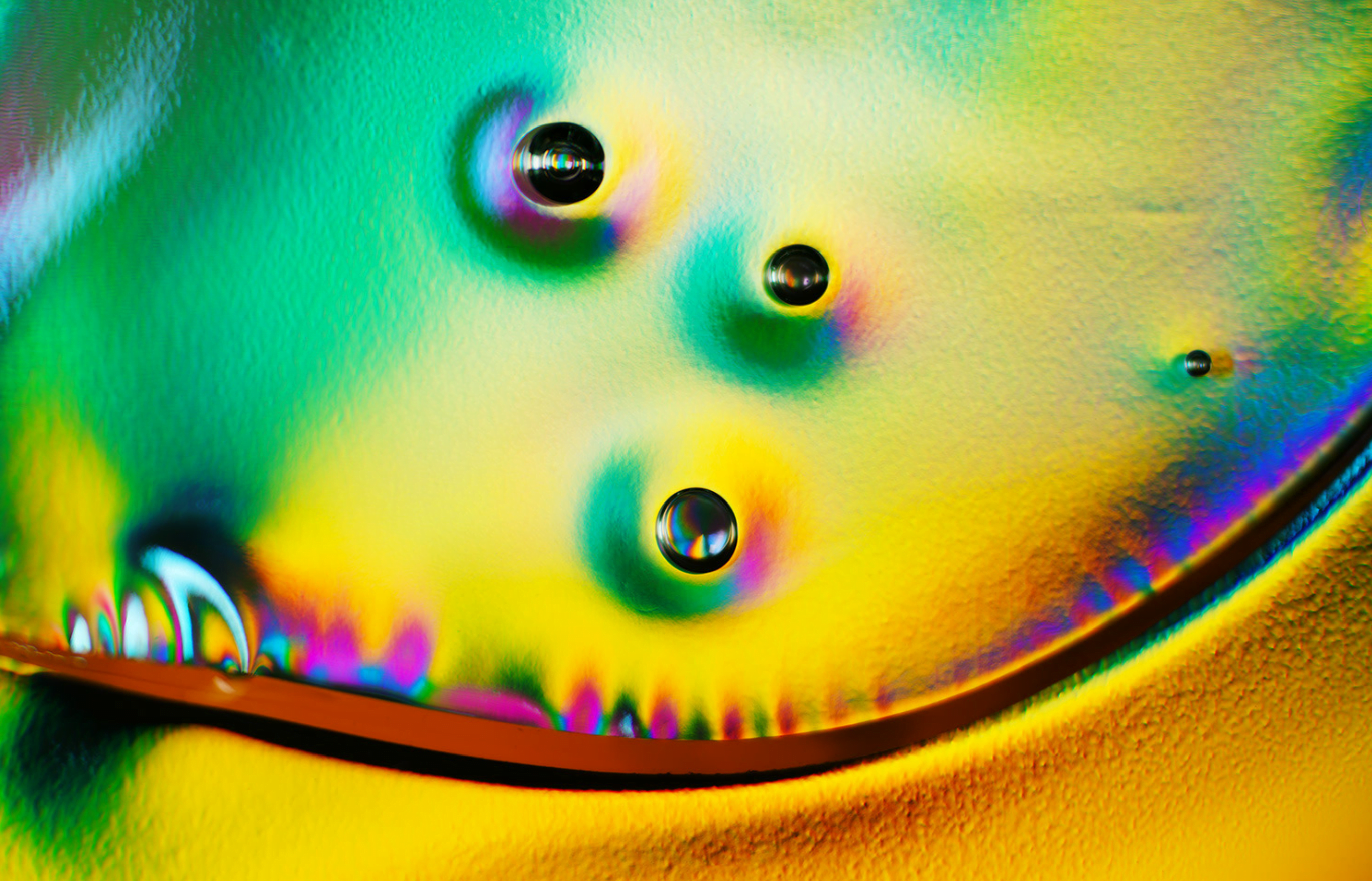
    As a bubble sitting on a pool collapses, wrinkles form around its edges. Visually, the result is quite similar to the wrinkles one gets on an elastic sheet. Unlike the solid sheet, though, the bubble’s film varies in thickness; we know this because of the fringes shown in the enlarged inset of the poster. Researchers are studying this non-uniformity to see whether it affects the number and shape of wrinkles that form on the bubble. (Image and research credit: O. McRae et al.)

  • Featured Video Play Icon

    Visualizing Radiation

    Radiation is invisible, but it’s not too difficult to build an apparatus that lets you see it. This video shows the ghostly aftermath of passing radiation in a cloud chamber, one of the first set-ups used to study radiation. The chamber contains a radioactive source and chilled isopropyl alcohol. The alcohol forms a supersaturated vapor — essentially a cloud in waiting — inside the chamber.

    When a radioactive particle gets emitted from the source, it streaks through the chamber, colliding with atoms and ionizing them. Those ions then serve as nucleation sites where alcohol condenses into droplets. It’s these condensation trails that we see bloom and decay in the particle’s wake. (Image and video credit: L. Gledhill)

  • Featured Video Play Icon

    Fluid Chains

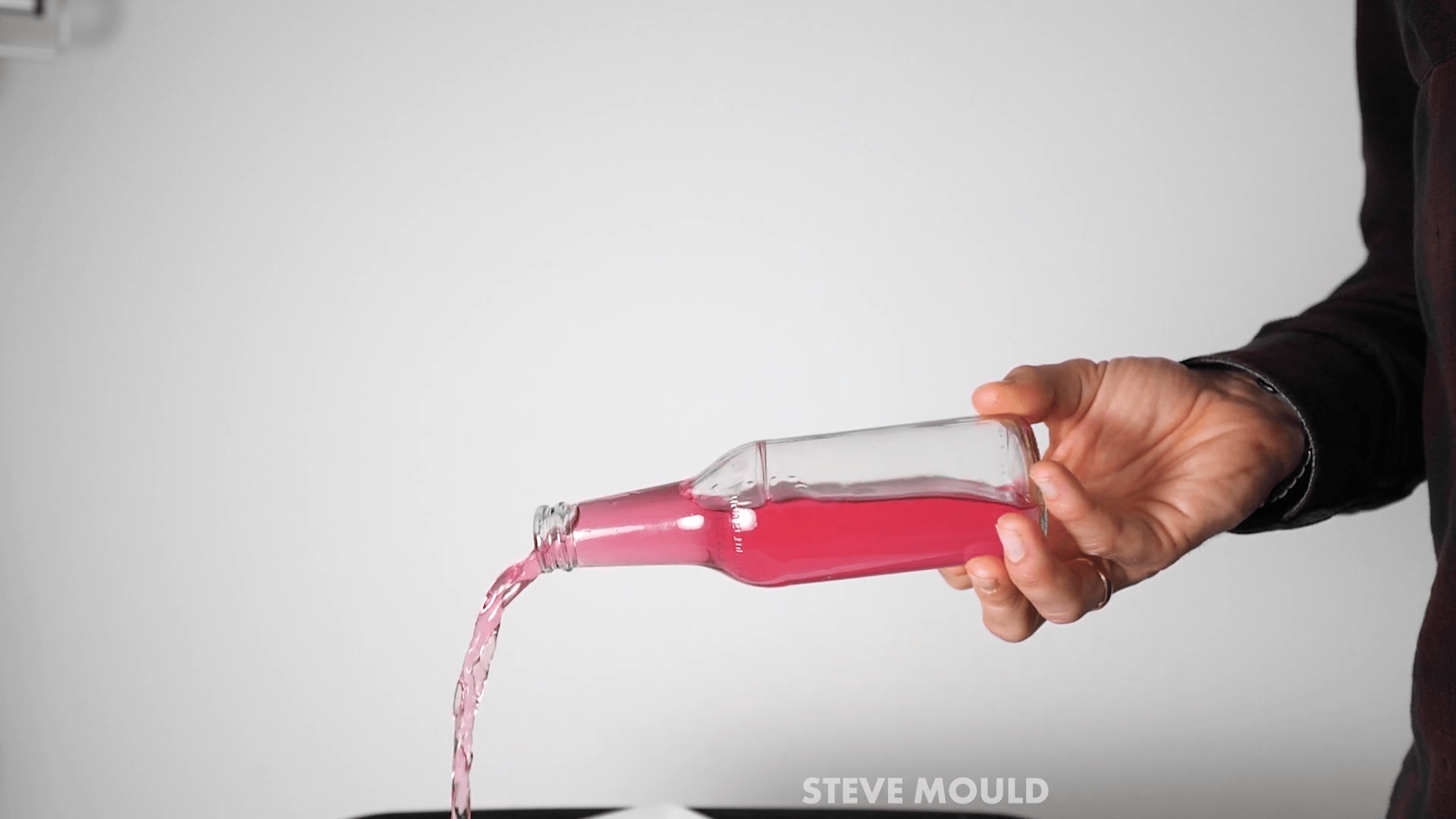
    In this video, Steve Mould tackles a question many of us have likely wondered: just why does falling water make this chain-like shape? When pouring from a slit-like orifice, water jets take on this undulating pattern. While I have no issue with Steve’s explanation of surface tension oscillations driving the shape, I’ll quibble a little bit with the idea that this hasn’t been studied. Personally, I’d connect it to the fishbone instability, which classically occurs when two jets collide. At low flow rates, though, the colliding jets form a pattern very much like this one. And if you look just past the initial conditions at the container opening, all of these flows have thicker jet-like rims colliding. I think the flows in these videos are just a slightly messier version of the low-flow-rate fishbone. What do you think? (Video and image credit: S. Mould)

  • Featured Video Play Icon

    Taylor Columns

    When rotating, fluids often act very differently than we expect. For example, an obstacle in a rotating flow will deflect flow around it at all heights. This is known as a Taylor column.

    In this video, we see the phenomenon recreated in a simple rotating tank (that’s easy to build yourself). Once all the water in the tank is rotating at the same rate, there is very little variation in flow with height. Food coloring dropped into the tank forms tight vertical columns. Even with a short obstacle in place and induced flow in the tank from a change in rotation rate, the dye continues to move uniformly in height. Because the dye cannot travel through the obstacle, it goes around and does so at every height, leaving the space above the obstacle dye-free.

    The same phenomenon occurs in planetary atmospheres; this rotating tank is basically a mini-version of our own atmosphere. Where there are obstacles — like mountains — on our planet, air has an easier time flowing around the mountain instead of over it! (Image and video credit: DIYnamics)

  • Chaotic Mixing in Porous Media

    Chaotic Mixing in Porous Media

    One of the peculiar characteristics of viscous, laminar flows is that they are reversible. Squirt dye into glycerin, stir it one way, then the opposite direction, and the dye returns to its initial position. But this neat trick only works in simple geometries; in a more complex environment, like the pores between packed gravel, flows cannot make their way back to their initial state.

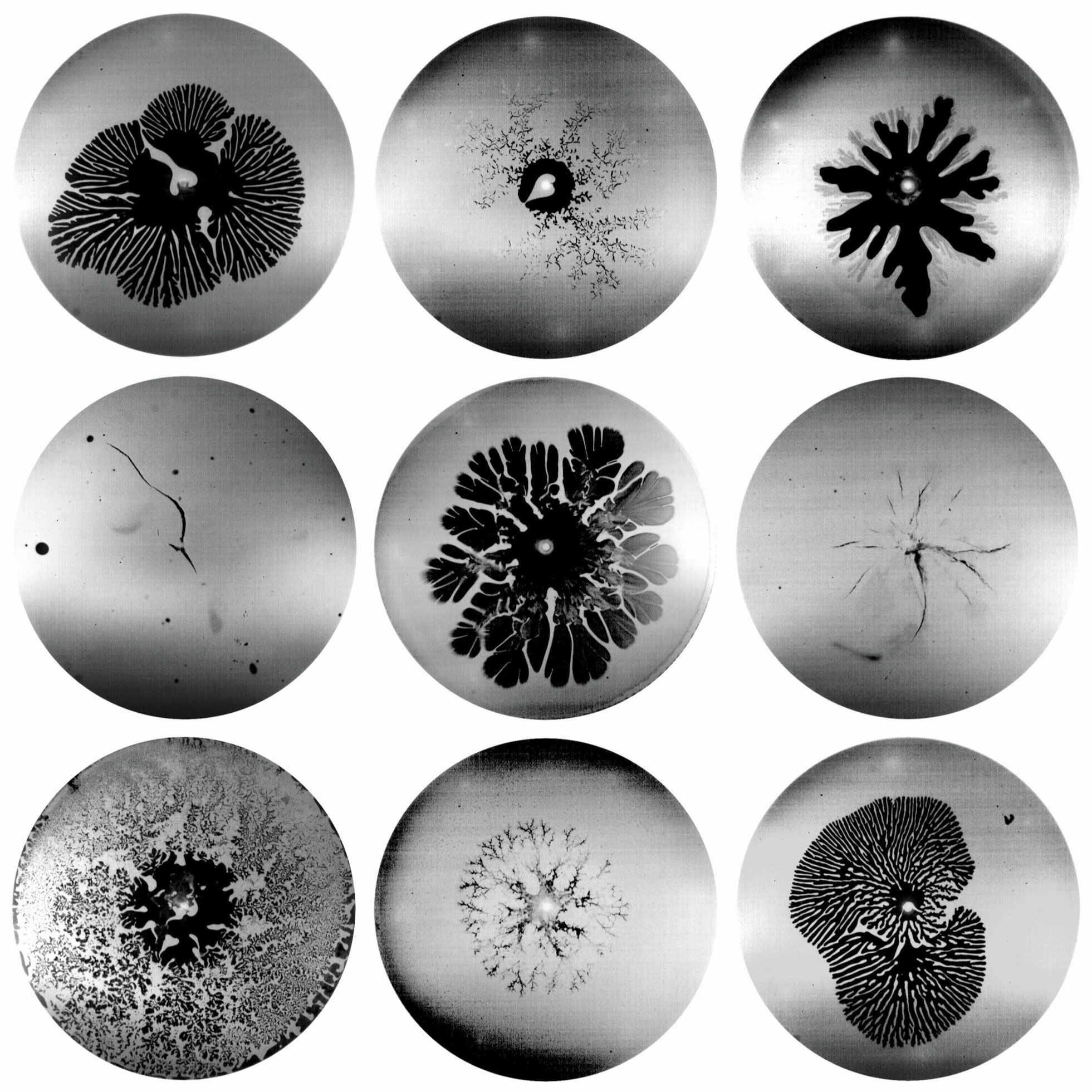
    That’s the idea at the heart of this new study of mixing in porous media. Researchers took a bed of packed beads and pushed a slow, steady flow of dye into the bed. Then they steadily withdrew fluid to reverse the flow and observed how the dye they’d injected appeared at the surface of the bed (top image). If the flow were perfectly reversible, we’d expect the dye to return to its injection point. But instead the dye is spread chaotically across the surface, giving researchers a snapshot of the chaotic mixing taking place between beads. (Image and research credit: J. Heyman et al.; via APS Physics)

  • Snowflake Velocimetry

    Snowflake Velocimetry

    In our era of remote learning, students don’t always have a chance to do hands-on lab experiments in the usual fashion. But that doesn’t mean they can’t explore important flow diagnostic techniques. Here a simple smartphone video of snow falling gets turned into a lesson on particle image velocimetry, or PIV, a major technique for measuring flow velocities.

    A nearby house acts as a fixed backdrop, and by comparing snowflake positions from one frame to the next, students can measure the instantaneous flow patterns in the snowfall. Of course, that’s a tedious task to do by hand, but luckily there are computer programs that do it automatically. Simply run the smartphone video through the software, and analyze the patterns it reveals!

    As a bonus, students don’t have to get distracted by the complexities of laser sheets and flow seeding that are normally a part of PIV. Instead, the flow and the lighting are already right outside their window, and they can concentrate instead on learning the principles of the technique and how to use the software. (Image and submission credit: J. Stafford)