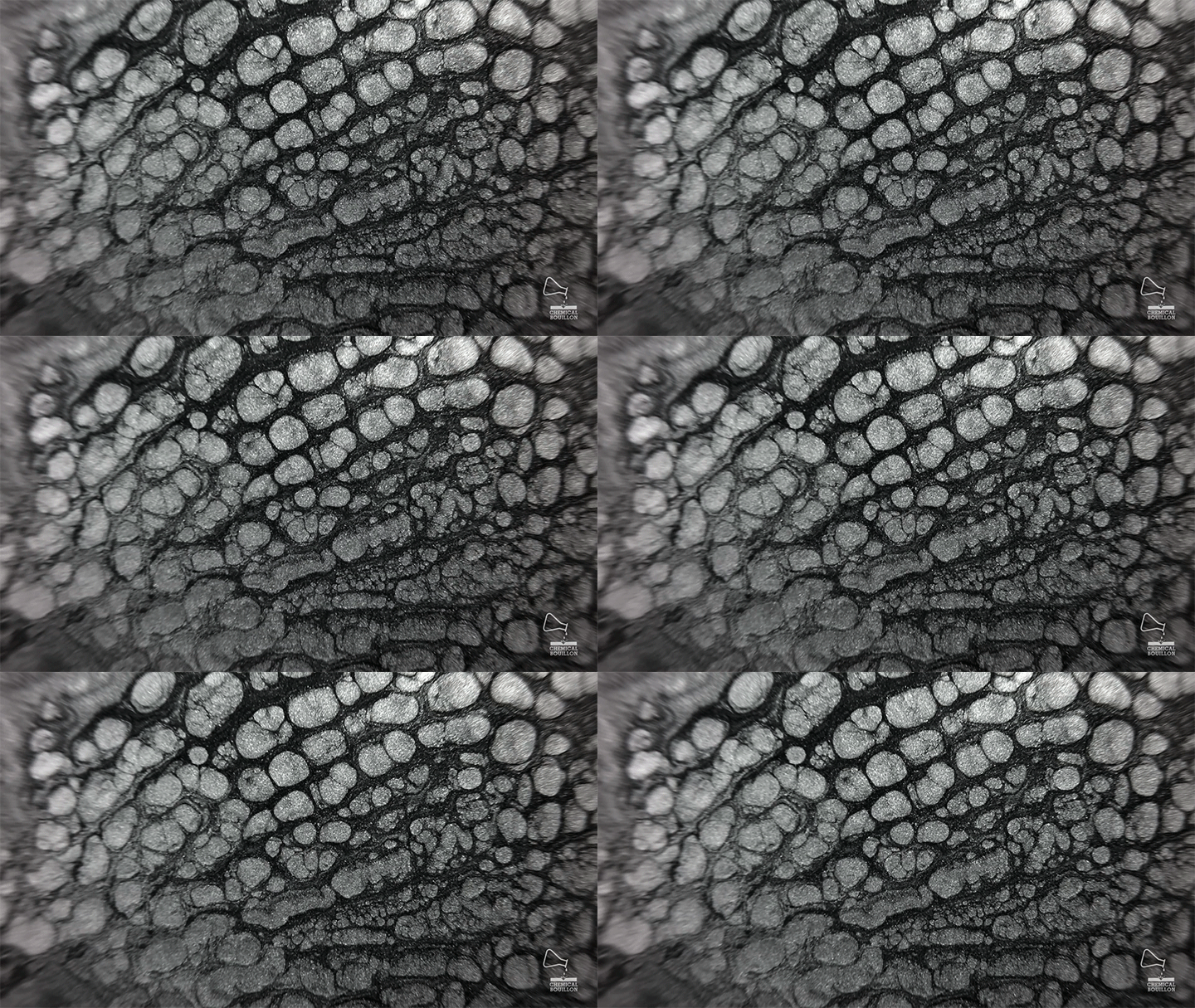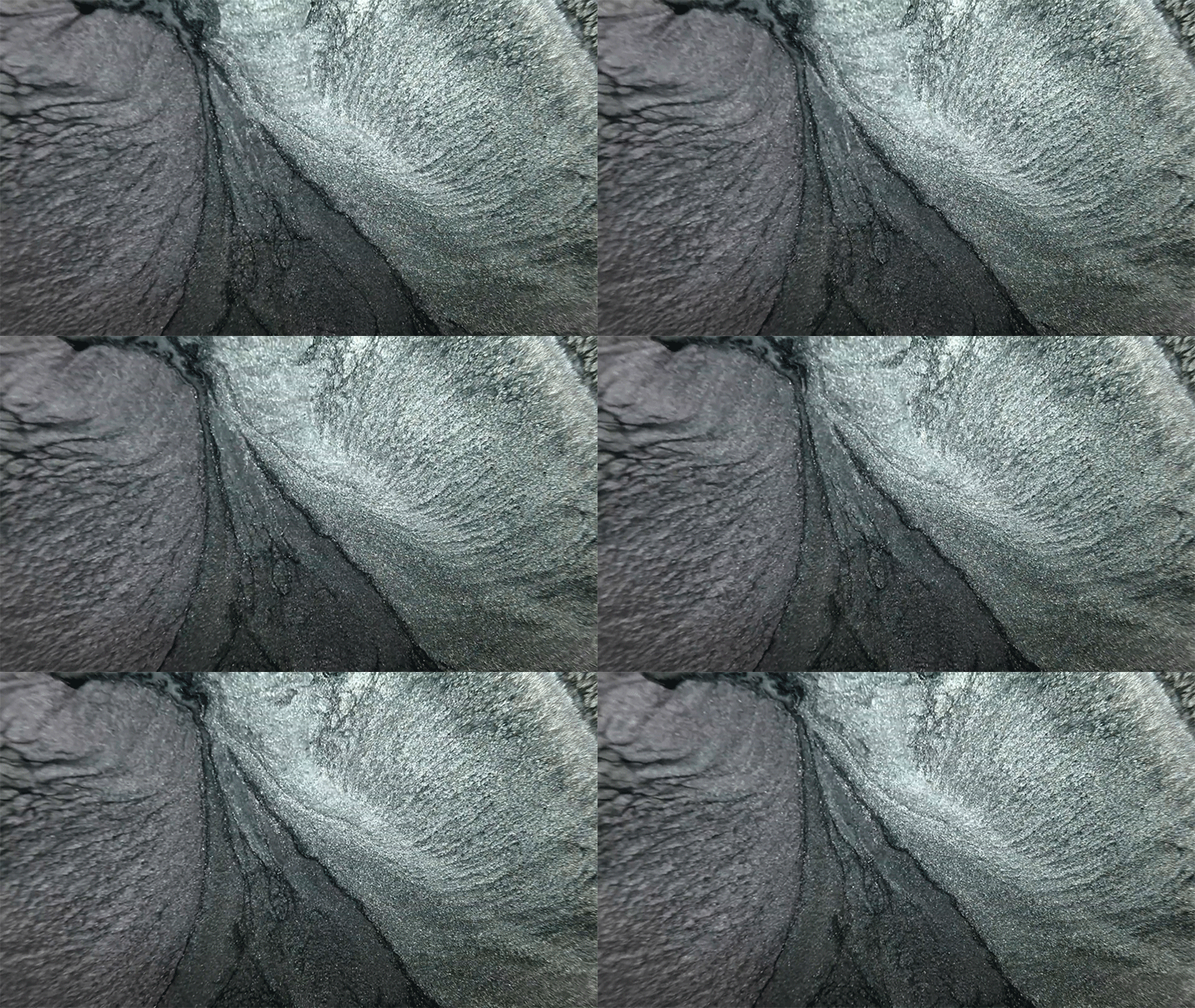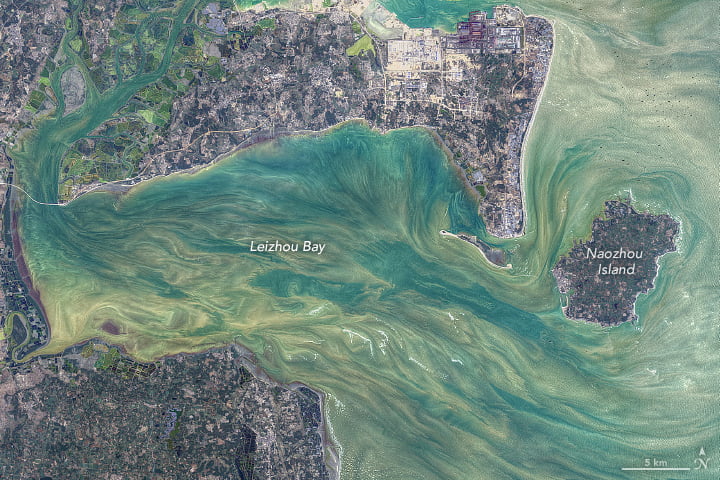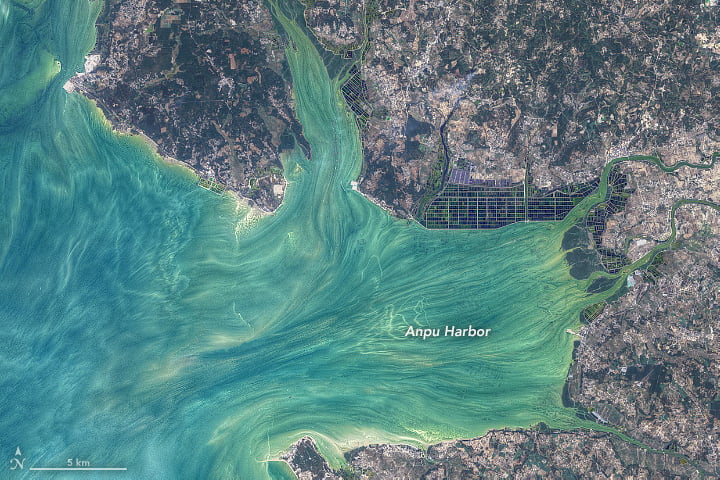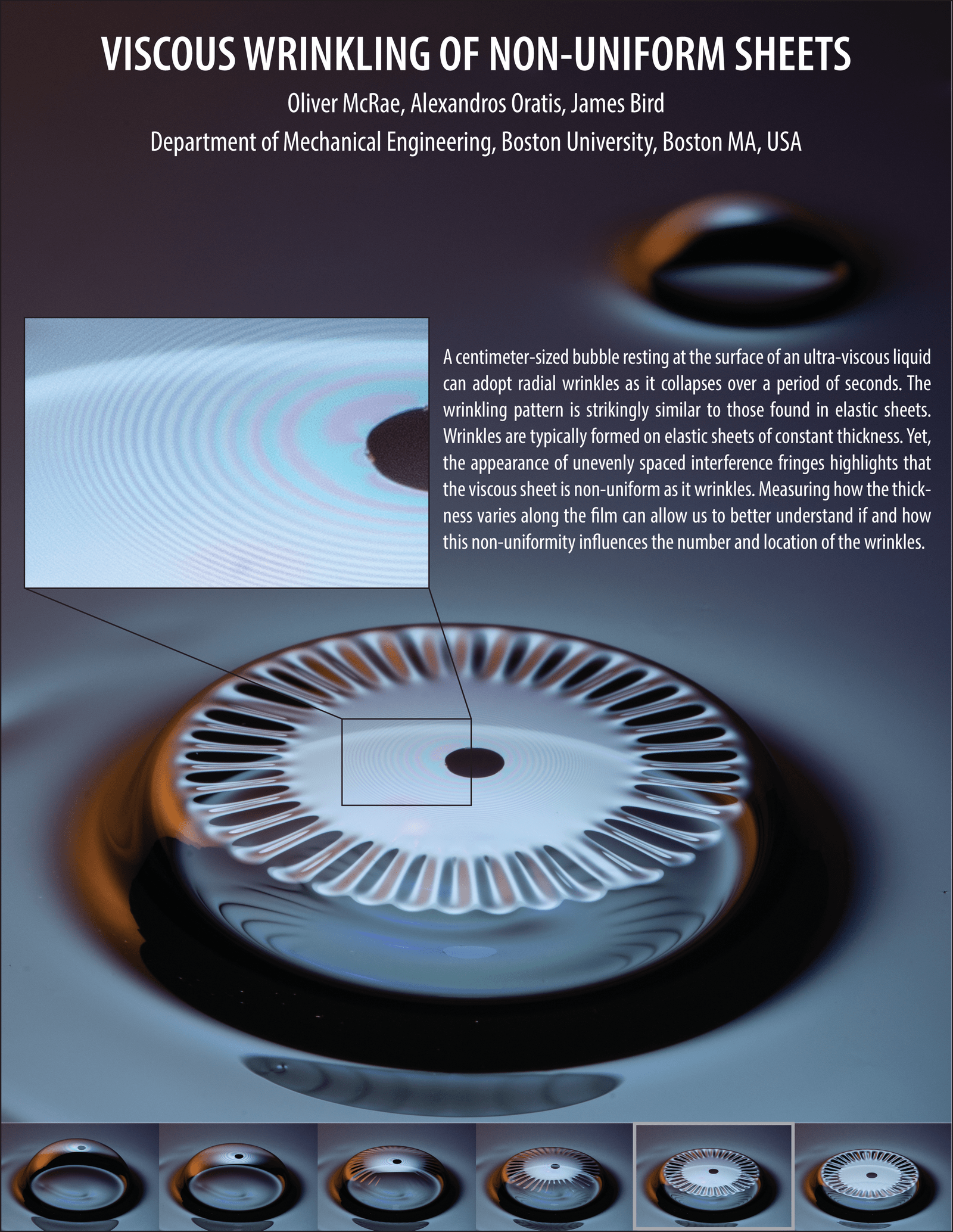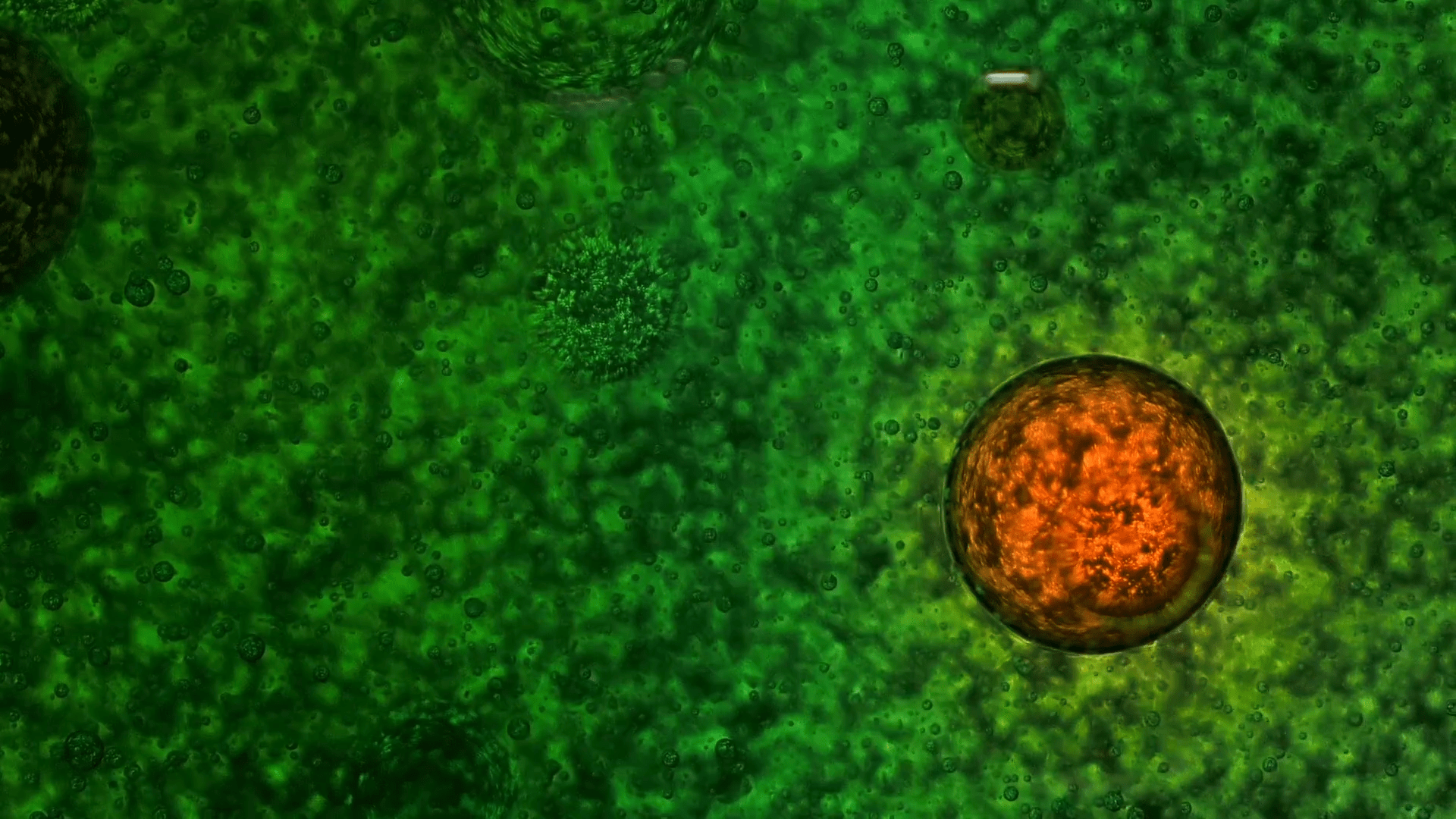
Since Michael Faraday, scientists have watched the curious patterns that form in a vibrating liquid. By adding floating particles to such a system, researchers have discovered spiky, hedgehog-like shapes that form near the surface. At low amplitudes, the surface patterns resemble the typical smooth rounded lobes one would expect, but as the wave amplitude increases, spikes form in the tracers, driven by the motion of the waves. (Image and research credit: H. Alarcón et al.; via APS Physics)
Tag: flow visualization

High Tide
Broad Sound, in eastern Australia, is home to some of the most extreme tidal swings in the world, with more than ten meters difference between high and low tides. The bay’s peculiar geography, along with the topography of nearby reefs, combine to cause the large tides. This color-enhanced satellite image shows the bay at high tide, as phytoplankton and suspended sediments are swept into the bay and around its many islands. The level of detail is just stunning. I particularly love all the von Karman vortex streets visible in the wakes of islands. I count more than a dozen of them! (Image credit: N. Kuring/NASA/USGS; via NASA Earth Observatory)

Slow Mo Pulse Jet Engine
Pulse jet engines rely on their shape to maintain combustion without moving parts. The pressure waves that travel through the engine pump fresh oxygen into the combustion chamber and then ignite it with exhaust remaining from the last cycle. In this Slow Mo Guys video, we get to see that process in action. It’s a pretty neat view of combustion in a working engine, but these guys are definitely not going to win any awards for safety measures. Seriously, don’t try this at home! (Image and video credit: The Slow Mo Guys)

“Mist and Water”
Years ago, I drove through the Blue Ridge Mountains on a wet and misty New Year’s Day. The fog that clung to the dark trees made the whole world quiet and surreal. And although Mike Olbinski’s “Mist and Water” takes place on the opposite side of the country in Oregon, that’s what the video reminds me of. So take a few minutes to enjoy the calm of mist and water flowing in this beautiful short film. (Image and video credit: M. Olbinski)

Density Drift
This colorful photo shows three fluids — oil, water, and dish soap — illuminated by the rainbow reflection of a CD. The differing densities of each fluid creates a stratification with water sandwiched between dish soap on the bottom and oil on the top. Because the dish soap is miscible in water, it leaves a smudgy blur against the background, whereas the immiscible oil creates bubble-like lenses at the top. (Image credit: R. Rodriguez)

Curls Past the Canaries
When winds flow past a solitary peak, like an island in the ocean, they’re disrupted into a series of counter-rotating curls. That’s what we see here stretching to the southwest of Madeira Island. The official name for this flow is a von Karman vortex street, and it can be found anywhere from a soap film to a starship. (Image credit: J. Stevens; via NASA Earth Observatory)

Precipitation
Chemistry and fluid dynamics often go hand-in-hand. Here chemical reactions produce visible precipitates as one chemical drops into the other. The shapes that form are distinctly fluid dynamical, with vortex rings, plumes, and instabilities all appearing.
In many applications, chemical reactions and fluid dynamics are tied inextricably to one another because the rate of chemical reaction depends on local concentrations driven by fluid dynamics, and the fluid motion is itself influenced by those concentration gradients. This is why reacting flows, like those found in combustion, are among the hardest topics in fluids. (Image and video credit: Beauty of Science)

Slow Motion Speech
Sneezing, coughing, and speaking all produce a spray of droplets capable of spreading COVID-19 and other respiratory illnesses. This Slow Mo Guys video is the latest demonstration in a long line of evidence for why wearing masks in public is such an important part of ending our current public health crisis. Also, I think we can all agree: that sneeze footage is gross. (Image and video credit: The Slow Mo Guys)

Hudson Bay Watercolors
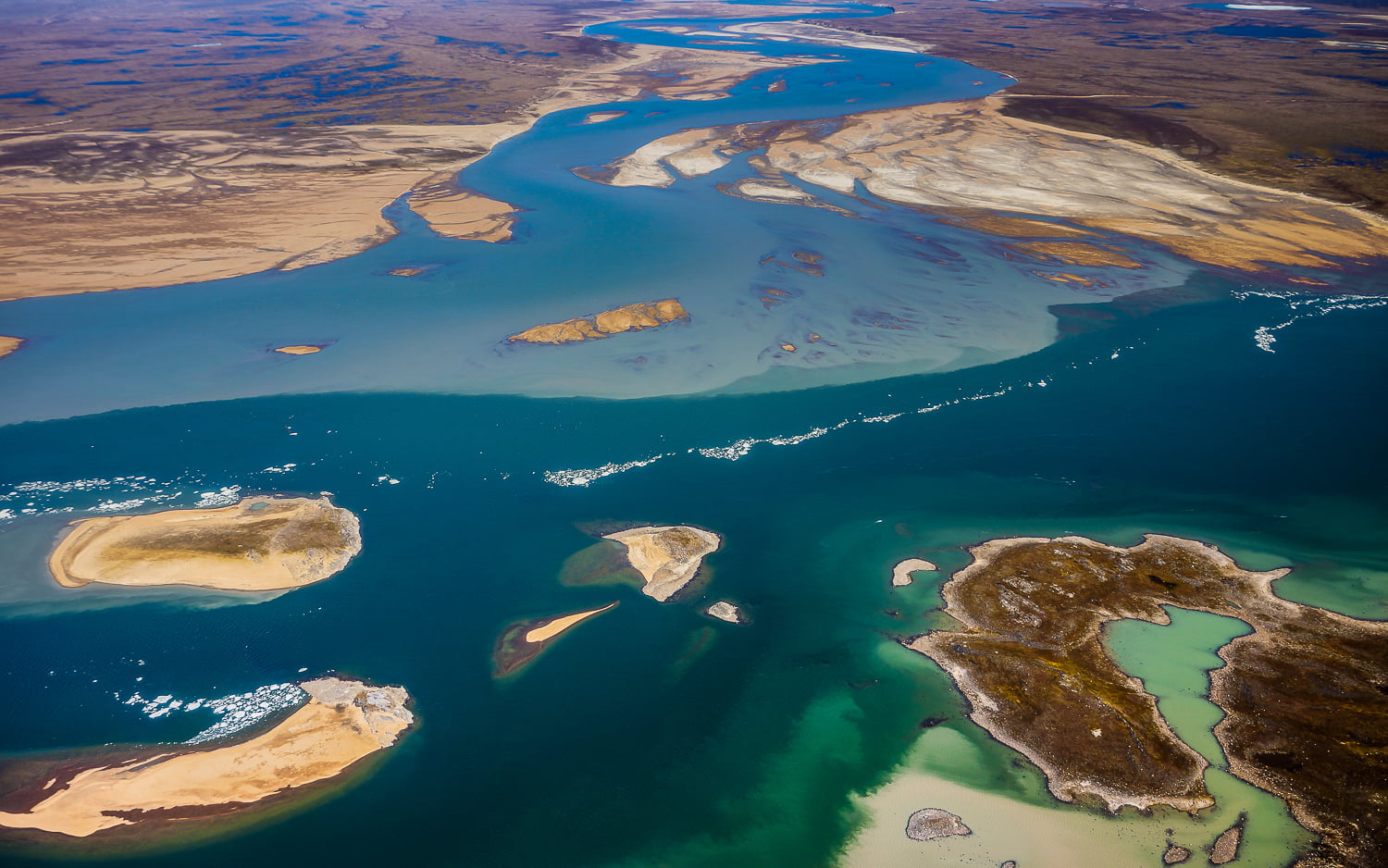
Rivers sweep fresh water and sediment into the Hudson Bay in this satellite image. Dark brown plumes mark the mouths of several coastal rivers as they add to the cyclonic sediment flow around the bay and out the Hudson Strait. Paler swirls, like strokes of watercolors, mark turbulent mixing between the sediment-filled shallows and the deep blue waters of the bay. (Image credit: J. Stevens/USGS; via NASA Earth Observatory)

Storm Eyes and Mushrooms in a Drop
In industry, drying droplets often have many components: a liquid solvent, solid nanoparticles, and dissolved polymers. The concentration of that last component — the polymers — can have a big effect on the way the droplet dries, as seen in the video above.
Without polymers, the droplet dries similarly to a coffee ring stain. But at moderate concentration, we see something very different. The droplet forms an eye in the middle, similar to a hurricane’s, and the edges of the droplet sprout mushroom-shaped plumes that grow and merge with one another along the edge. With even larger polymer concentrations, the mushrooms sweep their way inward, leaving a feathery stain behind. (Video, image, and research credit: J. Zhao et al.)