Leidenfrost drops – which skitter almost frictionlessly across extremely hot surfaces on a thin layer of their own vapor – are notoriously mobile. We’ve seen numerousmethodsof controlling their propulsion, often using specially-shaped surfaces. But it turns out that some Leidenfrost drops can self-propel even on a smooth, flat surface (top image).
Internally, large Leidenfrost drops have complicated, but symmetric flows that are driven by temperature and surface tension variations across the drop. But as the drop evaporates, that symmetry eventually gets broken, leaving behind a single large circulating flow.
Beneath the drop, that internal circulation affects the vapor layer. It causes the layer to take on an overall tilt, and the rotation, along with that slight angle in the vapor layer, causes the Leidenfrost drop to roll away like a wheel. (Image and research credit: A. Bouillant et al.; via NYTimes)
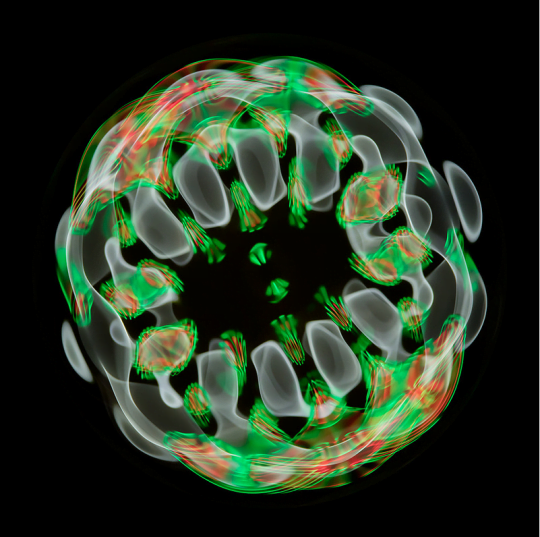
Cymatics are the visualization of vibration and sound. Here photographer Linden Gledhill has taken a simple speaker vibrating a dish of water and turned it into some incredible art. When you vibrate liquids like water up and down, it disturbs the usually flat air-water interface and creates waves on the surface. These Faraday waves are a standing wave pattern that differs depending on which sound is being played. By combining the wave patterns with LED lighting and strobe effects, Gledhill creates some remarkable images that combine sound, light, and fluid dynamics all in one. If you watch the video (make sure to hit the HD button!), you’ll see the patterns in motion and hear the sounds used to generate them. In the last clip (around 0:19), he’s added glitter to the set-up, which highlights the circulation within the vibrating fluid. As you can see, there are strong recirculating regions in each lobe of the pattern, but other areas, like the center region are almost entirely stationary. You can see more photos from the project in his Flickr feed. Special thanks to Linden for letting me post the video of his work, too! (Video and image cred
so, how is lift actually generated? i’ve been going through Anderson’s Introduction to Flight (6th Ed.) and while it offers the derivation of various equations very thoroughly, it barely touches on why lift is generated, or how camber contributes to the increase of C(L)
This is a really good question to ask. There are a lot of different explanations for lift out there (and some of the common ones are incorrect). The main thing to know is that a difference in pressure across the wing–low pressure over the top and higher pressure below–creates the net upward force we call lift. It’s when you ask why there’s a pressure difference across the wing that explanations tend to start diverging. To be clear, aerodynamicists don’t disagree about what produces lift – we just tend to argue about which physical explanation (as opposed to just doing the math) makes the most sense. So here are a couple of options:
Newton’s third law states that for every action there is an equal and opposite reaction. If you look at flow over an airfoil, air approaching the airfoil is angled upward, and the air leaving the aifoil is angled downward. In order to change the direction of the air’s flow, the airfoil must have exerted a downward force on the air. By Newton’s third law, this means the air also exerted an upward force–lift–on the airfoil.
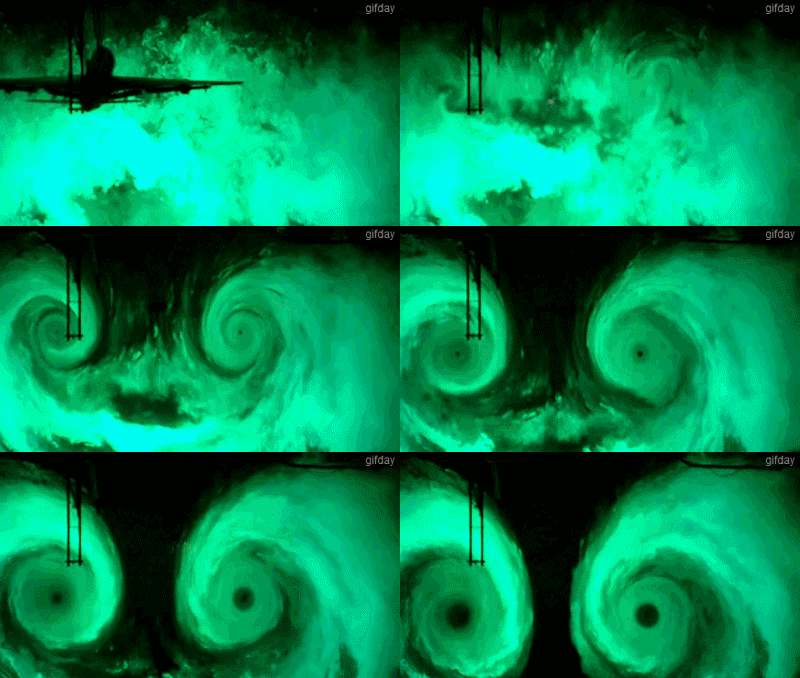
The downward force a wing exerts on the air becomes especially obvious when you actually watch the air after a plane passes:
This one can be harder to understand. Circulation is a quantity related to vorticity, and it has to do with how the direction of velocity changes around a closed curve. Circulation creates lift (which I discuss in some more detail here.) How does an airfoil create circulation, though? When an airfoil starts at rest, there is no vorticity and no circulation. As you see in the video above, as soon as the airfoil moves, it generates a starting vortex. In order for the total circulation to remain zero, this means that the airfoil must carry with it a second, oppositely rotating vortex. For an airfoil moving right to left, that carried vortex will spin clockwise, imparting a larger velocity to air flowing over the top of the wing and slowing down the air that moves under the wing. From Bernoulli’s principle, we know that faster moving air has a lower pressure, so this explains why the air pressure is lower over the top of the wing.
Asymmetric Flow and Bernoulli’s Principle
There are two basic types of airfoils – symmetric ones (like the one in the first picture above) and asymmetric, or cambered, airfoils (like the one in the image immediately above this). Symmetric airfoils only generate lift when at an angle of attack. Otherwise, the flow around them is symmetric and there’s no pressure difference and no lift. Cambered airfoils, by virtue of their asymmetry, can generate lift at zero angle of attack. Their variations in curvature cause air flowing around them to experience different forces, which in turn causes differing pressures along the top and the bottom of the airfoil surface. A fluid particle that travels over the upper surface encounters a large radius of curvature, which strongly accelerates the fluid and creates fast, low-pressure flow. Air moving across the bottom surface experiences a lesser curvature, does not accelerate as much, and, therefore, remains slower and at a higher pressure compared to the upper surface.
Arctic sea ice often appears as a single extensive sheet when, in reality, it is made up of many smaller sections of ice shifting and grinding against one another under the influence of winds and ocean currents. This can cause cracks–known as leads–to open up between sections of the ice. This animation, constructed from infrared satellite images, shows the growth of several cracks, leading to extensive break-up of the ice sheet from late-January through March. The fracturing was driven by a high-pressure system that parked over the region, bringing warmer temperatures and southwesterly winds that fueled the Beaufort Gyre, a large-scale, wind-driven, clockwise circulation in the sea that helped pull the ice apart. For more, see NASA EO’s explanation. (Video credit: NASA Earth Observatory)
Almost everyone has tried skipping rocks across the surface of a pond or lake. Here Professor Tadd Truscott gives a primer on the physics of rock skipping, including some high-speed video of the impact and rebound. In a conventional side-arm-launched skip, the rock’s impact creates a cavity, whose edge the rock rides. This pitches the rock upward, creating a lifting force that launches the rock back up for another skip. Alternatively, you can launch a rock overhand with a strong backspin. The rock will go under the surface, but if there’s enough spin on it, there will be sufficient circulation to create lift that brings the rock back up. This is the same Magnus effect used in many sports to control the behavior of a ball–whether it’s a corner or free kick in soccer or a spike in volleyball or tennis. (Video credit: BYU Splash Lab/Brigham Young University)
One way to explore some of the large-scale atmospheric dynamics we observe here on earth is through table-top demonstrations such as this one. Here a platform with a water tank is rotating at a constant velocity. The camera rotates with the tank; this is why the hand in the video seems to spin. At the center of the tank, ice in a can cools the water, while the warmer air along the periphery provides heating. The green dye marks initially cooler fluid while the red dye marks the warmer fluid from the outside of the tank. The dense cooler fluid sinks and moves outward while warmer water moves in to replace it. This creates radial circulation; the thermal gradients and rotation cause the eddies and jets seen from this top view, in much the same way that they form in the mid-latitudes of earth’s atmosphere. (Video credit: Marshall Lab, MIT)
This video shows sea surface temperature results and their seasonal variation from a numerical simulation modeling circulation in the atmosphere and oceans. Modeling such enormous problems requires the development of reasonable models of the turbulent physics, clever algorithms to quickly progress the solutions, relatively low-fidelity (a single grid node may cover tens of kilometers), and enormous computing power. (Video credit: NOAA; via Gizmodo)
This video describes how the sun’s energy drives wind and ocean currents on earth. As solar winds stream forth from the sun, our magnetosphere deflects the brunt of the impact (creating auroras at the poles) while the atmosphere, land masses, and oceans absorb thermal energy from the sun’s light. Because of our cycles of day and night and the differences in how land, water, and ice absorb heat, temperature differentials around the earth drive a massive heat engine, causing the circulation of water and wind all around our world. Numerical simulations like the ones underlying this video are vital for the prediction of climate and weather, as well as for developing models and techniques that can be applied to other problems in science and engineering. (Video credit: NASA; via Gizmodo)
As a followup to yesterday’s question about ways to explain lift on an airfoil, here’s a video that explains where the circulation around the airfoil comes from and why the velocity over the top of the wing is greater than the velocity around the bottom. Kelvin’s theorem says that the circulation within a material contour remains constant for all time for an inviscid fluid. Before the airplane moves, the circulation around the wing is zero because nothing is moving. As shown in the video, as soon as the plane moves forward, a starting vortex is shed off the airfoil. As the plane flies, our material contour must still contain the starting position and thus the starting vortex. However, in order to keep the overall circulation in the contour zero, the airfoil carries a vortex that rotates counter to the starting vortex. This is the mechanism that accelerates the air over the top of the wing and slows the air around the bottom. Now we can apply Bernoulli’s principle and say that the faster moving air over the top of the airfoil has a lower pressure than the slower moving air along the bottom, thus generating an upward force on the airfoil. (submitted by jessecaps)
I’m a Undergrad Aeronautical Engineering student. I’m curious as to your opinion as to how airfoils produce lift. I know the usual theory told in this situation. However my aerodynamics professor says that there are many things going on during the flow around an airfoil. I’m hoping to get a better idea of the different mechanisms responsible for lift.
There’s a common misconception of Bernoulli’s principle that’s often used to explain how an airfoil creates lift (which I assume is the “usual theory” to which you refer), and while there are many correct (or, perhaps, more correct) ways of explaining lift on an airfoil, I think the only opinions involved are as to which explanation is best. After all, opinions don’t keep a plane in the air, physics does!
I tackled the air-travels-farther-over-the-top misconception and presented one of my preferred ways of looking at the situation in a previous post; in short, the airfoil’s shape causes a downward deflection of the flow, which, by Newton’s 3rd law, indicates that the air has exerted an upward force on the airfoil. There’s a similar useful video from Cambridge on the topic here.
Another explanation I have heard used concerns circulation and its ability to produce lift (see the Kutta-Joukowski theorem for the math). In this case, it’s almost easier to think about lift on a cylinder instead of lift on a more complicated shape like an airfoil. If you spin a cylinder, you’ll find that the circulation around that object results in a force perpendicular to the flow direction. This is called the Magnus effect and, in addition to explaining why soccer balls sometimes curve strangely when kicked, has been used to steer rotor ships. One of my undergrad aero professors used to do a demonstration where he’d wrap a string around a long cardboard cylinder and demonstrate how, by pulling the string, the cylinder’s spinning produced lift, making the cylinder fly up off the lectern and attack the unsuspecting students.
An airfoil doesn’t spin, but its shape produces the same type of circulation in the flow field. Without delving into the mathematics, it’s actually possible through conformal mapping and the Joukowski transform to show that the potential flow field around a spinning cylinder is identical to that around a simple airfoil shape! Although that mathematical technique is not all that useful in a world where we can calculate the inviscid flow around complicated airfoils exactly, it’s still pretty stunning that we can analytically solve potential flow around (and thus estimate lift for) a host of airfoil shapes on the back of an envelope.
In short, your aerodynamics professor is right in saying that there are many things going on during the flow around an airfoil. If you get a roomful of aerodynamicists together and ask them to explain how airfoils generate lift, you would be faced with a lively discussion with about as many competing explanations as there are participants. As you learn more in your classes, you’ll gain a better intuitive feel for how it works and you’ll learn more of the nuances, which will help you understand why there is no one simple-to-understand explanation that we use!**
** Lest I confuse someone into thinking that aerodynamicists don’t know how airfoils produce lift, let me add that the argument here is over how best to explain the production of lift, not over how the lift is produced. We have the equations to describe the flow and we can solve them. We know that lift is there and why. We simply like to argue over how to explain it to people without all the math.