Tag: biology

  • Bioluminescent Plankton

    Bioluminescent Plankton

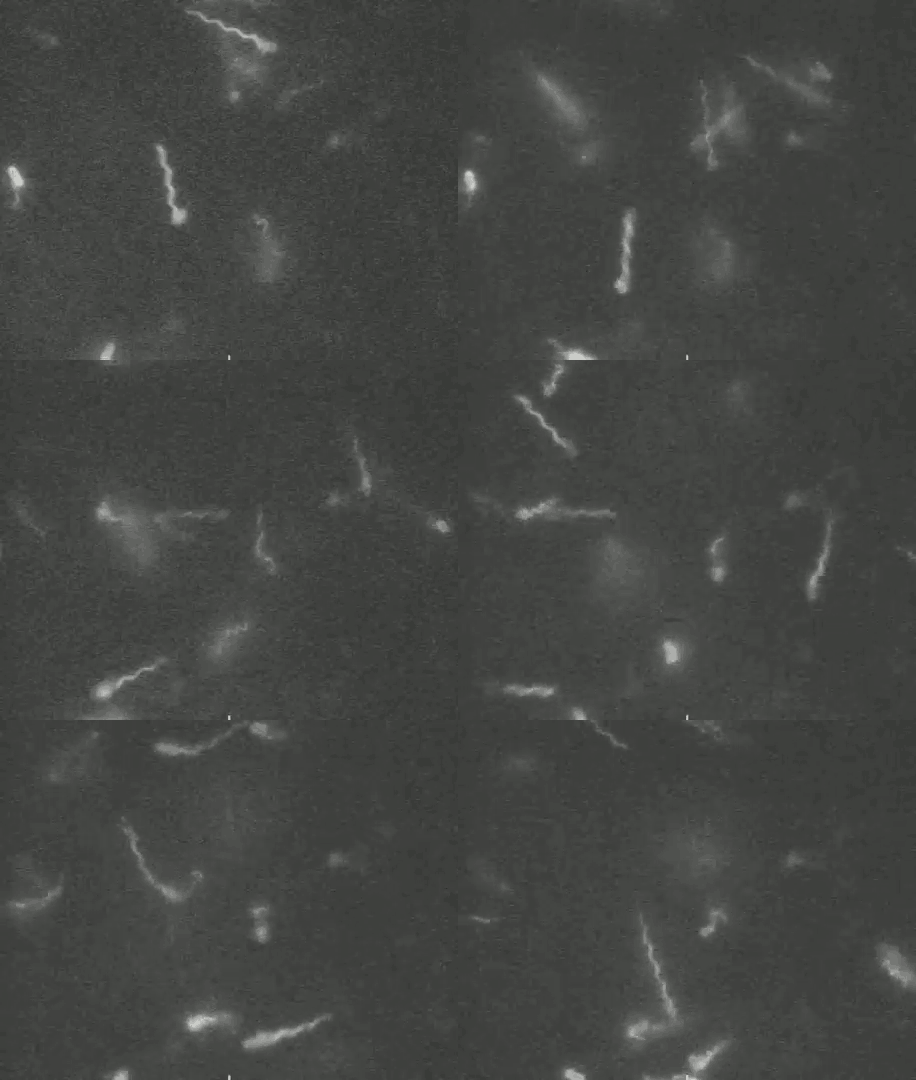
    The blue-outlined dolphins you see above get their glow from microorganisms called dinoflagellates. They are a type of bioluminescent plankton, shown in the lower image, that can be found in oceans around the world. Their glow comes from combining two chemicals: luciferase and luciferin. The dinoflagellates suspended in the ocean do this when they are disturbed–specifically, when the water around them transmits a shear stress above a certain threshold. Typically, this is caused by something larger–a potential predator–moving past, although it can also be stimulated by breaking waves. The higher the shear stress, the more intense the glow, but the dinoflagellates only use their bioluminescence sparingly. If you apply shear stress and keep applying it, their glow fades away without reactivating. After all, they can only produce so much chemical fuel. (Image credit: BBC from Attenborough’s Life That Glows; h/t to Gizmodo; research credit: E. Maldonado and M. Latz)

  • Featured Video Play Icon

    Fluttering Feathers

    Birds do not always vocalize in order to make their songs. The male African broadbill, shown in the top video above, makes a very distinctive brreeeet in its flight displays, but as newly published research shows, the sound comes from its wings, not its voice. During the display, the broadbill spreads its primary feathers and sound is produced on the downstroke, when wingtip speeds reach about 16 m/s. By filming a broadbill wing with a high-speed camera in a wind tunnel at comparable air speeds, researchers could localize the sound production to the 6th and 7th primary feathers.

    In the second video above, you can see these feathers twisting and fluttering in the breeze. This is an example of aeroelastic flutter, a phenomenon in which aerodynamic and structural forces couple to induce oscillations. The same phenomenon famously caused the collapse of the Tacoma Narrows Bridge in 1940. In the birds, however, the flutter is non-destructive and the vibration produces audible sound which the other feathers modulate into the calls we hear. Broadbills aren’t the only birds to use this trick; some species of hummingbirds use flutter in their tail feathers during mating displays. (Video, image, and research credits: C. Clark et al.; additional videos here)

  • Bumblebees in Turbulence

    Bumblebees in Turbulence

    Bumblebees are small all-weather foragers, capable of flying despite tough conditions. Given the trouble that micro air vehicles have when flying in gusty winds, bumblebees can help engineers to understand how nature successfully deals with turbulence. Under smooth laminar conditions like those shown in the animation above, bumblebees stay aloft by beating their wings forward and backward in a figure-8-like motion. On both the forward downstroke and the backward upstroke, you’ll notice a blue bulge near the front of the bee’s wing. This is a leading-edge vortex, which provides much of the bee’s lift.

    Researchers were curious how adding turbulence would affect their virtual bee’s flight. The still image above shows the bee in moderate freestream turbulence (shown in cyan). Surprisingly, this outside turbulence has very little effect on the flow generated by the bee, shown in pink. In fact, the researchers found that the bees could fly through turbulence without a significant increase in power. Too much turbulence does make it hard for the bee to control its flight, though. The bee’s shape makes it prone to rolling, and the researchers estimated, based on a bee’s 20 ms reaction time, that bumblebees can probably only correct that roll and maintain controlled flight at turbulence intensities less than 63% of the mean wind speed. (Image credits: T. Engels et al., source; via Physics Focus)

  • Mushrooms Make Their Own Breeze

    Mushrooms Make Their Own Breeze

    Plants and other non-motile organisms have developed some clever methods to disperse their seeds and spores for reproduction. Some plants use vortex rings for dispersal; others make their seeds aerodynamic. Low ground-dwellers like mushrooms must contend with a lack of wind to lift their spores and carry them away. Instead, they use evaporative cooling to generate their own air currents.

    Mushroom caps contain a lot of water and, as that water evaporates, it cools air near the mushroom, just as sweat evaporating off your skin cools you. That cooler, denser air tends to spread, carrying the spores outward. At the same time, the freshly evaporated water vapor is less dense than the surrounding air, so it rises. This combination of rising and spreading is capable of carrying spores tens of centimeters into the air, where the wind is stronger and able to carry spores further.  (Image credit: New Atlantis, source; research credit: E. Dressaire et al.)

  • Hovering Hummingbirds

    Hovering Hummingbirds

    Hummingbirds are incredible flyers, especially when it comes to hovering. To hover stationary and stable enough to feed, the hummingbird’s flapping pattern not only has to generate enough lift, or vertical force, to counteract their weight, but the bird must balance any forward or backward forces generated during flapping.

    As you can see in the animations above, when hovering the hummingbird’s wings move forward and back rather than up and down. When slowed down even further, the figure-8 motion of the wings becomes apparent. This careful motion is key to the hover; it allows the bird to generate about 70% of its lift on the downstroke when the wings move forward and creates the remainder of the lift needed on the upstroke. For much more high-speed footage of hummingbirds, check out the full BBC Earth Unplugged video, but be warned: you may experience a cuteness overdose! (Image credit: BBC Earth Unplugged, source)

  • Featured Video Play Icon

    Filter-Feeding Mantas

    Large filter-feeders like the manta ray face the interesting challenge of obtaining enough small particulates like plankton to sustain an animal the size of a car. They do this through what is known as ram filter-feeding, essentially swimming open-mouthed through food-laden waters, filtering out the food, and releasing the water through their gills. Their internal filtration doesn’t simply catch particles like a colander does, though – it would be too easy for the ray’s filters to clog. Instead, the animals use several alternative methods to catch and redirect particles toward their esophagus. One, known as crossflow filtration, causes water to turn sharply through the filters. Heavier particles cannot accelerate that quickly, so they are carried onward. Another method, vortex filtration, works like a tiny centrifuge, spinning the water and ejecting the heavier particles back toward the esophagus. (Video credit: Science Friday; research credit: E. Paig-Tran, thesis)

  • Review: “Life in Moving Fluids”

    Review: “Life in Moving Fluids”

    If you liked the prairie dog post earlier this week and you’re interested in more examples of biological fluid dynamics, you may enjoy Steven Vogel’s “Life in Moving Fluids”. I’m often asked for suggestions of readable textbooks for those who want an introduction to fluid dynamics, and this book is a great option. It addresses a wide variety of basic fluids concepts without getting as bogged down mathematically as many of the engineering texts do. It is written as an introduction to fluid dynamics for working biologists, though, so it contains plenty of technical detail – including relevant equations, discussions of basic flow measurement techniques, and overviews of the early academic literature.

    It is also chock full of interesting biological applications of fluid dynamics with examples ranging from the growth patterns of barnacles to the shape-shifting drag capabilities of trees. Vogel keeps a light-hearted tone and dry humor throughout and doesn’t shy away from puns.

    I read a first edition of the book (copyright 1981). The second edition, from the mid ‘90s, has updated coverage of the research literature, but I dare say the the topic has exploded within the last 20 years, so your mileage may vary with regard to the literature review. However, age in no way impacts the quality of Vogel’s coverage of the basics of fluid dynamics, and I feel confident in recommending this as an introductory text for those who’d like to pursue fluids in more depth.  (Images: S. Vogel/Princeton U. Press; h/t to Chris R.)

  • Prairie Dog Physics

    Prairie Dog Physics

    One challenge facing burrowing mammals is ensuring sufficient oxygen within their den. Prairie dogs achieve this with a clever use of Bernoulli’s principle. They build multiple entrances to their tunnels. One of them, labeled as Entrance A above, is built with a raised mound of dirt, while the other, Entrance B, is not. The raised mound creates an obstacle for the wind to move around, which increases the wind velocity at Entrance A compared to the normal wind speed at Entrance B. From Bernoulli’s principle, we know that a higher velocity means a lower pressure, so there is a decreasing pressure gradient through the tunnel from Entrance B to Entrance A. That favorable pressure gradient pulls fresh air through the prairie dog tunnels, allowing the colony to breathe easy. (Image credits: N. Sharp; original prairie dog photos by jinterwas and J. Kubina; final images shared under Creative Commons; research credit: S. Vogel et al.; h/t to Chris R.)

  • Grebe Rushing Physics

    Grebe Rushing Physics

    As capable a water-runner as the common basilisk is, the western and Clark’s grebe is even more impressive. Not only do these birds weigh up to three times as much as an adult basilisk, but they start their water-walking from inside the water, which requires overcoming much more hydrodynamic force.

    Like the lizards, grebes must slap the water with their feet to generate upward forces capable of supporting their weight above water. The birds take as many as 20 steps a second – an incredible and unmatched stride rate for a creature their size. Their feet impact the water at up at 4.5 m/s, which generates an impulse equivalent to 30-55% of the grebe’s weight. The rest of the necessary impulse comes from the stroke phase, where the bird pushes its foot down against the water.

    When retracting its foot, the grebe extracts the foot with a sideways motion through the water – unlike the basilisk which pulls its foot out through the air cavity its stroke created. In order to reduce drag, the grebe’s foot collapses into a more streamlined shape as it gets pulled from the water, letting the bird set up for the next step. (Image/video credit: B. Struck, source; research credit: G. Clifton et al.)

    This week FYFD is exploring the physics of walking on water, all leading up to a special webcast on March 5th with guests from The Splash Lab. The live webcast will be open to all FYFD patrons, so be sure to sign up if you want to tune in.

  • Surface-Tension Supported Walkers

    Surface-Tension Supported Walkers

    Nature’s smallest water-walkers use surface tension to keep themselves afloat. This includes hundreds of species of invertebrates like insects and spiders as well as the occasional extremely tiny vertebrate, like the 2-4 cm long pygmy gecko shown above. These animals typically have very thin parts of themselves touching the water – like the spindly legs of the water strider. These skinny appendages curve the air-water interface and that curvature, along with the water’s surface tension, generates the force supporting the animal.

    Staying afloat on surface tension does little good if a raindrop or passing splash submerges these tiny water-walkers. To avoid that fate, these animals are also hydrophobic or water repellent. This adaptation keeps them from drowning and helps them enhance the curvature where their feet meet the water.

    Those tiny indentations can also be important for the animal’s propulsion. Water striders, for example, use their long middle legs like oars to propel themselves. Any rower will tell you that sticks make poor paddles – they’re just not good at transferring momentum to the water. But curving the surface and then pushing off that curvature works remarkably well. It’s how the water strider creates the vortices in its wake in the image above.

    For more on water strider propulsion, I recommend this Science Friday video. If you’d like to see the gecko in action, check out BBC Life’s “Reptiles and Amphibians” episode, which is available on Netflix in the U.S. (Image credits: pygmy gecko, BBC; water strider, J. Bush et al.)

    This week FYFD is exploring the physics of walking on water, all leading up to a special webcast on March 5th with guests from The Splash Lab. You don’t want to miss it!