Tag: active matter

  • Crowd Vortices

    Crowd Vortices

    The Feast of San Fermín in Pamplona, Spain draws crowds of thousands. Scientists recently published an analysis of the crowd motion in these dense gatherings. The team filmed the crowds at the festival from balconies overlooking the plaza in 2019, 2022, 2023, and 2024. Analyzing the footage, they discovered that at crowd densities above 4 people per square meter, the crowd begins to move in almost imperceptible eddies. In the animation below, lines trace out the path followed by single individuals in the crowd, showing the underlying “vortex.” At the plaza’s highest density — 9 people per square meter — one rotation of the vortex took about 18 seconds.

    Animation of the crowd in motion, with overlaid lines showing the circulating path followed by individual crowd members.

    The team found similar patterns in footage of the crowd at the 2010 Love Parade disaster, in which 21 people died. These patterns aren’t themselves an indicator of an unsafe crowd — none of the studied Pamplona crowds had a problem — but understanding the underlying dynamics should help planners recognize and prevent dangerous crowd behaviors before the start of a stampede. (Image credit: still – San Fermín, animation – Bartolo Lab; research credit: F. Gu et al.; via Nature)

    Fediverse Reactions
  • Strata of Starlings

    Strata of Starlings

    Starlings come together in groups of up to thousands of birds for the protection of numbers. These flocks form spellbinding, undulating masses known as murmurations, where the movement of individual starlings sends waves spreading from neighbor to neighbor through the group. One bird’s effort to dodge a hawk triggers a giant, spreading ripple in the flock.

    To capture the flowing nature of the murmuration, photographer and scientist Kathryn Cooper layers multiple images of the starlings atop one another. The birds themselves become pathlines marking the murmuration’s motion. The final images are surprisingly varied in form. Some flocks resemble a downpour of rain; others the dangling branches of a tree. (Image credit: K. Cooper; via Colossal)

    Fediverse Reactions
  • Featured Video Play Icon

    Growing Hydrogels in an Active Fluid

    Active nematic fluids borrow their ingredients from biology. Using long, rigid microtubules and kinesin motor proteins capable of cross-linking between and “walking” along tubules, researchers create these complex flow patterns. Here, a team took the system a step further by seeding the flow with a hydrogel that turns into a polymer when exposed to light. Then, by shining light patterns on the flow, the scientists can create rigid or flexible structures inside the active fluid. In this case, they show off some of the neat flow patterns they can create. (Video and image credit: G. Pau et al.)

    Fediverse Reactions
  • Stretching Ant Rafts

    Stretching Ant Rafts

    In their natural habitat, fire ants experience frequent floods and so developed the ability to form rafts. Entire colonies will float out a flood in a two-ant-thick raft anchored to whatever vegetation they can find. Because ants in the upper layer of the raft are constantly milling about, the rafts have some ability to “self-heal” as they’re stretched.

    Pulling slowly gives the ants time to "heal" their stretching raft.
    Pulling slowly gives the ants time to “heal” their stretching raft.

    In these experiments, researchers slowly (above) and quickly (below) stretched ant rafts to see how they responded. Given a slow enough stretch, the ants were able to adjust and keep the raft together until it doubled in length. In contrast, a faster stretching rate overwhelmed the raft by the time it was 30% longer. (Image credit: top – Wikimedia Commons, others – C. Chen et al.; research credit: C. Chen et al.; via APS Physics)

    Pulling quickly breaks an ant raft because the ants cannot react quickly enough to heal the raft.
    Pulling quickly breaks an ant raft because the ants cannot react fast enough to heal the raft.
  • Swarm of Surfers

    Swarm of Surfers

    Self-propelled objects can form fascinating patterns. Here, researchers investigate how small plastic “surfers” move on a vibrating fluid. Each surfer is heavier in its stern than its bow. When the fluid vibrates, the surfer creates waves that are asymmetric — deeper in the stern than at the bow. For single surfers, this imbalance propels the surfer in the direction of its bow. But with more than one surfer, other patterns form.

    The video demonstrates five of the seven patterns pairs of surfers exhibit.
    The video demonstrates five of the seven patterns pairs of surfers exhibit.

    The team looked at groups of surfers all the way up to eight members. Among pairs, the researchers found seven distinctive patterns, including orbiting groups, tailgaters, and promenading pairs. Larger groups, they found, had similar collective behaviors. They hope their surfers will be an easily accessible platform for exploring active matter. (Image and research credit: I. Ho et al.; via APS Physics)

  • Understanding Cyanobacteria

    Understanding Cyanobacteria

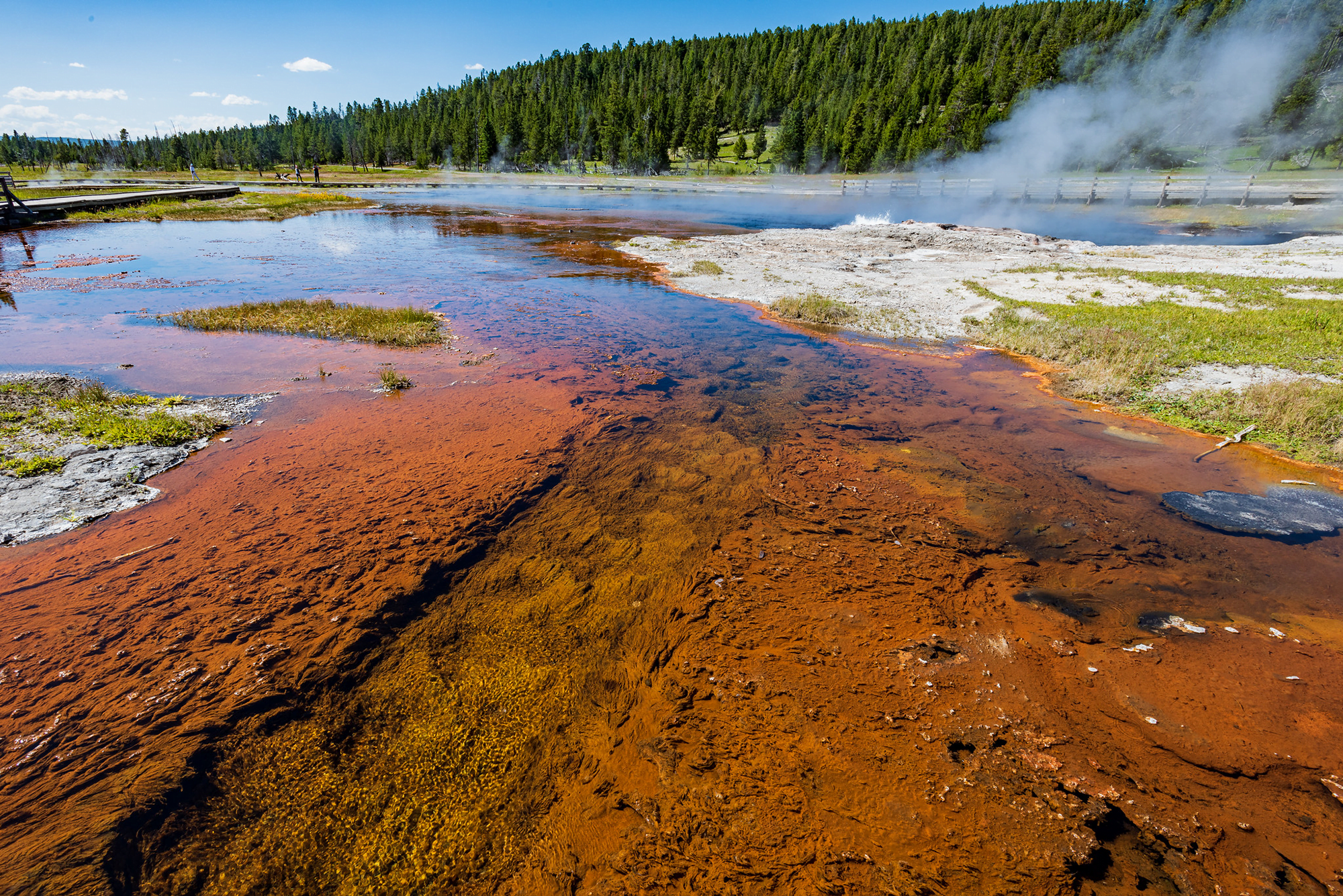
    Over 2 billion years ago, cyanobacteria emerged as Earth’s first photosynthesizing organisms. Today they are widespread and critical contributors to both carbon and nitrogen cycles. Colonies can form large mats, like those pictured above, but, even at the microscale, cyanobacteria are actively forming patterns among individual bacteria. A recent study considers cyanobacteria as active matter.

    At the microscopic scale, cyanobacteria form different patterns.
    At the microscopic scale, cyanobacteria form different patterns, depending on their density.

    By simulating the cyanobacteria as filaments that interact through a series of simple rules, the researchers were able to reproduce the complex patterns bacterial colonies form. Their physical model also offered an explanation — based on the relative importance of advective and diffusive transport — for the characteristic length scales found in the bacterial patterns. (Image credit: Yellowstone – B. Cappellacci, patterns – M. Faluweki et al.; research credit: M. Faluweki et al.; via APS Physics)

  • Lanes in Crowds

    Lanes in Crowds

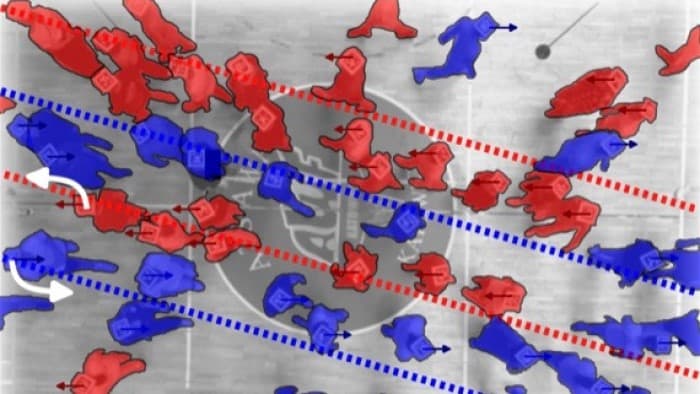
    In nature — from atoms to human crowds — two groups moving in opposite directions often spontaneously organize into interwoven lanes flowing in their respective directions. Now researchers have built a mathematical model for this behavior, building on Einstein’s observations of Brownian motion.

    To test their model, the researchers performed numerical simulations and experiments with pedestrians. Intriguingly, they found that introducing rules like “always pass on the right” created unexpected results, such as tilted lanes. With their model verified — at least for low-density crowds — the group hope to uncover other hidden patterns within crowds. (Image and research credit: K. Bacik et al.; via Physics World)

    An animation showing one pedestrian experiment.
    In their validation experiments, the researchers filmed groups of pedestrians walking past one another under different conditions. Note the lanes that form as the two groups interleave.
  • Featured Video Play Icon

    Recreating Flocks

    Birds, fish, and other creatures form amazing, undulating swarms of individuals. How these collectives comes together and move continues to fascinate scientists. Here, researchers look at simple particles with two “instructions,” if you will. One causes the particle to self-navigate toward a target; the other causes short-range repulsion if the particle gets too close to another one. With only these two simple guidelines, a flock of these particles forms complex, ever-changing flows! (Image and video credit: M. Casiulis and D. Levine)

  • Featured Video Play Icon

    Starlings Over Rome

    Each winter millions of starlings migrate to Rome, where they form enormous murmurations in the sky above. The ephemeral and amorphous displays are driven by each bird responding to its neighbor’s motions. But the slight delay in individual responses gives the flock as a whole a wave-like, fluid appearance. Behaviors like this help protect the starlings from predators while they search out places to roost.

    As neat as the displays are, though, they come with some real downsides, as the latter part of this video reveals. I don’t know about you, but I wouldn’t want to park my car outside in that storm! (Video credit: BBC Earth)

  • Featured Video Play Icon

    Collective Motion in Grains

    Flocks of birds and schools of fish swarm in complicated collective motions, but groups of non-living components can move collectively, too. In this Lutetium Project video, we learn about grains that, when vibrated, self-propel and form complex collective motions similar to those seen in groups of living organisms.

    A key feature of the grains is their lack of symmetry. To be self-propelling, they must have a well-defined orientation, defined by a different front and back. The grains also have the freedom to move in a direction that is not the same as the direction they’re oriented in. This allows the grains to rotate, which enables them to perform the large-scale motions seen in the experiments. (Video and image credit: The Lutetium Project; research credit: G. Briand et al.)