Tag: active matter

  • Featured Video Play Icon

    Starlings Over Rome

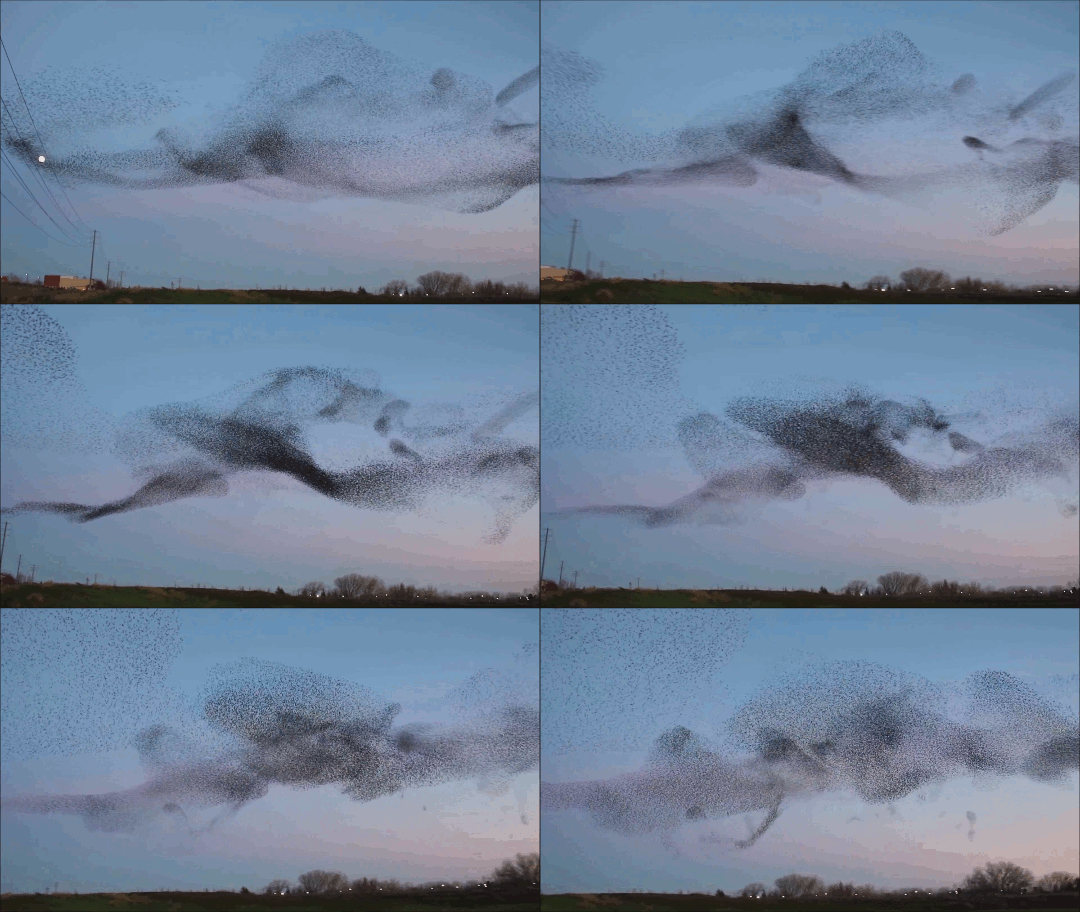
    Each winter millions of starlings migrate to Rome, where they form enormous murmurations in the sky above. The ephemeral and amorphous displays are driven by each bird responding to its neighbor’s motions. But the slight delay in individual responses gives the flock as a whole a wave-like, fluid appearance. Behaviors like this help protect the starlings from predators while they search out places to roost.

    As neat as the displays are, though, they come with some real downsides, as the latter part of this video reveals. I don’t know about you, but I wouldn’t want to park my car outside in that storm! (Video credit: BBC Earth)

  • Featured Video Play Icon

    Collective Motion in Grains

    Flocks of birds and schools of fish swarm in complicated collective motions, but groups of non-living components can move collectively, too. In this Lutetium Project video, we learn about grains that, when vibrated, self-propel and form complex collective motions similar to those seen in groups of living organisms.

    A key feature of the grains is their lack of symmetry. To be self-propelling, they must have a well-defined orientation, defined by a different front and back. The grains also have the freedom to move in a direction that is not the same as the direction they’re oriented in. This allows the grains to rotate, which enables them to perform the large-scale motions seen in the experiments. (Video and image credit: The Lutetium Project; research credit: G. Briand et al.)

  • The Fluidity of Worm Blobs

    The Fluidity of Worm Blobs

    The aquatic blackworm forms blobs composed of thousands of individual worms for protection against evaporation, light, and heat. The worms braid themselves together (Image 1). Once a blob forms, it is extremely viscoelastic, displaying properties both solid and fluid in nature (Image 2).

    The worm blobs act like a collective; they bunch up to prevent evaporation that would desiccate the worms. Under intense light, the blob contracts (Image 3). The worms also prefer colder temperatures (again, to prevent evaporation) and will move toward the colder side of a temperature gradient. Under dim light, they’ll move individually, but in brighter light, the worms move collectively as a blob (Image 4).

    To do so, worms on the colder side of the blob pull toward the cold, whereas worms elsewhere in the blob wiggle (Image 5). Their wiggling helps lift the blob and reduce its friction so that the pulling worms can move the blob in the right direction. For more, check out this excellent thread by one of the authors. (Image and research credit: Y. Ozkan-Aydin et al.; via S. Bhamla; submitted by Maximilian S.)

  • Bacterial Turbulence

    Bacterial Turbulence

    Conventional fluid dynamical wisdom posits that any flows at the microscale should be laminar. Tiny swimmers like microorganisms live in a world dominated by viscosity, therefore, there can be no turbulence. But experiments with bacterial colonies have shown that’s not entirely true. With enough micro-swimmers moving around, even these viscous, small-scale flows become turbulent.

    That’s what is shown in Image 2, where tracer particles show the complex motion of fluid around a bacterial swarm. By tracking both the bacteria motion and the fluid motion, researchers were able to describe the flow using statistical methods similar to those used for conventional turbulence. The characteristics of this bacterial turbulence are not identical to larger-scale turbulence, but they are certainly more turbulent than laminar. (Image credits: bacterium – A. Weiner, bacterial turbulence – J. Dunkel et al.; research credit: J. Dunkel et al.; submitted by Jeff M.)

  • Studying Active Polymers Using Worms

    Studying Active Polymers Using Worms

    I’ve covered some odd studies in my time, but this might be the strangest: to understand how active polymers affect viscosity, researchers loaded drunk worms into a rheometer. Active polymers are long-chain molecules that, like worms, can move on their own using stored energy or by extracting energy from their surroundings. Their dynamics are tough to study, though, because individual polymers are almost impossible to observe while a suspension of them is being deformed.

    Enter the humble sludge worm. Often sold as fish food, these worms — like the polymers they’re meant to imitate — are individually quite wiggly but, given their size, are far easier to observe. Researchers placed them in a custom rheometer in a solution of water and observed how the worm mass responded when sheared by a spinning top plate (Image 3). Like active polymers, the worms exhibited shear-thinning; the faster the plate spun, the lower the worms’ viscosity, likely because the additional force helps align the worms.

    But how do active worms compare with passive ones? The obvious solution would be to repeat their tests with dead worms, but the researchers found a more humane method: by adding some alcohol to the water, they temporarily reduced the worms’ activity, allowing them to compare active and passive worms (Image 2). Once rinsed in water, the worms sobered up and returned to their normal activity levels.

    The researchers found that both the active and passive worms exhibited shear-thinning as the force on them increased, but the shear-thinning in the active worms was not as pronounced, presumably because the movements of individual worms prevented them from aligning smoothly. (Image and research credit: A. Deblais et al.; via Gizmodo and APS Physics)

  • Featured Video Play Icon

    Doing the Wave

    Not everything that behaves like a fluid is a liquid or a gas. In particular, groups of organisms can behave in a collective manner that is remarkably flow-like. From schools of fish to fire-ant rafts, nature is full of examples of groups with fluid-like properties. 

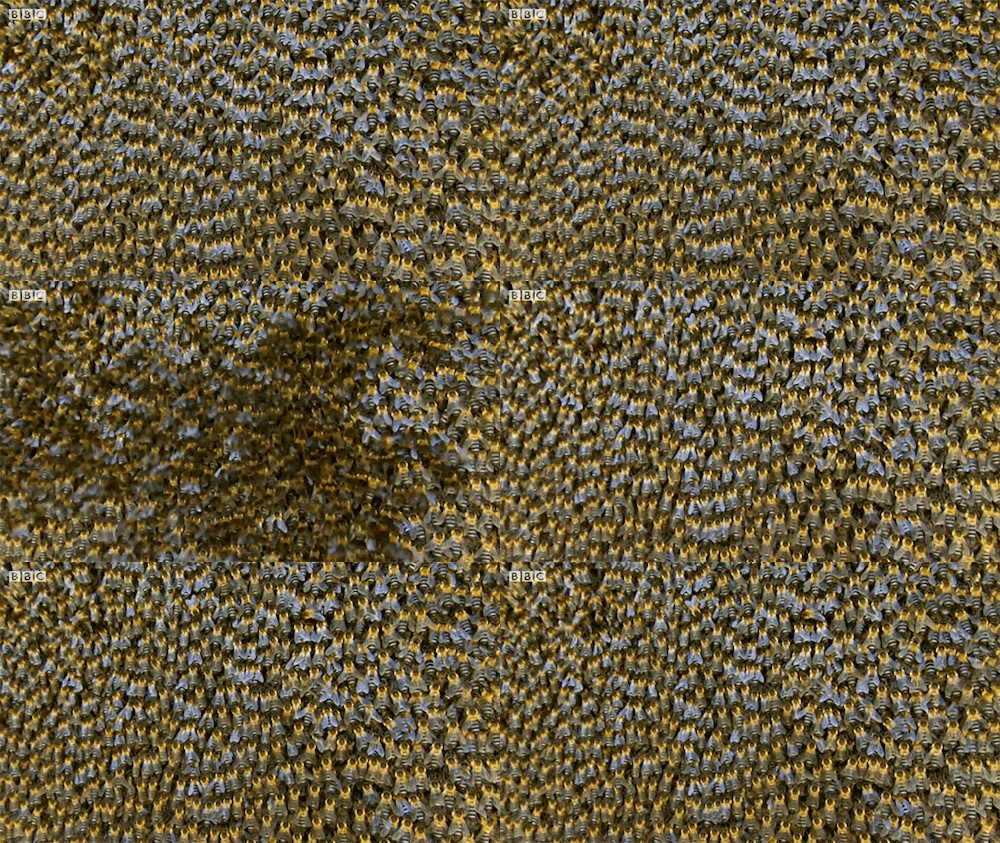
    One of the most mesmerizing examples are these giant honeybee colonies, which essentially do “the wave” to frighten away predators like wasps. Researchers are still trying to understand and mimic the way these groups coordinate such behaviors. Can even complicated patterns be generated by a simple set of rules an individual animal follows? That’s the sort of question active matter researchers investigate. Check out the video above to see a whole cliff’s worth of bee colonies shimmering. (Image and video credit: BBC Earth)

  • Collective Motion: Waving Bees

    Collective Motion: Waving Bees

    Giant honeybees live in huge open nests. To protect themselves, they’ve developed a mesmerizing wave-like defense known as shimmering. When shimmering, the bees in a hive, beginning from a distinct spot, will flip over to expose their abdomens. Taken together, this creates large-scale patterns like those seen above.

    Scientists have connected the behavior to the presence of wasps that prey on the bees. It seems that shimmering helps to repel the wasps without putting individual bees in danger. If shimmering doesn’t ward off the wasps, the bees can also use their flight muscles to heat the area around the intruder to a wasp-lethal temperature – or, individuals bees can sacrifice themselves by stinging the wasp. (Image credit: Beekeeping International, source; research credit: G. Kastberger et al.; via Gizmodo)

    This post is part of our series on collective motion. Check out our previous posts about how crowds are like sand, the fluid properties of worms, and why a lack of randomness makes predicting group behaviors hard.

  • Collective Motion: Intro

    Collective Motion: Intro

    Herds, flocks, schools, and even crowds can behave in fluid-like ways. On Science Friday, Stanford professor Nicholas Ouellette explains some of the physics behind these similarities. Fluids are, after all, made up of a many, many individual particles – typically molecules – just the way a crowd of people or a school of fish contains many individuals. What makes the collective behaviors of groups harder to model than a fluid, however, is a lack of randomness. In something like water, all the molecules move randomly, which allows scientists to make certain simplifications in how we describe that motion.

    In animal group behaviors, on the other hand, the motion of an individual is not completely random. It instead seems to be governed by relatively simple rules based on the observations that an individual can make. Combine those rules across a large number of individuals and you can get what’s called emergent behavior – exactly the sort of large-scale patterns we see in swarms of insects, flocks of birds, and schools of fish. (Image credits: fish – N. Sharp; starlings – N. Fielding, source; battle – New Line Cinema; podcast credit: Science Friday; submitted by Michelle D.)

    This week on FYFD, we’ll explore the world of collective motion and how it overlaps with fluid dynamics.

  • Reducing Viscosity With Bacteria

    Reducing Viscosity With Bacteria

    Conventional wisdom – and the Second Law of Thermodynamics – require all fluids to have viscosity, with the noted and bizarre exception of superfluids, which can flow with zero viscosity. In essence, you cannot have work (i.e. flow) for free. Some effort has to be lost to resistance.

    But scientists have discovered, bizarrely, that adding bacteria to water can result in zero or even negative viscosities – meaning that effort is required to keep the flow from accelerating. Before you ask, no, this is not a recipe for a perpetual motion machine. What happens when the bacteria-filled fluid is sheared is that the bacteria align and start collectively swimming. The local effects of each bacteria combine en masse to create a fluid that seemingly flows on its own. In the end, though, it’s the bacteria that are supplying that work. It certainly raises interesting prospects, though, for harnessing the power of bacterial superfluids. See the links below for more. (Image credit: M. Copeland, source; research credit: S. Guo et al.A. Loisy et al.; via Quanta; submitted by Kam-Yung Soh)

  • Fluids Round-Up

    Fluids Round-Up

    New year, new (or renewed) experiments. This is the fluids round-up, where I collect cool fluids-related links, articles, etc. that deserve a look. Without further ado:

    (Video credit and submission: Julia Set Collection/S. Bocci; image credit: IRPI LLC, source)