Tag: Mars

  • Martian Wind Power

    Martian Wind Power

    To support a crew on Mars, a landing site must offer resources like water and allow for sufficient power generation. Thus far, most analyses of this sort have focused on the possibilities of solar power, which is limited by day-and-night cycles and seasonal variations, and nuclear power, which carries some risk to the human crew. In a new report, researchers considered the possibilities of wind power on Mars.

    Since Mars’s atmosphere is so much thinner than Earth’s, wind power has largely been overlooked as an energy source there. But researchers found that a commercially-rated wind turbine expected to produce 330 kW here on Earth could still output a respectable 10 kW on Mars. Since the target power needs for a crew are 24 kW, adding wind energy can boost a power system from providing 40% of needs from solar alone to 60-90% of the needed energy from combined solar and wind sources. A wind turbine is especially helpful in supplementing power needs at times when solar power wanes, like at night or during the Martian winter solstice. (Image credit: NASA; research credit: V. Hartwick et al.; via Physics World)

  • Featured Video Play Icon

    Listen to a Martian Dust Devil

    A lucky encounter led the Perseverance rover to record the first-ever sound of a dust devil on Mars. The rover happened to have its microphone on (something that only happens a few minutes every month) just as a dust devil swept directly over the rover. Check out the video above to see and hear what Perseverance captured.

    Using the rover’s instrumentation, researchers worked out that the dust devil was at least 118 meters tall and about 25 meters wide. The team was even able to determine the density of dust in the vortex from the sound of individual grain impacts captured in the acoustic signal! Serendipitous as the experience was, planetary scientists may now look to include microphones on more missions, since we now know how to get useful meteorological data from them. (Video credit: JPL-Caltech/NASA; image credit: LPL/NASA; research credit: N. Murdoch et al.; via AGU Eos; submitted by Kam-Yung Soh)

  • Martian Glaciers

    Martian Glaciers

    On Earth, glaciers slide on lubricating layers of water, leaving complex landscapes like fjords and drumlins in their wake. Mars — though once home to enormous ice masses — lacks those geological features. Scientists assumed, therefore, that Martian ice stayed frozen and unmoving. But a new study demonstrates that is not the case.

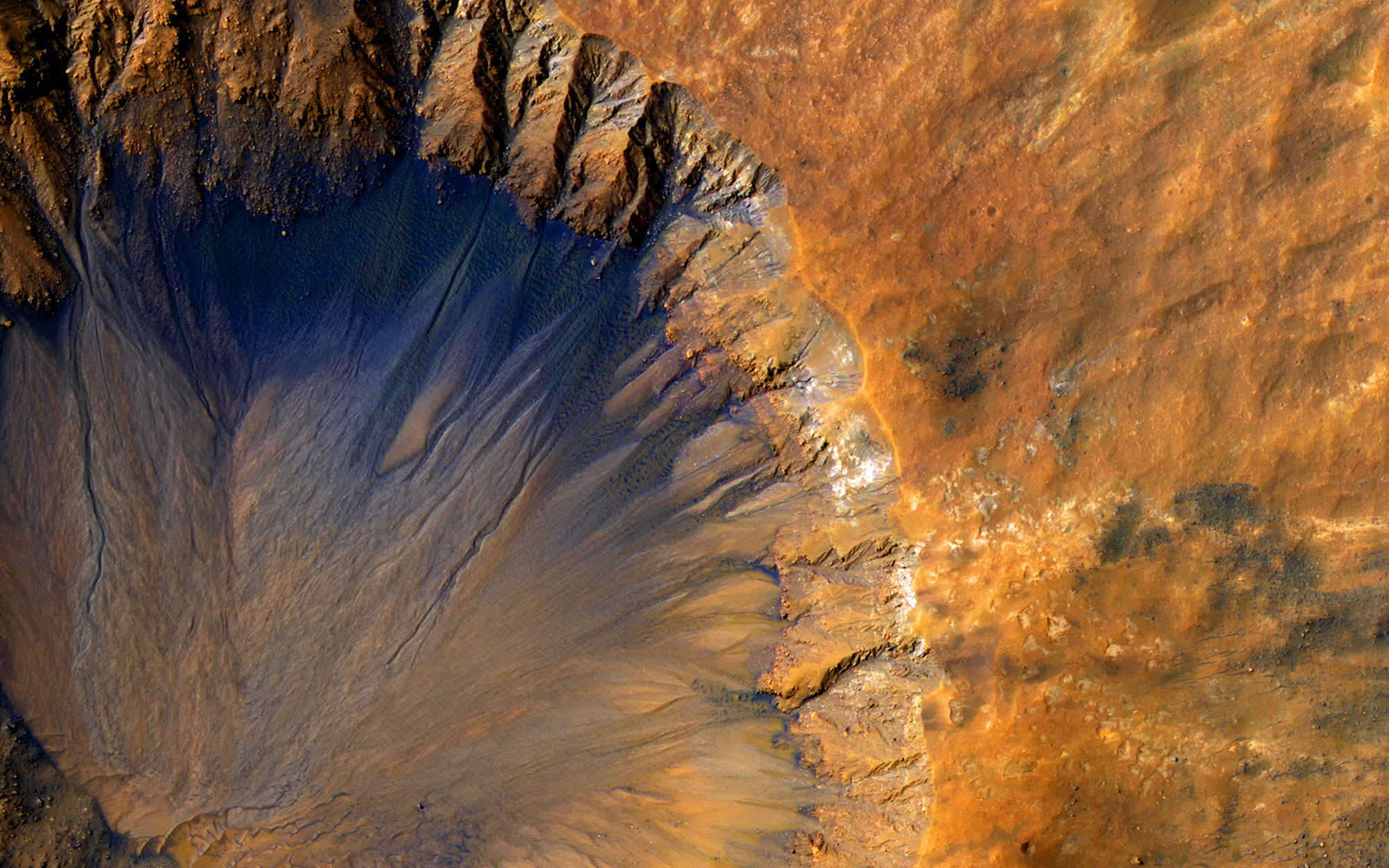
    Researchers used computational modeling to simulate two identical glaciers: one under Earth-like conditions and one under the lower gravity of Mars. They found that Martian glaciers did indeed move, but Mars’s lower gravity, combined with better water drainage beneath the ice, meant that they moved exceedingly slowly. Martian glaciers did erode the landscape but into different features than on Earth. Instead of forming moraines and drumlins, a large Martian glacier would instead carve channels and eskar ridges, geological features found on Mars today. (Image credit: NASA/JPL-CalTech/Uni. of Arizona; research credit: A. Grau Galofre et al.; via AGU; submitted by Kam-Yung Soh)

  • Ingenuity’s Dust Cloud

    Ingenuity’s Dust Cloud

    Mars is quite dusty. It periodically gets swallowed by planet-spanning dust storms, but it’s also home to regular dust devils whose size can put Earth’s to shame. Exactly how so much dust gets picked up by Mars’ incredibly thin atmosphere — only 1% of Earth’s — is still something of a mystery. So scientists were excited after the Ingenuity helicopter’s fourth flight, where cameras on the Perseverance rover caught a billowing dust cloud following Ingenuity as it flew. Knowing how the helicopter flies, they may be able to unravel just how its wake picks up and carries dust. Since Ingenuity’s only purpose was to demonstrate flight on another planet, this would be a big scientific bonus for an already successful mission! (Image credit: NASA/JPL-Caltech/ASU/MSSS/SSI; via Nature; submitted by Kam-Yung Soh and jpshoer)

  • Martian Polar Troughs

    Martian Polar Troughs

    Mars‘s northern pole is capped by a spiral-like pattern of deep troughs that are covered by carbon dioxide ice in winter but visible from orbit in summer. A new study posits that the spiral formed by wind erosion, exposing layer after layer of Martian geology.

    The center of Mars’s polar cap is higher in the center than toward the edges, so katabatic winds — cold, dense flows beginning at high elevation — rush down from the pole. But because Mars spins, the Coriolis force causes those winds to flow in an anti-clockwise spiral. As those winds encounter depressions perpendicular to their path, they generate vortices that erode the depression. Eventually, a depression deepens, merges with other depressions, and forms a trough. According to this theory, the clockwise spiral of the troughs is a direct result of the katabatic winds flowing across them. Head over to Bad Astronomy or check out the original paper for more. (Image credit: ESA/DLR/FU Berlin/J. Cowart; research credit: J. Rodriguez et al.; via Bad Astronomy; submitted by Kam-Yung Soh)

  • Blue Dunes

    Blue Dunes

    This false-color image shows a Martian dune field near the northern polar cap. The image itself covers an area 30 kilometers wide, but the dune field stretches over an area the size of Texas. In the photo cooler areas have been rendered in bluer tints, while warm areas are shown in yellow and orange. The sun warms the wind-sculpted dunes more than in the valleys that lie between. Complex dune networks like these build up over time as consistent winds push sand and create interactions between individual dunes. (Image credit: NASA/JPL-Caltech/ASU; via Colossal)

  • Shedding Light on Martian Dust Storms

    Shedding Light on Martian Dust Storms

    In 2018, Mars was enveloped by a global dust storm that lasted for months. Although such storms had been seen before, the 2018 storm offered an unprecedented opportunity for observation from five orbiting spacecraft and two operating landers. As researchers comb through that data, they’re gaining new insights into the mechanisms that drive these extreme events.

    At NASA Ames, a team of researchers used observations of dust columns as input to a simulation of Mars’ global climate, then watched as the digital storm unfolded. Simulations like these have an important advantage over observations: the simulations allow scientists to track the transport of dust from one region to another.

    That dust tracking is critical for some of the team’s results. They found feedback patterns between dust lifting and deposition in different regions. For example, early in the storm dust was largely supplied from the Arabia/Sabaea regions, but once that dust was deposited in the Tharsis region, it kicked off a massive lifting event from Tharsis that put twice as much dust into the atmosphere as had landed there. Later, dust deposited back in Arabia by the Tharsis lofting generated new dust uplifts. As long as more dust got lifted than deposited, the intense storms continued. (Image credits: NASA, T. Bertrand/A. Kling/NASA Ames; research credit: T. Bertrand et al.; see also JGR Planets and AGU; submitted by Kam-Yung Soh)

  • Featured Video Play Icon

    Exploring Martian Mud Flows

    When looking at Mars and other parts of our solar system, planetary scientists are faced with a critical question: if what I’m looking at is similar to something on Earth, did it form the same way it does here? In other words, if something on Mars looks like a terrestrial lava flow, is it actually made of igneous rock or something else?

    To tackle this question, a team of researchers explored mud flows in a pressure chamber under both Earth-like and Martian conditions. They found that mud flowed quite freely on Earth, but with Martian temperatures and pressures, the flows resembled lava flows like those found in Hawaii or the Galapagos Islands.

    On Mars, mud begins boiling once it reaches the low pressure of the surface. This boiling cools it, causing the outer layer of the mud to freeze into an increasingly viscous crust, which changes how the mud flows. In this regard, it’s very similar to cooling lava, even though the heat loss mechanisms are different. (Video and research credit: P. Brož et al.; image credit: N. Sharp; see also P. Brož; submitted by Kam-Yung Soh)

  • Martian Landslides

    Martian Landslides

    Sometimes there are advantages to studying planetary physics beyond Earth. Mars does not have plate tectonics, vegetation, or the level of erosion we do, allowing geological features like those left behind by landslides to persist undisturbed for millions of years. And, thanks to a suite of orbiters, we’ve mapped most of Mars at a resolution better than many parts of our own planet. All together, this gives researchers a treasure trove of geological data from our nearest neighbor.

    One peculiar feature of many landslides is their long runout. Even over relatively flat ground, some landslides cover extreme distances from their point of origin. On Earth, we often see this behavior near glaciers, so scientists theorized that the presence of ice was somehow necessary for the landslide to cover such a long distance. But previous laboratory experiments with dry, ice-free grains showed the same behavior: long runouts marked with ridges running parallel to the flow. The mechanism behind the ridges is still somewhat unclear, but it seems to be connected to fluid dynamical instabilities that form between fast-flowing particles of differing density. But such results have been confined to lab-scale experiments and numerical simulations.

    A new report, however, shows that landslides on Mars share the same characteristic spacing and thickness between their ridges. This evidence suggests that the same ice-free mechanism could account for the long run-out of landslides on Mars and other planets. (Image credit: NASA/JPL-Caltech/University of Arizona; research credit: G. Magnarini et al.; via The Conversation; submitted by Kam-Yung Soh)

  • Dust Envelopes Mars

    Dust Envelopes Mars

    Day has turned into night for NASA’s Opportunity rover as a massive dust storm envelopes Mars. The first signs of the dust storm were reported May 30th, and over the last two weeks, the storm has grown to an area larger than North America and Russia combined. Despite the low pressure and density of Mars’ atmosphere, solar heating can create fairly strong winds – they don’t reach hurricane-force speeds, but they’d qualify as a very windy day here on Earth. With the lower gravity on Mars, this can lift dust well into the atmosphere, choking out the sunlight Opportunity needs to continue operating. The rover has entered a low-power mode and is no longer responding to communications. Martian dust storms have been known to last for weeks or even months, and this may be the last we hear from the intrepid rover on its fifteen year journey. Here’s hoping that Opportunity makes it through the storm and can eventually get the solar power needed to phone home again. (Image credit: NASA JPL)