Ground effect vehicles (a.k.a. wing-in-ground-effect vehicles) rely on their proximity to a flat surface to inhibit the wingtip vortices that create lift-induced drag. This effectively increases the lifting capabilities of the vehicle in comparison to regular flight, but only so long as the vehicle remains close enough to the ground. This video features many model gliders that rely on ground effect.
Search results for: “wingtip vortices”
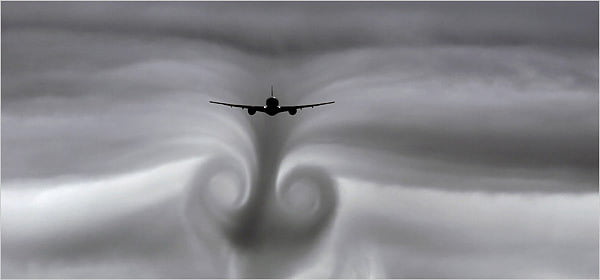
Airplane Vortex Wake
The wingtip vortices in the wake of a commercial airliner distort the clouds as the plane descends. Wingtip vortices form as a result of high pressure air from the underside of the wing accelerating around the wingtips to reach the low pressure on top of the wing. They can be hazardous to other (lighter) aircraft. They also contribute to downwash that decreases the effective lift of a wing. Geese use the same mechanism to their advantage when flying in a V-formation, and some snakes use it to glide.
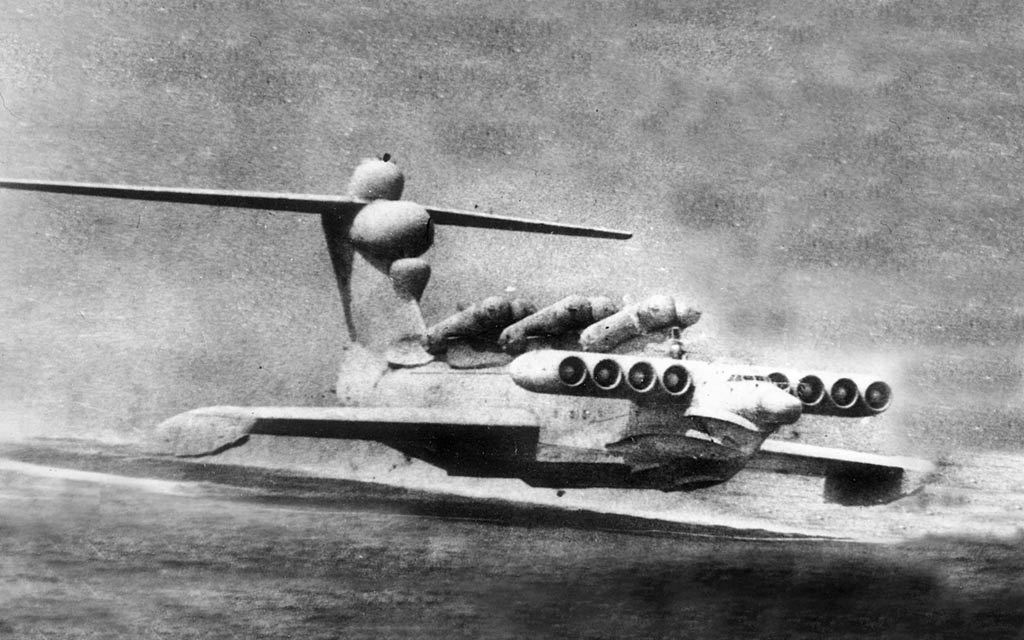
The Ekranoplan
The ekranoplan, the monster of the Caspian Sea, was a Soviet-era aircraft nearly 74 meters in length and weighing 380,000 kgs fully loaded. (In contrast, the C-17 is 53 m long and weighs 265,350 kg fully loaded.) This enormous craft relied on ground effect to stay aloft, where it was capable of 297 knots. Flying close to the ground or water increases the possible lift on wings through a “cushioning effect” that increases pressure on the lower wing surface and by disrupting the formation of wingtip vortices which typically reduce lift through downwash.

Computational Vortex Rings
Computational fluid dynamics (CFD) sometimes gets a bad rep as “colorful fluid dynamics”, but as computers get faster and faster, more complicated and physically accurate simulations are possible. Shown here are simulations of vortex rings and wingtip vortices in stunningly gorgeous detail. Understanding the evolution of these vortices from a fundamental level helps fluid mechanicians design better methods of controlling them. As mentioned in the video, wingtip vortices are a particularly hazardous everyday example; the time it takes for one plane’s wingtip vortices to disperse determines how quickly the next airplane can take-off or land on that same runway. Being able to break down these vortices faster would allow more frequent use of existing facilities.
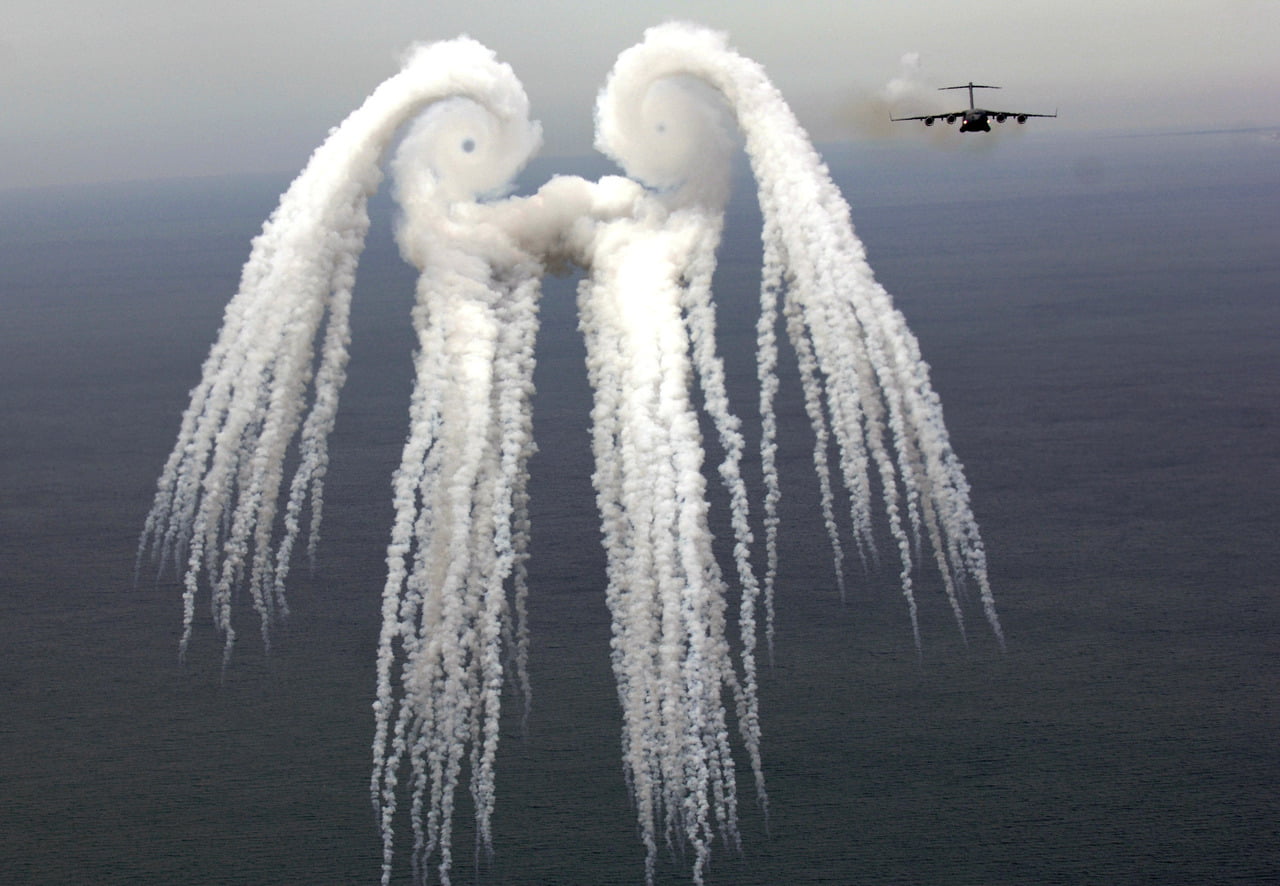
Smoke Angel
Smoke from flares released by a C-17 Globemaster III gets caught up by the aircraft’s wingtip vortices, creating a distinctive “smoke angel” shape. #
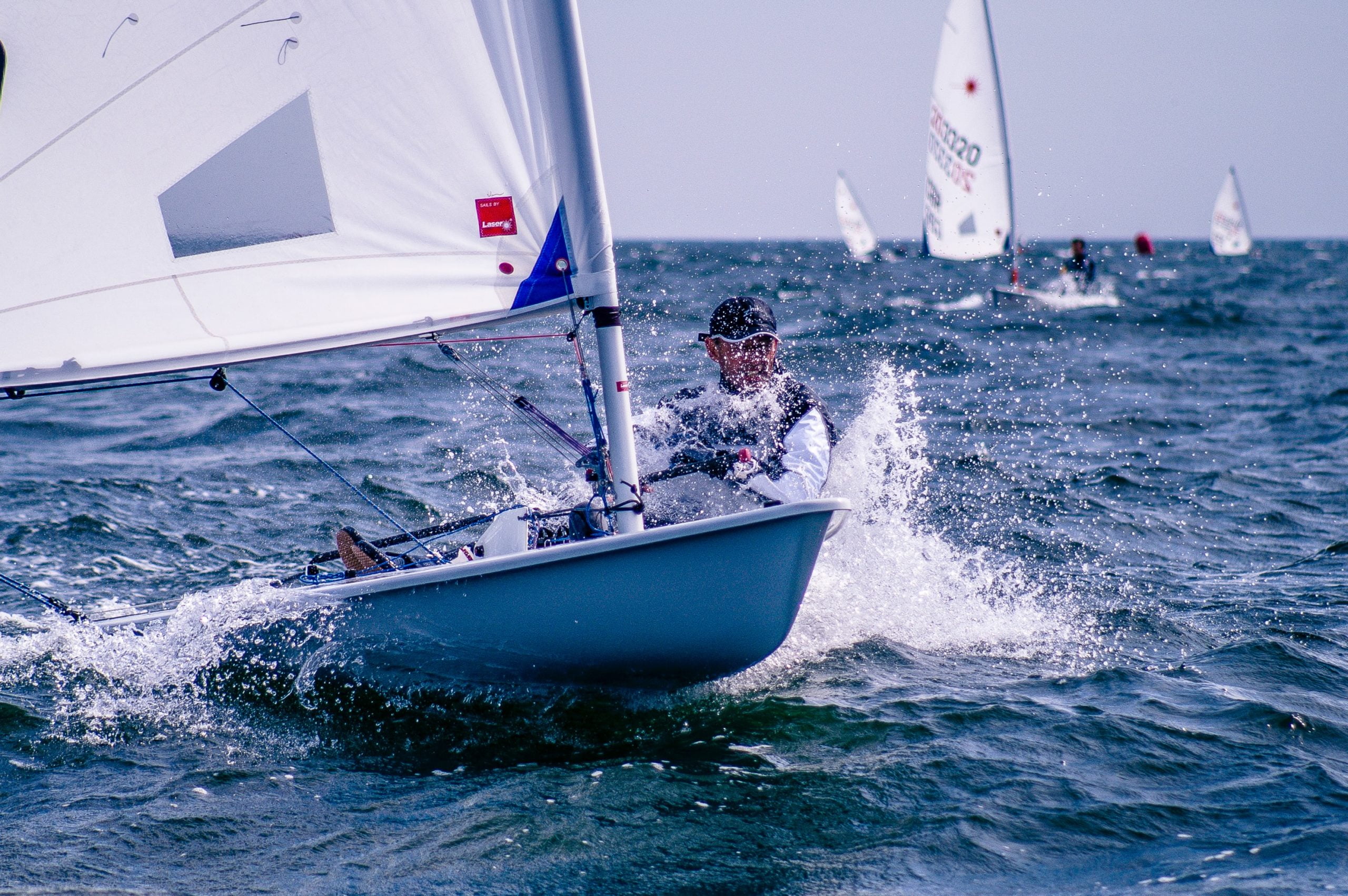
Tokyo 2020: Sailing Physics
At first glance, sailboats don’t look much like an airplane, but physics-wise, they’re closely related. Both the sail and hull of a sailboat act like wings turned on their side. Just as with airplane wings, the driving force for a sail comes from a difference in pressure across the two sides of the sail. The same effects applied to the hull and its keel (the wing-like extension that sits below the hull) provide the force that keeps a sailboat from slipping sideways as it cuts a path through wind and water.
Like airplane wings, sailboats also generate tip vortices: one from the top of the sail, the other from the bottom of the keel. Those vortices are typically invisible, but in foggy weather, like in the photo below, you can see the tracks they leave behind. (Image credits: top – Ludomił; bottom – D. Forster; research credit: B. Anderson; submitted by Lluís J.)

Follow along all this week and next as we celebrate the Olympics with sports-themed fluid dynamics.
Visualizing Flow with Snowfall
One of the challenges in engineering and operating wind turbines is that full-scale turbines rarely behave as predicted in smaller-scale laboratory experiments and simulations. One way to reconcile these differences (and discover what our experiments and simulations are missing) is to take the experiments out into the field. One research group has done this by using snowfall to visualize the flow around wind turbines. In this video, they share some of their observations, which include interactions of tip vortices with one another and with the vortex from the tower. My favorite part starts around 1:50 where you can observe tip vortices leap-frogging one another behind the wind turbine! (Video credit: Y. Liu et al.)

Tip Vortex
Smoke released from the end of a test blade shows the helical pattern of a tip vortex from a horizontal-axis wind turbine. Like airplane wings, wind turbine blades generate a vortex in their wake, and the vortices from each blade can interact downstream as seen in this video. These intricate wakes complicate wind turbine placement for wind farms. A turbine located downstream of one of its fellows not only has a decreased power output but also has higher fatigue loads than the upstream neighbor. In other words, the downstream turbine produces less power and will wear out sooner. Researchers visualize, measure, and simulate turbine wakes and their interactions to find ways of maximizing the wind power generated. (Photo credit: National Renewable Energy Laboratory)
Measuring Wind Turbines with Snowfall
One of the challenges in large-scale wind energy is that operating wind turbines do not behave exactly as predicted by simulation or wind tunnel experiments. To determine where our models and small-scale experiments are lacking, it’s useful to make measurements using a full-scale working turbine, but making quantitative measurements in such a large-scale, uncontrolled environment is very difficult. Here researchers have used natural snowfall as seeding particles for flow visualization. The regular gaps in the flow are vortices shed from the tip of the passing turbine blades. With a searchlight illuminating a 36 m x 36 m slice of the flow behind a wind turbine, the engineers performed particle image velocimetry, obtaining velocity measurements in that region that could then be correlated to the wind turbine’s power output. Such in situ measurements will help researchers improve wind turbine performance. (Video credit: J. Hong et al.)

Those Funny Fins on Airplane Wings
Ever look out an airplane’s window and wondered why a row of little fins runs along the upper side of the wing? These vortex generators help prevent a wing from stalling at high angle of attack by keeping flow attached to the surface. Airflow over the vanes creates a tip vortex that transports the higher-momentum fluid from the freestream closer to the wing’s surface, increasing the momentum in the boundary layer. As a result of this momentum exchange, the boundary layer remains attached over a greater chordwise distance. This also increases the effectiveness of trailing-edge control surfaces, like ailerons, on the wing. (Photo credit: Mark Jones Jr.)
