As demonstrated in the video above, lasers can be used to excite molecules into a higher energy state, which will decay via the emission of photons, causing the medium to glow. This laser-induced fluorescence is utilized in several techniques for measurements in fluid dynamics, including planar laser-induced fluorescence (PLIF) and molecular tagging velocimetry (MTV). In these techniques a flow is usually seeded with a fluorescing material–nitric oxide is popular for super- and hypersonic flows–and then lasers are used to excite a slice of the flow field. The resulting fluorescence can be used for both qualitative and quantitative flow measurements. Here are a couple of examples, one in low-Reynolds number flow and one in combustion. (Video credit: L. Martin et al./UC Berkeley)
Search results for: “supersonic”

Underwater Gunfire
When a projectile is fired from a gun or other firearm, it is propelled by the expansion of high-temperature, high-pressure gases resulting from the combustion of a propellant, like gunpowder, inside the weapon. The explosive expansion of these gases transfers momentum to the bullet; however, the gases will continue to expand outward from the gun even after the bullet is fired. They do so in the form of a supersonic blast wave; it’s this blast wave that’s responsible for the noise of the firearm. Firing a gun underwater is one way to see the blast wave, though it is far from the only way. In fact, a blast wave viewed underwater is not equivalent to one in air. The differences in density and compressibility between the two fluids mean that, while the general form may be similar, the specifics and the results may not be. In general, a blast wave underwater is much more damaging than one in air. (Video credit: destinsw2/Smarter Every Day; requested by nikhilism)
Homemade Hybrid Rocket Engine
In this video, Ben Krasnow details and demos a small hybrid rocket engine he built in his workshop. Hybrid rockets utilize propellants that are two different states of matter, in this case gaseous oxygen as the oxidizer and solid acrylic as the fuel. Krasnow’s verbal explanation of a convergent-divergent nozzle, used to accelerate flow to supersonic speeds is not quite right. In reality, a compressible fluid like air reaches the sonic point (i.e. Mach 1) at the narrowest point of the nozzle, also called the throat. The divergent portion of the nozzle causes the compressible fluid to expand in volume, which drops the temperature and pressure while the velocity increases beyond the speed of sound.
Krasnow says he did no calculations for his rocket, but I decided to have a little fun by doing some myself. Supersonic flow through the nozzle is only achieved if the flow is choked, meaning that the mass flow rate through the nozzle will not increase if the downstream pressure is decreased further relative to the upstream pressure. For Krasnow’s rocket, the downstream pressure is atmospheric pressure (14.7 psi) and the upstream pressure is provided by the oxygen canister, which he notes was at most 80 psi. Fortunately, the upstream pressure necessary to choke the nozzle is only 27.8 psi, so even with the ball valve partially closed, Krasnow’s rocket is definitely capable of supersonic speeds.
The Mach number achievable by any given supersonic nozzle is related to the ratio of the nozzle throat to its exit diameter (#). Krasnow gives the throat diameter as ¼-inch and the exit diameter as 5/8-inch. This means that the Mach number at the exit of the nozzle, assuming choked supersonic flow, is about Mach 3.4. (Video credit: Ben Krasnow; via Universe Today; submitted by jshoer)
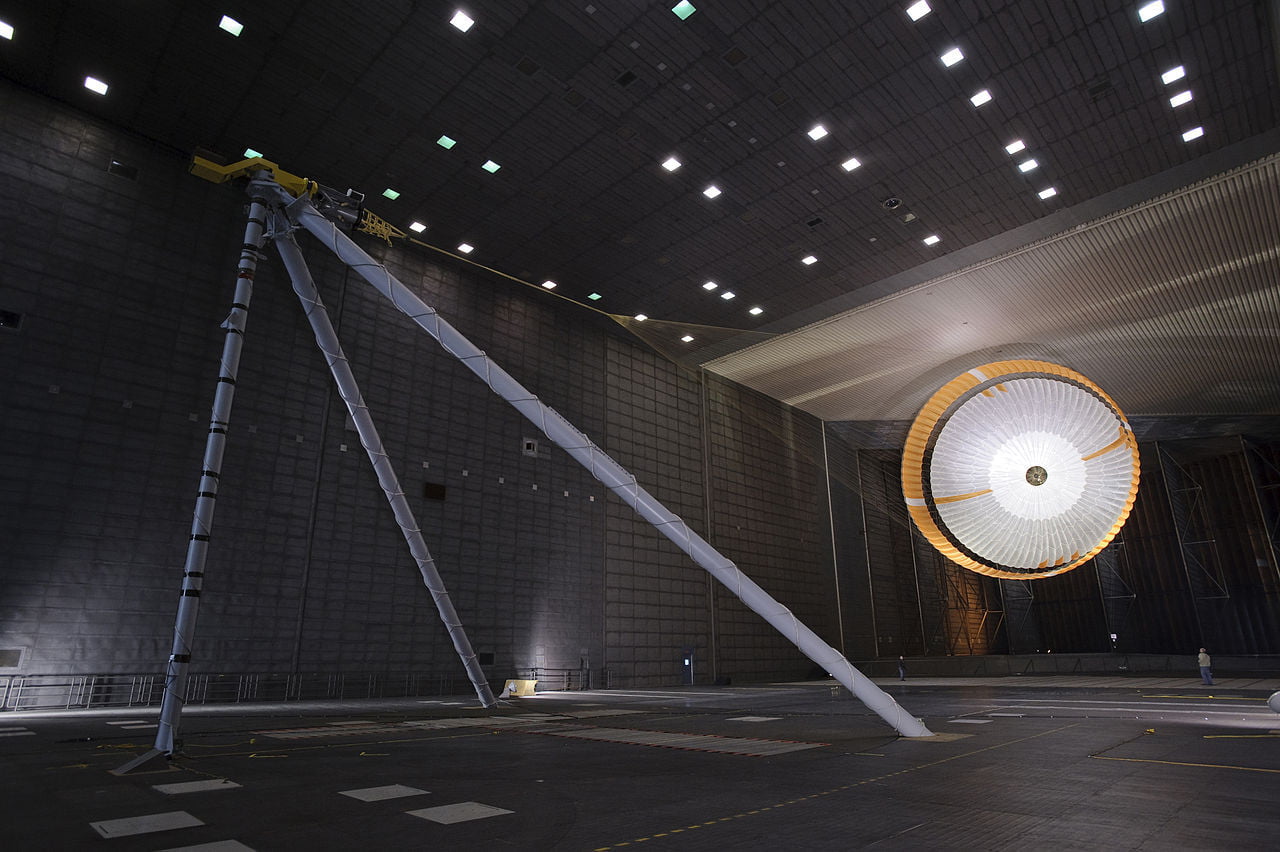
Martian Landing Physics
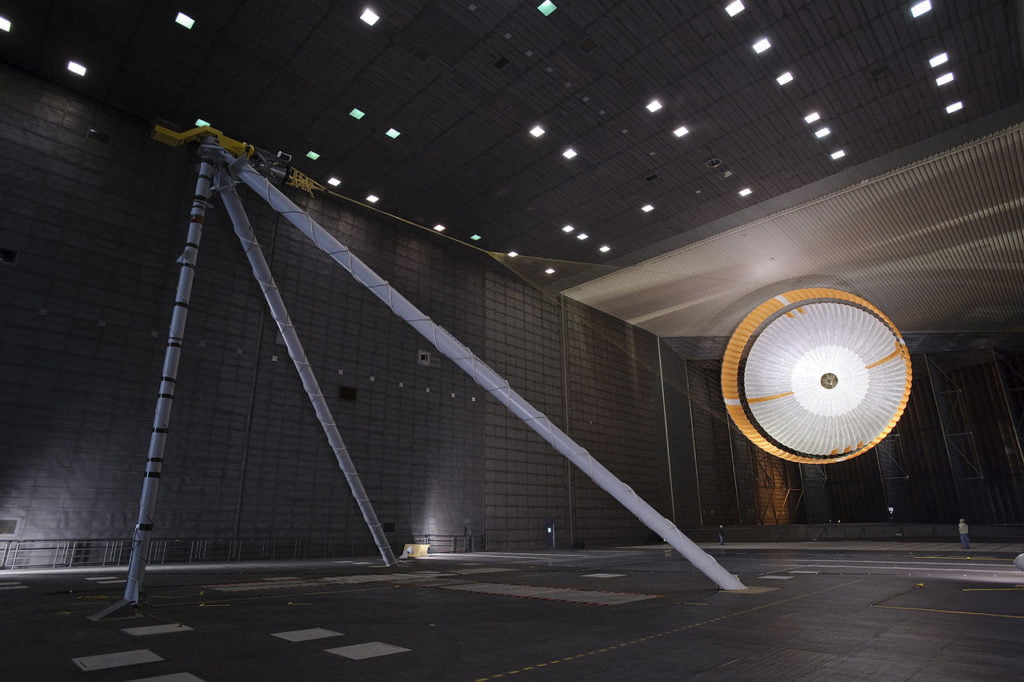
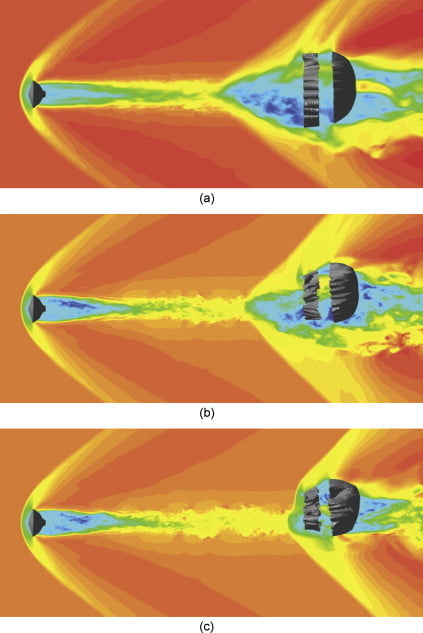
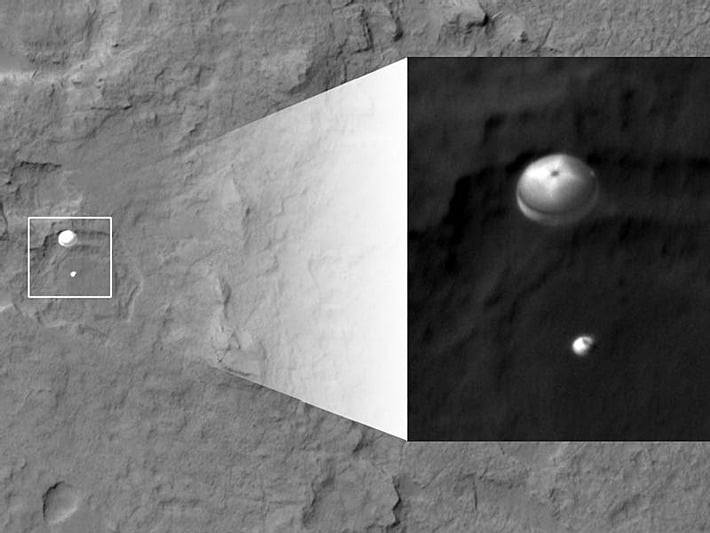
A little over a week ago, NASA’s Curiosity rover landed on Mars, the culmination of years of engineering. The mission’s landing, in particular, was the subject of intense scrutiny as Curiosity’s size necessitated some new techniques in the final segments of the landing sequence. As it hit the Martian atmosphere at 13,000 mph, the compression of the carbon dioxide behind the capsule’s shock wave slowed the descent. At roughly 1,000 mph–speeds still large enough to be supersonic–Curiosity deployed its parachute. Shown above are the parachute in numerical simulation (from Karagiozis et al. 2011), wind tunnel testing at NASA Ames, and during descent thanks to the Mars Reconnaissance Orbiter. The simulation shows contours of streamwise velocity at different configurations; note the bow shock off the capsule and the additional shocks off the parachute. These help generate the drag needed to slow the capsule. For an interesting behind-the-scenes look at the wind tunnel testing for Curiosity’s parachute check out JPL’s four–part video series. Congratulations to all the scientists and engineers who’ve made the rover a success. We look forward to your discoveries! (Photo credits: K. Karagiozis et al., NASA JPL, NASA MRO)
Mussels
In this video, schlieren imaging is used to make visible the flow field around a mussel. Mussels are filter-feeders, drawing nearby water in to obtain their food and expelling the unneeded fluid once they’ve gathered the plankton they eat. Normally this process is invisible to the naked eye, but schlieren imaging reveals changes in density (and thus refractive index) that make it possible to visualize the outflow from the mussel. The technique is also commonly used in supersonic flows to reveal shock waves. (Video credit: Stephen Allen)
Traffic Fluid Dynamics
What does traffic have to do with fluid dynamics? Rather a lot, actually! Many parallels exist between traffic and compressible fluid flow. One such example, the concept of a shock wave, is demonstrated in the video above. As the traffic jam develops, the cars experience sudden changes in their velocity and relative distance (in a fluid, this would be density). This change travels backward through the traffic in the form of a shockwave, just the same as discontinuous changes in a fluid.
Road construction provides another common example of compressible-flow-like behavior in cars. For an incompressible fluid like water, reducing the area of a pipe would increase the velocity, but just the opposite happens when a road is reduced from two lanes to one. Traffic slows down and clumps together. When the road opens back up from one lane to two, suddenly the speed and the distance between cars increases. This is exactly what happens in a rocket nozzle–it’s the expanding bell-like shape that causes air to accelerate supersonically. (Video credit: New Scientist)
Schlieren Montage
Dr. Gary Settles, a world-reknown expert in schlieren photography, shows here a montage of some of his lab’s results, including shockwaves from musical instruments, dogs sniffing, guns firing (both sub- and supersonic), and even snapping a wet towel going supersonic. As Settles jokes, schlieren is all mirrors and hot air. Mirrors are used to shine collimated light on the object to be imaged; then the light focused with a lens. By placing a knife-edge at the focal point, part of the light is blocked and the density variations in the final image become visible, thanks to their differing refractive indices. (Video credit: G. Settles et al.)
How Dams Affect Rivers
This video shows how the installation of a dam can affect river flow and sediment transport. Before the dam is added, the flow is shallow and the sediment transport is uniform. The installation of the dam creates deep subcritical flow upstream and supercritical flow downstream. This means that wave information–like ripples–can propagate upstream on the subcritical side; on the supercritical side, the wave velocity is lower than the flow velocity and ripples cannot propagate upstream. This is analogous to sub- and supersonic flow in air. The critical flow over the dam is analogous to a shock wave. The lower velocity upstream of the dam is unable to carry sediment downstream and transport essentially ceases until the sediment builds up to a height where the depth of the water above the dam is roughly equal to that below the dam and sediment transport resumes, scouring the downstream supercritical section. Around 0:40, a gate is closed on the downstream side (off frame), creating a hydraulic jump. In the final section of the video, after sediment has built up on both sides of the dam, the downstream gate is re-opened and the jump reforms as sediment is blown out below the dam. (Video credit: Little River Research and Design, with funding from the Missouri Department of Natural Resources)

Bow Shock over a Perforated Plate
This schlieren image shows a sphere traveling at Mach 3 over a perforated plate. The bow shock in front of the sphere is clearly visible, as is its reflection off the plate. The pressure caused by the bow shock produces a series of spherical acoustic waves below the plate. A tiny vortex ring moves downward from each hole, followed at the right by a secondary ring moving upward from the holes in the plate. (Photo credit: U.S. Army Ballistic Research Laboratory; reprinted in Van Dyke’s An Album of Fluid Motion)
Voyager Explores the Edge of the Solar System
Though unconventional by our terrestrial concepts of fluids, the solar wind and its interaction with objects in and around our solar system can be considered a form of fluid dynamics. This NASA video discusses discoveries made by the Voyager spacecrafts as they leave our solar system and pass into interstellar space. The solar wind, a rarefied stream of charged particles, streams outward from the Sun at supersonic speeds. Eventually, the pressure from the interstellar medium surrounding the solar system is sufficient to slow the solar wind to subsonic speeds, causing a termination shock much like the hydraulic jump that forms in a kitchen sink when you turn the faucet on.