When pulled, viscous liquids stretch into ligaments that thin and then break into droplets. In this video, researchers investigate how these ligaments break up, depending on their composition. The initial views show the break-up of a water-glycerol ligament (Image 1) and an oil ligament (Image 2). By placing a water droplet inside oil, the researchers got quite different results, including oil-encapsulated droplets (Image 3). The technique could be useful for making compound droplets, even with more than two components. (Image and video credit: V. Thiévenaz and A. Sauret)
Search results for: “droplet”

Triple Leidenfrost Effect
Droplets can skitter across a hot surface on a layer of their own vapor, thanks to the Leidenfrost effect. If two Leidenfrost droplets of the same liquid collide, they merge immediately. But that doesn’t always happen with two dissimilar liquids. A new study looks at how dissimilar Leidenfrost droplets collide. The researchers found that these drops can bounce off one another repeatedly before their eventual merger (Image 1).
Just as a vapor layer prevents the drops from touching the hot plate, a vapor layer forms between them when they collide, preventing contact (Image 2). Because of these three distinct areas of Leidenfrost vapor (one beneath each drop and one between the drops), the researchers call this the triple Leidenfrost effect.
Eventually, the more volatile (in other words, easily evaporated) drop shrinks to a size similar to its capillary length, at which point the drops merge. If the boiling points of the two liquids are vastly different, the merger can be explosive (Image 3). (Image and research credit: F. Pacheco-Vázquez et al.; via APS Physics)

Driven From Equilibrium
With the right application of force, liquids can take on shapes that defy our intuition. Here researchers sandwiched two immiscible oils between glass slides and applied an electric field. Because the two oils have different electrical responses, charges build along the interface between them. These charges lead to non-trivial electrohydrodynamic flows and a multitude of bizarre shapes. They observed polygonal droplets, streaming droplet lattices, and spinning filaments among others. As long as the electric field remains on, the wild behaviors continue; once the field is turned off, the oils relax back to typical, rounded drops. (Image, video, and research credit: G. Raju et al.; via Physics World)

Spreading By Island
How does a droplet sinking through an immiscible liquid settle onto a surface? Conventional wisdom suggests that the settling drop will slowly squeeze the ambient fluid film out of the way, form a liquid bridge to the solid beneath, and spread onto the surface. But for some droplets, that’s not how it goes.
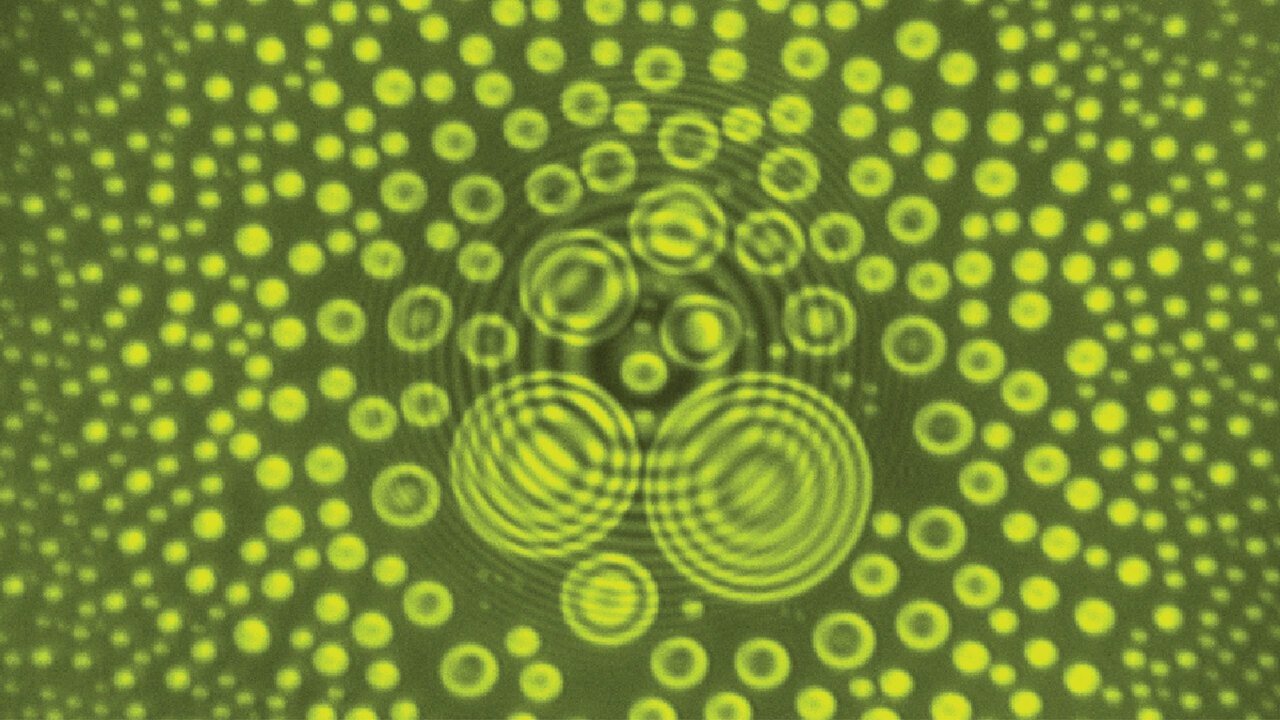
While watching a glycerol droplet settle through silicone oil, researchers discovered a new mechanism for wetting. Initially, the silicone oil drained from beneath the drop, as expected. But then the thinning of the film stalled. Tiny bright spots (above) appeared beneath the light and dark interference fringes of the parent drop. These are spots of glycerol, formed when material from the main drop dissolved into the oil and then nucleated onto the solid surface below. Over time, the island-like spots of glycerol grew. Eventually one grew large enough to coalesce with its parent drop (below), causing the glycerol to quickly spread over the solid surface!

Islands of liquid (darker rings) grow beneath a parent drop (brighter rings) until reaching a size where they coalesce, causing the interference fringes to disappear. The key to this phenomenon seems to be that immiscibility isn’t perfect. Even trace amounts of solubility between the drop and surrounding fluid are enough to allow these islands to form. And once formed, the islands will grow as long as the drop fluid and the solid surface are chemically attractive. (Image, research, and submission credit: S. Borkar and A. Ramachandran; see also Nature Behind the Paper)

Falling Pancake Drops
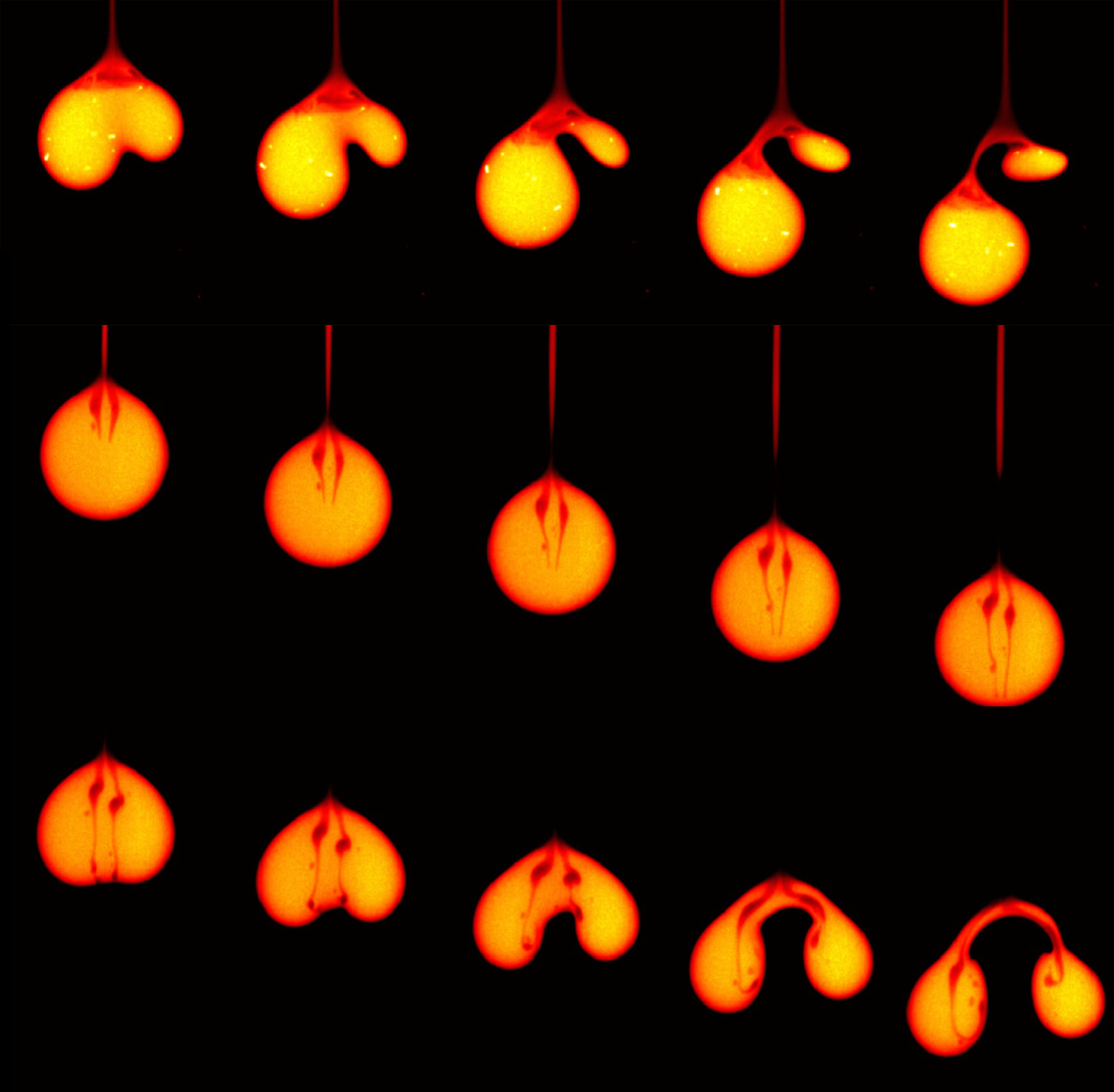
Despite their round appearance, the droplets you see here are actually shaped like little pancakes. They’re sandwiched inside a Hele-Shaw cell, essentially two plates with a viscous fluid between them. As these droplets fall through the cell, some remain steady and rounded (Image 1), while others experience instabilities (Images 2 and 3). By varying the ratio of the ambient fluid’s viscosity relative to the drop, the authors found two different kinds of breakup. In the first type (Image 2), droplet breakup occurred due to perturbations inside the drop itself. In the second type (Image 3), the viscosity of the ambient fluid is closer to that of the drop and intrusions of the ambient fluid into the drop break it apart. (Image and research credit: C. Toupoint et al.)

Liquid Umbrellas
Two well-timed and properly aligned droplets combine to create these umbrella-like fluid sculptures. The initial drop creates a jet that shoots upward. When the second drop hits that jet, it forms an expanding sheet of liquid like a miniature parasol. The higher the viscosity of the drops, the less lacy and unstable the sheet’s rim will be.
Although set-ups for these sorts of pictures can be finicky, they’re very doable, even for amateur photographers. In fact, the techniques used here have been around for about a century! (Image and research credit: A. Kiyama et al.)

On the Butterfly Effect
Fluid dynamics is a veritable playground of chaotic systems, but that doesn’t always translate to easy explanations, as Henry Reich points out in this Minute Physics video. The common metaphor for chaos is the Butterfly Effect, an idea that a butterfly flapping its wings causes a typhoon on the other side of the world. I agree with Henry that this is a poor example of chaos, for many of the same reasons he lays out. In reality, we call a system chaotic when its outcome is so sensitive to the initial conditions that the result becomes effectively unpredictable. And there are some very simple systems that are chaotic, like a double pendulum or a three-body problem. The weather is, honestly, too complicated of a system for the metaphor to make sense, but fluid dynamics does have other, simpler examples, like mixing in porous media, bouncing droplets, or, my personal favorite, the fluid dynamical sewing machine. (Video credit: Minute Physics)

Fractal Frost
As nightly temperatures drop in the northern latitudes, many of us are beginning to wake up to frosty patterns on leaves, windows, and cars. Frost‘s spread is a complex dance between evaporation and nucleation, as seen in this recent study.
Here, researchers watched frost grow on a surface covered in 30-micrometer-wide micropillars. The pillars serve as anchor points for droplets, making frosting easier to observe. At low humidity levels (Image 1), droplets evaporate so quickly that frost regions remain isolated and do not interact. At high humidity levels (Image 3), on the other hand, the droplets evaporate so slowly that they’re able to poach water vapor from their neighbors to form frost spikes. When a spike touches another droplet, it freezes the region almost instantly. As a result, the frost spreads quickly and covers nearly every part of the surface. At intermediate humidity levels (Image 2), though, this frost chain reaction and evaporation compete, causing the frost to grow in fractals. (Image and research credit: L. Hauer et al.; via APS Physics)

Sliding Along
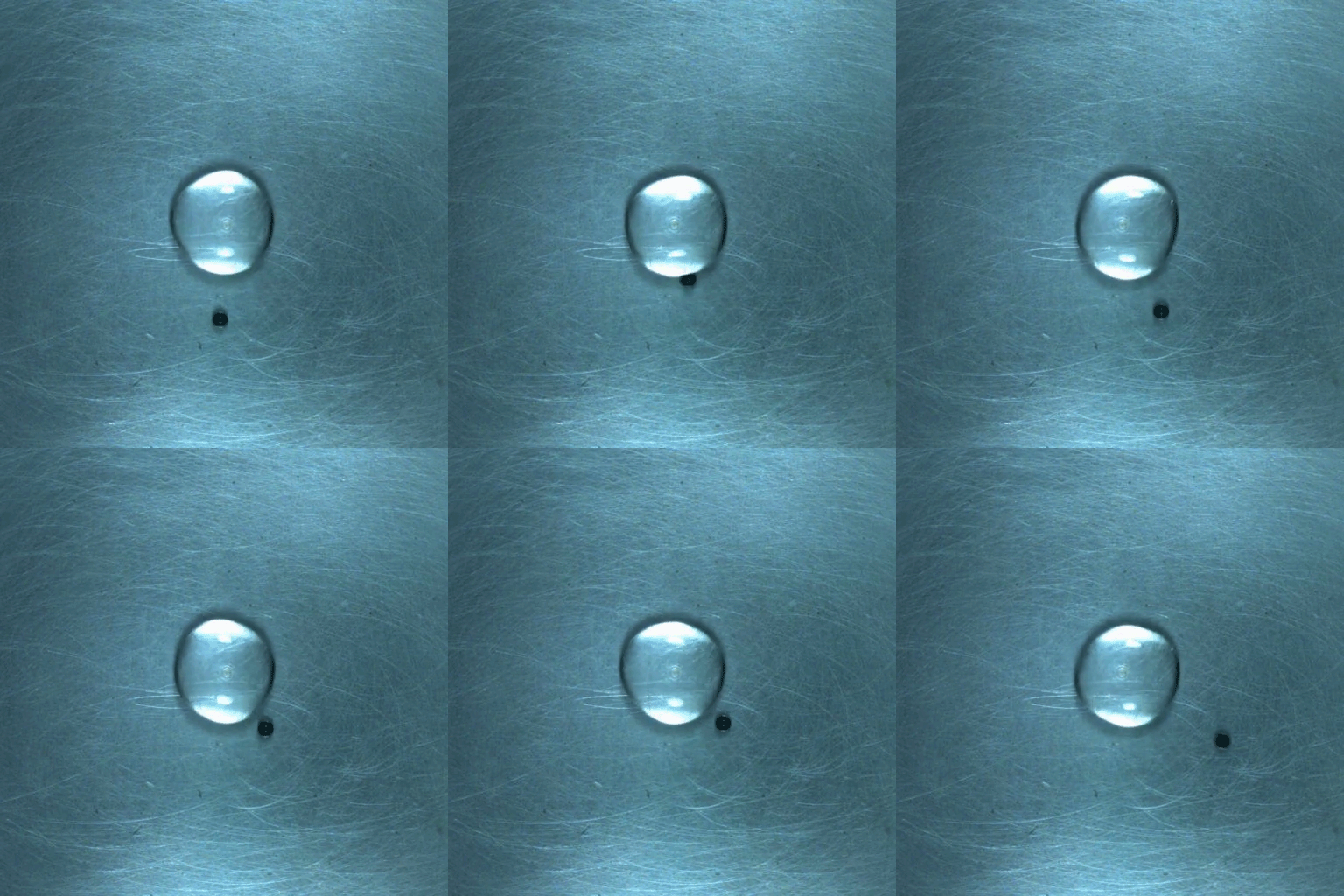
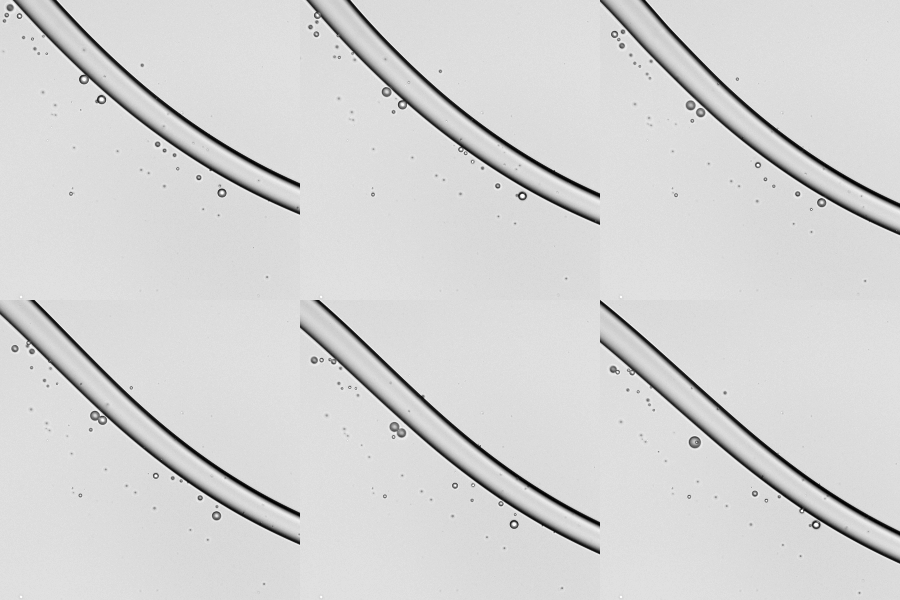
Robust, self-cleaning surfaces are a holy grail for many engineers, but they’re tough to achieve. One necessary ingredient for a self-cleaning surface is the ability to shed water, which is why superhydrophobic coatings and surface treatments are popular. Here, researchers prompt their droplets to move at speeds up to 16 cm/s by dropping them onto a thin layer of heated oil.
Longtime readers will no doubt be reminded of self-propelling Leidenfrost drops, but this situation is not quite the same. In general, the oil layer suppresses the Leidenfrost effect. Instead, the oil heats the drop, evaporating its vapor. A bubble of vapor will nucleate at a random location in the droplet and eject itself, pushing the drop in the opposite direction. Because of the disruption caused by that ejection, new bubbles will preferentially form at the same spot, providing an ongoing supply of vapor that keeps the drop sliding in the same direction. It’s like a miniature rocket zooming along the oil film! (Image and research credit: V. Leon and K. Varanasi; via APS Physics)

Taking A Turn
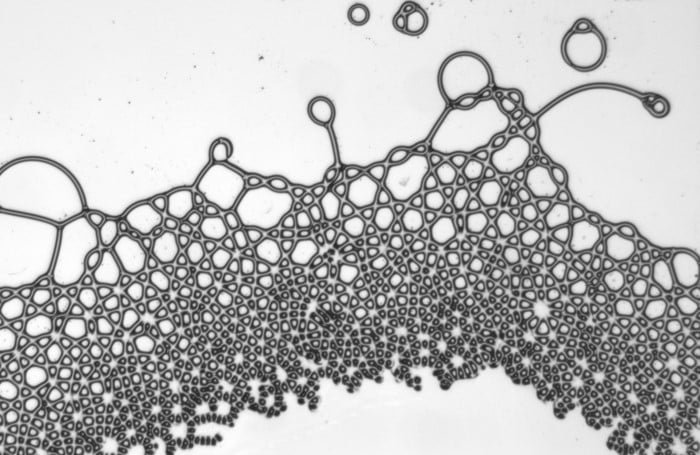
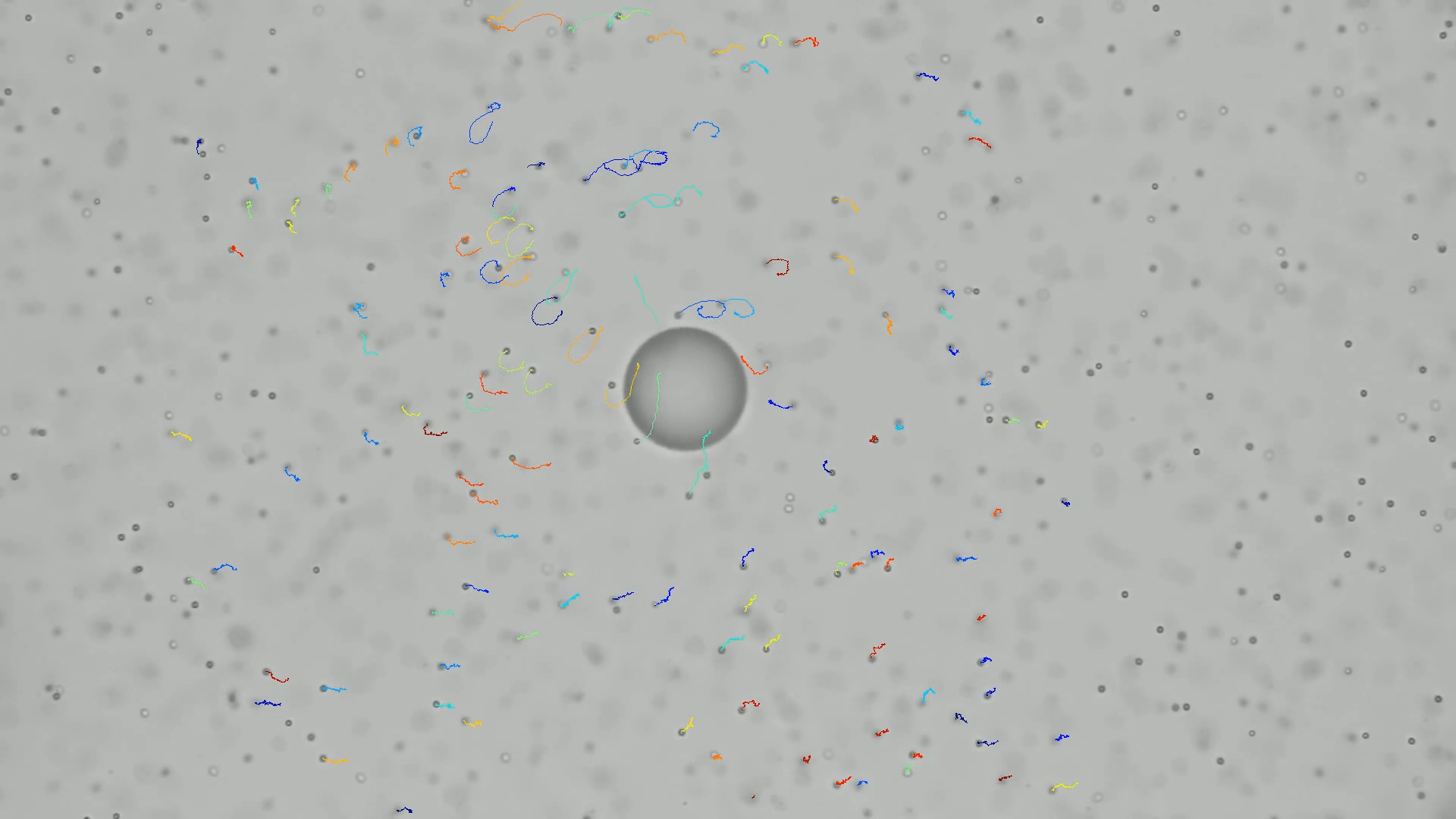
Water droplets immersed in a mixture of oil and surfactants will move about, propelled by the Marangoni effect. Surfactant molecules congregate along the interface between the water and oil, but they do not do so uniformly. This uneven grouping causes variations in the surface tension, which in turn creates flows inside the droplet from areas of low surface tension to ones with higher surface tension. Those internal flows then dictate how the droplet as a whole moves.
Researchers found that droplet trajectories in these systems depend on the droplet’s size. Small droplets move in relatively straight lines, whereas larger droplets take highly curved paths. The difference comes from the way surfactants get distributed around the drop’s interface. Larger drops are more sensitive to shifts in surfactant location, making them more prone to take changeable, curving paths. (Image credits: top – P. Godfrey, others – S. Suda et al.; research credit: S. Suda et al.; via APS Physics)