Search results for: “art”

  • Beneath the Surface

    Beneath the Surface

    Signs of a ship’s passage can persist long after it’s gone. The churn of its propellers and the oil leaked from its engines leave a mark on the water’s surface that, in some cases, is visible even from orbit. But the frothy wake of a ship is no easy place to measure; there are simply too many bubbles. To reveal the physics behind that froth, these researchers turned to direct numerical simulation, a type of computational fluid dynamics that calculates the full details of a flow, typically using a supercomputer to do so.

    In their poster, the blue field of wavy lines shows turbulence under the water’s surface. For (relative) simplicity, the turbulence is statistically uniform — as opposed to matching a particular ship’s wake. The interface between air and water is shown in red. The water surface is complex and undulating, spotted with bubbles trapped below the water and droplets flying through the air. Simulations like these help scientists focus on the detailed mechanisms that connect the turbulent water to the complex air-water surface. Once those are understood, researchers can develop models that approximate the physics for more specific situations, like the passage of a cargo ship. (Image credit: A. Calado and E. Balaras)

  • Frictional Fingers

    Frictional Fingers

    Air pushes into a thin gap filled with water and granular particles in the labyrinth-like image above. The encroaching air pushes grains like a bulldozer’s blade, building up a compacted wall. The invasion continues until the pressure of the air is countered by the combined capillary and frictional forces of the wet grains. Researchers built an analytical model that explains how these frictional fingers form and grow. Unlike Saffman-Taylor fingering patterns, which depend on long-range viscous forces, these patterns depend entirely on short-range forces from surface tension and friction. (Image and research credit: E. Flekkøy et al.)

  • Icelandic Glow

    Icelandic Glow

    Solar wind particles slam into the atmosphere near Earth’s poles, creating billowing curtains of glowing plasma known as auroras. Beneath the earth, molten rock seethes and flows, squeezed up fissures to release explosive gases and spurts of lava to the surface world. These natural phenomena are captured in the left and center of this image, respectively. To the right, three plumes of water vapor rise from a geothermal power plant. Three very different phenomena — all fluid dynamical in nature and all captured in a single image of Iceland. It’s no wonder the island is covered in tourists. (Image credit: W. Gorecka; via APOD)

  • Calming the Waves

    Calming the Waves

    Wave action can be a major source of erosion along riverbanks and shorelines. But in a recent study, scientists were able to perfectly absorb incoming waves to create a downstream region with calm, wave-free waters.

    Experimental data shows that waves approaching from the left interact with the resonant chambers and get perfectly absorbed, leaving the water on the right side still.
    Experimental data shows that waves approaching from the left interact with the resonant chambers and get perfectly absorbed, leaving the water on the right side still.

    The group began with a narrow channel that waves could move down. They added two small, side-by-side cavities perpendicular to the channel; as waves travel down the channel, they resonate with the cavities, which reflect and transmit their own waves back into the channel. With the right tuning to the size and spacing of the cavities, the team was able to make the cavities’ waves perfectly cancel the channel’s waves. The group demonstrated this absorption theoretically, numerically, and experimentally.

    Currently, they’ve only managed perfect absorption with a single wave frequency, but an array of cavities should be able to absorb a range of incoming waves. The authors hope their work will one day help protect coastal structures and prevent erosion by countering incoming waves. (Image and research credit: L-P. Euvé et al.; via APS Physics)

  • The Best of FYFD 2023

    The Best of FYFD 2023

    A fresh year means a look back at what was popular last year on FYFD. Usually, I give a numeric list of the top 10 posts, but this year the analytics weren’t as clear. So, instead, I’m combining from a few different sources and presenting an unordered list of some of the site’s most popular content. Here you go:

    I’m really pleased with the mix of topics this year; many of these topics are straight from research papers, and others are artists’ works. At least one is both. From swimming bacteria to star-birthing nebulas, fluid dynamics are everywhere!

    If you enjoy FYFD, please remember that it’s a reader-supported website. I don’t run ads and it’s been years since my last sponsored post. You can help support the site by becoming a patronmaking a one-time donationbuying some merch, or simply by sharing on social media. And if you find yourself struggling to remember to check the website, remember you can get FYFD in your inbox every two weeks with our newsletter. Happy New Year!

    (Image credits: sphinx – S. Boury et al., ear model – S. Kim et al., maze – S. Mould, dandelion – S. Chaudhry, water tank – P. Ammon, e. coli – R. Ran et al., drop impact – R. Sharma et al., Leidenfrost – L. Gledhill, toilet – J. Crimaldi et al., engine sim – N. Wimer et al., rivers – D. Coe, fin – F. Weston, snake – P. Schmid, nebula – J. Drudis and C. Sasse, flames – C. Almarcha et al.)

  • Featured Video Play Icon

    The Hydrodynamics of Marbling

    In marbling, an artist floats paints on a viscosified water bath, using various thin tools to manipulate the final image. Many cultures have developed a version of this art, but for many it will be most recognizable as a technique used to decorate book interiors. In this video, researchers consider the physics behind this beautiful practice. Surface tension helps keep the paint on the surface, even though it’s denser than the water it’s on. Variations in surface tension shape and reshape the surface as new colors are added. And then low-Reynolds-number effects help artists mix the paints without inertia or diffusion disturbing the pattern. See more examples here, here, and here. (Video credit: Y. Sun et al.)

  • Exoplanet Heating

    Exoplanet Heating

    WASP-96B is a tidally-locked exoplanet between the size of Saturn and Jupiter. This hot, massive planet lies close to its star, orbiting in less than three-and-a-half Earth days. A recent study shows that planets like these can have very different weather, depending on what depth their atmosphere absorbs heat at.

    Using numerical simulations, researchers took a detailed look at the possible atmospheric dynamics on this planet. When the atmosphere absorbed heat at a shallow depth — near the outer layers of the planet — a coupled vortex pair formed (left, below). These vortices promenaded westward and completed a circuit around the planet every 11-15 days.

    Shallow heating on a hot Jupiter produces a pair of coupled vortices (left), but deeper heating in the atmosphere generates four more-chaotic vortices (right).
    Shallow heating on a hot Jupiter produces a pair of coupled vortices (left), but deeper heating in the atmosphere generates four more-chaotic vortices (right).

    In contrast, deeper heating produced a more-chaotic pattern of four vortices (right, above) that each lasted 3 to 15 days before disappearing, replaced by a new vortex. This atmosphere, they found, was very turbulent, with smaller-scale vortices as well.

    Since each weather pattern is visually distinct and carries its own brightness signature, the authors predict that additional observations of WASP-96b with the current generation of telescopes will show which type of heating dominates on the exoplanet. (Image and research credit: J. Skinner et al.; via APS Physics)

    Snapshots from a simulation of a deep-heated hot Jupiter. Each image shows the planet on a different day.
    Snapshots from a simulation of a deep-heated hot Jupiter. Each image shows the planet on a different consecutive day.
  • Swarm of Surfers

    Swarm of Surfers

    Self-propelled objects can form fascinating patterns. Here, researchers investigate how small plastic “surfers” move on a vibrating fluid. Each surfer is heavier in its stern than its bow. When the fluid vibrates, the surfer creates waves that are asymmetric — deeper in the stern than at the bow. For single surfers, this imbalance propels the surfer in the direction of its bow. But with more than one surfer, other patterns form.

    The video demonstrates five of the seven patterns pairs of surfers exhibit.
    The video demonstrates five of the seven patterns pairs of surfers exhibit.

    The team looked at groups of surfers all the way up to eight members. Among pairs, the researchers found seven distinctive patterns, including orbiting groups, tailgaters, and promenading pairs. Larger groups, they found, had similar collective behaviors. They hope their surfers will be an easily accessible platform for exploring active matter. (Image and research credit: I. Ho et al.; via APS Physics)

  • “The Reef”

    “The Reef”

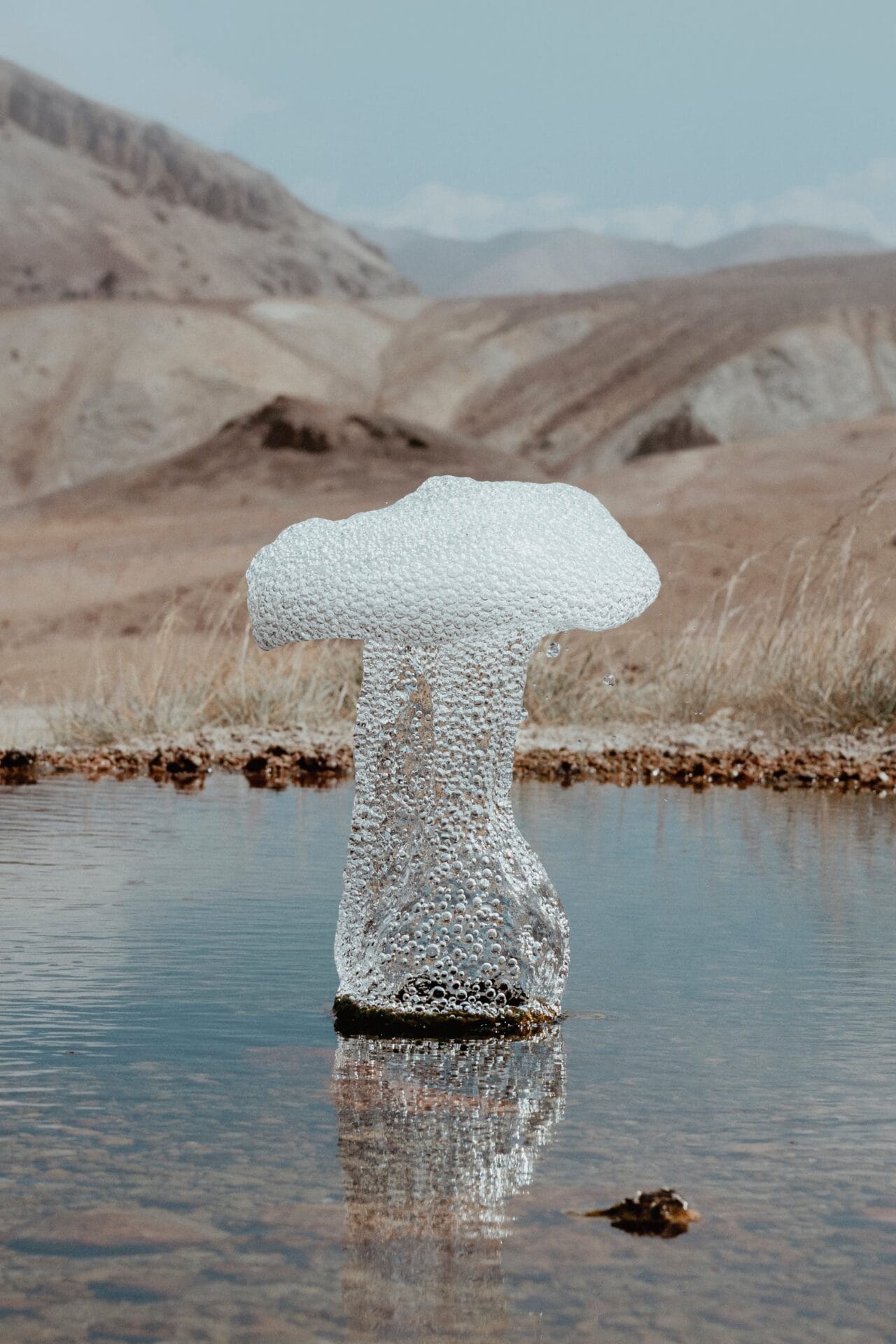
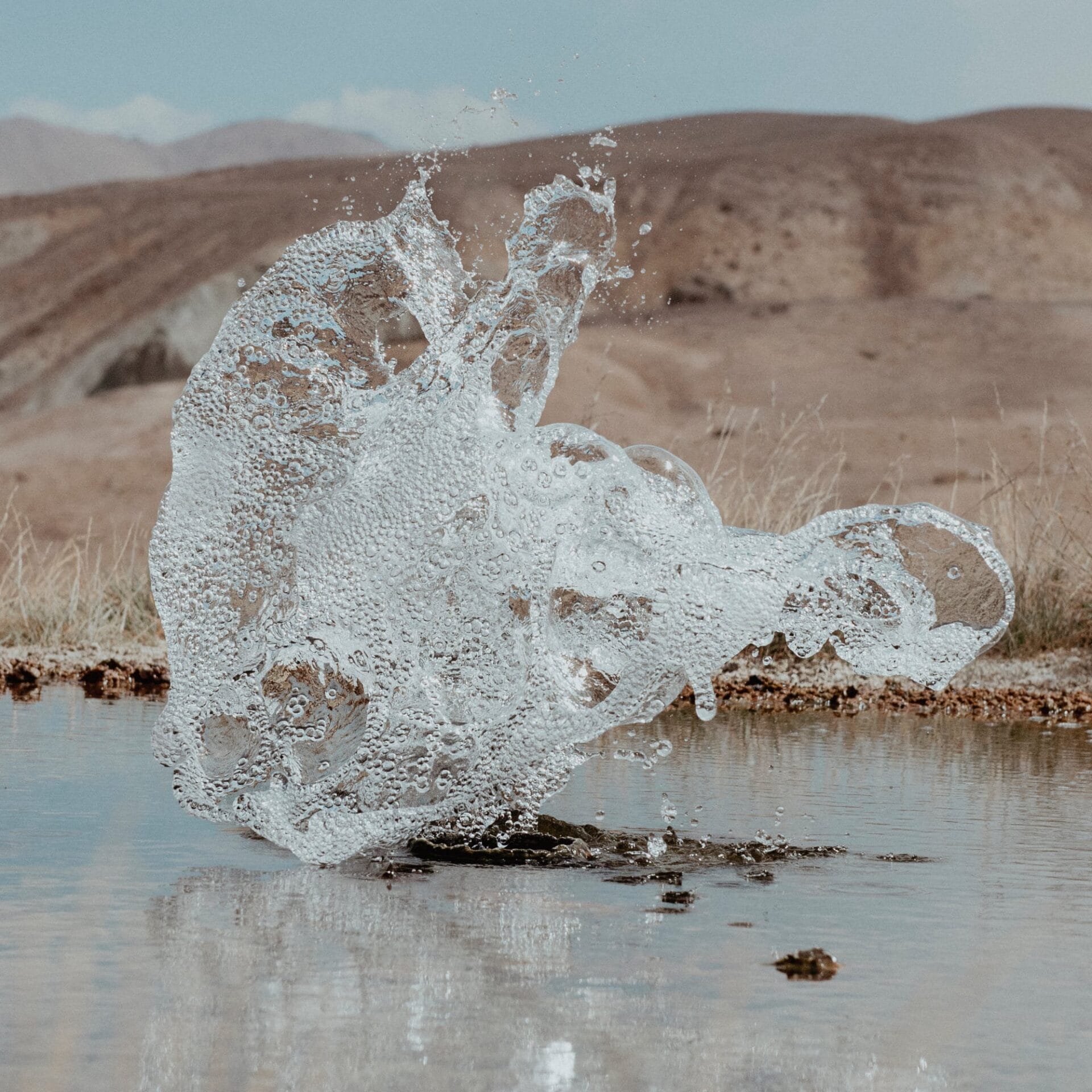
    Artist Alberto Seveso returns to his colorful ink plumes (1, 2, 3, 4, 5), but this time with a twist. Here, Seveso took ink injected in water and digitally altered it, adding texture and shaping the ink to mimic the shapes of coral reefs. The results are stunning, though I confess a few of them remind me of mushrooms or organs more than reefs. (Image credit: A. Seveso; via Colossal)

  • Controlling Finger Formation

    Controlling Finger Formation

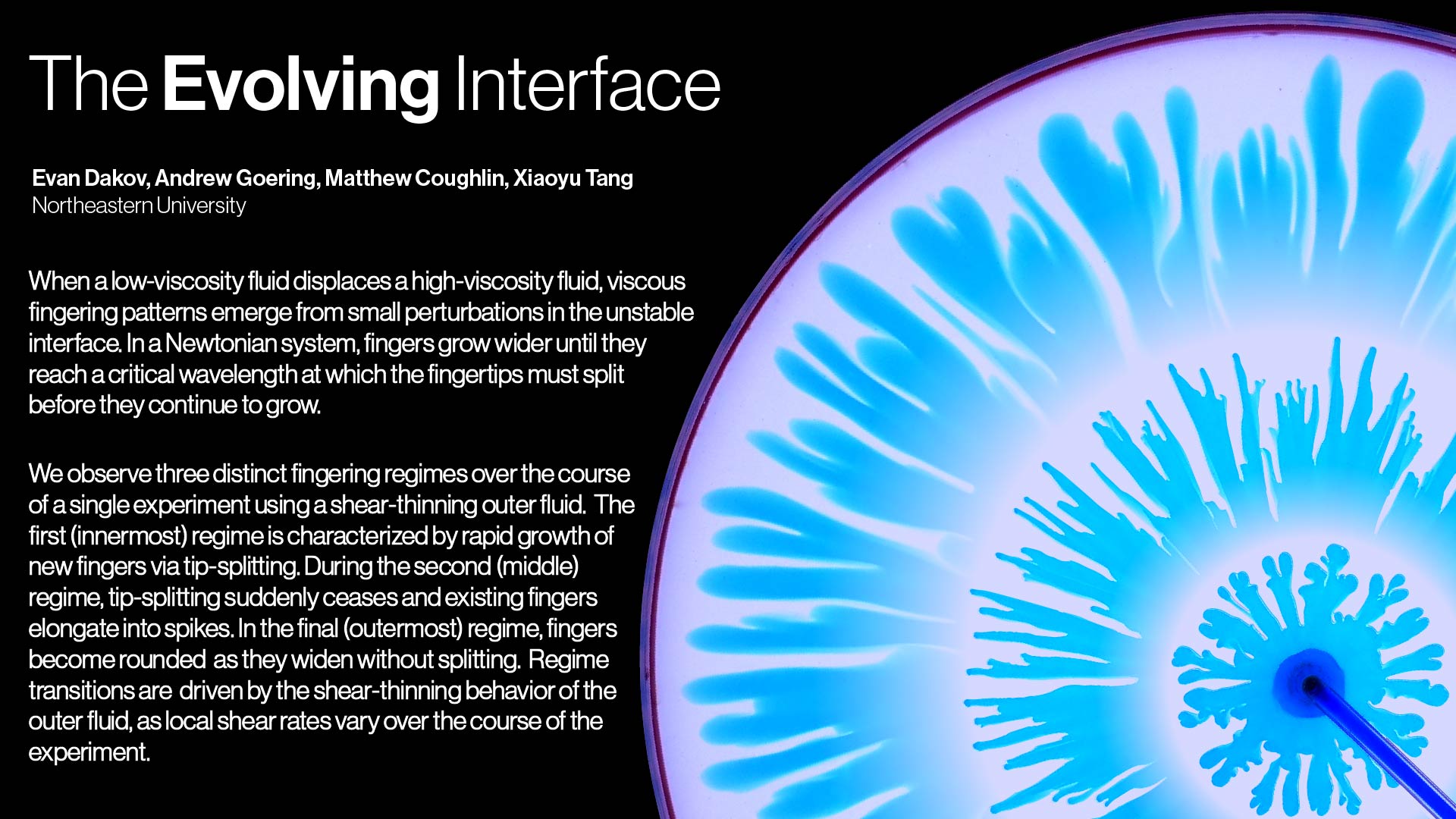
    When gas is injected into thin, liquid-filled gaps, the liquid-gas interface can destabilize, forming distinctive finger-like shapes. In laboratories, this mechanism is typically investigated in the gap between two transparent plates, a setup known as a Hele-Shaw cell. In the past, researchers looking to control the instability have explored how surface tension, viscosity, and the elasticity of the gap itself affect the flows. But a new set of studies look at the compressibility of the gas being injected.

    The team found that viscous fingers formed later the higher the gas’s compressibility. That provides a potential control knob for people trying to exploit the mechanism, especially geologists. For geologists trying to extract oil, viscous fingering is detrimental, but, on the flip side, viscous fingers are desirable when injecting carbon dioxide for sequestration. With these results, users can tweak their injection characteristics to match their goals. (Image credit: C. Cuttle et al.; research credit: C. Cuttle et al. and L. Morrow et al.; via APS Physics)